Key Takeaways
- By 2026, AI code assistants are no longer experimental tools but a core part of software development workflows, influencing how teams plan work, collaborate, and review code rather than just how fast they write it.
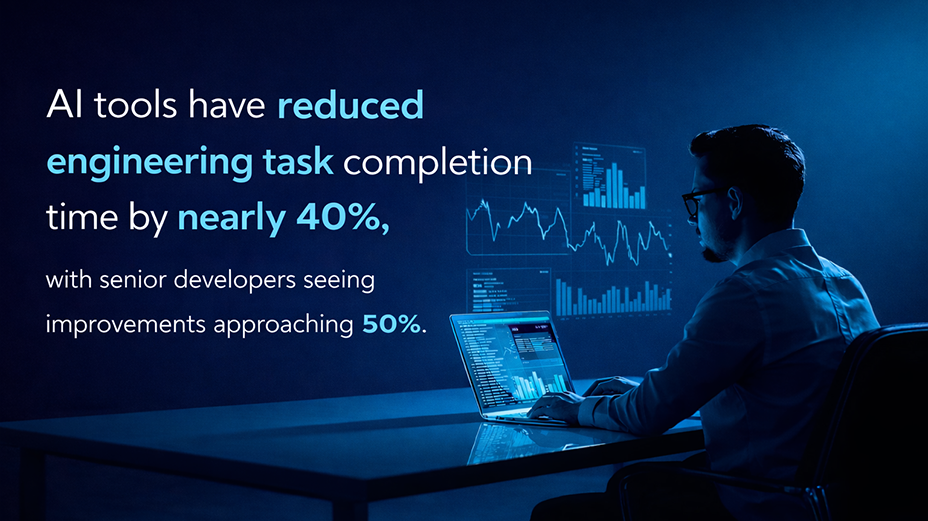
- While AI-assisted software development delivers productivity gains of up to 40 to 46%, its deeper value lies in reducing cognitive load for developers and creating space for better architectural and product-level thinking.
- The impact of AI on software development goes beyond coding, improving documentation quality, feedback cycles, and infrastructure reliability across the entire development lifecycle.
- As AI agents in software development take over repetitive execution tasks, human judgment becomes more critical in areas like system design, domain logic, and long-term product decisions.
- In the next era of software development, success will be defined less by output volume and more by clarity of intent, product discipline, and the ability to build software that delivers sustained value.
Most engineering teams adopted AI code assistants for the obvious reason: speed. Write code faster, ship features sooner, close the gap between what the business wants and what the team can deliver.
That was the promise. And to a significant extent, it delivered. GitHub’s research shows developers using AI code assistants complete tasks up to 46% faster. McKinsey reports that AI-assisted development tools reduce overall engineering effort by 30 to 40%. These are not incremental improvements — they are signals of a structural shift in how software teams operate.
But here’s what those numbers don’t capture: the teams seeing the strongest outcomes from AI-assisted software development are not the ones who moved the fastest. They are the ones who used the speed to think more clearly.
This blog examines what AI code assistants actually change in a software engineering team — not in theory, but in practice. How they reshape daily workflows, where they genuinely add value, where they still fall short, and what the rise of AI agents in software development means for the human decisions that still matter most.
AI Code Assistants Have Become Core to Modern Software Development
In the early days of AI-assisted software development, the excitement was centred on visible features like autocomplete, syntax correction, and faster debugging. These capabilities felt revolutionary because they removed friction from everyday coding.
Today, they are expected.
AI code assistants are no longer optional tools. They are becoming foundational infrastructure within modern engineering teams, much like cloud platforms or version control systems. In practice, this means developers often use these tools without consciously deciding to use them, similar to how Git or CI pipelines quietly support daily work.
As AI software development services mature, the real change is no longer about how fast code is written, but about how teams allocate attention and responsibility across planning, execution, and review.
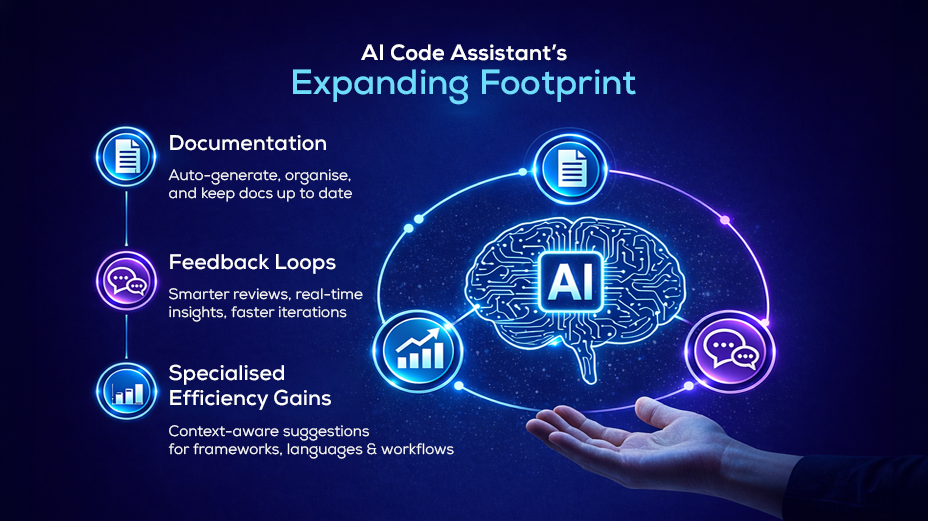
This shift is not limited to the code editor. The impact of AI code assistants is now visible across the entire development lifecycle.
Documentation and Knowledge Sharing
According to the Google Cloud DORA report, teams using AI-assisted tools report a 7.5% improvement in documentation quality. Clear documentation reduces onboarding friction, improves cross-team collaboration, and lowers long-term maintenance risk.
Faster and Smarter Feedback Loops
AI identifies issues before pull requests reach senior engineers, allowing reviews to focus on architecture, scalability, and design decisions rather than syntax corrections. This elevates the quality of engineering discussions.
Role-Based Efficiency Gains
Research from BairesDev shows that infrastructure-heavy roles, such as DevOps and SREs experience productivity improvements of up to 50%. At SP18, similar gains were observed when teams used AI to reduce repetitive operational work and redirect effort toward improving system reliability and deployment processes.
As these efficiencies compound, teams naturally shift how they define progress. Success is no longer measured only by code output, but by stability, clarity, and long-term system health.
From Writing Code Faster to Thinking Better
The most overlooked benefit of AI in software development is not productivity. It is cognitive relief.
By handling repetitive implementation tasks, AI frees developers from low-value execution work such as writing boilerplate, setting up standard configurations, or fixing minor syntax issues. While these tasks are necessary, they also consume a disproportionate amount of mental energy. Over time, this constant context-switching reduces a developer’s ability to think deeply about the system they are building.
Cognitive relief changes this dynamic.
When AI code assistants take care of repetitive and predictable work, developers are no longer mentally exhausted by the mechanics of coding. Instead, they can focus on understanding system behaviour, anticipating edge cases, and making more deliberate architectural decisions.
A real-world example of this shift can be seen in everyday engineering workflows at SP18. Earlier, developers often spent significant time setting up similar service structures, validating basic logic, or resolving small but frequent implementation issues. With AI-assisted software development in place, those tasks became quicker and less mentally exhausting. The result was not just faster execution, but more thoughtful conversations during code reviews and planning sessions.
Developers began asking better questions. Instead of debating syntax or structure, discussions moved toward scalability concerns, long-term maintainability, and whether a feature truly aligned with product goals. This shift reduced rework, improved solution quality, and helped teams catch potential issues earlier in the development cycle.
As Gergely Orosz accurately puts it:
“The speed of typing out code has never ever been the bottleneck for software development.”
AI removes the illusion that speed was the constraint. What remains are questions of clarity, intent, and quality. Cognitive relief allows developers to engage with these questions more consistently, leading to better project outcomes and stronger engineering discipline across teams.
Where AI Code Assistants Deliver the Most Impact
AI code assistants excel at predictable, repeatable work that traditionally slowed teams down. They add measurable value in the following areas:
- Recognising Common Patterns Across Large Codebases
AI helps developers quickly align with existing coding standards and architectural patterns without manually searching through documentation or legacy code, improving consistency across projects.
- Generating Boilerplate and Scaffolding Instantly
AI reduces setup time by automatically creating foundational structures for new services, features, or integrations, allowing developers to focus on core business logic.
- Supporting Modular Implementation Tasks with Consistency
AI ensures that components and services follow predefined structures, maintaining uniformity in modular and service-oriented architectures.
These capabilities explain why organisations investing in AI software development services often see faster release cycles without proportional increases in headcount.
However, understanding the limits of AI is just as important as understanding its strengths.
Why Human Judgment Still Defines Software Excellence
Despite their power, AI agents in software development lack true contextual understanding.
They struggle with:
- System-wide debugging, where issues span multiple interconnected systems and environments. These scenarios require tracing dependencies, understanding infrastructure behavior, and evaluating cascading impacts across services.
- Domain-specific logic, especially when business rules are implicit, evolving, or not publicly documented. AI may generate technically correct code, but it cannot reliably interpret nuanced internal processes or strategic priorities.
- Architectural decisions, including scalability trade-offs, security considerations, and ethical implications. These decisions require long-term thinking, risk assessment, and accountability that extend beyond code generation.
This boundary is critical. The teams seeing the strongest outcomes are not replacing human judgment. They are repositioning it.
AI handles execution. Humans define direction.
This balance allows AI-assisted software development to scale without eroding software quality.
Moving Toward a Product Mindset
The most significant impact of AI code assistants is the devaluation of raw coding speed and the rising premium on product discipline.
From “Can We Build This?” to “Should We Build This?”
Historically, technical complexity often limited product scope. Today, that barrier is dissolving, forcing teams to confront higher-order questions:
- Does this feature solve a legitimate user problem?
- Is the experience truly intuitive, or merely functional?
- What are the long-term implications for user trust and system maintenance?
Quality Over Volume
With AI-generated code becoming abundant, success is increasingly measured by:
- Knowing exactly what the product is trying to achieve.
- Ensuring a seamless journey across the entire application.
- Proving value for both the customer and the business.
This transition toward high-level thinking is being further accelerated by the rise of specialised, task-oriented AI counterparts.
The Rise of Specialised AI Agents in Software Development
The next phase of adoption goes beyond general-purpose tools.
Organisations are increasingly deploying AI agents in software development tailored to specific roles, including:
- Developer-focused agents that assist with implementation and refactoring while maintaining consistency with the existing architecture. These agents help reduce repetitive coding effort, suggest improvements aligned with codebase standards, and support cleaner, more maintainable implementations.
- Product and requirement analysis agents, which help translate business intent into structured technical tasks. By organising user stories, clarifying requirements, and identifying dependencies early, they reduce ambiguity between product and engineering teams.
- QA and testing agents, which improve coverage, catch regressions earlier, and support more reliable releases. These agents assist in generating test cases, identifying edge scenarios, and strengthening validation processes across different environments.
These systems do not replace expertise. They reinforce it by reducing cognitive load and improving focus.
Conclusion: The True Impact of AI Code Assistants
The impact of AI code assistants in the next era of software development is not about writing more code. It is about building better software with clearer intent.
By removing execution friction, AI exposes what truly matters: product thinking, architectural discipline, and responsible decision-making. Organisations that succeed will be those that use AI-assisted software development to elevate conversations, not avoid them.
At SP18, the focus has been on using AI to support developers in improving decision quality and long-term system outcomes, rather than chasing speed alone.
In the future of AI software development services, the advantage will belong to teams that think clearly, build responsibly, and stay grounded in real user needs.