The US is the undisputed center of gravity for agentic AI right now. The global agentic AI market was valued at $7.29 billion in 2025 and is projected to reach $139.19 billion by 2034, expanding at a 40.5% CAGR (Source: Fortune Business Insights). The US alone is estimated to hold $2.33 billion of that market in 2026.
What separates the companies shaping this market from the ones just labeling existing tools as “agents” is straightforward: genuine agentic AI requires autonomous decision-making, multi-step reasoning, memory across steps, and dynamic error handling. Most products on the market today do not meet that bar, according to enterprise practitioners evaluating platforms for production deployment.
This blog covers the 15 agentic AI companies with the clearest production track records, the deepest AI agent development capabilities, and the most defined value in enterprise AI agent deployments across the US in 2026.
Quick Reference: 15 Agentic AI Companies at a Glance
| # | Company | Category | Best For |
| 1 | Salesforce Agentforce | CRM-native AI agent platform | Sales and service teams on Salesforce |
| 2 | Microsoft Copilot Studio | Enterprise AI agent builder | Microsoft 365 environments |
| 3 | ServiceNow AI Agents | IT and HR automation | Enterprise service management |
| 4 | UiPath Agentic Automation | RPA plus AI agent platform | Process automation at scale |
| 5 | Automation Anywhere | Cloud-native AI automation platform | Back-office and finance workflows |
| 6 | IBM watsonx Orchestrate | Regulated industry AI agents | Banking, insurance, healthcare |
| 7 | Google Vertex AI Agent Builder | Custom AI agent development | Cloud-native engineering teams |
| 8 | OpenAI (Agents SDK) | Foundation model AI agent platform | Developer-built autonomous workflows |
| 9 | LangChain / LangGraph | Open-source AI agent workflows | Custom enterprise agent architectures |
| 10 | Moveworks | Vertical AI agents for IT and HR | Employee-facing service resolution |
| 11 | Sierra AI | Customer-facing agentic AI | Enterprise customer experience |
| 12 | CrewAI | Multi-agent orchestration framework | AI agent development teams |
| 13 | Cohere | Enterprise LLM and agent tooling | Private, compliant AI deployments |
| 14 | Writer | Enterprise content AI agents | Marketing and knowledge work |
| 15 | Relevance AI | No-code AI agent builder | Non-technical enterprise teams |
15 Top Agentic AI Companies in the US for 2026
1. Salesforce Agentforce
Category: CRM-native AI agent platform Best for: Sales, service, and marketing teams running on Salesforce
Salesforce Agentforce is the most widely adopted agentic AI company deployment in CRM workflows. It embeds autonomous AI agents directly into the Salesforce ecosystem using the Atlas reasoning engine, allowing agents to resolve service cases, qualify leads, execute campaign tasks, and manage customer interactions without leaving the platform.
Key capabilities:
- Live customer data access via Data Cloud for accurate autonomous decision-making
- Pre-built enterprise AI agents for case resolution, lead qualification, and campaign execution
- 29,000 deals closed since launch, with $800 million in ARR (Source: MarkTechPost)
- Flex Credits pricing at $0.10 per action enables scalable consumption-based deployment
Consideration: Delivers maximum value for organizations already deep in the Salesforce stack. Cross-system deployments outside Salesforce typically require MuleSoft or custom connector development.
2. Microsoft Copilot Studio
Category: Low-code enterprise AI agent builder Best for: Organizations standardized on Microsoft 365
Microsoft’s agentic AI stack centers on Copilot Studio for AI agent development, backed by AutoGen for multi-agent orchestration and Microsoft 365 Copilot for end-user deployment. It is one of the largest-scale AI agent platform deployments in enterprise history.
Key capabilities:
- 230,000 businesses using Copilot Studio, including 90% of the Fortune 500 (Source: Sana Labs)
- 400,000+ custom agents built and deployed across enterprise customers
- Low-code AI agent builder accessible to non-engineering teams
- AutoGen framework for multi-agent coordination across complex, parallel workflows
Consideration: Best suited to Microsoft-native environments. Organizations running non-Microsoft core systems may face integration overhead that reduces deployment speed.
3. ServiceNow AI Agents
Category: IT and HR service management AI agents Best for: Enterprise IT operations, HR service delivery, and compliance workflows
ServiceNow was ranked number one for AI Agents in the 2025 Gartner Critical Capabilities report. Its entire commercial model has been restructured around autonomous AI tiers, reflecting how central enterprise AI agents are to the platform’s go-forward strategy.
Key capabilities:
- AI Agent Orchestrator and Control Tower for managing multi-agent workflows
- Autonomous resolution of IT tickets across Jira, Workday, and ServiceNow integrations
- Vertical AI agents purpose-built for ITSM, HR service delivery, and compliance management
- Predictable enterprise contract pricing, unlike consumption-based competitors
Consideration: Longer implementation cycles than CRM-native platforms and requires dedicated admin resources for governance configuration.
4. UiPath Agentic Automation
Category: AI automation platform combining RPA and AI agent workflows Best for: Process automation at scale across finance, operations, and IT
UiPath holds an estimated 35.8% share of the RPA market and has made the transition to AI agent platform capabilities through its Agentic Automation offering. It bridges rule-based process automation with goal-driven AI agent workflows, giving enterprises a path to upgrade existing RPA infrastructure without full replacement.
Key capabilities:
- Agent Builder for developing custom AI agent workflows on top of existing process maps
- Combines RPA bots with AI agents for hybrid automation of structured and unstructured tasks
- AI agent marketplace with pre-built solutions for finance, HR, and supply chain
- Process mining layer that identifies the highest-ROI automation candidates
Consideration: Most valuable for organizations with significant existing UiPath deployments. Teams without prior UiPath infrastructure may find purpose-built agentic platforms faster to deploy.
5. Automation Anywhere
Category: Cloud-native AI automation platform Best for: Back-office automation in finance, procurement, and shared services
Automation Anywhere’s AARI (Automation Anywhere Robotic Interface) and its AI automation platform, CoE Manager, position it as one of the more mature agentic AI companies for back-office enterprise AI agents. Its cloud-native architecture enables deployment at global scale without on-premise bot infrastructure.
Key capabilities:
- Generative AI-powered bot creation for faster AI agent development timelines
- Document processing with AI understanding of unstructured inputs like invoices and contracts
- AI agent workflows for accounts payable, compliance reporting, and procurement automation
- CoE Manager for centralized governance of AI agent deployments across business units
6. IBM watsonx Orchestrate
Category: Enterprise AI agents for regulated industries Best for: Banking, insurance, and healthcare with strict data governance requirements
IBM watsonx Orchestrate is the enterprise AI agent platform built for organizations where data privacy, auditability, and regulatory compliance are non-negotiable. It orchestrates AI agent workflows across existing IBM and third-party enterprise systems, with enterprise contract pricing that provides cost predictability at scale.
Key capabilities:
- Skills-based AI agent development: agents are built from reusable, auditable action components
- Integration with SAP, Salesforce, Workday, and ServiceNow via native connectors
- Full audit trail and explainability layer for regulated industry deployments
- On-premise and private cloud deployment options for data sovereignty requirements
7. Google Vertex AI Agent Builder
Category: Developer-grade AI agent development platform Best for: Engineering teams building custom autonomous AI systems on Google Cloud
Vertex AI Agent Builder is Google’s offering for teams that need full flexibility in AI agent development, not a packaged solution. It provides the infrastructure for building, deploying, and scaling custom AI agent workflows using Gemini models, with grounding from enterprise data sources and a full tool-calling framework.
Key capabilities:
- Custom AI agent builder with Gemini Pro and Gemini Ultra as the reasoning layer
- Grounding in enterprise data via BigQuery, AlloyDB, and Google Workspace integrations
- Multi-agent orchestration using Agent Engine for complex, parallel workflow coordination
- Vertex AI Model Monitoring for production-grade performance tracking and governance
8. OpenAI (Agents SDK and Operator)
Category: Foundation model AI agent platform Best for: Development teams building autonomous workflows on the most capable generative models
OpenAI’s Agents SDK gives enterprises a programmable layer for building multi-step autonomous workflows on GPT-4o and o3. ChatGPT Operator enables browser-based autonomous task execution. For organizations building agentic AI company infrastructure from scratch, OpenAI provides the most capable underlying model with the broadest tool-calling ecosystem.
Key capabilities:
- Agents SDK for orchestrating multi-agent pipelines with structured handoffs
- Operator for autonomous browser-based task execution
- Codex integration for software engineering agents that write, test, and deploy code
- Real-time API with persistent memory and tool calling for production deployments
9. LangChain / LangGraph
Category: Open-source AI agent workflows and orchestration Best for: Enterprise engineering teams building custom, modular AI agent architectures
LangChain and its graph-based orchestration sibling LangGraph are the most widely used open-source frameworks for AI agent development in the enterprise. For organizations where the agent design itself is a competitive differentiator, LangGraph provides the flexibility that packaged AI automation platforms cannot match.
Key capabilities:
- LangGraph for stateful, multi-actor AI agent workflows with cyclical and branching logic
- LangSmith for observability, evaluation, and debugging of production agents
- Full compatibility with all major LLM providers: OpenAI, Anthropic, Google, and open-source models
- Active ecosystem of integrations and enterprise AI agents templates
10. Moveworks
Category: Vertical AI agents for IT and HR service delivery Best for: Employee-facing IT support and HR query resolution at enterprise scale
Moveworks is among the most tightly scoped agentic AI companies in enterprise deployment. Its agents autonomously resolve IT and HR tickets across Jira, Workday, and ServiceNow without human triage at each step. The tight vertical focus means faster time-to-value and more consistent performance than general-purpose platforms in this specific domain.
Key capabilities:
- Autonomous resolution of IT tickets covering software access, account issues, and system errors
- HR query resolution integrated with Workday, SuccessFactors, and custom HRIS platforms
- Conversational interface available across Slack, Teams, and web
- Multilingual support for global enterprise deployments
11. Sierra AI
Category: Customer-facing agentic AI company Best for: Enterprise organizations requiring high-quality, brand-consistent autonomous customer interactions
Sierra builds conversational AI agent platform technology specifically for customer-facing deployments: returns, billing, order management, and complex support interactions. It is one of the top-rated agentic AI companies for customer experience in enterprise evaluations.
Key capabilities:
- Goal-based conversational agents designed for enterprise customer experience standards
- Deep integration with backend systems: order management, billing, CRM, and logistics
- Human escalation architecture with full context handoff when agents reach their decision boundary
- Built-in brand voice controls to maintain tone and compliance across autonomous interactions
12. CrewAI
Category: Multi-agent orchestration framework Best for: AI agent development teams building coordinated, role-based autonomous workflows
CrewAI is a fast-growing open-source and enterprise AI agent platform for building multi-agent systems where specialized agents collaborate under a defined coordination structure. It is particularly suited to organizations that need multiple agents handling different parts of a workflow simultaneously rather than sequentially.
Key capabilities:
- Role-based agent architecture: each agent has a defined role, goal, and set of tools
- Sequential and parallel AI agent workflows configurable without complex infrastructure code
- Integration with LangChain, OpenAI, Anthropic, and open-source models
- Enterprise tier with deployment infrastructure, monitoring, and support SLAs
13. Cohere
Category: Enterprise LLM and AI agent tooling Best for: Organizations requiring private, compliant AI deployments with on-premise or VPC options
Cohere positions itself as the enterprise-first agentic AI company, prioritizing data privacy, deployment flexibility, and compliance over raw benchmark performance. Its Command R and Embed models are optimized for retrieval-augmented AI agent workflows in regulated environments.
Key capabilities:
- On-premise, VPC, and cloud deployment options for data sovereignty requirements
- Command R models optimized for tool use and multi-step reasoning in production
- Embed models for semantic search across enterprise knowledge bases
- Toolkit for building retrieval-augmented AI agent workflows with enterprise data
14. Writer
Category: Enterprise content AI agents Best for: Marketing, communications, and knowledge work automation at scale
Writer is the leading agentic AI company for content-intensive enterprise workflows. It deploys AI agent workflows that research, draft, review, and publish content across multiple formats while enforcing brand voice, compliance, and style guidelines. For enterprises where content volume and consistency are operational challenges, Writer’s AI automation platform addresses both.
Key capabilities:
- Knowledge Graph grounding for brand-consistent, factually accurate content generation
- Multi-step AI agent workflows from brief to published output with human review gates
- AI agent builder for custom content operations workflows
- Compliance review layer for regulated industries publishing external-facing content
15. Relevance AI
Category: No-code AI agent builder and marketplace Best for: Non-technical enterprise teams deploying AI agent workflows without developer resources
Relevance AI offers one of the most accessible AI agent marketplace experiences for business users who need to build and deploy autonomous workflows without writing code. Its drag-and-drop AI agent builder and pre-built template library reduce the time from use case identification to production deployment significantly.
Key capabilities:
- No-code AI agent builder for non-technical business users
- Pre-built AI agent templates for sales, support, research, and operations
- Multi-agent orchestration without developer configuration
- Integration with Salesforce, HubSpot, Slack, and major enterprise data sources
What Separates a Real Agentic AI Company from “Agent Washing”
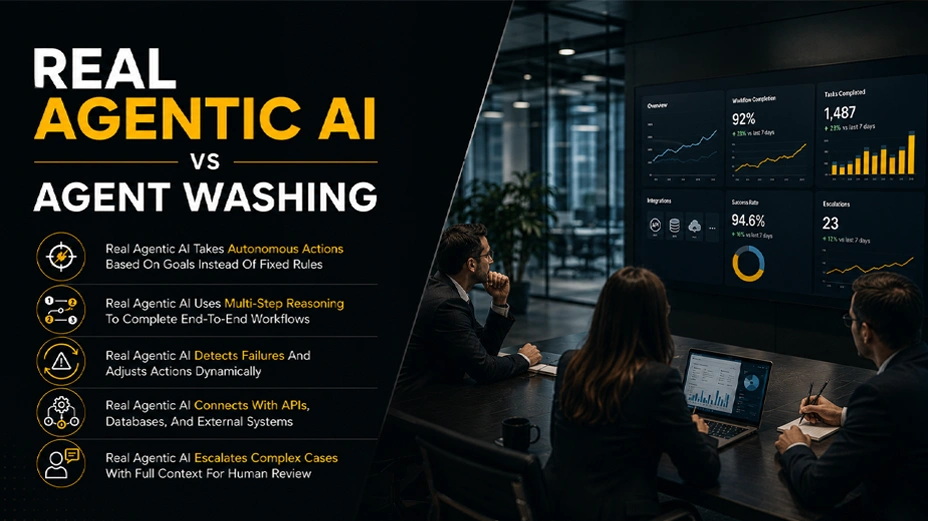
The biggest evaluation risk in 2026 is deploying a packaged chatbot or rule-based workflow tool that has been rebranded as an AI agent. Genuine agentic AI companies produce systems with these characteristics:
- Autonomous decision-making: The agent takes actions based on goals, not scripted rules
- Multi-step reasoning: Each action informs the next, with context retained across the full workflow
- Dynamic error handling: The agent detects when an action fails and adjusts its approach
- Tool execution: The agent calls external APIs, databases, and systems, not just generates text
- Escalation logic: The agent identifies when to involve a human, and hands off with full context
According to Deloitte’s 2026 State of AI in the Enterprise report, only 21% of enterprises currently have mature governance infrastructure for managing agentic AI safely. That gap is where evaluation rigor matters most.
Conclusion
The agentic AI company landscape in the US in 2026 has moved decisively past the pilot stage. According to Gartner, 40% of enterprise applications will include task-specific AI agents by the end of 2026, and McKinsey’s 2025 State of AI survey found that 62% of organizations are at least experimenting with agentic AI (Source: Azumo). The infrastructure is maturing, the platforms are proven, and the competitive gap between organizations with working agent deployments and those still evaluating is widening.
The decision is not which agentic AI companies are best in the abstract. It is which AI agent platform fits your existing infrastructure, your governance readiness, and the specific workflows you need to automate first. Start there, and the rest of the evaluation becomes significantly more straightforward.
If you need help identifying the right AI agent platform for your enterprise workflows and want a framework for making that evaluation, you can reach out at coffee@sparkeighteen.com.