53% of enterprise engineering time goes to pipeline maintenance. The focus isn’t product development or new capabilities. It’s maintenance. And among organisations managing more than 200 active pipelines, 61% face this maintenance burden.
The instinct is to frame this as a tooling problem or an operations problem: the wrong scheduler, insufficient automation, pipelines that were not monitored properly. The actual cause is more fundamental. Most data pipelines were not designed. They grew. A data analyst needed revenue figures from a production database, someone wrote a Python script, it got scheduled, other processes depended on it, and gradually it became mission-critical infrastructure without ever being architected to fill that role. The maintenance overhead that follows is not a tooling failure. It is the predictable outcome of architecture that was never planned.
This guide is for CTOs, heads of data engineering, and senior data engineers who are living with that overhead and want to understand its root cause. It covers the 5 architectural principles that eliminate maintenance debt at the source, the 3 pipeline architecture patterns in production use in 2026 and how to choose between them, and a practical framework for evaluating the data engineering tools landscape without being led by vendor marketing.
Key takeaways
- 53% of enterprise engineering time goes to pipeline maintenance — rising to 61% for organisations with more than 200 active pipelines. The root cause is architectural, not operational.
- Silent data corruption, stale dashboards, and financial reporting gaps are the business outcomes of poor data pipeline architecture. They are not edge cases; they are regular occurrences in organisations that let pipelines grow without designing them.
- 5 architectural principles prevent the maintenance nightmare: design for schema change, separate ingestion from transformation, build modular pipelines with defined responsibilities, design observability in from the start, and match data freshness to actual business need.
- Data modelling in data engineering is the most commonly deferred architectural decision, and the one that causes the most expensive rebuilds. A deferred decision is not an avoided one; it is an expensive one.
- The data engineering tools decision should follow the architecture decision, not precede it. Buying a warehouse or an ingestion platform before the architecture is designed does not solve an architecture problem.
Why data pipelines become maintenance nightmares
Data pipelines accumulate technical debt because they are built as temporary scripts and become permanent infrastructure without ever being designed for that role.
The origin story is familiar. A product analyst needs a weekly revenue report. Someone pulls from the production database via a Python script, cleans it in pandas, and outputs a CSV. It works, it gets scheduled, and other teams gradually discover it. The sales team wants the same data in a dashboard. Finance needs a monthly breakdown. The data science team needs historical data for a model. Each new consumer adds a dependency. The script gets modified to serve each use case. The original author moves on. It becomes something the organisation cannot afford to break, even though no one fully understands its dependencies or the impact of changing it. Yet it becomes critical infrastructure without ever being designed for that role.
Tool fragmentation compounds this. Teams build separate batch and streaming stacks for different use cases, accumulate ingestion tools without a unified data movement strategy, and lose code ownership as contributors move across teams and out of the organisation. The data platform stops being the enabler and becomes the bottleneck.
The business impact is not measured solely in engineering hours. It shows up in outcomes. Silent data corruption, where NULL values or calculation errors flow through a pipeline for days without triggering an alert, surfaces in stale dashboards that drive wrong inventory decisions. Financial reporting gaps create discrepancies that take weeks to trace. Operational teams make decisions on data that is several days out of date without knowing it.
According to Fivetran’s Enterprise Data Infrastructure Benchmark Report 2026, a global survey of 500 senior data and technology leaders conducted at a 95% confidence level in Q4 2025, pipeline failures cost enterprises an average of $3 million per month. This is vendor-commissioned research and should be read as such, but the order of magnitude is consistent with what engineering leaders report in practice.
The question is not whether this pattern affects your organisation. It is what architectural decisions would have prevented it.
5 architectural principles that prevent the maintenance nightmare

The decisions that prevent data pipeline technical debt are not sophisticated. They are principles most engineering teams understand but defer in practice, because the pipeline needs to work now and the architecture can wait. These 5 principles address the root causes of maintenance overhead at the source. Applied early, they compound positively. Applied late, or not at all, they generate the maintenance tax that consumes more than half of enterprise engineering capacity.
1. Design for schema change, not schema stability
Every upstream system will change its schema. Columns get renamed, fields get added, data types change, APIs add endpoints and deprecate others. If your pipeline is brittle to schema change, you are not asking whether it will break, but when.
The design decision is explicit: before the pipeline runs for the first time, define how it responds to schema changes. If a required field disappears, fail loudly and alert the team. If a new field appears, accept it, log it, and route it for review. If a field is renamed, catch the change at the ingestion boundary rather than letting it corrupt downstream transformations silently.
This is not a tooling decision. Schema evolution strategy is an architectural decision that constrains which tools are appropriate. Teams that design for schema change at the source boundary spend a fraction of the time on schema-related incidents that teams with manually maintained, brittle mappings spend.
2. Separate ingestion from transformation (ELT over ETL)
Extract, load, transform (ELT) has become the standard for cloud data engineering for a specific reason: it preserves the source layer. Ingest raw data first, keep it exactly as received, and transform it downstream inside the warehouse. The alternative, extract, transform, load (ETL), applies transformation before the data lands, which means a transformation bug corrupts the source. The raw data is gone. There is no re-run.
With ELT, the raw layer is permanent. If transformation logic changes, or if a bug surfaces 6 months after the pipeline launched, you re-run the transformation against the original raw data. Every downstream layer is reproducible. Debugging becomes a tractable problem because the source of truth is always available at the ingestion boundary.
3. Build modular pipelines with defined responsibilities
A monolithic directed acyclic graph (DAG) that ingests, joins, transforms, aggregates, and loads in a single job is the fastest thing to build on day one and the hardest thing to maintain as data environments grow. When it fails, the blast radius is unbounded. When it needs to change, the change ripples through every step.
Modular pipelines assign one bounded responsibility to each pipeline. The ingestion pipeline moves raw data from source to the raw layer. The transformation pipeline cleans and conforms that data. The aggregation pipeline produces business-ready metrics. Dependencies between pipelines are explicit, documented, and managed through the orchestration layer — not through implicit assumptions about run order.
The payoff is operational. When a modular pipeline fails, the failure is bounded. The team knows which pipeline, which step, and which data domain is affected. The fix scope is proportional to the responsibility scope. In a monolithic pipeline, isolating a failure can require understanding the entire graph.
4. Design observability in, not after
Data lineage, pipeline monitoring, and alerting are architectural requirements, not features you add after the pipeline is running. A pipeline without observability has no audit trail. When silent data corruption occurs — and in a sufficiently complex data environment, it will — the team cannot determine when it started, which downstream consumers were affected, or which upstream change triggered it. The investigation becomes a forensic exercise rather than a systematic trace.
Build the logging, lineage tracking, and alerting in the same sprint as the pipeline. Define what healthy looks like for each pipeline and encode that definition as an alert threshold, not a mental model. If a pipeline produces output that is statistically unusual — unexpected NULL rates, row count anomalies, schema drift — that signal should surface automatically, not when a business stakeholder notices a wrong number in a dashboard.
5. Match data freshness to actual business need
Not every dataset needs real-time updates. The engineering cost of streaming infrastructure is substantial: higher operational complexity, harder-to-debug failures, a different skill profile for the team, and significantly higher infrastructure costs at scale.
Before designing for real-time, answer 3 questions. What specific business decision does this pipeline support? What is the maximum acceptable data latency before that decision becomes wrong or less valuable? And does the engineering cost of lower latency justify the business benefit? Many pipelines built as streaming architectures would have served the business equally well as well-scheduled batch jobs running every 15 to 30 minutes, at a fraction of the operational overhead. Architecture should follow latency requirements, which should follow business use cases — not vendor narratives.
Data pipeline architecture patterns: batch, streaming, and hybrid
The 3 architecture patterns in production use in 2026 are batch, streaming, and hybrid. The choice is not about which is most modern. It is about what data latency the business outcome actually requires.
Batch (ETL/ELT) extracts data from source systems on a schedule, transforms it, and loads it into the destination. Schedules can range from daily to sub-hourly windows. Batch is the right choice for reporting, analytics, historical analysis, and any business decision that does not require data fresher than the batch interval. It is lower in operational complexity, cheaper to run, and significantly easier to debug than streaming. It remains the majority use case in enterprise data engineering. The vendor narrative that batch is obsolete overstates the case considerably: if the business decision does not require sub-hour data freshness, batch solves the problem at a fraction of the cost.
Streaming (Apache Kafka with Apache Flink or Apache Spark Streaming) moves data as events in near-real time, with latency measured in seconds or milliseconds. Streaming is the right choice when the business outcome requires real-time action: fraud detection, live inventory management, real-time personalisation, or operational dashboards where stale data causes wrong decisions at the moment of action. It carries substantially higher engineering and operational complexity and requires a different skill profile than batch engineering. The default should not be streaming unless the business case specifically demands it.
Hybrid architectures — Lambda and Kappa — serve use cases where the business genuinely requires both historical analytics and real-time operational decisions from the same underlying data. Lambda architecture maintains 2 separate processing layers: a batch layer for historical accuracy and a streaming layer for real-time approximations, with a serving layer that merges both. Kappa architecture simplifies this by using a single streaming system for both real-time processing and historical replay, eliminating the separate batch layer. Both carry the combined operational complexity of the systems they unify.
The decision framework: before selecting an architecture pattern, answer 3 questions. What business decision does this pipeline support? What is the maximum acceptable data latency before that decision becomes wrong? Does the engineering cost of a lower-latency architecture justify the business value of that reduced latency?
Data modelling in data engineering: the decision most teams defer
Data modelling is the schema design layer of a data pipeline: how data is structured in the warehouse, what relationships exist between tables, and how raw data is aggregated into the forms that analysts, dashboards, and downstream systems consume. It is also the architectural decision most commonly deferred until it becomes expensive to fix.
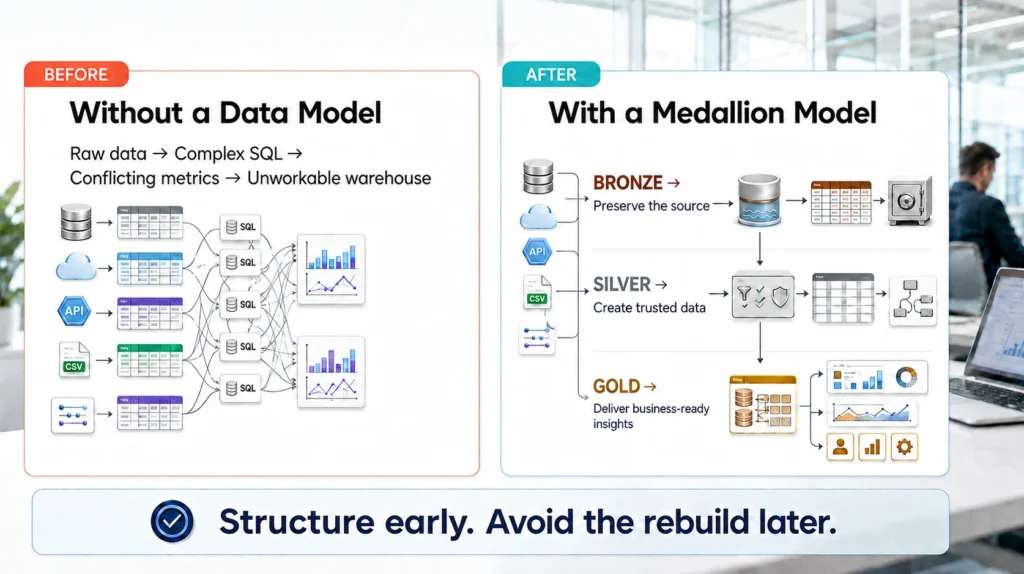
Most pipelines have no data model. Data lands in whatever structure the source system used. The warehouse becomes an archive rather than an analytical platform. Analysts work around it with increasingly complex SQL queries. Different teams define the same metric differently because there is no shared, modelled layer that enforces a single definition. Eventually the warehouse becomes unworkable, and someone proposes a rebuild — a months-long project that a data model built at the outset would have prevented.
The medallion architecture (Bronze, Silver, Gold) is a practical starting pattern that imposes structure without requiring a full-scale modelling exercise before the first pipeline runs.
The Bronze layer holds raw ingested data, preserved exactly as received from each source. No changes, no transformation. This is the source of truth for raw data and the foundation of ELT reproducibility.
The Silver layer holds cleaned, validated, and conformed data: standardised field names, consistent data types, referential integrity enforced, and de-duplication applied. This is the source of truth for clean data that transformation logic can trust.
The Gold layer holds business-ready aggregations, metrics, and marts built for consumption by analysts, dashboards, and downstream applications. This is the layer that answers business questions.
Each layer has one defined responsibility. A data quality issue in the silver layer does not affect the bronze layer. A change to a gold-layer metric does not require re-ingestion. Any downstream anomaly can be traced through the layers to its origin.
dbt (data build tool) has become the near-universal standard transformation layer for SQL-based data teams. It provides version-controlled SQL transformations, automatic lineage documentation, and a testing framework for defining and enforcing data quality assertions. What it does not provide: ingestion (dbt does not move data from source to destination), orchestration (dbt needs a scheduler such as Airflow, Prefect, or Dagster to execute in sequence), or storage (dbt works against whatever warehouse is already in place).
The sequencing point is worth stating directly: warehouse design and data modelling decisions are far cheaper to make before ingestion begins than during the migration that becomes necessary when those decisions are deferred. The earlier the model is defined, the less rework it generates.
What changes when your data pipeline is in the cloud
Cloud-native data engineering is not the same as running an on-premise pipeline on a cloud virtual machine. Migrating an on-premise Airflow and MySQL setup to an EC2 instance is lift-and-shift. The operational overhead is identical; the location has changed. Cloud-native architecture uses managed services that auto-scale, eliminate infrastructure patching, and shift operational responsibility from the engineering team to the cloud provider.
The modern cloud data engineering stack, by function:
Ingestion and integration tools (Fivetran, Airbyte, Estuary): evaluate on connector coverage for your specific source systems, not total connector count; the latency model, specifically whether the tool uses batch-based polling or near-real-time change data capture (CDC); managed versus self-hosted operational requirements; and cost at the data volumes you actually process, not at vendor benchmark volumes.
Orchestration tools (Apache Airflow via Astronomer or AWS MWAA, Prefect, Dagster): evaluate on DAG complexity support and dynamic task generation; backfill capability for historical replay; observability of task-level execution; and the operational overhead of the orchestrator itself, which is non-trivial for self-managed Airflow deployments.
Transformation tools (dbt, Apache Spark): evaluate on your team’s SQL versus Python preference; lineage documentation quality; the testing framework for data quality assertions; and IDE and version control integration for collaborative development. These are not competing choices; they address different scales and use cases.
Warehousing (Snowflake, BigQuery, Amazon Redshift, Databricks Lakehouse): each has distinct trade-offs around compute/storage separation, query performance at scale, and cost model. The choice between them should follow the data architecture design, not precede it.
Observability tools (Monte Carlo, Great Expectations, Datafold): evaluate on schema drift detection, row-count and distribution anomaly alerting, and integration with your incident management workflow.
The global data pipeline tools market is projected to reach $48.33 billion by 2030, growing at 26.8% CAGR, according to Grand View Research. A market growing at this pace creates strong vendor incentives to frame tooling as the architectural solution, not as a tool that serves one. The most common mistake in cloud data engineering tool selection is choosing the warehouse first and designing the architecture around it. The correct sequence is the reverse: understand the data requirements, design the architecture, then select the tools that serve that architecture.
Building a maintainable data pipeline across 1,000+ county data sources
The architectural principles above are not theoretical. At Spark Eighteen, we built a data engineering pipeline for Real T Solutions that illustrates what schema normalisation at ingestion looks like at scale, and why it is the single decision that makes everything downstream maintainable.
Real T Solutions needed automated property research across 1,000+ county jurisdictions in the United States. Every county has a different website, a different data structure, and a different update cadence. Some publish structured data tables. Others render data through JavaScript that changes with every site redesign. The pipeline problem was not data volume. It was data heterogeneity at a scale that made bespoke engineering per source unsustainable.
The naive approach — one scraper per county — would have produced 1,000+ fragile extraction scripts, each coupled to the specific document object model (DOM) structure of one county’s site. Every redesign would break a script. Maintenance would scale linearly with jurisdiction count. Adding a new county would require a new bespoke engineering effort.
The architectural decision was schema normalisation at ingestion. We used large language models (LLMs) to infer the DOM structure of each county website, map the inferred structure to a canonical JSON schema, and generate extraction rules dynamically. Every county’s data entered the pipeline in the same format, regardless of how the source was structured. The downstream pipeline, built on Django orchestration and Apache Airflow DAGs, saw clean, consistently structured data. It knew nothing about the 1,000+ heterogeneous sources above it.
The consequence: adding a new county jurisdiction means running the LLM inference step, not writing a new scraper. The architecture scales because the ingestion layer absorbs the heterogeneity. The transformation layer stays simple because the data it receives is already consistent.
This illustrates Principle 1 applied at ingestion scale: design for structural change at the source boundary, and the rest of the pipeline becomes straightforward. Build that heterogeneity in downstream instead, and every new source is a bespoke engineering problem that scales linearly with the number of sources.
How to evaluate data engineering tools without being sold to
The data engineering tools market is growing at 26.8% annually, which means the vendor landscape is expanding faster than most engineering teams can meaningfully evaluate it. New platforms launch, existing platforms add capabilities, and vendor marketing consistently frames tooling as the solution to problems that are architectural in nature.
A function-by-function evaluation framework produces more reliable decisions than vendor benchmark comparisons.
For ingestion and integration tools, evaluate on connector coverage for your specific source systems (not total connector count), the latency model (batch polling versus CDC), managed versus self-hosted operational requirements, and cost at your actual data volumes. A 300-connector library matters only if it connects to the systems your organisation actually uses.
For orchestration tools, evaluate on DAG complexity support and dynamic task generation, backfill capability for historical replay, the observability of task-level execution, and the operational overhead of the orchestrator itself. Self-managed Airflow carries meaningful operational overhead that managed alternatives (Astronomer, AWS MWAA) offset at a cost premium.
For transformation tools, the evaluation is largely SQL versus Python and team preference. dbt is the clear standard for SQL-based transformation teams; Apache Spark covers Python-based, large-scale transformation. Lineage documentation quality and the testing framework for data quality assertions are the secondary evaluation criteria.
For observability tools, the key capabilities are schema drift detection, row-count and distribution anomaly alerting, and integration with your incident management workflow. An observability tool that surfaces a data quality issue after the business has already noticed it is not operating as designed.
The principle that governs all of these evaluations: tool selection follows architecture decisions, not the reverse. A data platform product that claims to cover ingestion, transformation, orchestration, and observability in a single system is either making architectural trade-offs that will constrain you at scale, or it is genuinely differentiated — and the way to know which is to evaluate it against the function-specific criteria above.
Conclusion
The data pipeline maintenance problem is real. 53% of engineering capacity and an average of $3 million a month in failure costs are the numbers that make it legible to a leadership audience. But neither of those numbers improves by adding more tooling to a pipeline that was not architected to scale.
The maintenance overhead is the predictable outcome of pipelines that were built quickly to solve an immediate problem and were never designed for the infrastructure role they eventually filled. The architectural decisions that prevent it — ELT separation, schema normalisation at ingestion, modular pipeline responsibilities, observability by design, data freshness matched to business need — are not complex. They are simply decisions that most teams defer because the pipeline needs to work now.
Those decisions do not disappear when they are deferred. They reappear as a rebuild project, measured in team-months rather than hours of upfront design.
If you are working through what a maintainable data pipeline architecture looks like for your organisation’s specific data environment, the team at Spark Eighteen is happy to think through it with you. Drop a note to coffee@sparkeighteen.com with where you are starting from.