A data engineer joins a mid-size fintech. On day 3, they inherit a pandas-based pipeline that’s been running for 18 months. It extracts data from 4 sources, applies a set of transformations, and loads the result into a PostgreSQL database. It works fine, most days. The problem surfaces when the engineering team tries to move the pipeline to production at scale: the same script that finishes in 4 minutes on 200,000 rows takes 47 minutes on 20 million, runs out of memory at 100 million, and has no retry logic, no alerting, and no way to reprocess a single failed day without rerunning everything from scratch.
This is not a Python problem. It is an architectural problem. Python is the right language for data engineering. The question is which part of the Python ecosystem to reach for, and when.
The Stack Overflow Developer Survey 2025 recorded Python’s largest single-year jump in adoption history, a 7-percentage-point increase that cemented its position as the most used programming language for AI, data science, and back-end development. But “Python for data engineering” is not 1 skill. It is 4 distinct ones, each requiring different libraries, different mental models, and different production considerations. Most guides treat them the same. This one does not.
Key takeaways
- You will understand why Python is the standard language for data engineering, and what that actually means for library and tool selection in a production stack.
- You will learn the 4 distinct layers of Python data engineering (processing, orchestration, ingestion, and quality), and which tools belong in each layer.
- You will see how to think about building a data pipeline in Python across different scales, from a 100,000-row extract, transform, and load (ETL) job to a distributed pipeline serving billions of events.
- You will understand the architecture decisions behind a Python data pipeline that holds up in production: error handling, idempotency, observability, and schema evolution.
- You will know where Python’s limits are in data engineering, and what the production-grade response to those limits looks like in 2026.
Why Python became the standard language for data engineering
Python is the standard language for data engineering because it offers the widest library ecosystem of any language at every layer of the data stack, combined with enough performance, through native bindings to Rust and C libraries, to handle production workloads without switching languages mid-pipeline.
The alternatives exist. Java and Scala are the underlying languages of Apache Spark and Apache Flink. SQL is the transformation language of dbt. Go has performance advantages for certain pipeline components. But Python wraps all of them: PySpark is the Python application programming interface (API) for Spark, PyFlink is the Python API for Flink, and dbt models are orchestrated and tested using Python-based tooling. A data engineer fluent in Python can work across every layer of the modern data stack without leaving the language.
The market reflects this. The data pipeline tools market reached $14.76 billion in 2025 and is projected to grow to $48.33 billion by 2030, driven largely by Python-native tooling. There are now over 150,000 data engineering professionals in the US alone, with 20,000+ new roles added in the past year and a projected 20% job growth over the decade, all requiring Python as a baseline skill. The World Economic Forum’s Future of Jobs Report 2025 lists AI and big data as the fastest-growing skill area globally.
None of this means Python is the only language a data engineer needs. It means Python is the connective tissue of the data engineering stack: the language in which pipelines are defined, orchestrated, tested, and monitored, even when the heavy lifting is delegated to a distributed processing framework underneath.
The 4 layers of Python data engineering
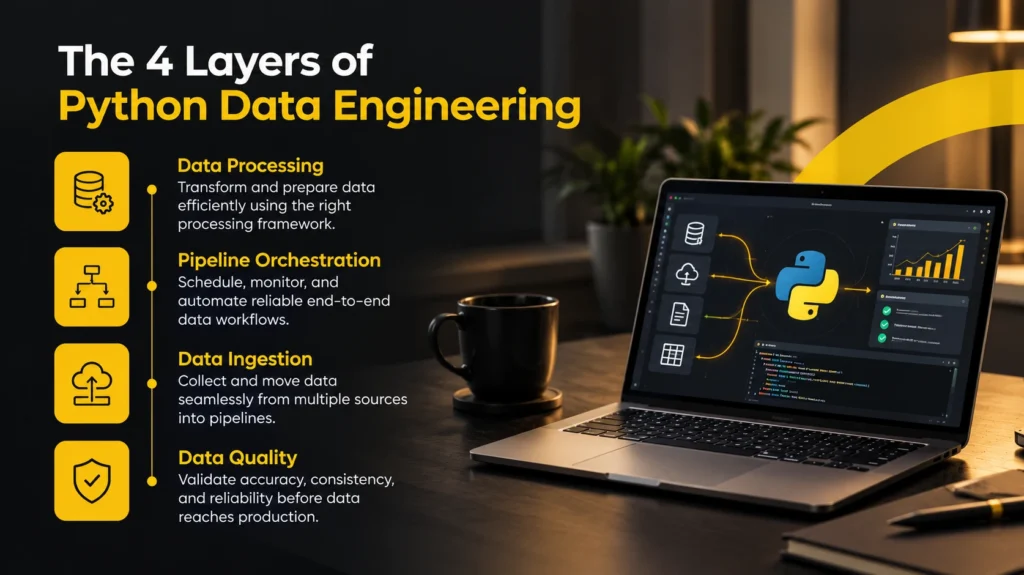
Understanding Python for data engineering means understanding where each tool sits in the stack. Most confusion in Python data engineering comes from mixing up the layers: using a processing library (pandas) for a problem that needs an orchestration layer (Airflow), or using an orchestration tool to do data transformation work that belongs in a processing framework. The 4 layers are: processing, orchestration, ingestion, and quality.
Layer 1: Data Processing
The data processing layer is where transformation happens: filtering rows, joining tables, computing aggregations, applying business logic, and reshaping data from source schema to target schema. Python offers 3 tools at this layer, each suited to a different scale of data.
Pandas is the right choice for datasets that fit comfortably in memory, roughly under 1 to 2 gigabytes (GBs) on a standard machine. It is expressive, well-documented, and universally understood by Python engineers. Its limitation is precisely that it loads data into memory: a 10 GB file will likely cause a memory error, and a pandas pipeline does not scale horizontally to a distributed cluster.
Polars is the correct choice for single-machine processing beyond what pandas handles efficiently. Written in Rust with lazy evaluation and Apache Arrow columnar memory format, Polars delivers 10 to 50x speedups over pandas for most transformation workloads. It handles multi-gigabyte files without memory issues and expresses the same transformation logic as pandas with a cleaner API. For organisations running pandas pipelines that are slow but not yet at cluster scale, migrating to Polars is the highest-leverage performance improvement available today.
PySpark, the Python API for Apache Spark, is the right choice for datasets that genuinely require distributed processing across a cluster: hundreds of gigabytes to petabytes, or transformation logic that benefits from parallelism across machines. PySpark adds operational overhead (cluster management, serialisation, network I/O) that is not worth paying below a certain data volume threshold. The mistake is reaching for PySpark at gigabyte scale, not because it cannot handle it, but because Polars handles it with far less complexity and cost.
Layer 2: Pipeline Orchestration
The orchestration layer schedules, sequences, and monitors pipeline runs. It is not where transformation happens; it is the system that decides when transformation runs, retries failed tasks, alerts on errors, and provides visibility into pipeline health. Without an orchestration layer, a data pipeline is a script: it works when you run it manually and fails silently when it does not.
Apache Airflow is the most widely deployed orchestration tool in data engineering. Pipelines are defined as directed acyclic graphs (DAGs) in Python, with tasks as nodes and dependencies as edges. Airflow’s strengths are its maturity, its integrations with every major cloud and data platform, and its established community. Its limitation is operational complexity: managing an Airflow deployment at scale requires dedicated infrastructure attention.
Prefect and Dagster are the 2 primary modern alternatives. Prefect focuses on Python-native workflow definitions with minimal infrastructure setup, making it a faster path to production orchestration for teams that cannot commit infrastructure time to running Airflow. Dagster focuses on data assets: each pipeline step is associated with the data it produces, making lineage, testing, and observability first-class concerns rather than afterthoughts. For teams building pipelines where data quality and asset-level visibility matter from day 1, Dagster’s model is more useful than Airflow’s task-centric model.
Layer 3: Data Ingestion
The ingestion layer moves data from sources (APIs, databases, event streams, files) into the pipeline. Python’s role here is defining connectors and handling the mechanics of extraction: authentication, rate limiting, pagination, schema inference, and incremental loading. dlt (data load tool) is the fastest-growing Python ingestion library in 2026: it is an open-source library that builds production-grade ingestion pipelines with very little code, handling incremental loading, schema evolution, and destination normalisation out of the box. For teams building custom connectors to proprietary APIs, dlt reduces the boilerplate from hundreds of lines to tens.
For Kafka-based real-time data streaming, confluent-kafka-python provides high-performance consumer and producer code for building event-driven ingestion pipelines. For change data capture (CDC) from relational databases, Python wrappers around Debezium enable database-level event streaming into downstream pipelines without polling.
Layer 4: Data Quality & Testing
The quality layer validates that data meets expectations at every stage of the pipeline. A pipeline without a quality layer is a delivery mechanism for bad data: it moves incorrect, incomplete, or malformed records into production systems with the same reliability as good ones.
Great Expectations is the most mature Python data quality framework. It defines expectations (column values should be between 0 and 100, this column should never be null, this foreign key should always exist in the reference table) as Python code, runs validations against real data at each pipeline stage, and generates human-readable data documentation. Pydantic is the right tool for schema validation at the Python code level: defining the expected shape of records as Python dataclasses and catching schema violations before data reaches the transformation layer. Soda Core is the newer, lighter alternative to Great Expectations for teams that want SQL-native quality checks integrated into their orchestration layer.
Building a data pipeline in Python: architecture before code
A production-grade data pipeline in Python is not defined by the libraries it uses. It is defined by 5 architectural properties that determine whether it holds up under real conditions.
Idempotency means that running the pipeline twice produces the same result as running it once. This is the most important property for operational reliability. A pipeline that duplicates records on retry, or that cannot reprocess a specific date range without side effects, will cause data quality incidents every time something goes wrong. Idempotent pipeline design in Python means using upsert operations rather than inserts, partitioning data by timestamp or identifier, and designing transformation logic that is safe to rerun.
Incremental Loading means processing only new or changed data rather than reprocessing the full dataset on every run. A full-refresh pipeline that reprocesses 3 years of transaction history to add yesterday’s records is not just slow; it is a cost and reliability problem at scale. Incremental loading requires tracking a high-water mark (the timestamp or ID of the last successfully processed record) and filtering source data accordingly. dlt handles this automatically for supported sources. For custom pipelines, the high-water mark is typically stored in the target database and read at the start of each pipeline run.
Schema Evolution handling means the pipeline does not break when a source system adds a new column, renames a field, or changes a data type. Python’s dynamic typing makes schema changes easy to miss at the code level. Production pipelines need explicit schema validation (via Pydantic or Great Expectations) at ingestion, and a clear policy for how schema changes propagate: are new columns automatically added to the target table, or do they require a manual migration?
Observability means knowing, in real time, whether the pipeline is healthy: how long each task took, how many records were processed, whether any quality checks failed, and what happened on the last failed run. Python orchestration frameworks (Airflow, Dagster) provide task-level execution metadata out of the box. Custom metrics (record counts, null rates, processing latency) should be emitted as structured logs or sent to a monitoring platform at each pipeline stage.
Error Handling & Retries means the pipeline fails gracefully and recovers automatically for transient errors. Python’s native exception handling is a start, but production pipelines need explicit retry logic with exponential backoff for API calls, dead-letter queues for records that fail transformation, and alerting (Slack, PagerDuty, email) for pipeline failures that require human intervention.
A data pipeline example: what this looks like in practice
The architecture decisions above are not theoretical. They are what separate a pipeline that works for 6 months from one that runs for 3 years without a rebuild.
When we built the data engineering infrastructure for ClaritasRx, a pharma patient data analytics platform, the Python stack covered 4 distinct responsibilities: AWS Glue (Python-based ETL jobs) for batch transformation of patient dataset files, AWS Lambda (Python functions) for event-driven processing triggered by new data arrivals, a custom Python ingestion layer for normalising data from multiple pharma client formats into a standard schema, and Pydantic models for schema validation at the ingestion boundary. The architectural decision that made this maintainable at scale was not the library choices. It was designing each layer to be independently replaceable: the transformation logic in Glue jobs could be rewritten without touching the ingestion layer, and the serving layer (a React and Python SaaS analytics platform) consumed from a stable, documented schema regardless of what changed upstream. Python’s role was the connective tissue across all 4 layers, not the solution to every problem within each layer.
Python data pipeline tools: the 2026 default stack
The default Python data engineering stack in 2026 has converged around a set of tools that most enterprise teams can implement without custom infrastructure:
Ingestion: dlt or Airbyte for managed connectors; custom Python with confluent-kafka-python for Kafka-based streaming.
Processing: Polars for single-machine workloads under ~100 GB; PySpark (via Databricks or Amazon EMR) for distributed processing above that threshold; DuckDB for analytical queries over local files or S3 during development and testing.
Transformation: dbt with a Python model layer for analytics-ready transformations on top of cloud warehouses (Snowflake, BigQuery, Databricks). dbt’s Python models allow PySpark or pandas logic where SQL is insufficient, keeping transformation logic in a single, version-controlled framework.
Orchestration: Dagster for teams building asset-oriented pipelines where data lineage and quality are primary concerns; Apache Airflow for teams with existing Airflow investments or strong task-dependency orchestration requirements; Prefect for teams that need fast setup with minimal infrastructure overhead.
Quality: Pydantic for schema validation at ingestion; Great Expectations or Soda Core for data quality assertions at transformation checkpoints.
Warehousing/serving: Snowflake or BigQuery for cloud data warehouse serving; Apache Iceberg with Polaris or Unity Catalog for open lakehouse architectures.
Where Python’s limits are in data engineering
Python for data engineering has real limits, and understanding them prevents over-engineering in one direction and under-engineering in the other.
Python is a slow language for compute-intensive work at the interpreter level. PySpark and Polars address this by delegating computation to JVM (Java Virtual Machine) or Rust-compiled code, with Python serving as the orchestration and API layer. This matters in practice: a Python loop over millions of rows in a pandas DataFrame is slow; the same operation expressed as a Polars expression or a PySpark transformation is fast. Learning to “think in expressions” rather than “think in loops” is the most important performance shift for a Python data engineer moving from scripts to production pipelines.
Python’s global interpreter lock (GIL) limits true parallelism for CPU-bound work in a single process. For CPU-intensive transformation work that cannot be expressed as vectorised operations, the right answer is parallelism at the orchestration layer (multiple Airflow task workers) or at the framework layer (Spark executors), not multi-threading in a single Python process.
Sub-second, stateful event processing is not Python’s domain. A fraud detection system that must evaluate transaction risk in under 100 milliseconds, maintaining stateful context across thousands of concurrent sessions, should run on Apache Flink (via PyFlink for the Python API, though Java and Scala are the production languages of choice for Flink at extreme throughput). Python is excellent for defining the logic and testing the pipeline; it is not the right execution engine for microsecond-latency requirements.
Python for data engineering is an architectural skill, not a library list
The engineers who build data pipelines that last are not the ones who know the most libraries. They are the ones who understand which problem each layer of the stack is solving, and which tool fits each layer at the scale they are actually operating at.
Python for data engineering in 2026 is a more powerful and more clearly structured skill than it was even 2 years ago. Polars has made single-machine processing genuinely competitive with distributed frameworks for most enterprise data volumes. dlt has reduced the cost of building production ingestion pipelines from weeks to days. Dagster has made asset-level observability a first-class concern rather than a bolt-on. The default stack is clearer, more stable, and better documented than it has ever been.
The engineers still getting this wrong are not choosing the wrong libraries. They are choosing the right libraries and applying them at the wrong layer: orchestrating with a processing framework, transforming in the ingestion layer, skipping quality checks until something breaks in production. Getting the layer separation right is the skill that multiplies everything else.
If you are scoping a data engineering platform or evaluating whether your current pipeline architecture can support the data volumes and latency requirements your product now demands, reach out at coffee@sparkeighteen.com.