The app launched on time. The reviews were good. Downloads climbed. Then, three weeks in, the app started timing out. Users reported blank screens, stalled requests, data that never arrived. The engineering team scrambled. The problem was not the frontend. It was not the device. It was the backend, and specifically, the fact that it had been built to handle 1,000 concurrent users and was now being asked to handle 50,000.
Stories like this are not unusual. Mobile app backend development is the part of the product that users never see, until it goes wrong. And when it goes wrong at scale, it does so in the most visible, reputation-damaging way possible: the app simply stops working.
The backend is where data lives, where logic runs, where authentication is enforced, where APIs serve every request the app makes. Getting it right is not about choosing the trendiest framework. It is about making a set of architectural decisions early that determines whether the app can grow without being rebuilt from scratch six months later.
This guide walks through those decisions: what mobile app backend development actually involves, the architecture choices and their trade-offs, the backend technologies for mobile apps that matter today, the differences between Android and iOS backend requirements, and how to evaluate whether your team or a development partner is approaching the backend correctly.
Key takeaways
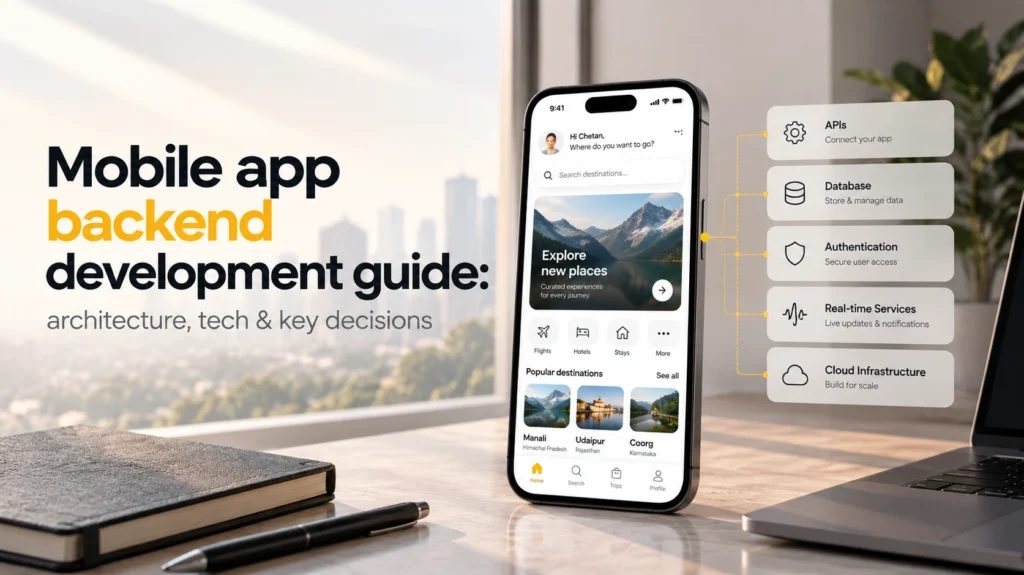
- Mobile app backend development covers every server-side layer of your application: APIs, databases, authentication, real-time services, and cloud infrastructure
- The global mobile backend as a service market is valued at USD 11.31 billion in 2025 and is projected to reach USD 29.98 billion by 2034, reflecting the scale of investment in backend infrastructure for mobile products
- Architecture decisions made at the start, such as monolithic versus microservices, REST versus GraphQL, and relational versus NoSQL databases, determine how much the product costs to scale and maintain, not just how quickly it ships
- Android app backend development and backend iOS development share the same server-side architecture: the differences are in the client-side SDKs and notification delivery systems, not the backend logic itself
- 65% of enterprise app projects fail due to poor API orchestration: the most common and most avoidable backend failure mode
What is mobile app backend development?
Mobile app backend development is the discipline of building and maintaining every server-side component that a mobile application depends on. When a user logs into an app, searches for something, receives a push notification, makes a payment, or loads a data feed, they are interacting with the result of the backend for mobile app development: the APIs, databases, business logic, authentication systems, and cloud services that sit behind the screen.
The frontend of a mobile application (the screens, animations, and interactions the user sees) is only half of the product. The backend is the half that processes, stores, secures, and returns data. A brilliant frontend served by a poorly designed backend produces an app that feels fast in a demo and fails in production.
Application backend development for mobile is distinct from general web backend development in a few meaningful ways. Mobile apps operate in constrained network environments. Users switch between Wi-Fi and cellular, experience latency spikes, and drop connections entirely. A backend designed without these conditions in mind produces APIs that time out on mobile networks, responses that are too large for a 4G connection, and authentication flows that break when a session is interrupted. Backend mobile development must account for these realities by design, not as an afterthought.
The mobile backend as a service market was valued at USD 11.31 billion in 2025 (Fortune Business Insights), reflecting the scale of investment that enterprises and product teams are committing to backend infrastructure for mobile. That investment is driven by a straightforward reality: the backend is where mobile products succeed or fail at scale.
The core components of a mobile app backend
Before architecture decisions are made, the engineering team needs a clear picture of what a backend for mobile app development actually comprises. These are the components every production mobile backend requires.
APIs: the contract between app and server
The API (Application Programming Interface) is the interface through which the mobile app communicates with the backend. Every time the app requests data, submits a form, authenticates a user, or processes a transaction, it does so through an API call. The quality of that API, how it is structured, versioned, and documented, determines the speed, reliability, and maintainability of the entire product.
REST (Representational State Transfer) APIs are the dominant pattern for backend mobile development. They are stateless, use standard HTTP methods, and return JSON responses that mobile clients parse efficiently. Most production mobile backends use REST because it is well-understood, well-tooled, and supported natively by every mobile SDK.
GraphQL is an alternative API specification that allows clients to request exactly the data they need, reducing over-fetching. It is increasingly used for mobile backends with complex, nested data requirements such as social feeds, content-heavy apps, and dashboards, where a single REST endpoint would return far more data than the mobile client needs. The trade-off is added complexity on the backend and a steeper learning curve for the team.
API versioning is not optional for any mobile app that has been released to production. When the backend changes, old versions of the app must still work. Without versioning, a backend update can break every user who has not yet updated the app, which, depending on the platform and user behaviour, could be a significant share of the active user base.
Databases: where data lives
Every mobile application stores data. The architecture of that data storage is one of the most consequential decisions in backend for app development.
Relational databases (PostgreSQL, MySQL, SQL Server) store data in structured tables with defined relationships. They enforce schema consistency, support complex queries, and provide strong transactional guarantees. They are the right choice for applications with complex, interconnected data models: user records, financial transactions, healthcare data, anything where data integrity matters more than raw write speed.
Non-relational (NoSQL) databases (MongoDB, DynamoDB, Cassandra, Firebase Realtime Database) store data in flexible formats (documents, key-value pairs, wide columns) and scale horizontally with less friction than relational databases. They are well-suited to mobile apps with high write volumes, simple data structures, or requirements for real-time data synchronisation across devices.
The choice between relational and NoSQL is not a matter of preference. It is a matter of the product’s data requirements. Choosing a NoSQL database because it seems faster to start with, without considering the consistency requirements of the data the app actually manages, is a common source of technical debt that surfaces at scale.
Authentication and security
Every mobile app that stores user data or processes transactions needs a robust authentication layer. For backend application development in mobile, this typically involves:
JWT (JSON Web Tokens): short-lived tokens issued on login, sent with every subsequent API request, validated on the server. JWTs allow stateless authentication, meaning the server does not need to store session state, which simplifies scaling.
OAuth 2.0: the standard for third-party authentication (Sign in with Google, Apple, Facebook). OAuth delegates authentication to a trusted identity provider and returns an access token to the backend.
Role-based access control (RBAC): a permissions model that defines what each type of user can see and do. In multi-tenant applications or products with complex permission hierarchies, RBAC must be enforced at the API and database level, not just in the UI.
Security in backend mobile development is not a feature to add after launch. Data encrypted in transit (HTTPS / TLS) but not at rest, or authentication that works correctly in the happy path but fails under edge cases like token expiry or network interruption, produces the kind of vulnerability that security audits and incident reports are made of.
Push notifications and real-time services
Push notifications are one of the most-used and most-misunderstood components of backend mobile app development. They are not sent directly from the backend to the device. They are sent from the backend to a notification gateway (Apple Push Notification Service (APNs) for iOS, Firebase Cloud Messaging (FCM) for Android), which delivers them to the device.
This distinction matters for architecture. The notification service needs to know which gateway to use for each device, manage device token registration and rotation, handle delivery failures, and respect platform-specific rate limits. A notification service bolted onto a backend without these considerations produces unreliable delivery and, in high-volume scenarios, delivery failures at exactly the moments when reliable notification matters most.
Real-time functionality such as live chat, live data feeds, and collaborative features requires a persistent connection between the client and server. WebSockets are the standard mechanism: they keep a connection open and allow the server to push data to the client without the client polling repeatedly. For backend mobile development, this means managing connection state, handling disconnections gracefully, and ensuring that real-time services scale alongside the rest of the backend.
Cloud infrastructure
Modern backend for mobile app development runs on cloud infrastructure: AWS, Google Cloud Platform (GCP), or Microsoft Azure. These platforms provide the compute, storage, networking, and managed services (databases, queues, notification gateways, CDNs) that production mobile backends require.
The choice of cloud provider is less consequential than the decisions made within it: how services are containerised and deployed, how scaling policies are configured, how logging and monitoring are set up, and whether the infrastructure is defined as code so that environments are reproducible and changes are auditable. A mobile app whose backend has no auto-scaling configuration will not survive a traffic spike. One whose logs are not structured and centralised is difficult to debug when something goes wrong in production.
Architecture decisions that determine how the backend scales
The architecture of a mobile app backend is set early and is expensive to change later. The decisions below are the ones that tend to be made under time pressure at the start of a project and revisited under financial pressure when the product grows.
Monolithic versus microservices
A monolithic backend has all functionality (user management, data processing, notifications, payments) in a single deployable unit. It is faster to build, simpler to test, and easier to reason about in the early stages of a product. For MVPs, early-stage startups, and products with small teams, a well-structured monolith is usually the right starting point.
A microservices architecture breaks the backend into independent services, each responsible for one domain, that communicate over APIs or message queues. Services can be deployed, scaled, and updated independently. A traffic spike in the notification service does not affect the authentication service. Teams can own individual services without needing to understand the full backend.
The trade-off is complexity. Microservices require more infrastructure, more operational discipline, and more explicit management of the contracts between services. A team that moves to microservices before they have the operational maturity to run them is not gaining scalability: they are gaining complexity without the benefits.
The practical guidance: start with a modular monolith. Structure the code so that domains are clearly separated internally, making the future migration to microservices tractable. Migrate individual services when a specific domain has scaling requirements that the monolith cannot meet cost-effectively.
Synchronous versus asynchronous processing
Not every backend operation needs to happen before the API returns a response to the mobile app. Sending a welcome email, generating a PDF, resizing an uploaded image, running a fraud check: these can be processed asynchronously, via a message queue (RabbitMQ, AWS SQS, Kafka), without making the user wait.
Synchronous processing for operations that should be asynchronous is a common source of slow API response times on mobile. The API waits for the operation to complete before responding, the mobile app waits for the API, and the user experiences a delay that has nothing to do with the network.
Designing for asynchronous processing from the start, accepting a request, queuing the work, returning a 202 Accepted response, and notifying the user when the work is done, produces a faster, more resilient backend application development pattern.
Backend technologies for mobile apps: what the stack looks like
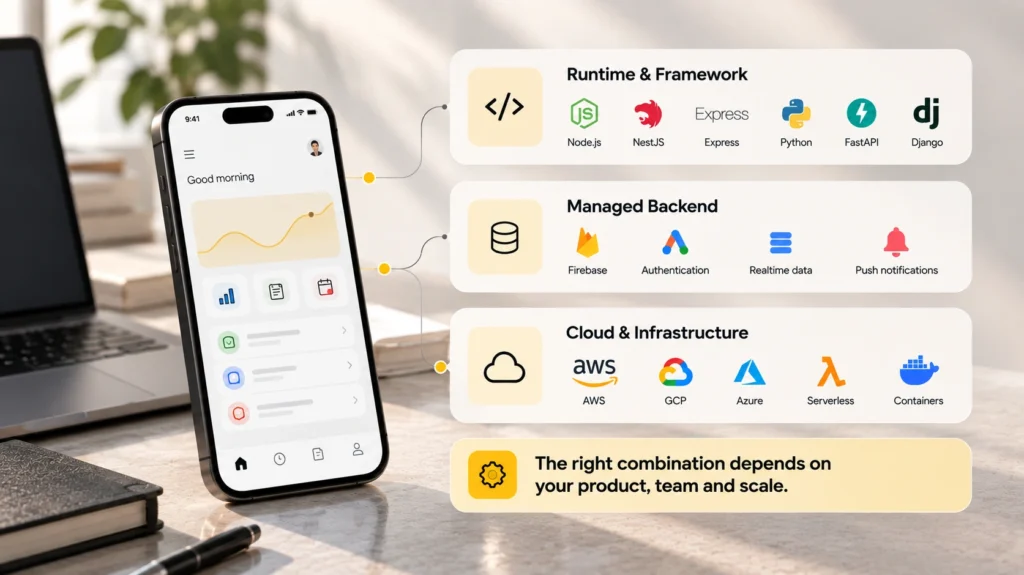
The backend technology stack is the combination of language, framework, database, and infrastructure that the backend is built on. There is no universally correct stack for backend mobile app development. The right stack depends on the team’s expertise, the product’s requirements, and the operational environment.
Node.js
Node.js is the most widely used server-side runtime for backend mobile development. Its non-blocking, event-driven architecture makes it well-suited to handling high volumes of concurrent API requests, which is the pattern that mobile app backends experience. Express.js (minimal, flexible) and NestJS (opinionated, TypeScript-first) are the dominant Node.js frameworks for production mobile backends.
NestJS in particular has become the standard for enterprise-grade backend mobile development in TypeScript ecosystems: it provides structured module organisation, built-in support for dependency injection, and strong TypeScript typing that reduces a class of runtime bugs before they reach production.
Python
Python’s backend frameworks, FastAPI and Django, serve different backend application development contexts.
FastAPI is the modern, async-first Python framework growing fastest in AI-native and data-intensive mobile backends. It generates OpenAPI documentation automatically, enforces type annotations, and handles concurrent requests efficiently. For mobile apps that require a machine learning inference layer, a RAG pipeline, or any AI-driven feature, FastAPI is increasingly the default backend choice.
Django is batteries-included: ORM, admin panel, authentication, and form handling are built in. It is the right choice for data-driven mobile apps with complex domain models where the framework’s convention over configuration reduces development overhead.
Firebase
Firebase is Google’s serverless backend platform for mobile and web applications. It provides a real-time database, cloud functions, authentication, and push notification delivery (via FCM) in a managed service with minimal infrastructure overhead.
Firebase is a strong choice for rapid prototyping, consumer apps with real-time sync requirements (collaborative apps, live chat, gaming), and teams without dedicated backend engineers. Its trade-off is flexibility: Firebase’s data model and pricing structure can become limiting at scale for products with complex query requirements or large data volumes.
AWS, GCP, and Azure
Cloud providers are not backend frameworks: they are the infrastructure on which any of the above runs. The decision between AWS, GCP, and Azure for backend for app development is primarily driven by existing enterprise agreements, the team’s operational familiarity, and specific managed service requirements (AWS Lambda, Google Cloud Run, Azure Functions for serverless; DynamoDB, Firestore, Cosmos DB for managed NoSQL).
AWS is the dominant cloud platform for backend mobile development by market share. Its managed services are the most mature, its documentation is the most extensive, and its ecosystem of tooling for deployment, monitoring, and security is the broadest.
Android and iOS: where the backend differs
A question that comes up frequently in backend mobile app development discussions: do Android app backend development and backend iOS development require different backends?
The short answer is no. The backend serves data via APIs. The mobile client, whether it is an Android application or an iOS application, makes HTTP requests to the same endpoints and receives the same responses. The server does not know or care whether the request originated from an Android device or an iPhone.
The differences are at the client-integration layer, not the server layer:
Push notifications: Android uses Firebase Cloud Messaging (FCM). iOS uses Apple Push Notification Service (APNs). The backend must manage two notification gateways and store device tokens correctly for each platform. The notification routing logic sits on the backend.
Authentication: Sign In with Apple is mandatory for iOS apps that offer any social login option. The backend must implement Apple’s identity token verification in addition to any OAuth providers used for Android.
File storage and media handling: iOS and Android have different image formats and compression characteristics. If the mobile app uploads user-generated media, the backend needs to handle both correctly.
SDK versions and API compatibility: Android and iOS release cycles differ. Both platforms have users on older OS versions who expect the app to work. API versioning on the backend protects both platforms from being broken by backend changes.
Backend mobile app development for Android and iOS is the same discipline applied to two client environments. The architecture, the database, the business logic, and the security model are identical. What changes is the integration surface at the notification and authentication layer.
What production-grade mobile app backends look like
The difference between a backend that works in staging and one that survives production is design. Two examples from Spark Eighteen’s work illustrate what that distinction looks like in practice.
CustomerInsights.AI is a life sciences intelligence company that needed a backend capable of powering ciATHENA: an agentic conversational interface that answers complex market research questions through voice and text, visualises data in real time, and coordinates responses across multiple product teams simultaneously.
The backend was built on FastAPI (Python) with Azure infrastructure. The choice was driven by the product’s core requirement: every user query triggered an agentic AI pipeline orchestrated by LangChain, calling OpenAI models, retrieving from vector stores, and returning structured responses that the Next.js frontend rendered as interactive data visualisations via D3.js. A synchronous API architecture would have made users wait for the full pipeline to complete before seeing any response. Instead, the backend was designed for streaming: partial results arrived progressively as the pipeline ran. The API contract between the FastAPI backend and the frontend was defined before any application code was written, which meant that when the two tracks converged at integration, there were no mismatches. The product shipped on time.
The lesson this illustrates for backend for app development: the API contract is not a detail to work out during integration. It is the first engineering decision. Teams that define what the backend will expose (the endpoints, the data shapes, the authentication flow, the error handling) before writing either the backend or the frontend ship faster and integrate more cleanly than teams that leave it to be figured out at the end.
A different set of backend decisions presented themselves at ClaritasRx, a specialty-pharmacy data platform serving pharmaceutical clients including Gilead, GSK, BeiGene, Amicus, and Ionis. The backend requirement was precise: a single codebase serving multiple fully isolated tenants, with patient data governed under HIPAA at every API endpoint, and analytics data from an Athena data lake continuously reconciled into the operational database without data loss.
Spark Eighteen built the backend on NestJS (Node.js), PostgreSQL with a 3-tier tenant-scoped architecture, and AWS. The tenant isolation was not implemented at the application layer with conditional WHERE clauses: it was enforced at the database connection level, so that a query from one tenant’s session could not access another tenant’s data by construction. Every API endpoint that touched patient data was authorised and access-logged structurally, making HIPAA compliance a property of the backend architecture rather than a set of conventions that could be bypassed.
The SDI service, a custom data pipeline, continuously reconciled the Athena analytics lake into the operational database per tenant, ensuring that reporting and AI-assisted insights reflected current data without requiring the analytics infrastructure to be rebuilt as a separate product.
The backend serves 5 product surfaces: Patient Watchtower, a CRM, analytics, self-serve reporting, and the Ask Ascend AI assistant. All from one codebase, one backend deployment, one data model.
This is what mature backend mobile development and backend application development look like: not the fastest stack to prototype, but the architecture that can carry the product through its growth without requiring a rebuild.
How to evaluate whether a team can actually build this
For product teams working with an external IT solutions partner, or evaluating an internal team’s backend capability, these are the questions that distinguish genuine backend application development expertise from surface-level familiarity.
How do you design the API contract? A capable team defines the API specification before writing backend or frontend code. They use OpenAPI / Swagger, define request and response schemas, document error states, and version from the start. A team that says “we figure it out as we build” is describing a backend that will be difficult to maintain and nearly impossible to version correctly.
How do you handle authentication at scale? The answer should involve JWT with appropriate expiry and refresh token rotation, OAuth integration for social providers, and explicit handling of edge cases: what happens when a token expires mid-session, when a device is offline, when a user logs in on a second device. Vague references to “we use JWT” without specifics about token lifecycle management are a prompt to ask further.
How do you approach database design for a multi-tenant product? Tenant isolation can be implemented at the row level (a tenant_id column on every table), the schema level (separate schemas per tenant), or the database connection level (separate connections per tenant). Each has different performance, security, and operational trade-offs. A team that has built production multi-tenant backends will have a considered answer. A team that has not will treat this as a new question.
What does your deployment and infrastructure look like? Production backend mobile development requires containerised deployments (Docker / Kubernetes or equivalent), infrastructure as code (Terraform, AWS CDK), centralised logging and monitoring, and defined scaling policies. A team deploying manually to a single server is not production-ready for a mobile app at scale.
How do you test the backend? Unit tests, integration tests against a real database (not mocks), and end-to-end API tests that catch regressions before they reach production. A team that relies primarily on manual testing is a team that will ship bugs to production at a rate the product cannot sustain.
The answers to these questions tell you more about a team’s actual capability than their portfolio or their technology list. An IT solutions company that can answer them specifically, with examples, trade-off awareness, and production context, is a team that has built backend systems at scale. One that cannot is one that will learn on your product.
Conclusion
Mobile app backend development is not a technology choice. It is a discipline of architectural decisions, each of which has compounding consequences for how the product performs, scales, and evolves. The backends that fail in production fail in predictable ways: APIs without versioning, databases without isolation, authentication without lifecycle management, infrastructure without scaling policies. These are not exotic failure modes. They are the result of decisions made under time pressure at the start of a project, without a clear view of the consequences.
Build backend for mobile app development correctly, and the backend becomes the foundation the product scales on: adding features, serving more users, and integrating new capabilities without requiring a rebuild. Build it incorrectly, and the backend becomes the ceiling: the constraint that prevents the product from growing beyond the scale it was originally designed for.
The backend technologies for mobile apps available today are mature, well-documented, and well-supported. The challenge is not the technology. It is the architecture: the decisions about structure, contracts, isolation, and resilience that determine whether the backend can carry the product through its growth.
Build a backend that carries your product forward
Spark Eighteen builds production-grade backends for mobile and web applications across healthcare, life sciences, fintech, and AI-native products, from ClaritasRx’s multi-tenant HIPAA-compliant NestJS and PostgreSQL platform to CustomerInsights.AI’s FastAPI agentic AI backend. If you are scoping backend for mobile app development and want to think through the right architecture, or evaluating a development partner’s backend capability, we are worth a conversation.
Read the work at sparkeighteen.com/work or reach us at coffee@sparkeighteen.com.