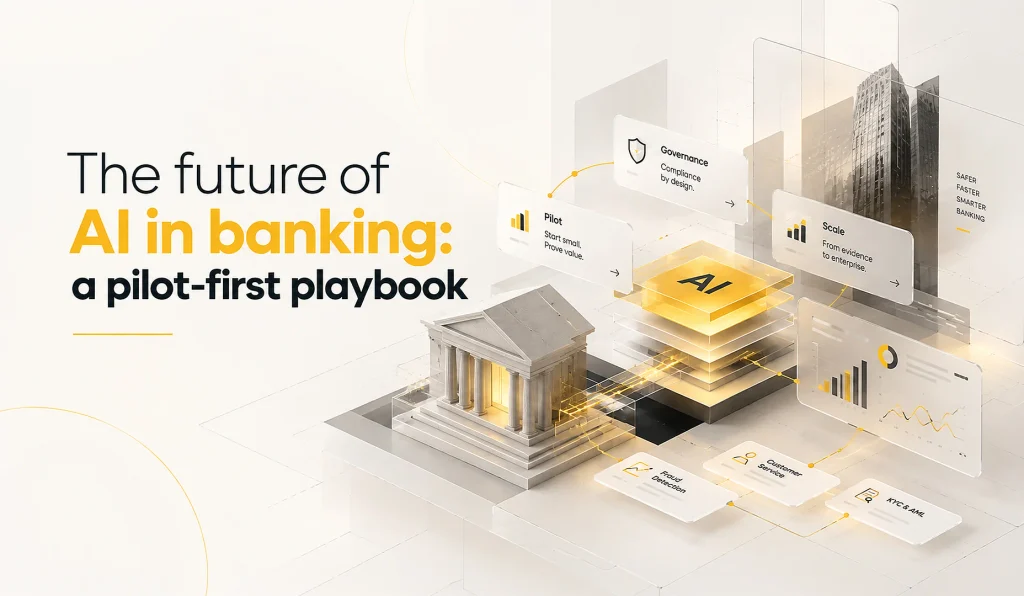
Most banks that have tried to deploy AI at scale have something in common: they started too big, moved too fast, and found out too late that their governance, data infrastructure, and compliance processes were not ready for production. The lesson is not that AI does not work in banking. It is that the way most organisations have approached it does not work.
The smarter path is deliberate and incremental. Start with a contained pilot in a high-volume, low-risk workflow. Measure real outcomes. Build the governance and operational muscle to run AI in a regulated environment. Then scale from a position of evidence, not aspiration.
The AI in banking market is projected to grow from $45.27 billion in 2026 to $411.52 billion by 2034, which signals both the scale of the opportunity and the urgency to get the approach right. This guide explains which AI use cases in banking are ready for pilots now, what the benefits and risks look like in practice, and how to build the architecture and governance to scale without disrupting core systems.
Quick answer: What is the role of AI in banking?
Artificial intelligence in banking is used to automate repetitive high-volume processes, detect fraud in real time, personalise customer interactions, triage compliance alerts, and assist analysts with documentation. The most mature applications are fraud detection, document processing, customer service augmentation, and KYC and AML alert triage, each of which can be piloted without touching core banking infrastructure.
Key takeaways
- 81% of financial institutions have deployed AI, driven primarily by fraud detection, regulatory compliance, and operational efficiency
- The AI in banking market is projected to reach $411.52 billion by 2034, up from $45.27 billion in 2026
- 90% of financial institutions now use AI for fraud detection, making it the most mature AI use case in the banking sector
- AI fraud detection systems can achieve 98% accuracy compared to traditional rule-based systems
- A sidecar architecture allows banks to run AI alongside existing systems without rewriting core platforms, reducing deployment risk significantly
- Governance, human oversight, and audit readiness must be built into pilot design from day one, not added after proof of concept
The state of artificial intelligence in banking
Banking is one of the most data-intensive industries on earth, generating structured and unstructured data at a scale that rule-based systems struggle to process with the speed and accuracy modern operations require. The role of AI in the banking sector has shifted from experimental to operational. JPMorgan alone has invested $2 billion in AI, demonstrating that the ROI case is real when the approach is disciplined. The challenge is not access to AI technology. It is knowing which applications are ready for regulated deployment, and how to run them without introducing the operational or compliance risk that has stalled many programmes.
Key AI use cases in banking ready for pilots today
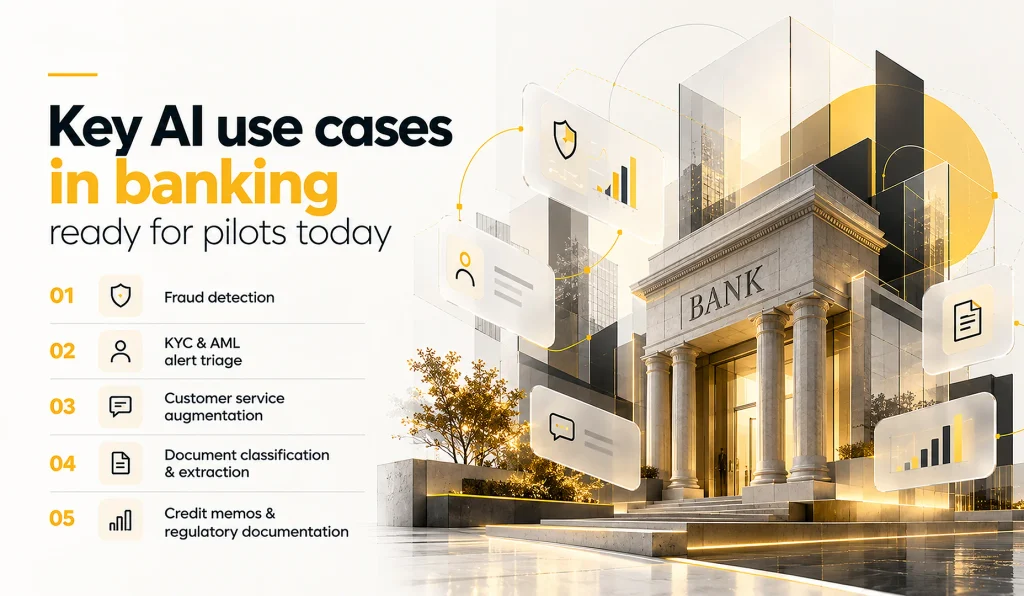
Not all AI use cases in banking carry the same risk profile. The most practical starting points share two traits: they handle high-volume, repetitive tasks, and they keep final decisions in human hands.
| AI use case | What AI does | Benefit | Risk level | Pilot readiness |
| Fraud detection | Detects suspicious patterns | Reduce fraud | Medium | High |
| KYC/AML | Prioritises alerts | Reduce analyst workload | Medium | High |
| Customer service | Agent assistance | Faster support | Low to medium | High |
| Document processing | Extracts data | Reduce manual work | Low | High |
| Credit analysis | Supports analysis | Faster decisions | High | Controlled |
| Regulatory reporting | Drafts and summarises | Reduce effort | Medium | Controlled |
| Risk management | Identifies patterns | Better monitoring | High | Controlled |
| Personalisation | Recommends products | Better CX | Medium | Medium |
Fraud detection using AI in banking
90% of financial institutions now use AI for fraud detection, making it the most mature application. AI fraud detection systems achieve 98% accuracy compared to rule-based approaches, and in a pilot context, pre-screening models work well in review-only mode: the model flags anomalies for human investigators rather than blocking transactions directly.
KYC and AML alert triage
Compliance workflows generate thousands of alerts that analysts must review manually, the vast majority of which are false positives. AI-based alert triage can reduce AML alert volumes by up to 89% while improving investigation quality. Because the model is assisting rather than deciding, this use case is suitable for an early pilot.
Customer service augmentation
Agent assist tools summarise call transcripts, generate suggested responses, and surface relevant policy documentation in real time. This runs as a layer above existing call recording and CRM infrastructure, with the human agent retaining full control. Average handle time, first-call resolution rate, and agent coaching efficiency are straightforward to measure.
Document classification and extraction
Loan origination, onboarding, and regulatory filing workflows involve large volumes of documents requiring manual review. AI extracts structured data from unstructured documents, with low-confidence fields flagged for human verification. This is a high-value, low-risk application that accelerates a labour-intensive process without touching customer decisions.
Credit memo and regulatory documentation
Generative AI can produce accurate, consistent summaries from structured financial data, giving analysts a strong draft to refine and approve. The governance requirement: the model’s output must be clearly marked as a draft, reviewed by a qualified analyst, and approved through a documented process before filing.
Benefits of AI in banking
The case for AI in banking is increasingly well-evidenced. On the operational side, AI reduces the cost and time of repetitive, high-volume processes: document extraction, alert triage, and report drafting are all tasks where AI delivers measurable efficiency gains without significant risk. On the risk side, AI improves the accuracy and speed of fraud detection, flagging patterns that rule-based systems cannot surface in time. On the customer side, AI enables faster service, more relevant personalisation, and more consistent experiences across channels. For compliance teams, AI can reduce the volume of manual review work while improving the traceability and consistency of the review process. These benefits are not theoretical: they are operational at the institutions that have invested in the right architecture and governance from the start.
AI in banking: challenges and risks
The risks are as real as the benefits. Model drift is one of the most common operational problems: a model that performs well at launch can degrade quietly as real-world data diverges from its training distribution, leading to missed fraud, biased outputs, or non-compliant recommendations. Data quality is a foundational challenge; AI cannot compensate for poorly labelled, incomplete, or biased training data. Explainability is a regulatory requirement in many jurisdictions: any AI application that influences credit or compliance decisions must produce outputs a regulator can audit. And shadow AI, the unsanctioned use of AI tools by staff outside the bank’s governance framework, represents a growing data security and compliance exposure that many institutions have not yet addressed with clear policy or technical controls.
AI in banking security and compliance
Every AI application in banking that touches customer data, transaction processing, or regulatory reporting carries compliance obligations. The foundations of a defensible governance framework are: explicit human review checkpoints before any model influences a regulated decision; audit logs for all model inputs, outputs, and overrides; explainability for credit and compliance-adjacent decisions; model cards and runbooks that auditors can review without specialist data science knowledge; and adversarial testing before production launch to identify edge cases and failure modes that accuracy benchmarking alone will not surface. Red-teaming for prompt injection and distributional shift is as important in banking AI as it is in any other security context. Governance built at the design stage is far less costly than compliance remediation after a model is already in production.
The sidecar architecture: running AI without rewriting core systems
One of the most common reasons AI pilots fail to reach production in banking is architecture. Teams build a proof of concept on a bespoke stack, demonstrate value, and then discover that the operations team cannot run it, the compliance team cannot audit it, and the integration with core systems is far more complex than the pilot made it appear.
The sidecar architecture avoids this failure mode. In a sidecar setup, the AI service runs alongside the existing platform rather than inside it. It connects through secure, read-only interfaces, drawing on production data without modifying core systems or transaction records.
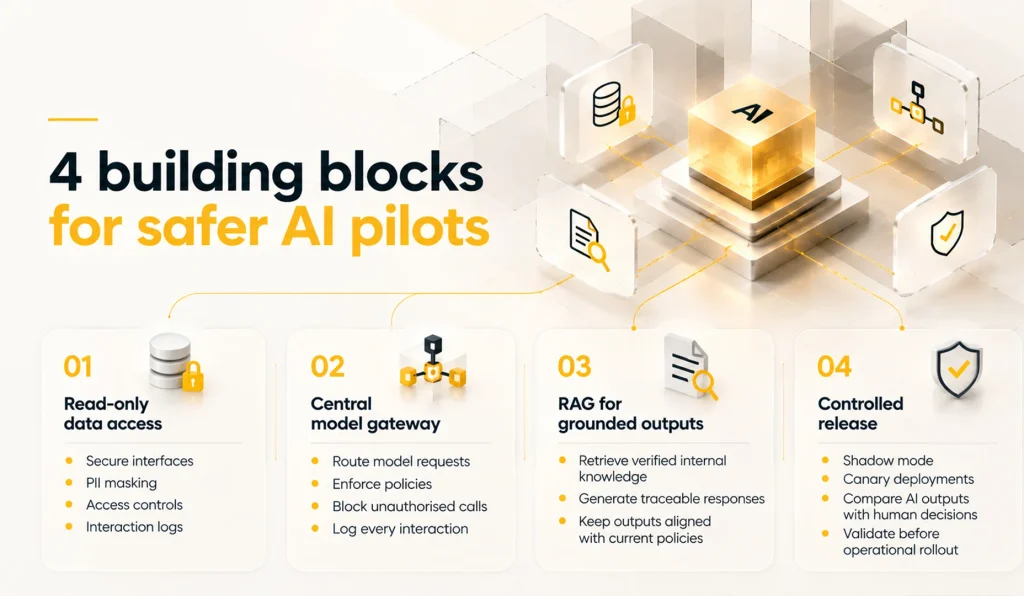
This approach has four practical implications.
Data access through read-only interfaces. AI services consume data through controlled access layers with PII masking, dataset-level access controls, and comprehensive interaction logging. Every data access is traceable and auditable.
A central model gateway. A gateway layer routes requests to the appropriate model, applies policy-based rules, blocks unauthorised calls, and logs every interaction. This is the observability and control layer that makes the architecture auditable.
Retrieval-augmented generation for grounded outputs. When AI generates summaries, recommendations, or draft documents, it should draw on verified internal content rather than generating from training data alone. A RAG layer retrieves relevant policy documents, procedures, and data at inference time, keeping outputs accurate, traceable, and aligned with current institutional knowledge.
Controlled release patterns. Canary deployments and shadow mode testing allow teams to validate model behaviour in production conditions before giving the model any operational authority. Shadow mode is particularly valuable: the model runs in parallel with the existing process, its outputs are compared to human decisions, and divergences are reviewed without any customer impact.
The sidecar pattern lets banks demonstrate AI value in production within one to two quarters, using existing infrastructure and without the risk of a core system migration.
How to implement AI in banking
Implementation follows a clear sequence. Start with use case selection: choose a high-volume, lower-risk workflow where the benefit is measurable and the decision boundary is clear. Define what the AI is allowed to do and where a human must remain in the loop before any build begins. Involve compliance and legal in pilot design, not in pilot review after the fact. Stand up the data access layer with read-only interfaces, PII masking, and interaction logging from the first sprint. Build the model gateway before the model; the observability and control infrastructure is the foundation, not an afterthought. Run in shadow mode first, comparing model outputs to human decisions and reviewing divergences. Set explicit success metrics tied to operational outcomes: time saved, error rate, loss avoided, or analyst hours freed. Once the pilot meets its thresholds, expand scope incrementally and assign a permanent run-state owner responsible for ongoing performance monitoring.
How to measure AI ROI in banking
AI ROI in banking is measured against the operational problem the system was built to solve, not against generic accuracy benchmarks. For fraud detection: the primary metrics are fraud loss reduction, false positive rate, and investigator throughput. For AML alert triage: the key metric is the reduction in analyst time spent on low-risk alerts, measured against the rate at which high-risk alerts are correctly surfaced. For document processing: throughput per analyst hour and data extraction error rate. For customer service augmentation: average handle time, first-call resolution, and agent satisfaction. Set ROI thresholds before the pilot launches and review against them at a defined checkpoint. If the model is not meeting its targets at the checkpoint, investigate before expanding scope. The institutions that measure carefully at the pilot stage are the ones that scale with confidence.
AI in banking: a practical decision framework
Before committing to an AI use case in banking, four questions determine whether it is ready to pilot. First: is the decision boundary clear? If teams cannot agree on what the AI is allowed to decide and what requires human sign-off, the use case is not ready. Second: is the data available, labelled, and of sufficient quality? AI cannot compensate for poor data, and discovering data quality problems in production is expensive. Third: can the output be explained to a regulator? If the answer is no, the model architecture is wrong for the use case. Fourth: does the team have the governance infrastructure to run this in production? That means model owner assigned, drift monitoring defined, override logging in place, and a rollback procedure tested before launch. Use cases that clear all four questions are ready for a controlled pilot. Those that do not need a defined remediation path before piloting begins.
How an IT company like Spark Eighteen approaches AI in banking
Deploying AI in a regulated environment is a software engineering and governance challenge as much as a data science challenge. The model is often the smallest part of the problem. Architecture, data access controls, audit logging, integration patterns, compliance review, and operational handoff are where most programmes succeed or fail.
Spark Eighteen, as an experienced IT company, brings this full-stack perspective to AI in banking. Our approach starts with the infrastructure that governance and compliance teams need to say yes: sidecar architecture patterns, model gateways with comprehensive logging, PII masking at the data access layer, and human review workflows built into the deployment from the first sprint. The goal is not a successful demo. It is a successful handoff.
Conclusion
The future of AI in banking will not be written by organisations that made the biggest bet. It will be written by those that built the right foundation: clear use cases, contained pilots, sidecar architectures that do not touch core systems, and governance frameworks that satisfy compliance from day one. The AI in banking market is projected to reach $411.52 billion by 2034, and the institutions that have invested in the operational capabilities to run AI in production will have a compounding advantage. The time to start is now. The way to start is small, measured, and governed.