Here is a scenario most engineering leaders have lived through. The fraud team flags an anomaly 14 hours after it appeared in the data. By the time the alert fires, the pattern has already repeated across 200 transactions. The root cause: the fraud model runs on a nightly batch job, because when the pipeline was built, “near enough” was close enough. It is not close enough anymore.
The instinct that follows is usually “we need to go real-time.” Kafka gets spun up, a streaming layer is bolted on, and the team discovers they now have 2 pipelines with 2 codebases, 2 sets of data quality checks, 2 alert systems, and 2 versions of the same metric that sometimes produce different numbers. This is the Lambda Architecture trap: not a bad idea in theory, genuinely costly to operate in practice.
The future of data engineering is not “more real-time.” It is a unified architecture where batch and streaming are expressions of the same pipeline, not competing systems that need to agree on their outputs before a business decision can be made.
Key takeaways
- You will understand why the “real-time vs batch” framing produces worse engineering decisions than asking the right architectural question from the start.
- You will learn the 3 architectural patterns data teams actually encounter (Lambda, Kappa, and the unified lakehouse model) and the practical trade-offs of each.
- You will see what a production-grade, unified data engineering pipeline looks like in 2026, including where Snowflake data engineering and Apache Flink each fit.
- You will understand the hidden operational costs of a disconnected batch and streaming setup, and what it takes to resolve them without a full rebuild.
- You will get a practical framework for deciding which workloads belong in real-time data processing, which belong in batch, and which need both simultaneously.
Why the “real-time vs batch” debate is asking the wrong question
The debate between real-time and batch data processing persists because it is the wrong unit of comparison. Batch processing and real-time data streaming are not competing paradigms. They are tools that solve different parts of the same problem, and the data engineering teams that treat them as an either/or choice tend to build systems that do neither well.
Real-time data processing is the right tool when latency directly affects outcome: fraud detection, personalisation at point of interaction, live pricing, anomaly alerting, or operational dashboards that drive action. Batch processing is the right tool when full dataset consistency matters more than speed: monthly reconciliations, heavy aggregations over years of history, complex transformations with multiple joins, and model training runs that need a stable data snapshot. Most enterprise workloads need both, simultaneously, operating over the same underlying data.
The global streaming analytics market reached $44.55 billion in 2025 and is projected to grow to $146.72 billion by 2034. That is not a signal that batch processing is dying. It is a signal that real-time data analysis has become a baseline expectation for the kinds of operational intelligence that drive competitive differentiation, and that the infrastructure to support it at enterprise scale is finally mature enough to deploy without heroic engineering effort.
The question for a data engineering team in 2026 is not “should we stream?” It is “how do we design a single pipeline that can serve both modes from a shared data layer, without duplicating transformation logic or maintaining 2 separate lineages?”
The 3 architectural patterns every data team encounters
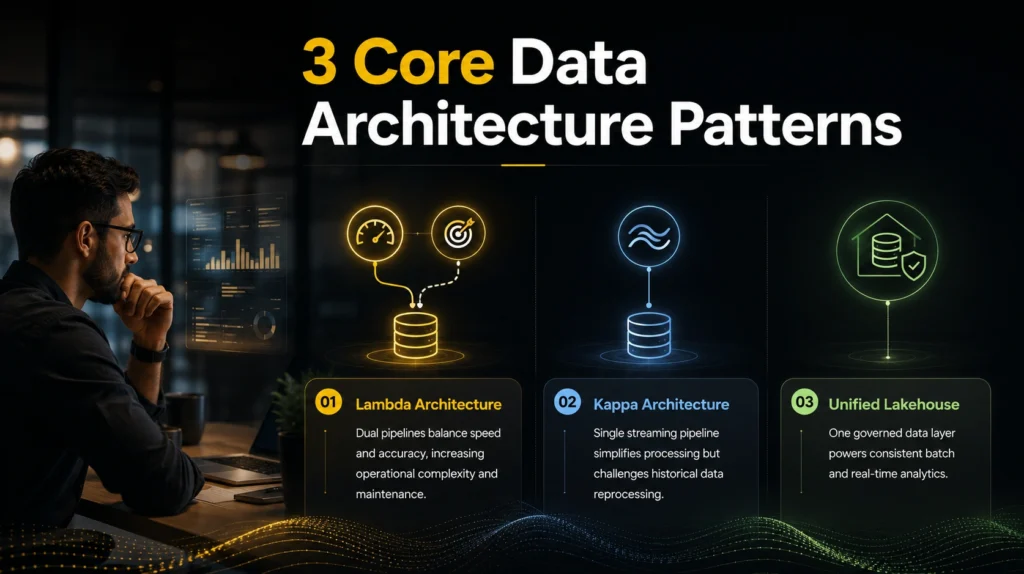
Most data engineering teams building at scale will pass through, or settle into, 1 of 3 architectural patterns. Understanding where each pattern breaks down is more useful than debating which is theoretically best.
Lambda Architecture: both layers, both problems
Lambda Architecture, proposed by Nathan Marz in 2011, was the first formal answer to the batch/streaming split. It runs a batch layer (for accuracy and full reprocessing) alongside a speed layer (for low-latency real-time results), with a serving layer that merges both outputs for queries. In theory, this delivers both correctness and speed. In practice, it requires maintaining 2 codebases that must produce consistent outputs: if the batch layer and the speed layer define a metric differently, the downstream consumer gets 2 different answers. The debugging and governance overhead this creates at scale is the single most common reason teams look to migrate off Lambda.
Kappa Architecture: streaming only, with trade-offs
Jay Kreps introduced Kappa Architecture in 2014 as a simplification: treat all data as a continuous stream, eliminate the batch layer entirely, and reprocess historical data through the same streaming pipeline when needed. This is elegant in principle and the right pattern for genuinely event-driven, low-latency use cases. The real-world limitation is that reprocessing months or years of historical data through a streaming system is slow, expensive, and operationally complex. Kappa works well for organisations that can genuinely commit to stream-first data management. It underperforms when heavy analytical workloads, complex historical aggregations, or cost-sensitive batch jobs are core to the business.
The unified lakehouse model: one data layer, both modes
The architectural model that has become dominant in 2026 is the lakehouse: cloud object storage as the foundation, an open table format (Apache Iceberg, Delta Lake, or Apache Hudi) providing ACID transactions and schema evolution, and a processing layer that can run both streaming ingestion and batch transformation over the same tables. Data lake architecture in 2026 increasingly means real-time ingestion into Iceberg-backed tables on S3, with federated catalogs for governance and a consumption layer that serves SQL, machine learning (ML), and business intelligence (BI) tools with consistent semantics. The key shift: streaming and batch are no longer separate systems that must agree. They write to the same table format, under the same schema governance, with the same lineage tracking.
What a unified data engineering pipeline actually looks like in 2026
A production-grade, unified data engineering pipeline in 2026 has 5 layers, each with a clear responsibility.
Ingestion layer: streaming and batch from day 1
Apache Kafka remains the de facto standard for real-time data streaming and event-driven ingestion. Change data capture (CDC) tools like Debezium sit alongside Kafka to bring database updates into the streaming layer without polling. Batch ingestion runs through the same downstream table formats, so there is no divergence in how the data lands. Confluent’s Tableflow and Stream Designer write directly to Iceberg with exactly-once guarantees, blurring the line between a streaming platform and a data lake at the ingestion stage.
Processing layer: Flink for real-time, Spark for unified workloads
The 2026 rule of thumb is clear: use Apache Flink for true real-time, stateful, event-driven architectures; use Apache Spark for unified batch-and-streaming workloads where ML integration matters. Apache Flink 2.2, released in December 2025, added native AI/ML inference in SQL and a disaggregated state backend, making it the strongest option for low-latency, stateful workloads. Databricks’ Real-Time Mode for Spark Declarative Pipelines now achieves end-to-end latencies as low as 5 milliseconds without requiring a separate Flink deployment, closing the gap for teams that want unified batch and near-real-time processing in a single engine.
Storage layer: open table formats as the convergence point
Apache Iceberg has become the table format most actively converging the batch and streaming worlds. Delta Lake UniForm and Iceberg v3 now support the “write once, read anywhere” principle: a Kafka stream can write to an Iceberg table with exactly-once semantics, and the same table can be queried by a dbt batch transformation job or a real-time data warehouse serving layer without format conversion. Snowflake, Databricks, and BigQuery have all committed to Iceberg interoperability, which means the table format is no longer a vendor lock-in decision.
Transformation layer: dbt across batch and streaming
A significant 2026 development is dbt meeting Apache Flink, enabling one transformation workflow for data engineers working across Snowflake, BigQuery, Databricks, and Confluent. This is operationally significant: it means the same transformation logic, the same tests, and the same lineage tracking can govern both a nightly batch model and a real-time streaming aggregation, eliminating the dual codebase problem that makes Lambda Architecture expensive to maintain.
Serving layer: one query interface, multiple modes
The serving layer in a unified architecture is a real-time data warehouse or lakehouse query engine that can serve sub-second queries over freshly ingested streaming data alongside complex analytical queries over historical batch data. Snowflake data engineering supports this through Snowpipe Streaming for real-time ingestion, Hybrid Tables for transactional workloads, and Dynamic Tables for incrementally refreshed materialised views. The goal is a single query surface that does not require the consumer to know or care whether the data came from a stream or a batch job.
The real cost of disconnected batch and streaming
The cost of a disconnected batch-and-streaming architecture is not just engineering complexity. It is a data trust problem.
When 2 systems produce the same metric with different answers (because the batch job ran a full recalculation while the streaming job applied an incremental update with different deduplication logic), the downstream consumer stops trusting both. Data teams spend disproportionate time investigating discrepancies between their real-time analytics platform and their historical reports. Product and finance teams learn to wait for the “real” number from the batch run, defeating the business case for the real-time investment.
86% of IT leaders now identify data streaming as a top strategic priority. But only 25% of organisations had reached advanced streaming maturity by 2025, up from just 8% in 2024. The gap between strategic priority and operational maturity is where the discrepancy problem lives. Organisations prioritising real-time without investing in the architectural foundation that makes batch and streaming consistent are the ones rebuilding their pipelines 18 months after launch.
Companies using real-time analytics report a 29% improvement in decision speed and a 21% reduction in operational costs. These gains come from a unified, trusted data layer that both real-time and batch consumers can rely on. They do not come from adding a Kafka cluster next to an existing batch warehouse and hoping the outputs stay aligned.
Where Snowflake data engineering fits in a unified architecture
Snowflake’s evolution from a cloud data warehouse to a real-time data engineering platform is one of the clearest signals of where the market is heading. Snowflake’s native batch-and-streaming unification through Snowpipe Streaming, Dynamic Tables, and Hybrid Tables means that for many enterprise workloads, you no longer need a separate streaming engine for near-real-time analytics. Data engineers can define a Dynamic Table and let Snowflake decide when to refresh based on the target latency, rather than writing and maintaining a separate streaming job.
The honest trade-off: Snowflake is not the right choice for sub-second, stateful event processing. A fraud detection system that needs to evaluate transaction risk in under 100 milliseconds, with state held across thousands of concurrent user sessions, needs Flink or a purpose-built CEP (complex event processing) engine. Snowflake’s sweet spot is near-real-time analytics, 30 seconds to a few minutes of latency, over high-volume, governed enterprise data. Understanding this boundary is what separates a data architecture that holds up in production from one that requires emergency redesigns after the first major traffic event.
The broader Snowflake data engineering story in 2026 is about platform consolidation. For organisations that already run their data warehouse on Snowflake, extending into near-real-time through Snowpipe and Dynamic Tables is a lower-risk, lower-cost path than introducing a separate streaming infrastructure for workloads that do not genuinely require sub-second latency. The architecture decision comes first: establish what latency each workload actually requires, then choose the tool that serves it.
What this means for how you design your data management systems
The practical implication for any data engineering team designing or redesigning their data management systems is this: design for both modes from the start, not from the moment the batch system fails to keep up.
The decisions that determine whether a unified pipeline is achievable are made in the first weeks of the design phase, not after 2 years of batch-first development. Specifically: table format choice (Iceberg or Delta Lake), catalog strategy (Apache Polaris, Unity Catalog, or Snowflake’s native catalog), whether transformations are written in a mode-agnostic framework like dbt, and whether the serving layer is designed to query incrementally refreshed tables rather than requiring a full snapshot refresh.
These decisions are not expensive to make correctly at the start. They are very expensive to retrofit once 2 separate pipelines exist, each with their own schema evolution history, their own data quality contracts, and their own monitoring stack.
Across the data engineering work we do at Spark Eighteen, the pattern that consistently separates a maintainable unified architecture from an expensive rebuild is isolation at the right layer. In the ClaritasRx engagement, a pharma patient data analytics platform running on AWS, the foundation was client-level data isolation built before any processing logic was written. AWS Glue for batch ETL and AWS Kinesis streams shared the same partitioned S3 structure, governed by a common schema registry, so the serving layer (a custom SaaS analytics platform) could query historical batch aggregations and real-time stream updates from the same interface without resolving conflicts. The architecture decision came before the feature set. That sequence is what made the platform scalable to new pharma clients without rebuilding the ingestion or transformation layers for each one.
The architecture decision that determines everything else
The organisations that will get the most value from their data engineering investment in the next 3 years are not the ones that adopt the most tools. They are the ones that make 1 correct architectural decision early: design the storage and governance layer to support both batch and streaming from the start, and let the processing mode be a workload-level decision rather than a platform-level constraint.
The real-time analytics platforms that hold up in production are not faster batch systems. They are architectures where real-time data processing and batch transformation share the same schema registry, the same lineage graph, and the same data quality contracts, so the number that appears in a live dashboard at 2 PM is the same number that appears in the board report on Friday morning.
That is not a technology problem. It is a design discipline problem. And it is one that gets harder, not easier, to solve after the first production system is already running.
If you are designing a data engineering architecture or evaluating whether your current pipeline can support the real-time analytics workloads your business now needs, reach out at coffee@sparkeighteen.com.