The healthcare software market reached $47.1 billion in 2024 and is projected to exceed $104 billion by 2030, according to Grand View Research. That growth is not being distributed evenly. Hospitals that invested in integrated hospital software systems earlier are compressing administrative cost, reducing documentation time, and running faster revenue cycles than those still managing disconnected point solutions. For engineering leaders and technical decision-makers working with healthcare software development companies, the choice of software is no longer primarily a procurement decision; it is an architectural one. The wrong foundation delays every capability built on top of it.
This guide covers the main types of healthcare software, who each type is built for, what modern systems need to include, and how to make the build vs buy vs configure decision without committing to a platform before you understand what the platform requires of your data and your workflows.
What are the main types of healthcare software?
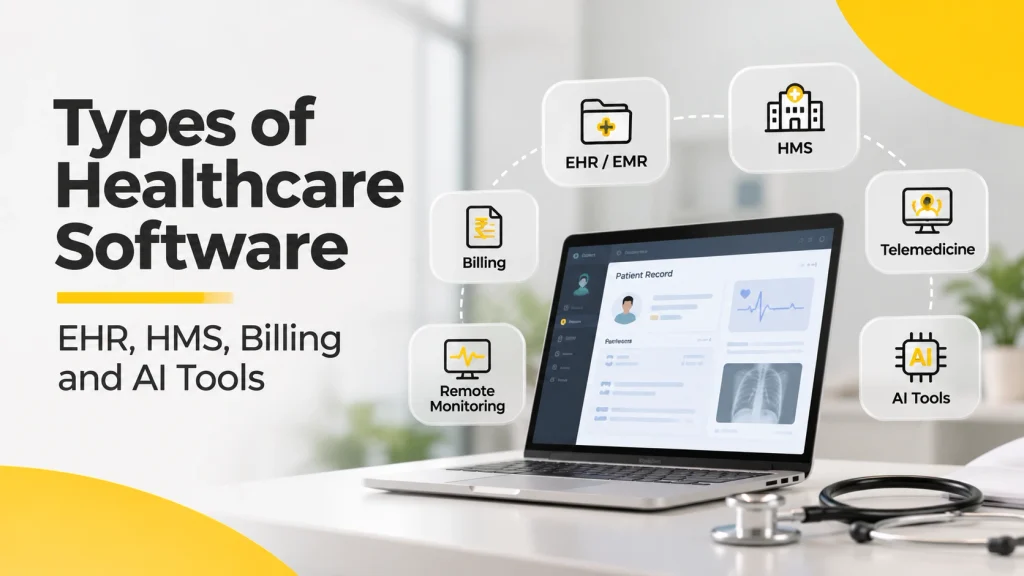
Healthcare software falls into four broad categories: clinical software (EHR, CDSS, medical imaging), administrative software (hospital management, billing, scheduling), patient-facing software (portals, telemedicine, remote monitoring), and AI software (ambient documentation, predictive analytics, clinical AI). Most enterprise deployments combine multiple types, connected through FHIR APIs and a shared data layer.
Key takeaways
- There is no single best healthcare software. The right system depends on care setting, user type, compliance jurisdiction, and whether the organisation needs to build custom workflows or can operate within a configured platform.
- EHR/EMR software is the foundation of clinical operations; every other type of healthcare software integrates with or depends on it.
- HMS platforms cover scheduling, billing, inventory, HR, and clinical workflow in a single system; smaller practices typically use lighter practice management software instead.
- Healthcare software development costs range from $80,000 for a basic telemedicine MVP to $2 million or more for a full hospital management system with custom integrations.
- HIPAA compliance (US), GDPR (EU/UK), and HL7/FHIR interoperability are non-negotiable requirements; they must be designed in, not retrofitted after build.
Healthcare software categories at a glance
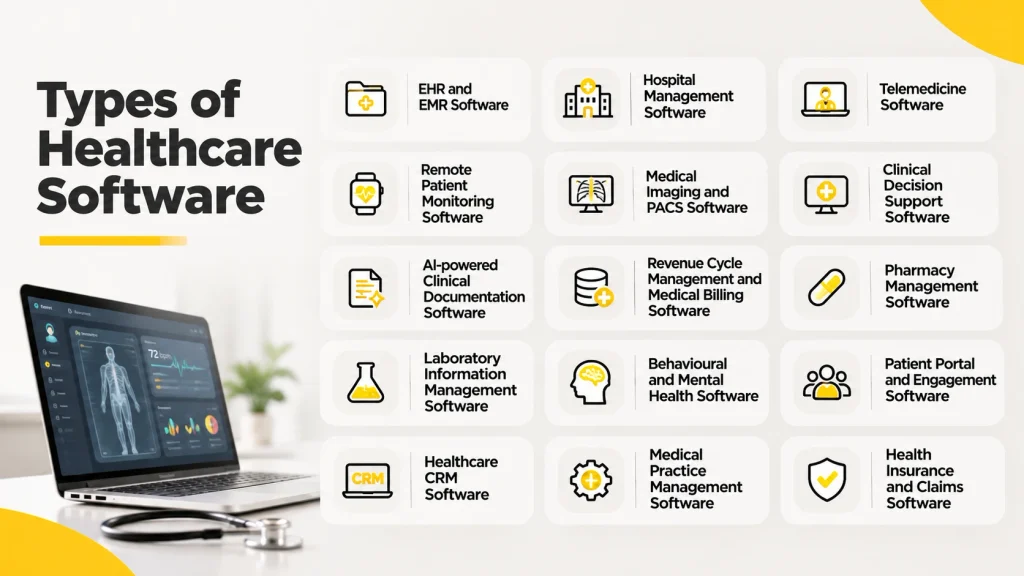
The table below maps the main types of healthcare software by user, function, and compliance obligation. Use it as a starting point before evaluating any specific platform.
| Category | Primary users | Core function | Key compliance |
| EHR/EMR | Clinicians, nurses, hospitals | Clinical documentation, patient records | HIPAA, HL7, FHIR |
| Hospital management software | Hospital administrators, operations teams | Scheduling, billing, inventory, HR | HIPAA, GDPR |
| Telemedicine | Doctors, patients | Virtual consultations, video care delivery | HIPAA, regional telehealth laws |
| Remote patient monitoring | Care teams, chronically ill patients | Continuous data collection outside clinical settings | HIPAA, FDA (device) |
| Medical billing software | Billing teams, revenue cycle teams | Claims, coding, payment posting | HIPAA, CMS guidelines |
| Clinical decision support | Clinicians, pharmacists | Real-time alerts, evidence-based recommendations | Clinical safety standards |
| Medical imaging and PACS | Radiologists, specialists | Image capture, storage, and diagnostic review | DICOM, HIPAA |
| Patient portal | Patients, care coordinators | Access to records, messaging, appointment booking | HIPAA, GDPR, patient privacy |
| Laboratory information system | Lab technicians, ordering physicians | Specimen tracking, result reporting | CAP, CLIA, HIPAA |
| Healthcare CRM | Outreach teams, administrators | Patient acquisition, retention, engagement | HIPAA, GDPR |
What is healthcare software?
Healthcare software is purpose-built software that manages clinical, administrative, or patient-facing workflows in a care delivery setting. The types of healthcare software in use today range from foundational record systems (EHR, LIMS) to AI-powered documentation and analytics tools. The defining characteristic that separates healthcare software from general enterprise software is its compliance obligation: systems that handle protected health information (PHI) must meet HIPAA in the United States, GDPR in the European Union and United Kingdom, and local health data regulations in most other jurisdictions.
Clinical healthcare software
Clinical software is used by clinicians to document, diagnose, and deliver care. EHR and EMR systems, clinical decision support tools, medical imaging platforms, and laboratory information systems all fall into this category. Clinical software is directly tied to patient safety, which means validation requirements, audit trails, and update processes are significantly more rigorous than in standard enterprise software.
Administrative healthcare software
Administrative software manages the operational layer of healthcare: scheduling, billing, workforce management, inventory, and compliance reporting. Hospital administration platforms and billing systems are the most common examples. This category generates the revenue that funds clinical operations, which means errors, delays, and poor system design have direct financial consequences.
Patient-facing healthcare software
Patient-facing software includes telemedicine platforms, patient portals, remote patient monitoring (RPM) apps, and health consumer apps. These systems sit at the boundary between the clinical environment and the patient’s daily life. The design bar is higher than for clinician-facing tools because patients have lower tolerance for friction, less familiarity with clinical terminology, and no obligation to return if the experience fails them.
Healthcare AI software
AI software in healthcare spans predictive analytics, ambient clinical documentation, medical image analysis, and large language model applications for clinical and administrative tasks. Unlike general-purpose AI, healthcare AI systems are subject to regulatory frameworks (FDA, CE marking, MHRA) that treat certain AI outputs as medical devices. Governance and human oversight are not optional features; they are regulatory requirements.
Types of healthcare software
Electronic health record (EHR) and EMR software
An EHR (electronic health record) system is the longitudinal digital record of a patient’s clinical history across providers and care settings. An EMR (electronic medical record) is the digital version of a paper chart within a single practice. The distinction matters for interoperability: EHRs are designed to share data across systems; EMRs typically are not.
EHR software is the most complex and most regulated category of healthcare software. KLAS Research and Black Book Market Research consistently find that EHR selection is the highest-stakes technology decision a health system makes, largely because migration costs and workflow disruption make switching prohibitive once embedded. Epic, Oracle Health (formerly Cerner), and athenahealth dominate the US market. Meditech and Altera Digital Health cover significant mid-market share.
For organisations building custom EHR-adjacent software, the key requirement is FHIR API compatibility: most health systems will require new tools to pull and push data to their existing EHR using standardised FHIR R4 endpoints.
Hospital management software
Hospital management software is an integrated platform that covers the full operational scope of a hospital: patient registration, appointment scheduling, clinical workflow, pharmacy, laboratory orders, billing, inventory, and HR. Unlike EHRs, which are primarily clinical record systems, the platform is designed to run the organisation.
Hospital software systems at the enterprise level typically include a patient administration module, an operational dashboard, and interfaces to the hospital’s EHR and financial systems. Hospital management system software for large tertiary care centres is often modular, allowing departments to configure workflows independently while sharing a common data layer. The hospital patient management system component specifically handles patient flow from admission to discharge, which directly affects bed utilisation and length-of-stay metrics.
HMS implementations for 500-bed or larger facilities routinely take 18 to 36 months. The hospital patient management system module, which governs ADT workflows, is typically the first to go live because every downstream system (radiology, pharmacy, laboratory) keys off ADT events. Smaller hospitals and clinics use lighter practice management systems that cover scheduling, billing, and basic clinical documentation without the full operational scope.
Spark Eighteen built and scaled Glide Health, a revenue cycle management platform for enterprise hospital systems, subsequently acquired by McKesson, a Fortune 10 healthcare company. The platform was built on a microservices architecture with a rigorous TDD process to meet enterprise compliance and throughput requirements at scale.
Telemedicine and virtual care software
Telemedicine software enables clinical consultations to happen remotely via video, audio, or asynchronous messaging. The category expanded rapidly during 2020 and has since stabilised at a level roughly 38 times higher than pre-pandemic telehealth visit volumes, according to McKinsey’s 2024 healthcare report.
Telemedicine platforms consist of three core components: a video conferencing layer (typically WebRTC-based), a clinical documentation interface connected to the EHR, and a scheduling and consent management system. HIPAA-compliant video infrastructure is a baseline requirement; standard Zoom or Google Meet cannot be used without a signed Business Associate Agreement.
The clinical scope of telemedicine software varies significantly: some platforms support synchronous video only, others add asynchronous messaging, remote prescribing, and integration with remote monitoring devices.
Remote patient monitoring software
Remote patient monitoring (RPM) software collects physiological data from patients outside clinical settings (home, workplace, or care facility) and transmits it to a care team for review. Common data streams include blood glucose, blood pressure, heart rate, oxygen saturation, and ECG.
RPM software has two components: a patient-facing app or device interface, and a clinical dashboard where care teams review data and trigger alerts. The FDA classifies certain RPM devices as medical devices, which introduces a regulatory pathway (510(k) clearance or De Novo) for the software used to collect and interpret data.
Continuous glucose monitors, cardiac rhythm monitoring patches, and connected blood pressure cuffs are the highest-volume RPM applications in production. Chronic disease management (diabetes, heart failure, COPD) represents the primary use case.
Medical imaging and PACS software
Medical imaging software captures, processes, stores, and retrieves diagnostic images: X-rays, MRI, CT scans, ultrasound, and pathology slides. Picture Archiving and Communication System (PACS) is the storage and retrieval layer; diagnostic workstations and AI-powered reading tools sit on top of it.
Images are transmitted in DICOM (Digital Imaging and Communications in Medicine) format, the universal standard for medical imaging data. Any imaging software must support DICOM storage, retrieval, and viewer functionality to integrate with radiology workflows.
Cloud PACS has largely replaced on-premise installations in new deployments, driven by storage costs and the requirement to distribute images to remote radiologists and specialists.
Clinical decision support software
Clinical decision support (CDS) software delivers evidence-based guidance to clinicians at the point of care, integrated directly into the EHR workflow. Alerts for drug-drug interactions, dosing recommendations for renal-impaired patients, and sepsis early warning scores are examples of CDS in production.
Alert fatigue is the central UX problem in CDS: studies consistently show that clinicians override 90% or more of CDS alerts, most of which are non-actionable. Effective CDS design prioritises specificity and timing; a correctly timed, high-specificity alert is acted on significantly more often than a generic one.
Modern CDS systems use machine learning models trained on clinical outcome data to improve alert precision. Integration with the EHR is mandatory; standalone CDS tools that require a separate login or data entry step are rarely adopted.
AI-powered clinical and ambient documentation software
AI documentation software uses speech recognition and large language models to capture clinical encounters in real time and generate structured clinical notes automatically. Nuance DAX, Abridge, and Suki are the most widely deployed platforms in the US market.
The documentation burden on clinicians is significant: the American Medical Association’s 2025 physician survey found that documentation accounts for 45% of the total time physicians spend on electronic health record use. Ambient documentation software that routes speech to structured note reduces this directly.
The output of AI documentation software is reviewed by the clinician before sign-off; the software does not autonomously create a final clinical record. This human review requirement is both a regulatory expectation and a clinical safety control.
Revenue cycle management and medical billing software
Revenue cycle management (RCM) software manages the financial lifecycle of a patient encounter from pre-authorisation through claim submission, denial management, and payment posting. Healthcare billing software is the subset of RCM focused specifically on claim generation and submission; full RCM platforms cover eligibility verification, coding, billing, and analytics.
Medical billing software encodes diagnoses and procedures using ICD-10 and CPT codes, submits claims to payers (insurance companies), tracks claim status, manages denials, and processes patient payments. Denial rates above 5% typically indicate a coding or eligibility problem that the billing software should surface before submission.
The complexity of US medical billing is significant: claims can be denied for hundreds of distinct reasons, payer rules differ by contract, and the time window for appeals is narrow. Healthcare billing software that integrates with the EHR to pull coded diagnoses directly reduces coding errors at the source. Our breakdown of how business intelligence in healthcare creates a three-layer analytics framework covers how revenue cycle data feeds into operational performance reporting.
Pharmacy management software
Pharmacy management software manages prescription processing, drug inventory, dispensing workflows, and drug interaction checks. Hospital pharmacy systems integrate with the EHR to receive electronic medication orders and close the loop on medication administration.
Bar-code medication administration (BCMA) is the standard for inpatient pharmacy safety: nurses scan a patient wristband and the medication barcode before administration to verify the right drug, right dose, right patient, and right time. Pharmacy software must integrate with BCMA workflows.
Retail and outpatient pharmacy systems prioritise prescription queue management, insurance adjudication, and patient communication over the clinical integration requirements of inpatient pharmacy.
Laboratory information management software
Laboratory information management system (LIMS) software tracks specimens from collection through analysis and result reporting. Functions include specimen accessioning, test ordering, result entry, quality control, and result delivery to the ordering provider.
LIMS must integrate with the EHR to receive orders and return results using HL7 messaging or FHIR APIs. CAP (College of American Pathologists) accreditation requires documented quality management processes; the LIMS is the system of record for this documentation.
Molecular diagnostics and genomics labs have additional requirements: sample chain of custody, result interpretation support, and in some cases FDA oversight of the test itself.
Behavioural and mental health software
Mental health software covers electronic records and scheduling systems designed for psychiatric and therapy practices. The key distinction from general EHR software is the sensitivity of the data: mental health records carry additional legal protections in most jurisdictions beyond standard HIPAA PHI.
Functional requirements include progress note templates designed for therapy and psychiatry, consent management for sensitive diagnoses, medication management for psychiatric medications, and teletherapy integration.
Patient portal and patient engagement software
A patient portal is a secure online interface that gives patients access to their health records, lab results, appointment scheduling, prescription refill requests, and secure messaging with their care team. Patient portals are a regulatory requirement under the 21st Century Cures Act in the US; providers on Medicare and Medicaid programmes must make clinical data accessible via patient-controlled API access.
Patient engagement software extends the portal to include proactive outreach: appointment reminders, care gap notifications, post-discharge follow-up, and chronic disease management programmes. Engagement platforms have become a significant driver of preventive care utilisation and patient retention.
Healthcare CRM software
Healthcare CRM software manages patient acquisition, relationship management, and outreach. Unlike general CRM platforms, healthcare CRM must be HIPAA-compliant and built around care journey management rather than sales pipeline management.
Functions include referral management, campaign management for preventive care outreach, patient satisfaction tracking, and net promoter score (NPS) measurement. Healthcare CRM is more common in outpatient and ambulatory settings than in inpatient, where patient contact is managed through the EHR and patient portal.
Medical practice management software
Practice management software (PMS) handles the administrative operations of a medical practice: appointment scheduling, patient registration, billing, and reporting. Unlike enterprise hospital platforms, PMS is designed for smaller care settings (physician offices, specialty clinics, group practices) where operational complexity is lower.
PMS typically integrates with an EHR but does not replace it; the EHR handles clinical documentation while the PMS handles scheduling and billing. Many EHR vendors bundle a PMS, which simplifies integration but reduces flexibility.
Health insurance and claims software
Insurance software on the payer side manages member enrolment, plan administration, claims adjudication, provider network management, and regulatory reporting. Prior authorisation software automates the approval process for procedures and medications that require insurer sign-off before service delivery.
For healthcare organisations building on the provider side, insurance software is primarily relevant as an integration point: every healthcare billing software system must submit claims to and receive responses from payer systems using EDI 837/835 transaction formats.
Healthcare software by user type
Software for hospitals
Hospitals require the full stack: EHR, a hospital management system, laboratory, pharmacy, radiology, and billing systems, all connected through a shared integration layer. The core operational system (HMS) manages patient flow, bed management, and operational reporting. Hospital software systems in tertiary care settings typically include 15 to 30 integrated applications.
The hospital patient management system governs admission, discharge, and transfer (ADT) workflows, which are foundational to clinical communication: every downstream system (pharmacy, lab, imaging) keys off the ADT event stream.
Software for clinics
Clinics prioritise EHR and practice management software over the full operational scope of hospital management system software. Smaller care settings that do grow into multi-site operations sometimes adopt a lighter version of hospital management system software to manage scheduling, billing, and clinical operations across locations. Scheduling, billing, and clinical documentation are the core functional requirements. Integration with external lab and imaging providers replaces the in-house systems that hospitals maintain.
Software for doctors
Physicians interact primarily with the EHR, clinical decision support, mobile documentation apps, and telemedicine interfaces. The usability of the EHR directly affects the time a doctor spends on documentation vs patient care; poorly designed EHR interfaces are a primary driver of physician burnout in survey data from the AMA and MGMA.
Software for patients
Patients access care through patient portals, telemedicine apps, RPM devices, and health consumer apps. Engagement software that surfaces the right action at the right time (scheduling a follow-up, reviewing a result, completing a health questionnaire) reduces care gaps and improves outcomes.
Software for pharmacies
Pharmacy systems manage prescription queuing, drug interaction screening, dispensing, and insurance adjudication. Integration with the prescribing EHR is the primary technical requirement; electronic prescribing (e-prescribing) standards govern the format of that connection.
Software for laboratories
Laboratories use LIMS software for specimen management, result reporting, and quality control. Integration with ordering EHRs via HL7 interfaces is mandatory for clinical labs; genomics and research labs have additional requirements for data management at the sample and variant level.
Software for health insurance companies
Insurers run separate software stacks for member management, claims adjudication, provider network management, and analytics. Prior authorisation automation is the highest-priority software investment in the US insurance market, driven by regulatory pressure (CMS Prior Authorization Rule) and provider relations.
Essential features of modern healthcare software
The features below apply across hospital software systems, clinic platforms, and patient-facing tools, though their configuration and priority differ by care setting.
Patient data management
Patient data management covers the creation, storage, retrieval, and update of clinical and administrative records. A hospital patient management system relies on a well-designed patient data layer with a Master Patient Index (MPI) to match records across systems and prevent duplicate patients. The hospital database management system underlies this: a hospital database management system must handle high read-write concurrency, enforce role-based access at the field level, and maintain a complete audit trail of every data access and modification.
Scheduling and workflow management
Scheduling in healthcare is significantly more complex than in general enterprise software: it must account for provider availability, resource availability (rooms, equipment), patient priority, and appointment type. Automated appointment reminders have been shown to reduce no-show rates by 20 to 38% in published studies; most modern scheduling systems include multi-channel reminder functionality. In a hospital patient management system, scheduling integrates with bed management, so that booked admissions trigger bed assignment workflows automatically.
Clinical documentation
Clinical documentation functions include structured note templates, voice dictation, problem lists, medication lists, allergy tracking, and order management. The goal is to reduce the time clinicians spend on data entry while ensuring that documentation meets the specificity required for coding and billing. AI-assisted documentation is the fastest-growing function in this category.
Billing and payments
Billing functions include eligibility verification, charge capture, claim generation, submission, denial tracking, and payment posting. Healthcare billing software must handle payer-specific rules, which change frequently and vary by contract. Integration with the EHR for direct charge capture eliminates a common source of revenue leakage. Medical billing software that provides real-time claim scrubbing (checking for errors before submission) reduces denial rates measurably.
Analytics and reporting
Analytics in healthcare software range from operational dashboards (bed occupancy, appointment wait times, claim denial rates) to clinical quality reporting (readmission rates, clinical outcome metrics submitted to CMS). The distinction between reporting and analytics matters: reporting surfaces historical data; analytics surfaces patterns and supports prediction. Our guide on business intelligence in healthcare: the three-layer framework covers how the data, reporting, and intelligence layers should be structured for a hospital or health system.
AI and automation
Modern healthcare software integrates AI for documentation assistance, risk stratification, scheduling optimisation, and billing automation. The integration pattern matters: AI that works within existing clinical workflows achieves significantly higher adoption than AI that requires a workflow change to use. Automation in billing and prior authorisation is delivering measurable reductions in administrative cost for organisations that have moved beyond point solution automation to full workflow integration.
Healthcare software interoperability and integration
Interoperability is not a feature; it is a design property. Hospital software systems that cannot exchange data with the broader health ecosystem force manual workarounds that consume clinical time and create data quality problems.
FHIR
FHIR (Fast Healthcare Interoperability Resources) is the current standard for healthcare data exchange APIs. FHIR R4 is the version required by the ONC’s 21st Century Cures Act final rule. Any healthcare software that needs to exchange data with US health systems must support FHIR R4. FHIR represents clinical data as resources (Patient, Observation, Medication, Encounter) accessible via RESTful APIs, which makes integration significantly simpler than HL7 v2 interfaces.
HL7
HL7 v2 is the legacy messaging standard for clinical data exchange. It is still the most widely deployed integration standard in production healthcare environments despite FHIR’s adoption curve. HL7 v2 messages (ADT, ORU, ORM) are pipe-delimited text messages that trigger events between systems: an ADT message fires when a patient is admitted, transferred, or discharged; an ORU message carries lab results back to the ordering system.
DICOM
DICOM (Digital Imaging and Communications in Medicine) is the universal standard for medical imaging data. Any software that handles medical images must support DICOM for storage, retrieval, and viewer functionality. DICOM stores both the image and the metadata (patient ID, study date, modality, body part) as a single file.
EHR integration
EHR integration is the most common and often most complex integration requirement for healthcare software developers. Epic and Oracle Health both publish developer APIs; Epic’s App Orchard and Oracle’s App Marketplace are the official channels for certified integration. Most EHR integrations use a combination of FHIR APIs for data exchange and webhooks or subscription resources for event-based notifications.
API-based healthcare integration
Modern healthcare software architecture uses API-first integration to connect systems rather than point-to-point HL7 interfaces. An integration engine (Mirth Connect, Azure API for FHIR, AWS HealthLake) sits between systems, translating messages, routing data, and providing a single integration point rather than a mesh of bilateral connections.
Healthcare data exchange
Health information exchanges (HIEs) and record localisation networks allow providers to query and retrieve records from outside their own organisation. Carequality and CommonWell are the two major record-sharing networks in the US; participation enables providers to access records from any network participant.
Healthcare software security and compliance
HIPAA
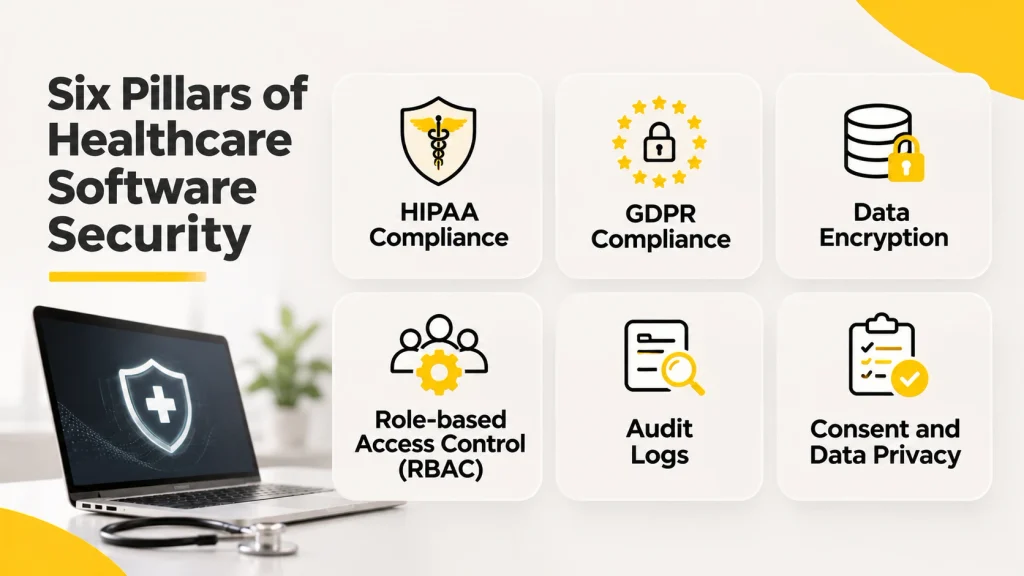
HIPAA (Health Insurance Portability and Accountability Act) requires covered entities and their business associates to protect PHI through administrative, physical, and technical safeguards. For software, the Technical Safeguard requirements translate to: encryption of PHI at rest and in transit, access controls with authentication, audit logging, and automatic session timeout. A Business Associate Agreement (BAA) must be in place with every vendor that has access to PHI.
GDPR
GDPR applies to health data involving EU and UK patients. Health data is a special category of personal data under GDPR, which means processing requires explicit consent or a specific legal basis beyond standard data processing. For healthcare software serving European markets, data residency (where PHI is stored) and data subject rights (the right to access, correct, and erase personal data) must be addressed at the architecture level.
Data encryption
Healthcare software must encrypt PHI at rest (AES-256) and in transit (TLS 1.2 or higher). Encryption key management must be documented and audited. For cloud deployments, encryption must be verified at the object storage level, database level, and application level; relying solely on platform-level encryption from the cloud provider is insufficient for HIPAA compliance without a signed BAA with the cloud provider.
Role-based access control
Role-based access control (RBAC) limits access to PHI based on the user’s clinical role. A nurse has different data access rights than a radiologist, a billing clerk, or a system administrator. RBAC must be configured at the field level, not just the record level, for sensitive data categories. Break-glass access (emergency override with mandatory logging) must be supported for clinicians needing urgent access outside their normal role scope.
Audit logs
Audit logs record every access, creation, modification, and deletion of PHI. The hospital database management system must retain audit logs for at least 6 years from creation or last use (HIPAA requirement). Logs must be tamper-evident, stored separately from application data, and accessible for compliance review and incident response. Real-time log monitoring with anomaly detection is a security best practice and an increasingly common requirement in enterprise healthcare contracts.
Consent and data privacy
Consent management tracks patient authorisation for data use, sharing, and research participation. For patient portal and engagement software, consent must be granular: patients may authorise sharing with a specialist but not with a research registry. Consent records must be version-controlled and linked to the actions they authorise.
AI in healthcare software
AI clinical decision support
AI-based clinical decision support uses machine learning models trained on clinical data to generate real-time alerts, risk scores, and recommendations at the point of care. Early warning scores for sepsis and deterioration, drug interaction alerts, and diagnostic suggestion tools are in production across major health systems. The performance of AI clinical decision support is highly context-dependent: a sepsis model trained on ICU data from one health system may not generalise to a different patient population without revalidation.
AI medical imaging
AI medical imaging tools assist radiologists with detection, measurement, and triage. The FDA has cleared more than 700 AI-enabled medical devices, with radiology tools representing the largest category. AI-assisted mammography, chest X-ray analysis, and CT pulmonary embolism detection are among the most widely adopted applications. The standard deployment model is AI as a second reader: the AI flags findings; the radiologist makes the final determination.
AI documentation
AI documentation software reduces clinician time on note creation using speech recognition and LLM-based note synthesis. The technology has improved significantly since 2023; modern ambient documentation tools achieve word error rates below 2% in clinical settings and produce note drafts that require minor editing rather than significant rewriting. Time savings of 2 to 3 hours per clinician per day have been reported in published evaluations.
Predictive analytics
Predictive analytics in healthcare uses historical patient data to forecast future events: readmissions, no-shows, sepsis onset, length of stay, and patient deterioration. The business case for predictive analytics is strongest where the predicted event is costly and the intervention is actionable: reducing readmissions by 1 percentage point on a 500-bed hospital’s discharge volume translates to measurable penalty avoidance under CMS value-based purchasing. Predictive models must be monitored for drift as patient population characteristics change.
Generative AI in healthcare
Generative AI is entering healthcare through documentation, patient communication, coding assistance, and administrative automation. Prior authorisation letter generation, patient education content creation, and clinical summary generation are the highest-adoption use cases to date. Generative AI in healthcare requires guardrails: hallucinated clinical content in a patient communication or a clinical note is not an acceptable error mode. Retrieval-augmented generation (RAG), grounding generated output in retrieved clinical evidence, is the standard pattern for reducing hallucination risk in high-stakes applications.
AI governance and human oversight
AI governance in healthcare software is a regulatory requirement, not an optional best practice. FDA guidance on AI/ML-based Software as a Medical Device (SaMD) requires predetermined change control plans, performance monitoring, and human oversight protocols. For AI tools used in clinical decision-making, the governance framework must specify who reviews model performance, at what frequency, and what triggers a model update or deactivation.
Healthcare software architecture
Cloud-based healthcare software
Cloud deployment has become the default for new healthcare software, including hospital software systems that previously ran on on-premise infrastructure. AWS, Azure, and GCP all offer HIPAA-eligible service sets; each requires a signed BAA to be used for workloads involving PHI. Cloud-native architectures enable horizontal scaling to handle variable clinical workloads (morning admission peaks, end-of-quarter billing surges) without overprovisioning on-premise infrastructure. Spark Eighteen builds healthcare software on AWS using client-level database isolation, a pattern that ensures data from one care organisation is never co-mingled with another at the infrastructure level, a design principle that was central to the ClaritasRx pharma analytics platform.
API-first architecture
API-first architecture means every component of the healthcare software exposes its functionality through documented APIs rather than direct database access or tightly coupled service calls. This approach makes integrations predictable, testable, and replaceable. FHIR-native APIs are the standard for clinical data; RESTful JSON APIs are standard for administrative data.
FHIR-first architecture
FHIR-first architecture structures the internal data model around FHIR resources from the beginning, not as a translation layer on top of a proprietary schema. This significantly reduces the integration effort when connecting to EHRs, payers, and health information exchanges, all of which increasingly expect FHIR as the exchange format. Organisations that adopt FHIR as a transport layer rather than a data model still carry significant translation overhead; designing the hospital database management system around FHIR resources from the beginning eliminates this.
Microservices
Microservices architecture decomposes a complex healthcare software system into independently deployable services, each owning a bounded domain (scheduling, billing, pharmacy, lab). The benefits for healthcare are significant: services can be scaled independently (the billing service scales for month-end claim submissions without scaling the scheduling service), and failures in one service do not cascade to others. The tradeoff is operational complexity: microservices require service discovery, distributed tracing, and careful management of inter-service communication. The Glide Health RCM platform at McKesson was built on a microservices architecture precisely to handle the throughput and isolation requirements of enterprise claims processing at scale.
Data and analytics layer
A purpose-built data and analytics layer, separate from the operational database, is a prerequisite for meaningful healthcare analytics. The operational hospital database management system is optimised for transactional read-write operations; analytical queries over multi-year patient datasets require a separate columnar store or data warehouse. The data architecture must handle both structured (EHR records, billing transactions) and unstructured (clinical notes, imaging reports) data, with pipelines to normalise and enrich the former and NLP to extract structure from the latter.
AI integration layer
AI models are integrated into healthcare software through a dedicated inference layer: a model registry, an API gateway for model serving, and a monitoring layer for performance tracking. The integration pattern matters for adoption: AI that surfaces outputs inside the existing clinical workflow (an alert in the EHR, a suggestion in the billing queue) achieves measurably higher adoption than AI delivered through a separate interface.
How much does healthcare software cost to build?
Healthcare software development cost depends on complexity, regulatory requirements, integration scope, and team composition. The ranges below represent market-rate custom development with full HIPAA compliance and EHR integration, not off-the-shelf configuration.
| Software type | Development cost range | Timeline |
| Telemedicine MVP | $80,000 to $200,000 | 3 to 6 months |
| Patient portal | $100,000 to $300,000 | 4 to 8 months |
| Remote patient monitoring | $150,000 to $400,000 | 5 to 9 months |
| Medical billing software | $200,000 to $600,000 | 6 to 12 months |
| EHR/EMR system | $400,000 to $1.5 million | 12 to 24 months |
| Hospital management software | $500,000 to $2 million+ | 18 to 36 months |
| AI healthcare application | $200,000 to $1 million+ | 9 to 18 months |
EHR/EMR development cost
Custom EHR development is the most expensive and highest-risk category of healthcare software development. Most organisations building custom EHR-adjacent software are building speciality-specific extensions (oncology, behavioural health, long-term care) rather than replacing a full EHR. The cost range of $400,000 to $1.5 million covers a specialty EHR with core documentation, order management, and a single EHR integration; a general-purpose EHR replacement would cost significantly more.
Telemedicine development cost
A HIPAA-compliant telemedicine platform with video (WebRTC), scheduling, consent management, and EHR integration costs $80,000 to $200,000 for an MVP. The cost drivers are video infrastructure (self-hosted vs Twilio vs Daily.co), EHR integration complexity, and the number of concurrent sessions the platform must support. Multi-tenant architecture adds 30 to 50% to the baseline cost.
RPM development cost
Remote patient monitoring software development costs $150,000 to $400,000 for a device-connected platform with a patient app, clinical dashboard, and alert management. The cost varies significantly by the number of device types supported and whether FDA regulatory submission is required for the software component.
Hospital management software cost
Custom hospital system development ranges from $500,000 to over $2 million for a full implementation, depending on the number of modules, the complexity of existing system integrations, and the size of the target organisation. Most enterprise hospital deployments at tertiary care centres use a configured vendor platform (Epic, Oracle Health, Meditech) rather than custom build; custom development is more common for specific modules or workflow extensions.
AI healthcare software cost
Healthcare software development for AI-powered applications covers a wide range: a billing automation module using classification models costs significantly less than a diagnostic AI system requiring FDA clearance. The regulatory pathway is the primary cost driver for clinical AI; a 510(k) submission process adds $200,000 to $500,000 in validation and regulatory preparation costs before the product reaches the market.
Factors that affect development cost
Compliance and regulatory requirements add 20 to 40% to baseline healthcare software development costs compared to equivalent non-regulated software. The main factors are HIPAA-compliant infrastructure, BAA management, security audit preparation, and documentation requirements. Integration complexity is the second-largest variable: each EHR integration adds 4 to 12 weeks of development time, depending on the API quality and the EHR’s integration support process. Team location and composition affect rates but not necessarily total cost; a smaller team of senior engineers consistently delivers better outcomes in healthcare software development than a larger team of generalist developers unfamiliar with clinical workflow and compliance requirements.
How long does healthcare software take to develop?
| Software type | Discovery | Design | Development | Integration | Testing and compliance | Deployment | Total |
| Telemedicine MVP | 2–3 weeks | 3–4 weeks | 10–16 weeks | 4–6 weeks | 4–6 weeks | 2 weeks | 3–6 months |
| Patient portal | 3–4 weeks | 4–6 weeks | 12–20 weeks | 4–8 weeks | 6–8 weeks | 2–4 weeks | 4–8 months |
| Medical billing software | 3–4 weeks | 4–6 weeks | 14–24 weeks | 6–10 weeks | 8–10 weeks | 4 weeks | 6–12 months |
| EHR/EMR | 4–8 weeks | 8–12 weeks | 24–52 weeks | 10–20 weeks | 12–20 weeks | 6–8 weeks | 12–24 months |
| Hospital management software | 6–12 weeks | 10–16 weeks | 36–72 weeks | 16–28 weeks | 16–24 weeks | 8–12 weeks | 18–36 months |
Discovery
Discovery in healthcare software development covers requirements gathering, clinical workflow mapping, compliance assessment, and integration planning. A common mistake is rushing through discovery to get to build; requirements errors discovered in development cost 5 to 10 times more to fix than those identified in discovery. For any system involving clinical workflow, at least one clinician must be involved in the discovery process.
Design
Design covers both UX and system architecture. Clinical UX is a specialist discipline: interface decisions that seem intuitive to general users can create serious safety risks in clinical settings. System architecture decisions made in design lock in compliance posture, integration capability, and scalability; they are expensive to reverse after development begins.
Development
Development of healthcare software proceeds in sprints with working software reviewed at the end of each iteration. The development phase must include security testing (OWASP, penetration testing), not as a gate before deployment but as an ongoing practice embedded in the sprint cycle.
Integration
Integration with EHRs, billing systems, and lab platforms is typically the highest-risk phase in healthcare software development. EHR APIs differ by version and by health system configuration; integration testing must be done against the specific EHR instance the customer uses, not against a generic sandbox. Building integration test environments and maintaining them as the EHR vendor updates APIs is an ongoing operational cost.
Testing and compliance
Testing for healthcare software includes functional testing, performance testing, security testing, and compliance validation. HIPAA risk assessments, penetration testing, and access control audits are compliance deliverables, not optional QA activities. Regulated AI software (SaMD) requires additional validation: intended use documentation, performance benchmarks on representative datasets, and a bias evaluation.
Deployment
Deployment of healthcare software to production environments requires change management procedures, rollback plans, and downtime notification for clinical users. Healthcare organisations have clinical workflows that cannot be interrupted; unplanned downtime in a patient management system during admissions hours is a patient safety event, not just an operational inconvenience.
Build vs buy vs configure healthcare software
Most healthcare software decisions are not binary; they sit on a spectrum from pure configuration of a vendor platform to fully custom build with no vendor dependency.
| Decision | When it fits | Risk | Cost profile |
| Buy (SaaS) | Standard workflows, fast time-to-value, no proprietary clinical process | Vendor lock-in, limited customisation | Recurring subscription, lower upfront |
| Configure | Existing platform supports workflow with configuration; vendor API allows extension | Still platform-dependent, configuration ceiling | Licence fee plus implementation |
| Build custom | Proprietary workflow, competitive differentiation, existing platform cannot meet requirements | Higher upfront cost, longer timeline, ongoing maintenance | Higher upfront, full ownership |
When to buy
Buy (SaaS) when the workflow is standard and the organisation does not need differentiation at the software layer. Practice management, scheduling, and patient communication tools are categories where configuring an existing platform is almost always faster and cheaper than building. Healthcare billing software from established vendors covers 90% of claim scenarios out of the box; custom build is only justified for payer-specific edge cases or proprietary billing workflows.
When to configure
Configure when a vendor platform supports the core workflow but needs workflow-specific extensions via API or a low-code configuration layer. Most large health systems configure Epic or Oracle Health rather than replacing them; the configuration layer is extensive. Billing platforms from major vendors support significant configuration without code changes; healthcare software development is required only for integration to proprietary financial systems.
When to build custom software
Build custom when the workflow is proprietary, the data model cannot map to a vendor’s schema, or the competitive differentiation is in the software itself. Healthcare software development companies are the right partner for this scenario; the risk of building custom healthcare software with a general-purpose development team unfamiliar with HIPAA, HL7, and FHIR is significant. Clinical-grade software requires engineering decisions at every layer of the stack that a team without domain experience will routinely get wrong, not because of incompetence but because the failure modes are not obvious unless you have shipped healthcare software before.
How to choose the right healthcare software
Define the healthcare workflow
For any of the types of healthcare software covered in this guide, start with the clinical or administrative workflow the software must support, not with the software category. A workflow definition should specify the actors (who does what), the data objects involved (patient, encounter, claim), the decision points, and the system handoffs. Software evaluation against a defined workflow produces decisions that hold; software evaluation against a feature checklist produces decisions that unravel after go-live.
Evaluate interoperability
Any healthcare software system that cannot interoperate with the organisation’s EHR via FHIR or HL7 creates a manual data transfer burden that clinicians and administrators will circumvent or ignore. Interoperability capability must be evaluated against the specific EHR version and configuration in use, not against the vendor’s published API documentation.
Check security and compliance
HIPAA compliance and a signed BAA are baseline requirements. Beyond HIPAA, evaluate the vendor’s SOC 2 Type II report, penetration testing frequency, incident response history, and data residency options. For AI-enabled software, ask specifically whether the vendor uses PHI to train models and whether patient consent is obtained.
Evaluate scalability
Scalability in healthcare software means two things: handling peak clinical volumes (morning admissions, flu season surges) without performance degradation, and supporting organisational growth (adding sites, users, patient volume) without re-implementation. For hospitals, this translates directly to whether the hospital management system software can add new departments, beds, and user roles without a re-implementation project. Ask vendors for documented peak load performance data, not theoretical capacity.
Assess AI readiness
AI readiness in a healthcare software platform means: does the platform expose data in a format AI models can consume, does the AI integration layer support model updates without downtime, and does the governance framework meet the requirements of the intended AI use case. Regulatory-grade AI (diagnostic AI, clinical decision support) requires platform capabilities that consumer-grade AI tools do not provide.
Calculate total cost of ownership
The purchase price or subscription cost of healthcare software is typically 20 to 40% of its total cost of ownership over a five-year period. Implementation cost, integration development, training, ongoing support, and the cost of workflow disruption during transitions account for the remainder. Total cost of ownership analysis must include all of these; organisations that optimise on licence cost and underestimate implementation cost consistently report higher-than-expected total spend. This is one of the most common lessons healthcare software development companies share with organisations evaluating build vs buy for the first time.
Conclusion
Healthcare software is not a category to evaluate by features; it is an infrastructure decision with clinical, financial, and regulatory consequences that compound over years. The types of healthcare software described in this guide (from EHR and HMS to billing platforms, telemedicine, and AI-enabled clinical tools) each carry distinct integration requirements, compliance obligations, and architecture patterns. Getting the category choice right is the prerequisite for everything that follows.
For hospital and clinic leaders, the decision framework is straightforward in principle but requires discipline in practice: start with the workflow, not the software; evaluate interoperability against your specific EHR version, not published API documentation; and apply a total cost of ownership model that includes implementation, integration, and transition costs alongside licence or development spend.
The hospital management system and EHR choices carry the most downstream consequences; changes to these platforms ripple through every integrated system and every clinical workflow. Treat them as architectural decisions, not procurement decisions.
For organisations building custom healthcare software, choosing among healthcare software development companies based on clinical domain expertise and a production track record in regulated environments is the decision that most directly predicts whether the project delivers value or becomes a costly rebuild.
Build healthcare software that works in production
Spark Eighteen has built healthcare platforms across RCM, patient data analytics, and clinical workflows. Our work includes Glide Health, a revenue cycle management platform acquired by McKesson (a Fortune 10 healthcare company), with Spark Eighteen retained as the ongoing engineering partner post-acquisition, and ClaritasRx, a pharma patient support analytics platform built on AWS with client-level database isolation.
If you are evaluating types of healthcare software to build or procure, or need a healthcare software development partner that has shipped production systems in regulated environments, we can help. As an IT solution company with deep healthcare engineering experience, our team brings the domain knowledge and technical rigour that healthcare software requires.
Write to us at coffee@sparkeighteen.com