The average physician’s week includes 13 hours of prior authorisation requests — not patient care, not diagnosis, not clinical reasoning. Administrative requests to insurance companies, 13 hours per week, according to the American Medical Association’s 2025 prior authorisation survey of 1,000 practising physicians. 40% now employ staff whose full-time role is handling prior authorisation alone.
This is the specific, measurable problem that agentic AI in healthcare is already solving — not autonomous clinical diagnosis, not AI-driven treatment decisions. The most validated near-term use cases are administrative: prior authorisation, clinical documentation, care coordination, and evidence synthesis. The more complex clinical applications are being built. But the measurable returns today are in removing the administrative friction that surrounds clinical work.
This guide is for engineering and product leaders in healthcare who want an honest picture of where agentic AI stands: what it is and how it differs from the AI already in clinical use, where it is delivering measurable results, what the evidence actually shows, and what it takes to build or evaluate it responsibly in a clinical environment.
Key takeaways
- Agentic AI goes beyond chatbots and GenAI. It can work autonomously, handle multiple steps, and take actions across systems without needing a prompt at every stage.
- Healthcare’s strongest use cases are currently administrative. Prior authorisation, clinical documentation, revenue cycle management, care coordination, and evidence synthesis are showing the most practical value today.
- The evidence is promising, but still developing. Only 7 studies met the criteria in the first systematic review of agentic AI in healthcare, even though major health systems are already deploying these systems in real-world workflows.
- Human clinicians still need to remain in control of clinical decisions. The most effective deployments use AI to retrieve information, coordinate workflows, and handle documentation while humans make high-stakes clinical decisions.
- Good data infrastructure is essential. Agentic AI depends on data from EHRs, labs, claims, wearables, and other systems. Poor-quality or disconnected data can make AI outputs unreliable.
- Compliance needs to be built in from the start. HIPAA, FHIR interoperability, the EU AI Act, and FDA requirements should be considered during architecture and development, rather than added later.
- Human oversight should be designed around the use case. Low-risk workflows can have more autonomy, while clinical applications need stronger review and accountability mechanisms.
- The best healthcare AI solutions are not necessarily the most autonomous. The immediate opportunity is to automate well-defined workflows while keeping clinical judgement with healthcare professionals.
What makes AI “agentic” — and why the distinction matters in healthcare
Agentic AI is not a more capable chatbot. It is a fundamentally different category of system: one that operates with autonomy, pursues goals across multiple steps, and initiates actions with external tools, databases, and clinical systems without requiring a human prompt at each step.
The distinction matters in healthcare because the word “AI” now covers a wide spectrum of capabilities, and the architectural differences between categories determine what is safe to deploy, where, and at what level of clinical oversight. The broader landscape of AI in healthcare encompasses many categories that predate agentic AI; understanding where agentic AI sits within that landscape is the starting point for any responsible deployment decision.
The Nature npj Digital Medicine scoping review (2026), the first systematic scoping review specifically on agentic AI in healthcare, offers the clearest taxonomy:
Traditional AI operates within narrow, rule-based boundaries. A clinical risk score tool that always produces the same score for the same inputs is traditional AI. It does not adapt, initiate, or coordinate.
Generative AI (GenAI) creates novel outputs — summaries, drafts, analyses — but requires a user prompt for each task. It has no autonomous initiative and no persistent goal across multiple interactions.
AI agents pursue specific goals autonomously within narrow, defined domains. They are bounded in scope and limited in adaptability, but they act without step-by-step human instruction within their domain.
Agentic AI combines autonomous operation, goal-directed behaviour across multiple steps, adaptability to changing inputs, action initiation across external systems (EHRs, APIs, databases, payer portals, scheduling tools), multi-agent coordination, and long-term memory — with minimal human input after initial setup.
The 3 features that are irreducible to the definition: autonomous operation, goal-directed behaviour, and action initiation with external systems. A system that has all 3 is agentic AI. A system missing any one of them is not.
The practical difference in a clinical context:
A GenAI clinical documentation tool summarises a visit note when you prompt it.
An agentic AI clinical documentation system listens to the patient consultation, generates a structured note in the relevant EHR (electronic health record) format, identifies documentation gaps against coding requirements, pre-fills the relevant EHR fields, and flags items for physician review — without being prompted after the initial setup.
The first is useful. The second is what is reducing clinician burnout by more than 13 percentage points in 30 days at health systems that have deployed it.
What the evidence actually shows — and what’s already working
The honest picture here requires holding 2 things at once, because both are true.
The peer-reviewed evidence is early-stage. The Nature scoping review searched 5 databases, identified 984 records, retrieved 89 for full-text review, and included 7 studies after applying the minimum definitional criteria for agentic AI. Six of the 7 qualifying systems had not been deployed in real-world clinical settings at the time of the review. The one real-world deployment included — TraumaTracker, a multi-agent system for trauma resuscitation documentation — ran for approximately 9 months and generated over 430 trauma reports. The single randomised controlled trial (RCT) in the review involved 42 patients across 3 trial arms. This is not a large evidence base by any clinical research standard.
Real-world deployments are already delivering measurable results. Deloitte’s 2026 survey of 100 US health technology executives from organisations with annual revenues exceeding $500 million — conducted in September 2025 — shows 61% are already building and implementing agentic AI or have secured budget, and 85% plan to increase investment in the next 2 to 3 years. The deployments at MUSC Health, Sentara Health, Stanford Health Care, and Mayo Clinic are operational, not pilots.
What does this gap between peer-reviewed evidence and real-world deployment mean? The validation frameworks need to catch up with the practitioners. That is not an argument for slowing down. It is an argument for building with rigorous internal governance, clear audit trails, and human-in-the-loop design — so that operational deployments contribute to the evidence base rather than race ahead of it without accountability.
What is already working, based on named real-world examples from Deloitte’s primary research:
Prior authorisation: MUSC Health has deployed AI agents that now complete 40% of prior authorisation requests without human involvement. The agent handles the full workflow — ingesting payer requirements, cross-referencing clinical documentation, drafting and submitting the request, and monitoring for the payer response.
Clinical documentation: Clinician burnout fell from 51.9% to 38.8% among 263 clinicians across 6 health systems after 30 days of ambient AI scribe use, according to a 2025 quality improvement study published in JAMA Network Open (Olson et al., Yale School of Medicine). Severe burnout fell from 18.4% to 12.2%. Clinicians also reported reduced after-hours documentation time and improved focused attention during consultations.
Nursing operations: Sentara Health “reclaimed thousands of nursing hours across its facilities within months of deployment” through virtual nursing, ambient documentation, and care management workflows.
Point-of-care evidence: Stanford Health Care’s ChatEHR-based agentic system proactively surfaces personalised real-world evidence within the EHR at the moment of care, combined with ambient listening. The clinician sees the relevant evidence; the agent does the retrieval.
Administrative and eligibility workflows: Mayo Clinic is piloting AI agents for eligibility and benefit verification, prior authorisation, and prescription support. Humana has deployed an agentic tool for member advocates that summarises calls, anticipates member needs, and surfaces relevant benefits information in real time.
The pattern across every named deployment is the same: the agent removes administrative friction from around clinical work. It does not make clinical decisions autonomously. It handles coordination, documentation, and information retrieval — freeing time for the high-judgment work that only human clinicians can do.
The 5 highest-ROI agentic AI applications in healthcare right now
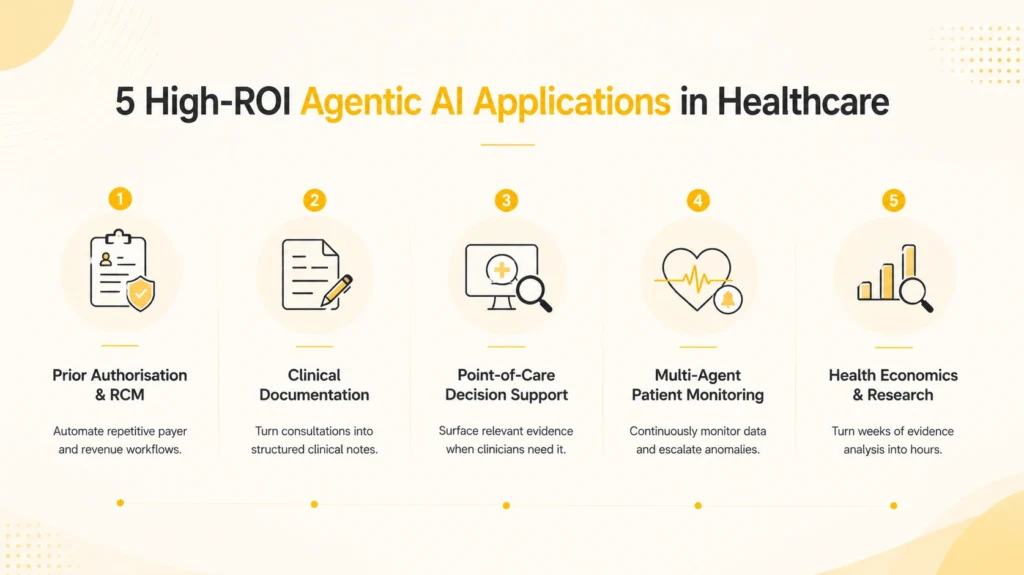
The agentic AI applications delivering measurable return in 2026 share a structural characteristic: they automate coordination and documentation workflows that surround clinical work, freeing clinical capacity for the high-judgment tasks that require human expertise.
Prior authorisation and revenue cycle automation
Prior authorisation consumes an average of 13 hours of physician and staff time every week, with 40% of physician practices now employing staff dedicated exclusively to prior authorisation tasks, according to the AMA’s 2025 physician survey. An agentic AI system for prior authorisation ingests payer requirement data, cross-references it against clinical documentation in the EHR, drafts the authorisation request, submits it, and monitors for the payer response — initiating follow-up actions if the request requires additional clinical information or is initially denied.
MUSC Health’s deployment completing 40% of prior authorisations without human involvement is the current benchmark. The workflow is well-suited to agentic automation: the decision criteria are rule-bound, the success metrics are objective (authorised or denied), and the volume is high enough that a 40% automation rate represents a substantial recovery of clinical and administrative capacity. More than 80% of health systems are prioritising agentic AI for revenue cycle management (RCM) alongside clinical operations, according to Deloitte’s 2026 survey.
Ambient clinical documentation
The most widely deployed agentic AI application in healthcare today. An ambient AI scribe listens to the patient-clinician consultation, generates a structured clinical note in the appropriate EHR format, identifies documentation gaps against coding requirements, and pre-fills the relevant fields — without requiring the clinician to dictate separately or complete post-visit documentation manually.
The evidence here is the strongest of any agentic AI application in healthcare. The 2025 JAMA Network Open study (Olson et al.) found ambulatory burnout fell from 51.9% to 38.8% among 263 clinicians across 6 health systems after just 30 days of ambient AI scribe use. Severe burnout fell from 18.4% to 12.2%. The agent does not make clinical decisions; it removes the documentation overhead that follows clinical decisions, and gives clinicians the capacity to be more present in the room with their patients.
Clinical decision support at point of care
This use case operates differently from the others and the distinction matters. AI in clinical decision making covers a wide range of architectures; agentic AI represents one specific one — systems that proactively retrieve and surface relevant clinical evidence, guideline-based recommendations, drug interaction alerts, and patient-specific data within the EHR workflow at the moment the clinician needs it, without being asked.
Stanford Health Care’s ChatEHR-based system does this by combining ambient listening with an agentic retrieval layer that searches the evidence base in real time and surfaces relevant results within the EHR at the moment of care. The agent brings the right information to the clinician at the right time. The clinical judgment remains human.
This distinction must be maintained clearly when evaluating solutions in this category: a system that provides evidence-based information for a clinician to act on is decision support. A system that initiates clinical actions autonomously without a human review step is a different architecture with a different regulatory and safety profile. The former is well-validated; the latter is not yet operating at clinical scale.
Multi-agent patient monitoring
For chronic disease management, remote care, and elderly populations with complex ongoing needs, agentic AI enables continuous monitoring across multiple data streams simultaneously — wearables, EHRs, sensor networks, lab results — with autonomous alerting and escalation when anomalies are detected.
The PMC/Frontiers in Medicine paper (Srinivasu et al., January 2026) describes a multi-agent ambient assisted living (AAL) system deploying simultaneous specialised agents: a heart-monitoring agent, a nutrition-monitoring agent, a human activity agent, an EHR analysis agent, and an emergency care agent — all ingesting data continuously and coordinating escalation workflows. This architecture addresses the caregiver-to-patient ratio challenge by enabling continuous monitoring at scale without proportionally increasing clinical staffing. The multi-agent structure is what makes this tractable: each agent has a defined, bounded responsibility, and the orchestration layer coordinates how they communicate and when to escalate.
Health economics and research intelligence for life sciences
For pharmaceutical and life sciences organisations, agentic AI systems that synthesise clinical trial literature, model health economic outcomes, and generate structured analyses from heterogeneous evidence sources are compressing expert workflows from weeks to hours. This is where the intersection of RAG (retrieval-augmented generation), knowledge graphs, and multi-agent orchestration produces the most measurable outcomes for health economics teams.
The economics of this use case are direct: a senior health economist may spend weeks on literature review and evidence mapping before any modelling work begins. If an agentic system handles evidence retrieval, synthesis, and structured output generation in hours rather than weeks, the expert’s time is redirected to interpretation, clinical reasoning, and model design — the work that actually requires domain expertise. For consumer-facing clinical products such as AI symptom checkers, the same principle applies: agentic systems can manage data synthesis and evidence retrieval, while human clinical review governs what reaches the patient.
The 3 readiness prerequisites for deploying agentic AI safely in healthcare
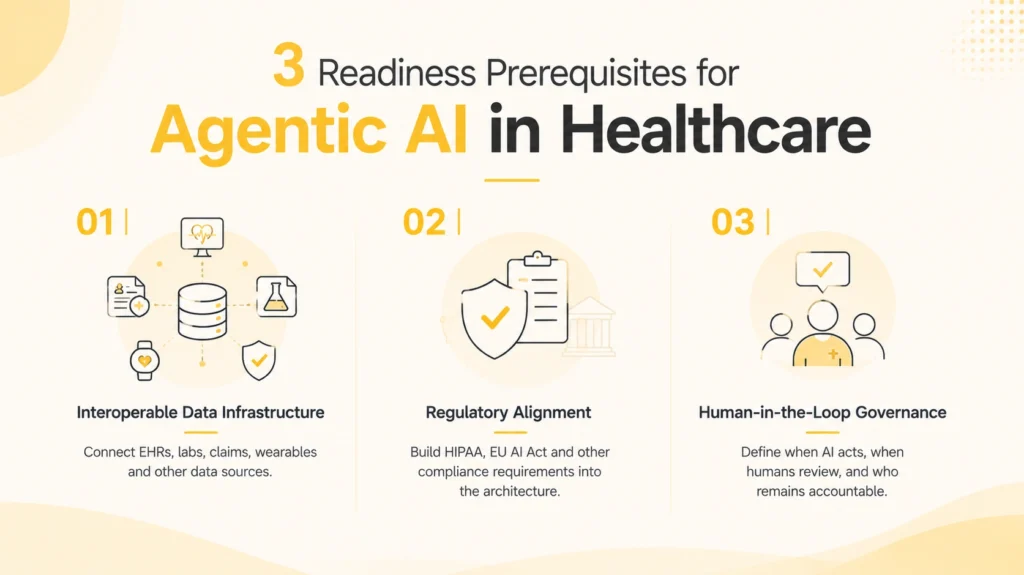
Agentic AI systems in healthcare operate on patient data, initiate actions in clinical systems, and make decisions that affect care workflows. The readiness requirements are correspondingly higher than for general enterprise AI. These 3 foundations must be in place before deployment, not after.
1. Interoperable data infrastructure
Agentic AI systems ingest heterogeneous clinical data: EHRs, imaging systems, claims databases, wearables, lab systems, and scheduling platforms. If those data sources are siloed, inconsistently formatted, or incomplete, the agent’s perception layer is operating on unreliable inputs — and in healthcare, unreliable inputs can produce clinically consequential outputs.
Fast Healthcare Interoperability Resources (FHIR) APIs are the emerging standard for healthcare data interoperability, providing a structured, standardised way for agentic systems to access and exchange clinical data across disparate systems. Deloitte’s research identified data quality as one of the top adoption hurdles for agentic AI in healthcare: 32% of health technology executives say they have overcome it. That means 68% have not. Building agentic AI on top of fragmented, low-quality data infrastructure does not fix the data problem; it amplifies it.
2. Regulatory alignment in the architecture, not bolted on at deployment
Healthcare agentic AI operates in one of the most tightly regulated environments for AI globally. The EU AI Act classifies healthcare AI as high-risk, mandating rigorous auditability, transparency, and human oversight mechanisms before deployment. In the US, HIPAA (Health Insurance Portability and Accountability Act) governs the handling of PHI (protected health information) by AI systems, including data that agentic systems access, process, and store. The FDA’s Predetermined Change Control Plan (PCCP) is the regulatory pathway for adaptive AI devices that update their behaviour as they learn — which describes most agentic systems in healthcare.
The Nature scoping review explicitly identifies FHIR-based APIs, federated learning with differential privacy, and edge-computing architectures as the technical enablers that make safe agentic AI deployment in healthcare possible. Building without regulatory alignment in the architecture from the start creates compliance debt that grows significantly as the system scales. The time to embed compliance is at design, not at deployment.
3. Human-in-the-loop governance designed for each use case
The boundary between a safe and an unsafe agentic AI deployment in healthcare is not whether the system is autonomous. It is whether human oversight is designed in at the right points for each specific use case. Deloitte’s three-tier initiative framework is a practical way to sequence this:
Quick wins have high autonomy and low clinical stakes. The agent handles the workflow end-to-end; human review is triggered only by exception flags. Prior authorisation for standard, rule-bound requests is the clearest example — the success criteria are objective, and a wrong decision is recoverable with clear accountability.
Strategic initiatives involve supervised autonomy. The agent handles workflow execution; a human reviews before any clinically significant output is acted on. Ambient clinical documentation operates this way: the agent drafts and pre-fills; the physician reviews and signs. The clinician remains accountable for what enters the clinical record.
Major undertakings are architectures where humans remain accountable for all critical decisions, with the agent’s role being information retrieval, evidence synthesis, and workflow coordination. Clinical decision support at point of care operates this way: the agent surfaces evidence, the clinician decides.
The governance model must specify 4 things before any system goes live: at what confidence threshold does the agent escalate to a human; who is accountable when an agent-initiated action has a clinical consequence; how are agent decisions logged and retrievable for audit; and how is model drift detected and managed over time as clinical practice and patient populations change. These are architecture decisions, not policy decisions. They must be built in.
Building an agentic health economics platform: the ConnectHEOR case
For health economics teams in the pharmaceutical and life sciences sector, model conceptualisation is expert work: synthesising clinical trial literature, identifying evidence gaps, and mapping the relationships between clinical outcomes and health economic models. The bottleneck is not expertise. It is the volume of heterogeneous evidence that must be synthesised before a single model can be conceptualised. A senior health economist can spend several weeks on literature review and evidence mapping before any modelling begins.
At Spark Eighteen, we built the ConnectHEOR agentic AI platform to address this bottleneck directly. The architecture uses LangGraph for multi-agent orchestration, LangChain for retrieval and reasoning pipelines, and Neo4j for the knowledge graph layer that structures relationships between clinical concepts and evidence sources. GraphRAG (graph-based retrieval-augmented generation) and Graph of Thought reasoning are combined to ground outputs in verifiable evidence and significantly reduce hallucinations across health economic literature. More than 6 advanced reasoning techniques were implemented to handle the complexity of evidence synthesis across heterogeneous source types.
The result: a workflow that previously took weeks now takes hours. The health economists direct the agent’s inquiry, review its structured outputs, and apply their judgment where it matters most — interpretation, clinical reasoning, and model design. The agentic system handles evidence retrieval, synthesis, and structured output generation. Each agent within the multi-agent architecture has a defined, bounded responsibility; the orchestration layer coordinates how they communicate and when outputs require human review before the health economist acts on them.
This is the architecture Deloitte’s framework would classify as a strategic initiative: supervised autonomy where the agent executes the evidence workflow and the human expert reviews and acts on the output. The efficiency gain is real and measurable. The clinical and scientific accountability remains human.
What to look for in an agentic AI healthcare solution provider
Evaluating an agentic AI healthcare solution provider requires a different framework than evaluating a standard enterprise software vendor. The questions are about architecture and governance, not features and pricing tiers.
Does it have a genuine multi-agent architecture? A real agentic AI system coordinates multiple specialised agents — a perception agent ingesting data from multiple sources, a reasoning agent synthesising that data against clinical guidelines, an action agent initiating workflow outputs, and an audit agent logging decisions for compliance review. A single large language model (LLM) processing structured inputs with a workflow interface is a GenAI tool, not an agentic AI system. Ask providers to explain the multi-agent coordination layer: how do agents communicate, how are tasks handed off, and how does the system handle conflicting outputs from different agents?
Is healthcare data compliance in the architecture or bolted on? HIPAA compliance, GDPR alignment, FHIR-based interoperability, and PHI access control should be architectural properties, not configuration options applied at deployment. Ask: where is patient data processed? What encryption and access control mechanisms govern PHI at rest and in transit? Is FHIR-based integration native or handled through third-party middleware?
Are reasoning outputs explainable and decisions auditable? Every recommendation or action an agentic AI system initiates in a clinical context must be traceable to its inputs and reasoning process. This is a regulatory requirement under the EU AI Act and FDA PCCP framework, and a clinical trust requirement for any team accountable for the system’s outputs. Ask providers: what does the audit trail for an agent decision look like? Can clinical staff see why the agent made a specific recommendation? Is confidence scoring included, and at what threshold does the agent escalate to human review?
Is human-in-the-loop escalation configurable by use case? The question is not whether a solution has “a human in the loop” — every provider will say yes. The question is whether the escalation architecture is configurable to the clinical stakes of each specific use case. A prior authorisation agent and a clinical documentation agent require different escalation thresholds and different accountability structures. A provider that applies a uniform escalation model uniformly across all use cases has not addressed the risk stratification problem at the architectural level.
Is there evidence of real-world deployment at clinical scale? Not pilots. Not research collaborations. Operational deployments where agentic AI is running in live clinical or administrative workflows at an organisation with meaningful patient volume. Ask about failure modes encountered in production and how the system handled them. The answer to this question tells you more about a provider’s maturity than any benchmark.
Conclusion
The most important thing to understand about agentic AI in healthcare right now is the gap it occupies: a peer-reviewed evidence base of 7 qualifying studies in the first systematic scoping review, alongside operational deployments at MUSC Health, Sentara Health, Stanford Health Care, and Mayo Clinic that are producing measurable results today. Both of those things are true simultaneously.
That gap is not a reason for caution about whether agentic AI belongs in healthcare. It is a reason for precision about where to deploy it, at what level of autonomy, and with what governance architecture. The use cases generating real return today — prior authorisation automation, ambient clinical documentation, revenue cycle management, care coordination — all share one structural feature: the agent handles a bounded, rule-governed workflow while clinical judgment stays human. That is not a compromise position. It is the correct sequencing for a technology category whose validation evidence is growing but not yet complete.
98% of health technology executives surveyed by Deloitte expect at least 10% cost savings from agentic AI in the next 2 to 3 years. The organisations expecting the largest returns are not those planning to invest the most. They are those building multi-agent infrastructure now and developing the governance models that make autonomous action safe at clinical scale. The investment timeline matters less than the architecture of what is being built.
If you are working through where agentic AI fits in your healthcare product or organisation, the team at Spark Eighteen is happy to think through it with you. Drop a note to coffee@sparkeighteen.com with where you are starting from.