In 2026, ECRI, the U.S. patient safety authority, ranked AI chatbot misuse as the number 1 health technology hazard of the year. Not a data breach. Not ransomware. AI giving people the wrong health guidance. That is the environment in which every AI symptom checker app is now being built and judged.
The market opportunity is real. The AI symptom checker segment is valued at $1.45 billion in 2025 and is projected to reach $3.55 billion by 2029 at a 25% compound annual growth rate (CAGR). Digital health assistant adoption sits at 47% in North America and 52% across parts of Asia. Symptom assessment completion rates have risen from 74% in the early market to 91% in 2025. Users are engaging. The challenge is not demand.
The challenge is clinical reliability and regulatory acceptance. A 5-year published study found the median triage accuracy of symptom checker apps was just 55.8%, with apps missing over 40% of emergencies. Most teams building in this space focus on the AI. The teams that ship products clinicians adopt and regulators permit focus on what the AI requires to be trustworthy: a clinical knowledge foundation, a compliance architecture, and a validation process that proves reliability before launch.
This blog is for product and technology leaders who want to build the latter.
Key takeaways
- You will understand why most AI symptom checker apps underperform clinically, and what building a reliable one actually requires.
- You will get the core features mapped against what clinical trust demands, including the 3 most commonly skipped.
- You will see the tech stack and architecture decisions that determine clinical reliability, not just functional performance.
- You will understand the compliance and regulatory requirements across HIPAA, GDPR, and the EU AI Act, and why they are architecture inputs, not launch checklists.
- You will know what the development process looks like when clinical governance is a founding requirement, and how that changes the outcome.
What an AI symptom checker is (and where the trust gap sits)
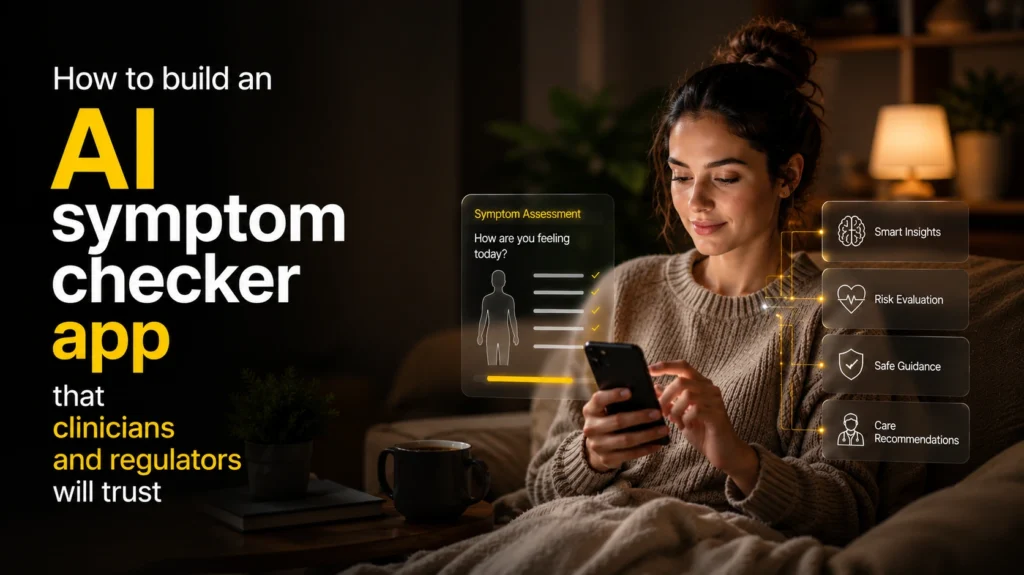
An AI symptom checker is a software application that uses natural language processing (NLP) and machine learning (ML) to interpret user-reported symptoms, suggest likely conditions, and recommend a care pathway: self-care, a general practitioner (GP) appointment, urgent care, or emergency services. It triages. It does not diagnose. That distinction matters clinically, legally, and in terms of what users do with the output.
There are 3 implementation models in use today:
- Rule-based systems operate on predefined decision trees. They are fast to build, transparent in their logic, and brittle at the edges. Any symptom presentation outside the rules produces an unreliable output.
- NLP-driven systems interpret conversational or free-text input using language models. They are flexible and feel natural to users. Without a structured clinical knowledge layer beneath them, they pattern-match on unstructured text rather than reason against clinical evidence, and hallucinate clinical facts at a rate that is unacceptable in a health context.
- Hybrid systems combine NLP with a structured medical knowledge base. They take longer to build. They are also the only architecture that consistently produces triage outputs clinicians will act on and that hold up under clinical validation.
The trust gap is measurable. The 5-year study found median triage accuracy had barely moved between 2015 and 2020, and apps were missing critical emergencies at scale. User engagement is improving. Accuracy has not kept pace. The gap is not an AI capability problem. It is a design, knowledge integration, and clinical validation problem, and it begins with the features most teams choose not to build.
The features that clinical trust actually requires
A clinically reliable AI symptom checker needs 8 feature areas. Most apps ship 5. The 3 that get cut, specifically medical knowledge base integration, a clinician review layer for high-risk outputs, and structured triage output mapped to clinical evidence thresholds, are the ones that determine whether a clinician will act on the app’s recommendations or override them.
- Structured symptom intake. Not a free-text box. An adaptive, branching questionnaire built around clinical interview patterns, where each answer narrows the question set and reduces ambiguity in the AI layer. A free-text chatbot interface feels more natural to users. A structured intake produces more reliable data for triage. The interface design is a clinical quality input, not just a user experience (UX) decision.
- NLP and large language model (LLM) symptom interpretation. The engine that maps user language to medical concepts must be fine-tuned on clinical corpora, not general text. A 2025 study in Communications Medicinedocumented LLMs generating false clinical facts in health contexts. General-purpose models produce plausible outputs. Clinically fine-tuned models produce reliable ones. The distinction is foundational, and it is a product decision, not just a model selection one.
- Medical knowledge base integration. SNOMED CT (Systematised Nomenclature of Medicine, Clinical Terms), ICD-10 (International Classification of Diseases, 10th Revision), and UMLS (Unified Medical Language System) ground the app’s output in validated clinical vocabulary. Without this layer, the AI reasons from pattern memory, not clinical evidence. This is the most commonly underscoped feature in the market, and it has the greatest single impact on triage accuracy and clinician trust.
- Risk stratification and triage output. A 4-tier urgency recommendation: self-care, contact a GP within 24 to 48 hours, urgent care today, or call emergency services now. Each tier must be mapped to clinical evidence thresholds, not just ML confidence scores. Clinicians can evaluate a recommendation grounded in clinical criteria. A confidence percentage gives them nothing to work with.
- Care pathway routing. The triage output must connect to a specific action: book this appointment, call this helpline, go to this facility. A recommendation without a clear next step increases patient uncertainty and over-reliance on the AI. Routing to action reduces both.
- Symptom history and tracking. Longitudinal symptom logging allows the app to detect worsening patterns and generate a structured summary for the clinician at first contact. This shifts the app from a one-time triage tool to something a clinical team can integrate into an ongoing care pathway.
- EHR (electronic health record) integration. For enterprise deployments, structured symptom data must flow into the clinical record via HL7 FHIR (Fast Healthcare Interoperability Resources). Without this, the app exists in isolation from the clinical system, and the clinician starts from scratch at every consultation.
- Clinician review layer for high-risk outputs. High-urgency triage outcomes should route to a human clinical review before or immediately after the recommendation is delivered. This is a patient safety measure and a liability management measure in equal parts. It is the feature most teams cut to reduce scope. It is also the feature that most directly determines whether clinicians will trust and adopt the platform.
The tech stack decisions that determine clinical reliability
The tech stack for an AI symptom checker divides into 5 layers: frontend, backend, AI and NLP, medical knowledge, and compliance infrastructure. The AI and medical knowledge layers are where architecture decisions have the most direct effect on clinical output quality. Choosing a general-purpose LLM without clinical fine-tuning, or skipping the medical ontology integration, produces an app that performs well in demos and fails in triage.
Frontend
Flutter or React Native for cross-platform mobile, covering iOS and Android from a single codebase. The interface design is a clinical reliability input: ambiguous symptom options and unclear escalation prompts degrade triage accuracy at the input stage, before the AI processes anything.
AI and NLP layer
- Hugging Face Transformers for model fine-tuning and deployment on clinical corpora
- Apache cTAKES (clinical Text Analysis and Knowledge Extraction System) for medical NLP, designed specifically to extract clinical concepts from natural language input
- TensorFlow or PyTorch for custom model training
The key architecture decision here: a general-purpose LLM versus a hybrid model grounded in a structured medical knowledge layer. The general-purpose model is faster to deploy. The hybrid produces triage outputs clinicians will act on, particularly on the edge cases where clinical harm is most likely.
Medical knowledge integration
SNOMED CT, ICD-10, and UMLS provide the clinical vocabulary that anchors AI outputs to validated medical concepts. Retrieval-augmented generation (RAG) pipelines over a vector database (Pinecone, Weaviate, or pgvector) allow the model to retrieve and reason against clinical reference material rather than generate from pattern memory. This is the layer that reduces hallucination risk most directly.
Backend and data
Python with FastAPI or Django for AI services; PostgreSQL for structured clinical data; FHIR-compatible data models from the start if EHR integration is in scope. Designing FHIR compatibility in from day one costs significantly less than retrofitting it post-launch.
Healthcare cloud infrastructure
AWS HealthLake, Google Cloud Healthcare API, or Azure Health Data Services are purpose-built for HIPAA (Health Insurance Portability and Accountability Act)-compliant healthcare data at scale. Using a general-purpose cloud deployment and retrofitting compliance later is a common and expensive mistake. General-purpose tech stacks produce general-purpose outputs. Clinical reliability requires deliberate clinical architecture decisions at every layer.
Compliance and regulation: the layer that determines whether regulators will allow it
In 2026, an AI symptom checker operates under the strictest regulatory scrutiny of any consumer-facing software category. The compliance requirements across HIPAA, GDPR, and the EU AI Act are not pre-launch checklists. They are architecture inputs. Teams that design for them from discovery move through regulatory review fastest. Teams that retrofit them post-build pay the highest cost.
There is also a clinical trust dimension that goes beyond the legal one. Clinicians will not integrate a tool into care pathways that has no audit trail, undefined liability, and outputs that cannot be interrogated. The compliance architecture, specifically audit logging, explainability of triage outputs, and human override mechanisms, is what makes an AI symptom checker clinically usable, not just legally permissible.
HIPAA
Any app collecting, processing, or transmitting individually identifiable health information in the U.S. must be HIPAA-compliant. Cloud infrastructure must be covered under a Business Associate Agreement (BAA). Healthcare-specific cloud services include BAA coverage by default. General-purpose cloud deployments must be specifically configured, and that configuration must be in place before any health data is collected.
GDPR (General Data Protection Regulation)
Health data is a special category under GDPR in Europe, requiring explicit consent, data minimisation, and the right to erasure. Privacy by design must be embedded in the architecture from the outset. Post-launch retrofitting is possible. It is disruptive and expensive.
EU AI Act
Medical AI systems that influence care decisions are classified as high-risk AI under the EU AI Act. This requires conformity assessments, transparency to users, human oversight mechanisms, and post-market performance monitoring. High-risk AI requirements became enforceable from August 2026. Any team building or deploying AI symptom checkers in the EU without a compliance framework in place is already behind schedule.
FDA classification
Apps that cross from symptom guidance into condition diagnosis may trigger FDA medical device classification under 21 CFR Part 820. The distinction between a wellness app and a regulated medical device is a legal and clinical question that must be resolved before the build begins. Most teams that discover they have inadvertently built a medical device do so at launch, not at scoping.
Transparency mandates
Texas RAIGA requires patients to be notified they are interacting with AI at the moment the interaction begins. Multiple U.S. states and the EU are introducing equivalent requirements. Transparency disclosure is both a legal requirement and a clinical trust mechanism: users who know they are interacting with AI make more considered decisions about when to escalate to a clinician.
The development process when clinical governance is built in from discovery
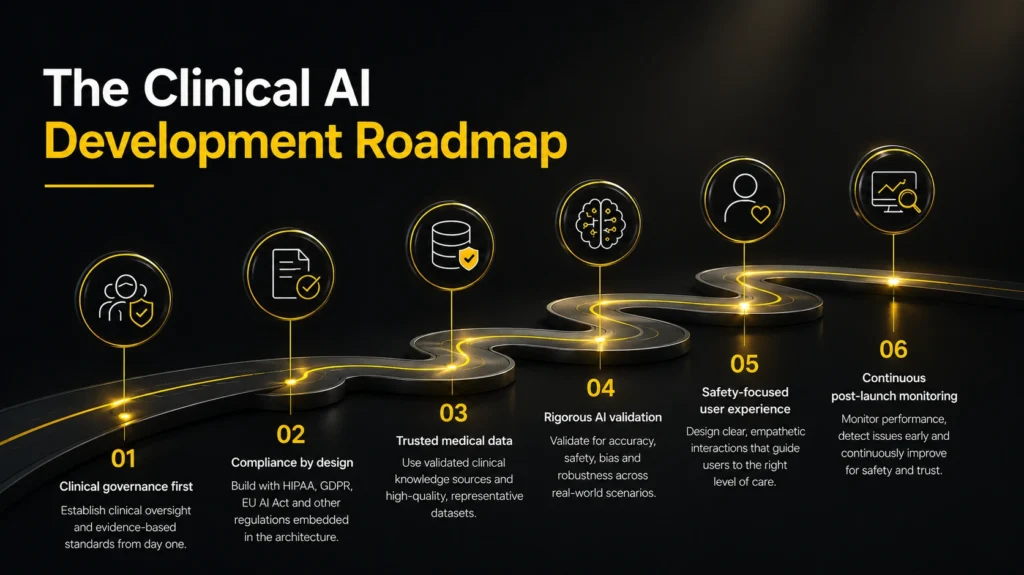
Successful AI symptom checker development follows 6 phases. Clinical requirements scoping and compliance architecture happen before any code is written. Clinical validation happens before any user-facing launch. The process takes longer by design. It produces the only outcome that matters: a product clinicians will adopt and regulators will permit to operate.
Phase 1: Clinical requirements scoping
Define the clinical use case precisely before any technical decisions are made. Which conditions will the app triage? Which patient population? What care pathways are in and out of scope? This requires clinical input, not just product input. A clinical advisor at this stage defines what the AI must and must not do. Without that definition, the AI will attempt both.
Phase 2: Compliance architecture
Define HIPAA, GDPR, and EU AI Act requirements for the specific use case and deployment geography. Select healthcare-compliant cloud infrastructure. Design audit logging, consent flows, and data retention policies. This runs in parallel with clinical scoping, not after the build is complete.
Phase 3: Medical knowledge base and dataset selection
Select the clinical ontologies (SNOMED CT, ICD-10, UMLS) and training dataset. Validate dataset representativeness across demographic, linguistic, and clinical dimensions. Gaps in training data produce systematic triage failures for under-represented groups. Algorithmic bias must be addressed at data selection, not as a post-training audit.
Phase 4: AI model selection and fine-tuning
Select the architecture (hybrid recommended for clinical reliability). Fine-tune on validated clinical datasets. Test against standardised clinical vignettes before any user-facing deployment. A vignette test is not quality assurance (QA). It is the minimum standard for clinical validation.
Phase 5: UX design and frontend build
Design the symptom intake flow and triage output with clinical UX principles:
- No ambiguous symptom options
- Clear 4-tier urgency signalling at every output
- Explicit escalation paths at each decision point
- AI transparency disclosure at the start of every interaction
- “When to ignore this and contact a clinician directly” guidance embedded in the interface
Phase 6: Clinical validation and phased launch
Test against clinical vignettes, measure triage accuracy, and run an internal or limited beta under clinical oversight before public launch. Monitor triage accuracy, escalation rates, and override rates in the first 90 days. These are not vanity metrics. They are the evidence base for clinician adoption and the data regulators will ask for.
At Spark Eighteen, we built an AI symptom intake module for a digital health platform where the team had to choose between a pure LLM approach and a hybrid architecture combining NLP with SNOMED CT-mapped triage logic. The LLM produced more natural-sounding conversation. The hybrid was less fluid in dialogue but significantly more accurate on edge cases. Clinical vignette testing in Phase 6 caught 3 triage failure patterns that standard QA would not have surfaced. 2 of them involved under-triaging chest pain presentations. The phase most teams cut to save time was the phase that made the product safe to launch.
The risks worth naming before you build
The 4 most significant risks in AI symptom checker development are triage accuracy gaps, algorithmic bias, patient over-reliance, and regulatory misclassification. Each is a direct consequence of building the AI without building the clinical trust and governance layer around it.
Triage accuracy gap
Published research puts median triage accuracy at 55.8%, with over 40% of emergencies missed. This is not an AI capability problem. It is a medical knowledge integration and clinical validation problem. The hybrid architecture and vignette testing phases exist specifically to close this gap. Teams that skip them inherit the gap.
Algorithmic bias
Training data that under-represents specific demographic, linguistic, or clinical groups produces systematically worse triage for those groups. In a health context, that is clinical harm, not a fairness metric. Dataset representativeness testing and bias audits must be part of the build process, not a post-launch review.
AI hallucinations in medical context
LLMs generate plausible but clinically incorrect recommendations. A 2025 study documented this explicitly in health AI contexts. The hybrid architecture reduces hallucination risk by grounding outputs in validated clinical vocabulary rather than generative pattern memory. A hallucination in a consumer chatbot is a nuisance. In a health triage tool, it is a patient safety event.
Patient over-reliance
ECRI’s 2026 designation of AI chatbot misuse as the top health technology hazard reflects a documented pattern: patients following AI guidance instead of seeking clinical care for serious conditions. The app design must actively counter this through explicit escalation prompts, transparent AI disclosure, and embedded guidance on when to override the recommendation and call a clinician.
Regulatory misclassification
Building a diagnostic tool and launching it as a wellness app to avoid FDA oversight carries increasing legal and reputational risk as regulatory frameworks tighten globally. The EU AI Act, state-level U.S. transparency mandates, and ECRI’s high-hazard designation are all moving in the same direction. Resolving FDA classification before the build costs far less than resolving it at launch.
The apps that will earn clinical adoption and survive regulatory scrutiny
The AI symptom checkers that will earn clinical adoption and survive regulatory scrutiny in 2026 are not the most technically sophisticated ones. They are the ones where clinical governance was a founding product requirement, not something added to satisfy a pre-launch checklist. The AI is the visible part of the product. The clinical validation framework, the compliance architecture, the triage accuracy testing, and the escalation design: that is the product.
Every team that skips those phases builds the same thing: an app that performs in a demo and fails in the field. The challenge in building an AI symptom checker is never the AI. It is building one that a clinician will trust with a patient’s care decision, and that a regulator will permit to make it.
If you are scoping an AI-powered healthcare app and want to think through the clinical and technical architecture before committing to a build, reach out at coffee@sparkeighteen.com.