Most healthcare AI projects do not fail because the model is wrong. They fail because the team picked the wrong capability type for the problem, or picked the right capability and built it on the wrong architecture. A general-purpose large language model (LLM) cannot do what a computer vision model does. A machine learning (ML) risk-scoring system is not the same governance problem as an ambient natural language processing (NLP) scribe. Treating them as a single decision, “we’re using AI,” produces a single outcome: a system that performs in a demo and fails in clinical deployment.
AI in healthcare is not one technology. It is 5 distinct capabilities applied across the clinical and operational stack. The organisations that understand this distinction, and design their data architecture, governance, and clinical validation around it from the start, are the ones building platforms that earn clinical adoption and survive regulatory scrutiny.
The market reflects the scale of the opportunity. The global AI in healthcare market stands at $36.96 billion in 2025, projected to reach $613.81 billion by 2034. And yet the World Economic Forum’s 2025 white paper still rates healthcare as “below average” in AI adoption compared to other industries. With 4.5 billion people currently without access to essential healthcare services and a projected health worker shortage of 11 million by 2030, the technology is not the constraint. The build decisions are.
Key takeaways
- You will understand what AI in healthcare means across 5 distinct capability types, and why getting the capability-to-problem match wrong is the single most common reason healthcare AI implementations fail.
- You will see where AI is delivering proven clinical value today, with specific published results and the architectural decisions that produced them.
- You will understand where the use of AI in healthcare is transforming operations, from clinical trials to remote patient monitoring to administrative automation.
- You will know the 6 enterprise obligations every organisation must meet before adopting AI: compliance architecture, data security, AI-specific risks, privacy governance, vendor risk, and bias auditing.
- You will get an honest view of why healthcare AI adoption is still below the industry average, and what the data says about the real barriers.
- You will see what the future of AI in healthcare looks like, and how the organisations building now are positioning themselves for it.
What AI in healthcare actually means
AI in healthcare is not a single technology. It is 5 distinct capability types applied across the clinical and operational stack. Which capabilities are relevant depends entirely on the problem being solved. Organisations that ask “should we use AI?” tend to make less progress than those that ask “which AI capability does this specific problem require?”
Machine learning (ML) identifies patterns in large clinical datasets. Applications include sepsis prediction from patient vitals, readmission risk scoring, fraud detection in claims processing, and demand forecasting for hospital resources. ML is the most widely deployed AI capability in healthcare today.
Computer vision analyses medical images including X-rays, MRIs, computed tomography (CT) scans, and pathology slides to detect abnormalities at a speed and consistency that human radiologists cannot match alone. It is the AI capability producing some of the most clinically significant diagnostic outcomes, and it requires labelled medical image datasets, not text corpora, to train.
Natural language processing (NLP) interprets and generates human language, enabling clinical note transcription via ambient scribes, extraction of structured insights from unstructured electronic health records (EHRs), and conversational patient triage tools. NLP underpins most ambient AI tools currently entering clinical workflows.
Generative AI (including LLMs) drafts EHR summaries, generates clinical documentation, supports patient communication, and assists pharmaceutical researchers with drug formulation hypotheses. Generative AI moves fast and fails specifically in clinical contexts when it operates without a structured clinical knowledge layer beneath it, producing plausible but inaccurate recommendations. This is not a flaw that better prompting solves. It is an architectural constraint that requires a purpose-built solution.
Robotics and automation handle surgical assistance, hospital logistics, automated laboratory analysis, and medication dispensing. AI-guided robotic surgery can operate in some cases with greater precision than hand-held instruments.
The governance requirements, data requirements, and validation standards are different for each capability type. A health system deploying an NLP ambient scribe is doing something architecturally and regulatorily distinct from one deploying a computer vision cancer detection model. Conflating them into “we’re doing AI” leads to poor procurement decisions, inadequate governance, and failed implementations. Understanding this distinction is the starting point for every AI in healthcare industry initiative that actually delivers.
The global AI in healthcare market was valued at $16.61 billion in 2024 and is projected to reach $630.92 billion by 2033, a figure that reflects all 5 capability types deployed across dozens of clinical and operational use cases in one of the most regulated industries on the planet.
Where AI is delivering proven clinical value today, and what made it work
The evidence base for the impact of AI in healthcare is no longer preliminary. Across 4 areas, medical imaging and diagnostics, early disease detection, clinical decision support, and drug discovery, published results show outcomes that were not achievable with previous technology. In each case, the capability type and architecture behind the result matter as much as the result itself.
Medical imaging and diagnostics
The American Cancer Society has reported that AI can review and interpret mammograms 30 times faster than human radiologists, with 99% accuracy, significantly reducing unnecessary biopsies. AI brain scan software developed by 2 UK universities is “twice as accurate” as professionals at examining stroke patient brain scans and can identify the timescale in which a stroke occurred, information that determines treatment eligibility. A UK-based AI tool has detected 64% of epilepsy brain lesions previously missed by radiologists. Urgent care doctors miss broken bone fractures in up to 10% of cases; NICE has confirmed AI-assisted X-ray analysis is safe, reliable, and reduces unnecessary follow-up appointments.
These results share a common architectural foundation: they come from computer vision models trained on labelled medical image datasets, not general-purpose language models. The capability type is what makes diagnostic performance measurable and reproducible. A different AI capability applied to the same imaging problem (a general-purpose LLM, for example) would produce descriptive text about what might be in an image, not quantifiable diagnostic accuracy. Choosing the right capability type is the first decision, and it is made before any model is selected.
Early disease detection
AstraZeneca trained an ML model on health data from 500,000 people in a UK health data repository. The model can predict disease diagnosis with high confidence many years before clinical symptoms appear, covering more than 1,000 conditions including Alzheimer’s, chronic obstructive pulmonary disease (COPD), and kidney disease. AI algorithms tracking patient variables including vital signs and lab results can identify sepsis before symptoms emerge, enabling intervention before the condition becomes life-threatening.
Both results are ML pattern-recognition applications trained on structured clinical data, not generative AI tools. The quality and representativeness of the training dataset determines clinical validity, which is why the 500,000-person health data repository matters as much as the model itself. An ML sepsis detection model trained on a dataset with missing vitals, inconsistent EHR coding, or unrepresentative patient demographics will produce unreliable predictions regardless of its architecture. The data infrastructure is a clinical quality input, not just an engineering one.
Clinical decision support
A JAMA Network Open study (2024) found that medical diagnoses based on 6 clinical cases fed directly to GPT-4 were significantly more accurate than those made by doctors using it only as an assistant. More instructive for builders: ChatRWD, a retrieval-augmented generation (RAG) system combining LLMs with clinical reference retrieval, produced clinically useful answers to 58% of physician questions. Standard general-purpose LLMs answered just 2% to 10% correctly.
The architectural difference is the finding: a RAG pipeline that grounds the LLM’s output in validated clinical knowledge sources produces an order of magnitude better clinical performance than the same LLM operating on general training data. General-purpose models are not insufficient; they are the wrong tool for unaided clinical decision support. Purpose-built systems with a clinical knowledge layer are the right one. This distinction should drive every clinical AI procurement and build decision.
Drug discovery
AI reduces the time pharmaceutical companies need to identify new drug candidates from 5 to 6 years to approximately 1 year. Around 80% of professionals in pharma and life sciences already use AI in drug discovery workflows. McKinsey estimates pharmaceutical companies could achieve 50% cost reductions from AI-optimised clinical trial processes, trials completed more than 12 months faster, and at least a 20% increase in net present value per compound.
The capability behind these results is ML-driven molecular screening: models trained to predict how specific chemical compounds interact with target proteins. This is not generative AI summarising drug literature. It is ML identifying structure-activity relationships at a scale no human team can approach manually. Deploying the wrong capability type at this stage does not just produce slow results; it produces confident-sounding but clinically unreliable outputs that waste research time and budget.
Where AI is transforming healthcare operations
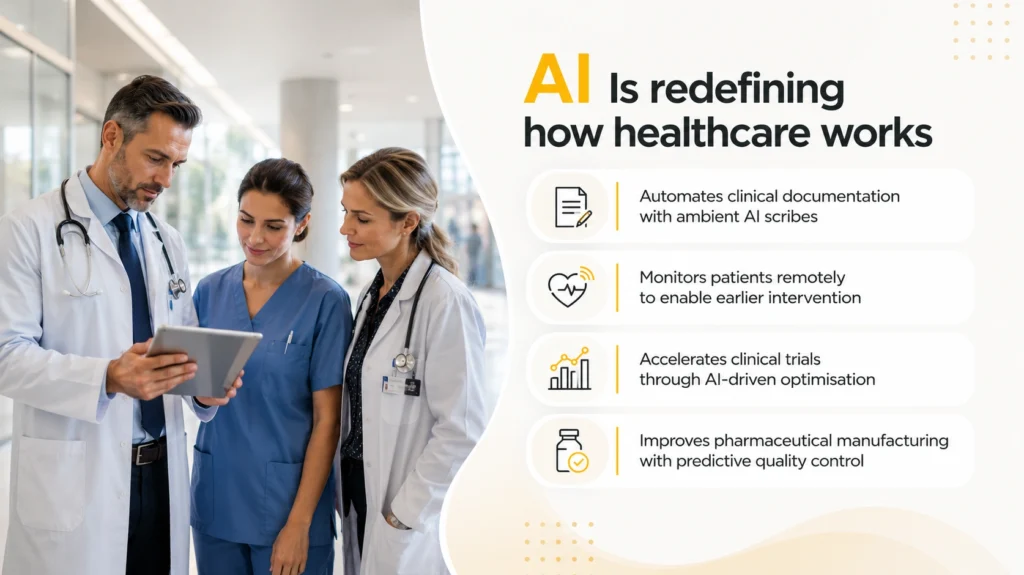
Beyond clinical outcomes, the most immediate near-term AI impact in most health systems is operational. 4 areas are already producing measurable results.
Administrative automation and clinical documentation
EHR documentation burden is one of the leading causes of physician burnout. Ambient AI scribes capture doctor-patient conversations and generate draft clinical notes, freeing clinicians to focus on the patient rather than the screen. AI-enhanced EHRs let doctors pull patient summaries, lab results, and history via voice commands. German AI healthcare platform Elea has cut testing and diagnosis turnaround from weeks to hours. One important caveat: a 2024 study found OpenAI’s Whisper, used by some hospitals for consultation transcription, was hallucinating portions of transcriptions. The implication is not that ambient AI should be avoided; it is that AI-generated documentation must remain in a human review loop before entering the clinical record.
Remote patient monitoring
Digital patient platform Huma reduced readmission rates by 30% and time spent reviewing patients by up to 40% in a documented deployment. AI-enabled wearables monitor cardiac, diabetes, and cancer conditions in real time, flagging deteriorations before patients reach crisis. A Yorkshire study found that AI correctly predicted in 80% of cases which ambulance patients needed hospital transfer, enabling better allocation of emergency resources.
Clinical trial efficiency
McKinsey estimates AI-driven trial optimisation could deliver 50% cost reductions, accelerate timelines by more than 12 months, and increase net present value by at least 20%. AI tools identify eligible participants faster, predict outcomes earlier, and streamline regulatory documentation.
Pharmaceutical manufacturing
Sanofi applied AI and ML to analyse quality control deviations at its production sites, reducing deviation closure times by 60% and shortening cycle times across the supply chain. McKinsey estimates AI could generate $60 billion to $110 billion annually in economic value for the pharmaceutical and medical-product industries.
What enterprises must get right before adopting AI in healthcare
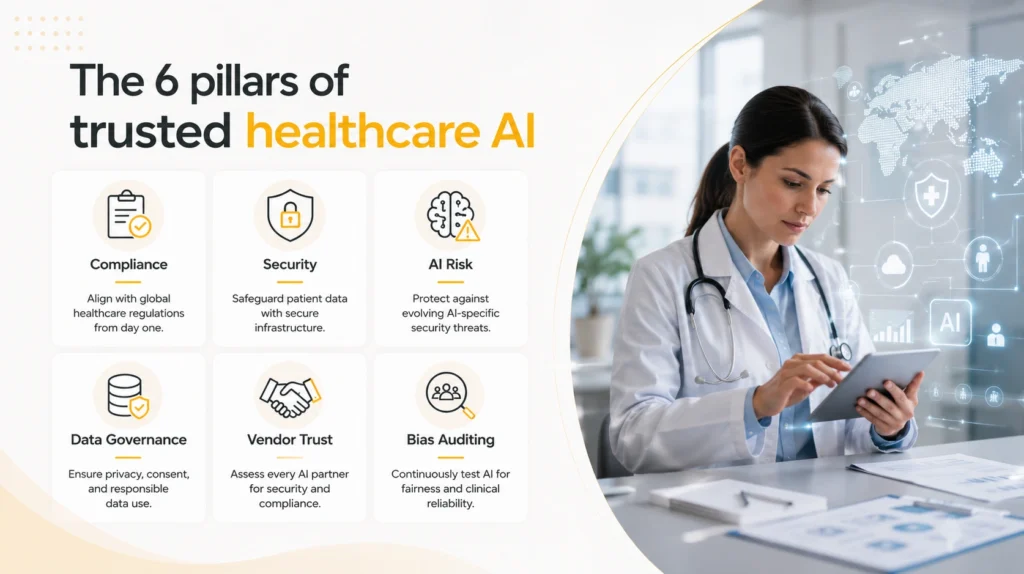
Healthcare AI adoption carries 6 enterprise obligations that go beyond model selection. Organisations that treat these as pre-launch checklists routinely face expensive rebuilds. Those that design for them from scoping move faster and encounter fewer regulatory blockers.
1. Regulatory compliance as an architecture input
- HIPAA (Health Insurance Portability and Accountability Act): Any system processing individually identifiable health information in the U.S. requires a Business Associate Agreement (BAA) with every cloud and third-party provider that touches patient data; end-to-end encryption; role-based access control (RBAC) enforcing minimum necessary access; and audit logs retained for at least 6 years.
- GDPR (General Data Protection Regulation): Health data is a special category under GDPR, requiring explicit consent, data minimisation, privacy by design in the system architecture, and the right to erasure. A Data Processing Agreement (DPA) is required with every third-party data processor.
- EU AI Act: High-risk AI provisions, which cover most medical AI systems, became fully applicable in August 2026. Compliance requires conformity assessments, transparent AI output explanations, human oversight mechanisms, and post-market performance monitoring.
- FDA classification: AI tools that cross from decision support into specific diagnosis or treatment recommendation may trigger medical device classification under 21 CFR Part 820.
2. Data security architecture
- Multi-tenant data isolation: Patient and client data must be isolated at the infrastructure level, not just the application level. Separate database instances per client protect against both breach propagation and regulatory cross-contamination.
- Healthcare-specific cloud infrastructure: AWS HealthLake, Google Cloud Healthcare API, and Azure Health Data Services include BAA coverage. General-purpose cloud deployments require explicit HIPAA configuration.
- Secure API design: HL7 FHIR (Fast Healthcare Interoperability Resources) APIs must be secured with OAuth 2.0 and scoped tokens.
3. AI-specific security risks
- Model inversion attacks: Adversaries can reconstruct sensitive training data from model outputs. When models are trained on patient records, this is a direct patient privacy risk requiring differential privacy techniques or federated learning architectures.
- Prompt injection: In LLM-based clinical tools, malicious inputs can cause the model to bypass safety constraints and return unsafe clinical recommendations. Input validation and output filtering at the application layer are non-negotiable.
- Model drift: AI performance degrades over time as patient populations and clinical practice change. Post-deployment monitoring is a clinical safety requirement and an EU AI Act obligation for high-risk systems.
4. Privacy, data governance, and consent
- De-identification: HIPAA Safe Harbor and Expert Determination are the 2 accepted de-identification standards. Using informally “anonymised” data to train AI models is a compliance risk.
- Data residency and sovereignty: EU patient data processed on U.S. servers without an appropriate transfer mechanism violates GDPR. India’s DPDP Act and UK GDPR add further cross-border constraints for organisations operating across markets.
- Consent and AI transparency: Patients must be informed when AI is being used in their care pathway, at the point of interaction, not buried in terms and conditions.
- Secondary use for model training: Using clinical data to train AI requires a clear legal basis: consent, research exemption, or secondary use authorisation under the European Health Data Space (EHDS).
5. Third-party and vendor risk
Every third-party tool in a healthcare AI platform that processes patient data requires a BAA under HIPAA, including analytics platforms, cloud-based LLM APIs, and push notification services. As of 2026, most major LLM providers offer BAA-eligible enterprise tiers, but these must be explicitly contracted and configured, not assumed. AI embedded in third-party EHR systems, imaging software, or billing platforms should be evaluated against clinical validation standards.
6. Algorithmic bias auditing
AI models trained on datasets that under-represent specific demographic or clinical groups produce systematically worse outcomes for those groups. This is clinical harm, not a fairness metric. A skin cancer detection model trained predominantly on lighter-skin images has documented lower accuracy for darker-skin patients. Under the EU AI Act, bias auditing across demographic segments is a documented, repeatable obligation for high-risk medical AI.
Why healthcare is still “below average” in AI adoption
The evidence above shows the technology is capable. The barriers are not technical. They are organisational, cultural, and structural.
The clinician trust gap
Only 16% of clinicians currently use AI tools to help make clinical decisions, according to a 2025 survey. More revealing: clinicians disregard 20% of AI-generated predictions even when those predictions were 100% accurate. Clinicians frequently perceive AI as a “black box”: outputs they cannot interrogate, explain to a patient, or take clinical responsibility for. This is not a marketing or communication problem. It is an explainability architecture problem. Clinical AI that cannot show its reasoning will not be adopted at scale regardless of its accuracy.
Data quality and interoperability
Patient records, imaging data, lab results, and genomic data are stored in isolated systems with inconsistent formats across EHR vendors. The Oracle analysis identifies lack of interoperability across EHR platforms as one of the most cited implementation barriers. The EU’s EHDS, which entered into force in 2025, begins to address this at a policy level, but infrastructure standardisation across health systems will take years.
Workforce and skills gaps
Nearly 80% of respondents in recent industry surveys cite lack of AI expertise as their top implementation barrier. Healthcare organisations are not short of willingness to adopt AI; they are short of teams who can scope, validate, and govern clinical AI implementations. As the PMC review notes, successful AI implementation requires redesigning clinical workflows around the AI, not layering AI on top of existing processes. AI on a broken process produces a faster broken process.
What the future of AI in healthcare looks like
The next phase is less about individual AI tools and more about AI integrated into the clinical workflow itself. 3 shifts are already underway.
From decision support to AI agents
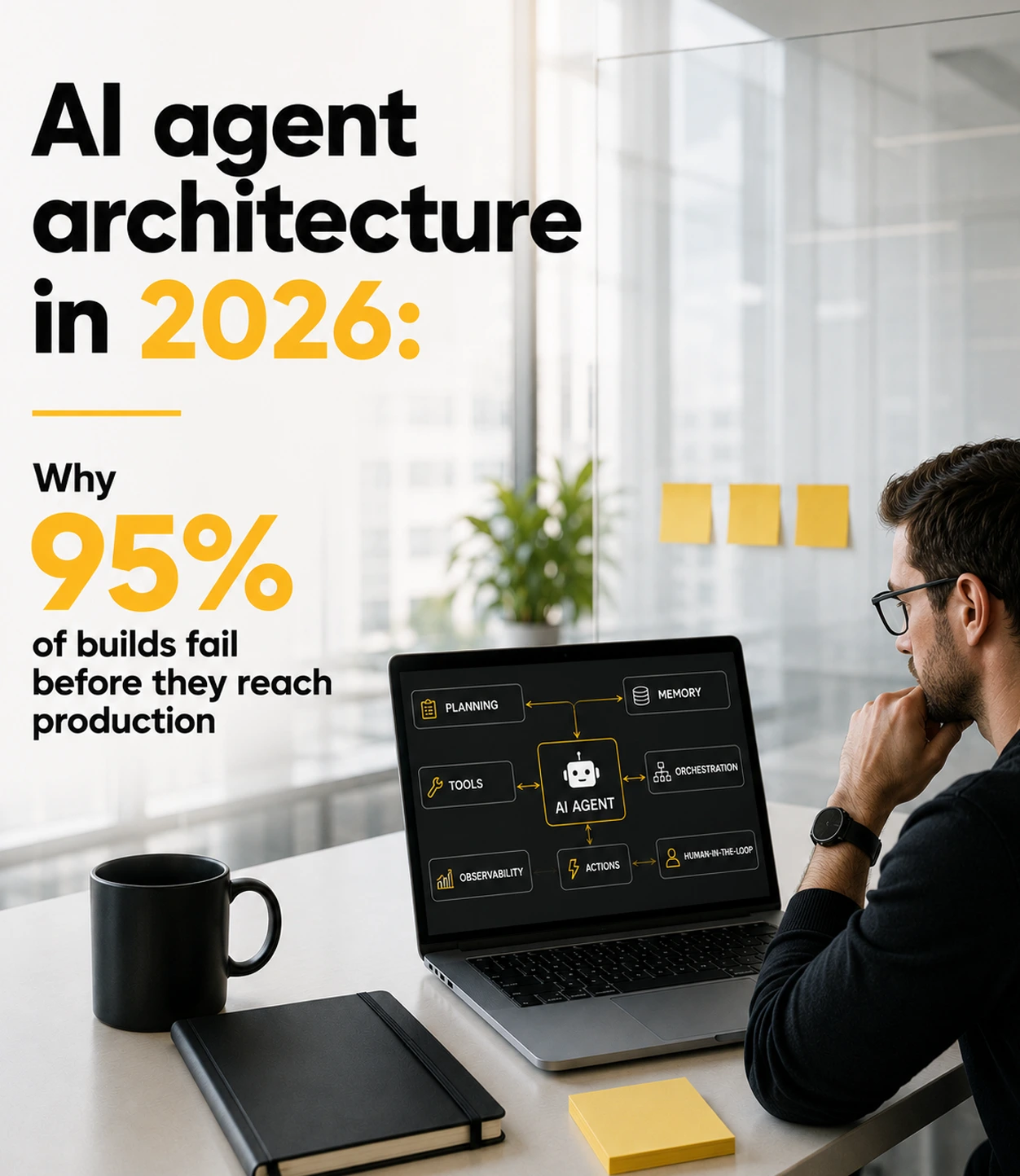
AI agents that take action, booking follow-up appointments, flagging deteriorating patients, escalating drug dosage alerts, triggering prior authorisation workflows, are beginning to replace single-task tools. BCG’s 2026 healthcare analysisidentifies AI agents as the defining shift of the next 3 years. Oracle Health Clinical AI Agent, Microsoft Dragon Copilot, and Google’s health AI suite are all moving in this direction.
Personalised medicine at scale
AI can synthesise genetic data, molecular analysis, lifestyle factors, and treatment history to recommend individual rather than population-level treatment. Brain-computer interfaces are restoring speech and movement in patients with ALS (amyotrophic lateral sclerosis), strokes, and spinal cord injuries. The combination of AI and genomics represents the clearest near-term pathway to precision medicine that works at population scale.
Addressing the health workforce shortage
With an 11 million health worker shortage projected by 2030, AI is the only scalable response available. McKinsey and Harvard estimate AI could save the US healthcare system $200 billion to $360 billion annually, with hospitals saving $60 billion to $120 billion, private payers $80 billion to $110 billion, and physician groups $20 billion to $60 billion.
How Spark Eighteen builds in healthcare
The principles in this blog are ones we apply in practice. Across our healthcare engagements, the pattern is consistent: the decisions that determine whether a platform succeeds, clinically, operationally, and from a compliance standpoint, are architecture decisions made in the first weeks, not features added at the end. With ClaritasRx, a pharma patient data analytics platform, the critical move was client-level database isolation built into the infrastructure before a single enterprise client was onboarded. With McKesson’s Glide Health, an enterprise claims processing platform, it was a microservices architecture designed to absorb continuous regulatory changes from healthcare payers without platform-wide rebuilds.
In both cases, compliance and governance came before the feature set. That sequence, architecture first, then features, is what produces healthcare platforms that scale.
AI in healthcare is not a future state — it is a present build decision
The organisations that will lead the next phase of AI in healthcare are not the ones waiting for the technology to mature. The technology is mature. They are the organisations building now with the right architecture: compliant from scoping, governed from the data layer up, and validated against clinical outcomes before public deployment, with the right capability type matched to the right problem from day 1.
Every health system and healthcare technology team faces the same underlying choice: treat AI as a feature to be added later, or design clinical and operational workflows with AI as a founding input. The evidence shows clearly which approach produces better clinical outcomes, better adoption rates, and stronger regulatory positioning. The question is not whether AI will transform healthcare. It is which organisations will have built the infrastructure to capture that transformation when it arrives.
If you are building a healthcare platform or scoping an AI integration for a clinical or operational workflow, reach out at coffee@sparkeighteen.com.