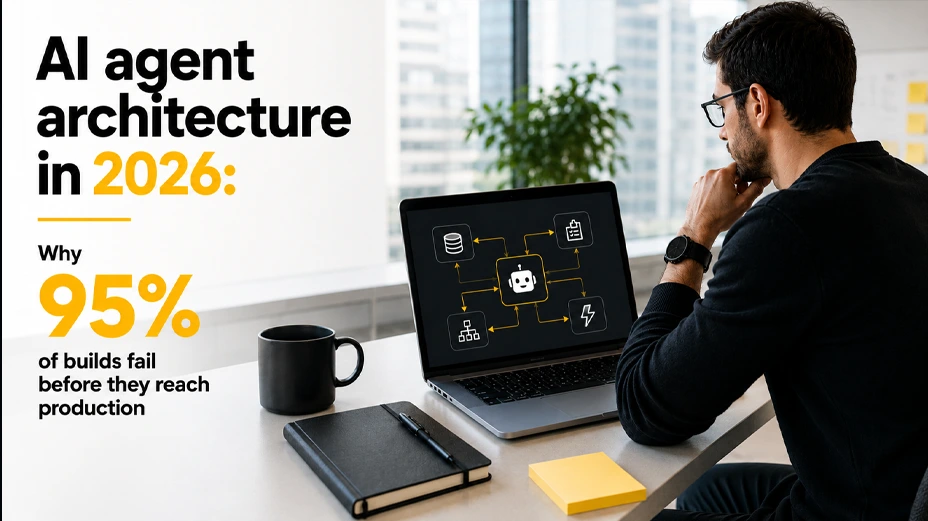
Only 5% of custom enterprise AI tools ever reach production. Not because building an AI agent is technically beyond most teams. Because teams start with frameworks before they have agreed on architecture, bolt security on after the first incident, and treat deployment as a final step rather than a design constraint. The result is a long list of impressive demos and a very short list of agents that run reliably in production.
This guide is for the engineers and product leads who want to be in that short list. It covers the agent architecture in artificial intelligence that teams are using in 2026, the 5 components you need to wire together to build an AI agent from scratch, where the Model Context Protocol fits into the stack, and the security and deployment decisions that determine whether your agent survives contact with real users.
Key takeaways
- You will understand the 4 main types of agent architecture in AI and the criteria for choosing between them before writing a line of code.
- You will learn how to build an AI agent by assembling 5 core components, and where most teams get the component boundaries wrong.
- You will see how the Model Context Protocol has changed the enterprise AI agent integration story, and why MCP tools are now a production standard.
- You will leave with a production readiness framework covering agentic AI security, observability, and human-in-the-loop design.
- You will find out which AI agent use cases are delivering the fastest, most credible returns in enterprise settings today.
What an AI agent actually is (and what it is not)
An AI agent is a software system that uses a language model as its reasoning core, connects to external tools and data sources, maintains state across multiple steps, and takes actions toward a goal without a human directing each decision. It is not a chatbot. It is not a prompt chain. It is a system with a feedback loop: perceive, reason, act, observe, repeat.
The architecture of agent in artificial intelligence has 5 essential layers: a language model backbone that drives reasoning, a memory system that preserves context across interactions, a tool layer that connects the agent to external systems, a planning module that breaks goals into steps, and an orchestration layer that sequences everything and handles failure. Remove any layer and you do not have an agent. You have a more sophisticated prompt.
This definition has a practical consequence for any AI application development team: agent design is systems design. The language model is one component, not the whole system. Teams that treat the model as the whole system are the ones producing demos that fail when exposed to real users.
Types of agent architecture in AI: 4 patterns and when to choose each
Choosing the right AI agent architecture before writing a line of production code is the single most consequential decision in the build. The 4 main types of agent architecture in AI suit different task profiles, and the wrong choice costs weeks of rework.
ReAct (Reasoning + Acting). The model alternates between a “thought” trace and a tool call, using each observation to update its next reasoning step. ReAct is the canonical general-purpose agent loop. Use it for tasks where reasoning and tool use naturally interleave, the task horizon is under 30 steps, and the goal can be expressed as a single directive. It is the right default for most single-agent builds.
Plan-and-Execute. A planning model (typically a larger frontier model) decomposes the goal into a structured task sequence, then a cheaper execution model runs each step. This separation reduces cost for planning-heavy workflows and makes long-horizon tasks more predictable. Use it when your task involves 10 or more discrete steps, the structure is knowable in advance, and cost efficiency matters.
Reflection (Reflexion). After each attempt, the model generates an explicit self-critique, which is appended to context before the next iteration. Reflection reduces repeated failure modes on complex coding, research, and analysis tasks where first-pass outputs are consistently incomplete. It adds latency and token cost, so apply it to high-value, low-frequency tasks rather than high-throughput pipelines.
Multi-agent orchestration. An orchestrator agent decomposes a goal and assigns sub-tasks to specialist worker agents. This pattern suits complex enterprise workflows where parallelisation and specialisation matter, such as multi-document processing, code review pipelines, or research synthesis. Multi-agent adds coordination overhead and increases failure surface area. Real production systems rarely start here. They promote to multi-agent when a single agent hits a genuine context or capability ceiling, not as a default architectural instinct.
The 5 components you need to build an AI agent from scratch
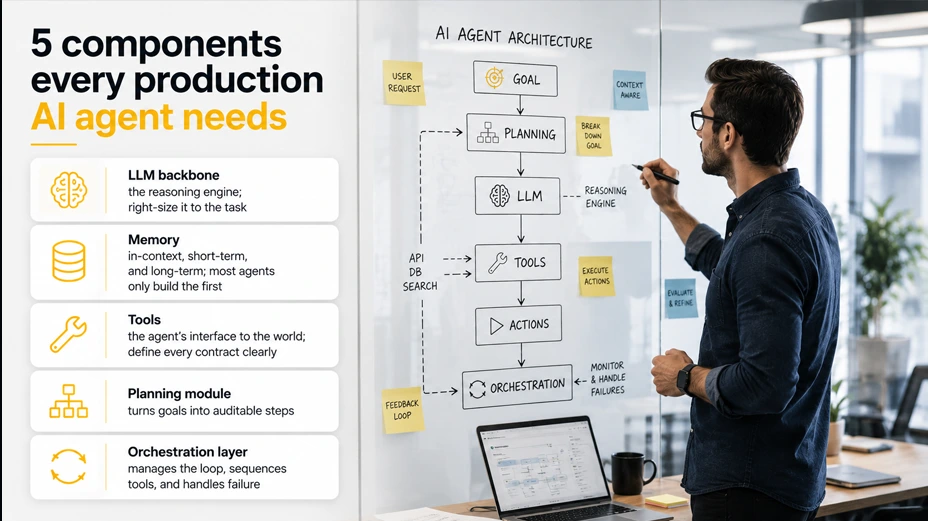
When you build an AI agent from scratch, you are assembling 5 components. Getting the boundaries between them right early is what separates agents that scale from agents that get refactored every sprint.
The LLM backbone. Your reasoning engine. For most production workflows, the largest available model is not the right model. Choose based on the task’s reasoning complexity, latency requirements, and cost at expected query volume. A fine-tuned 7 billion parameter model routinely outperforms a frontier model on narrow, well-specified tasks. Benchmark against your actual task before committing to an infrastructure stack.
Memory. Agents need 3 types: in-context memory (the current conversation window), external short-term memory (a fast key-value store or vector database for session state), and long-term memory (a persistent store for user preferences, past outcomes, and learned patterns). Most prototype agents implement only in-context memory, which is why they lose coherence across sessions. Long-term memory is what makes an agent genuinely useful over time, not just over a single interaction.
Tools. The agent’s interface to the world: APIs, databases, code execution environments, file systems, and web search. Each tool needs a narrow, well-defined contract: a name, a description the model can reason about, typed inputs, and typed outputs. Poorly described tools are a primary cause of tool misuse in production. This is the component where the Model Context Protocol (MCP) has had the most immediate impact.
Planning module. For simple agents, the model’s own chain-of-thought is sufficient planning. For multi-step workflows, an explicit planner improves consistency and makes the agent’s behaviour more auditable. The planner produces a structured task list; the key design decision is how much replanning to allow when an execution step fails, and how that failure is surfaced to the orchestration layer.
Orchestration layer. This manages the agent loop: routing observations back to the reasoning step, managing tool call sequencing, enforcing timeouts, and handling errors gracefully. LangGraph and LlamaIndex Workflows are the 2 most production-ready orchestration options as of mid-2026. Both support streaming, persistence, and interrupt-and-resume patterns that are non-negotiable for enterprise AI agents operating at scale.
Model Context Protocol: why MCP tools have become a production standard
The Model Context Protocol is an open standard introduced by Anthropic in November 2024 to standardise how AI systems connect to external tools, data sources, and services. Before MCP, every tool integration was bespoke: a different authentication scheme, a different context format, a different error contract. Building a production agent meant maintaining a library of one-off connectors that broke every time an upstream API changed.
MCP defines a common wire protocol between an AI host (the agent) and MCP servers (tool providers), so any MCP-compatible agent can connect to any MCP-compatible tool without custom integration code. The adoption curve has been steep: MCP downloads grew from roughly 100,000 in November 2024 to over 8 million by April 2025. OpenAI, Google, Microsoft, and AWS have all adopted the standard, which is now governed by the Linux Foundation.
For teams building enterprise AI agents, MCP tools deliver 3 practical advantages. First, the integration catalogue grows every week: file systems, GitHub, Slack, databases, CRMs, and internal APIs all have MCP servers either available or in active development. Second, MCP’s structured tool description schema improves the model’s ability to select and call tools correctly, because tool descriptions follow a consistent contract rather than being ad hoc strings embedded in a system prompt. Third, MCP shifts the security model: because each MCP server operates as a discrete, permissioned service, you can enforce least-privilege access at the server level. That last point is the one most teams underestimate until they have had their first production incident.
Agentic AI security: the architectural constraint most teams skip
Agentic AI security is not a feature you add before launch. It is a design constraint you build around from the first architecture session. The reason: once an agent can take real-world actions, the attack surface changes category. You are no longer defending a chat interface. You are defending a system with credentials, tool access, and the ability to write to production systems.
The 3 most dangerous threats in production are prompt injection, memory poisoning, and privilege escalation. Injection attempts against enterprise AI systems increased 340% year-over-year in late 2025. Indirect attacks, where malicious instructions are embedded in external content the agent reads rather than in direct user input, now account for over 55% of observed incidents. Any agent that reads emails, documents, or web pages is an agent that can be instructed by the content of those sources.
Memory poisoning is rarer but more persistent. An attacker implants false information into the agent’s long-term memory store, which the agent recalls and acts on in future sessions without any further attack required. Unlike prompt injection, a memory poisoning attempt does not need repeating once it succeeds.
Despite this, only 29% of enterprises report feeling prepared to secure their agentic AI deployments. The gap between deployment ambition and security readiness is where most production incidents originate.
The minimum viable security posture for any production agentic AI deployment has 4 non-negotiable components: a sandboxed execution environment for tool calls, least-privilege credentials for every external service the agent connects to, a complete audit log of every action and the reasoning trace that produced it, and a human confirmation gate on any irreversible action above a defined risk threshold. These controls belong in the architecture from the first sprint, not in the remediation plan after an incident.
From AI rapid prototyping to production: deployment patterns that hold
AI rapid prototyping for agents is genuinely fast now. A single engineer can wire together a working ReAct agent with tool calls in an afternoon. McKinsey reports that generative AI reduces development time by 30 to 50%. The problem is not building the prototype. It is the gap between a working demo and a production agent that handles thousands of real sessions, maintains state, fails gracefully, and generates a complete audit trail.
3 patterns separate agentic AI deployment that holds from deployment that collapses under load.
Observability before business logic. Instrument every agent step before you write workflow code. You need traces that show which tool was called, with what arguments, what it returned, and how the model reasoned from that output. Without this, debugging production failures is archaeology. LangSmith, Arize, and Weights and Biases all offer agent-level tracing that integrates with major orchestration frameworks.
Human-in-the-loop by design. For any action that is irreversible or high-stakes, build a confirmation step before the agent executes. Define exactly which actions the agent runs autonomously, which require confirmation, and which always escalate to a human. Document this contract before go-live, not after the first escalation failure.
Incremental scope. Deploy for a single workflow, measure task completion rate and failure modes, then expand incrementally. McKinsey’s 2025 AI survey found that organisations that redesign end-to-end workflows before selecting modelling techniques are twice as likely to report significant financial returns. The converse is also true: agents scoped too broadly at launch are the ones contributing to the 46% of proofs-of-concept that get scrapped before they ship.
At Spark Eighteen, we worked with a fintech company building a document processing agent to automate loan application review. The initial design called for a 7-agent multi-agent system with specialist agents for each document type. We recommended starting with a single ReAct agent equipped with 3 tools: a document parser, a compliance rules database, and an exception logger. That agent reached production in 6 weeks and handled 80% of the target volume with measurable accuracy. The multi-agent architecture is now in scope for the next phase, designed from real production data rather than from assumptions.
Where enterprise AI agents are delivering measurable returns
The AI agent use cases delivering the fastest, most credible returns in production today fall into 3 categories. Understanding where enterprise AI agents work well is as important as understanding how to build them.
Document-intensive workflows. Invoice processing, contract review, loan application triage, and insurance claims are all strong candidates. An agent can extract structured data, cross-reference rules, flag exceptions, and pass a decision to a human reviewer at a fraction of the cost and time of a manual process. Klarna’s AI agent saved the company $60 million and handled the workload of 853 full-time employees by Q3 2025.
Developer tooling and code operations. Agents that automate code review, test generation, documentation, and dependency analysis deliver measurable productivity gains without requiring changes to how developers work. Teams using AI in their development workflow report up to 40% productivity improvements on routine engineering tasks.
Customer operations. Conversational enterprise AI agents connected to CRM, ticketing, and knowledge base systems handle tier-1 support, order status, and account queries at scale. The qualification: these agents need robust escalation logic. Any system that traps users in unhelpful loops destroys more trust than it creates.
Research puts the average enterprise return from agentic AI deployments at 171%, with 74% of executives reporting ROI within the first year. The organisations achieving these numbers share a pattern: they start with a specific, measurable workflow, deploy narrow, and expand on production evidence.
Architecture first. Everything else follows.
Gartner predicts that 40% of agentic AI projects will be cancelled by 2027 due to high costs, unclear business value, or inadequate risk controls. The pattern in the projects that survive is consistent: they start narrow, instrument everything, treat agentic AI security as a structural constraint rather than a launch checklist item, and expand scope on evidence from production data.
When you build AI agent systems for enterprise deployment, the technology is rarely the limiting factor. The limiting factor is the discipline to define a specific workflow, choose the architecture that fits it, connect the right tools with the right permissions, and ship something that runs reliably under real load. AI product engineering at this level is not about using the most sophisticated model or the most complex orchestration pattern. It is about matching the right design to the right problem, and knowing when simpler is more durable.
If you are scoping an agent project and want a second opinion on architecture, tool selection, or the prototype-to-production path, we are happy to think it through with you: coffee@sparkeighteen.com.