Federal agencies reported 3,611 AI use cases in 2025, a 105% increase from 2024’s 1,757 reported cases. (Source: Government Executive) That surge reflects something more significant than adoption hype: it is the point at which AI agents moved from experiment to operational infrastructure.
Gartner predicts that 40% of enterprise applications will integrate task-specific AI agents by the end of 2026, up from less than 5% today. (Source: Gartner) These autonomous AI agents move well beyond simple chatbots to orchestrate complex, multi-step workflows across departments, systems, and data sources without requiring a human at every handoff.
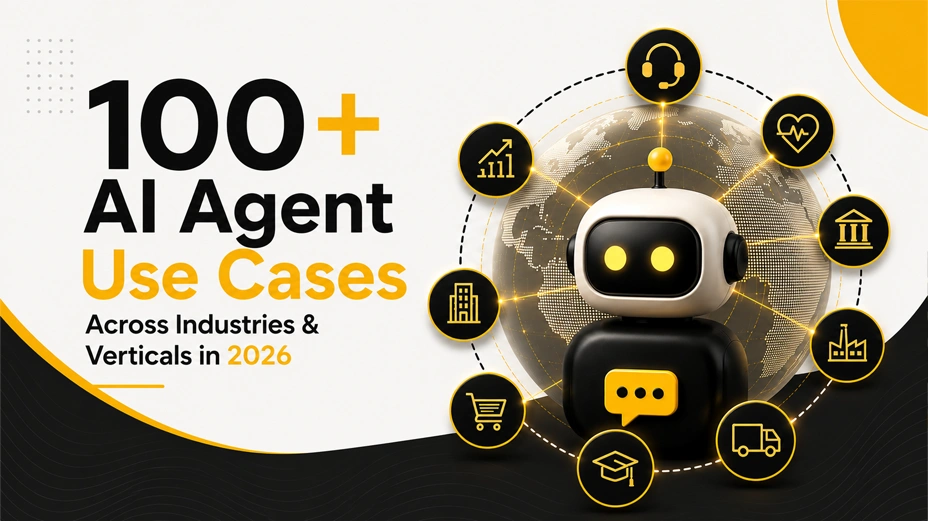
The AI agents market crossed $10 billion in 2026, and the AI agent use cases behind that number are not pilots anymore. They are live systems handling real volume across thousands of enterprise environments. This guide breaks down 100+ real AI agent use cases across industries, organized by vertical and function, with specifics on what each agent does and where autonomous agents in AI are producing the clearest return on investment.
Key Takeaways
- AI agents are not chatbots. They plan multi-step workflows, call external tools and APIs, retain context across sessions, and execute actions without per-step human direction.
- The AI agents market is projected to reach $52.62 billion by 2030 at a 46.3% compound annual growth rate (Source: MarketsandMarkets AI Agents Market Report)
- Industries seeing the fastest ROI from enterprise AI agents share two traits: high transaction volume and structured, repeatable workflows
- Multi-agent AI systems, where specialized agents collaborate under an orchestrator, are the architecture most enterprises are moving toward for complex workflows
- Organizations that start with one narrow use case, prove ROI, and expand incrementally consistently outperform those that deploy agents as a general-purpose solution
What Makes an AI Agent Different from a Chatbot?

Before diving into AI agent use cases, this distinction matters for setting expectations correctly.
A chatbot responds to a single prompt with a single output. It operates within one interface, follows predefined scripts, and fails or deflects when inputs fall outside its rules. An AI agent receives a goal, perceives its environment through tool outputs and data feeds, decides what action to take next, executes that action across external systems, observes the result, and repeats the process until the goal is achieved.
That perceive-decide-act loop, executed autonomously across multiple steps and multiple systems, is what makes AI agent use cases in enterprise settings qualitatively different from any prior automation technology.
The strongest agent architecture in AI for enterprise deployments today is the multi-agent system: multiple specialized agents, each handling a specific subtask, coordinated by an orchestrating agent that manages handoffs. A multi-agent system in AI for sales pipeline management, for example, might include a research agent, a scoring agent, a copywriting agent, and a scheduling agent, all executing autonomously under a single coordinator.
100+ AI Agent Use Cases by Industry Vertical
1. Customer Service and Support (15 Use Cases)
AI for customer support agents is one of the most mature deployment areas in 2026. Autonomous agents now handle 15 distinct support workflows, achieving 80% or higher automation in high-volume contact centers.
- Autonomous ticket resolution via chat, email, and phone
- Real-time order status tracking and proactive shipping delay notifications
- Return and refund processing with CRM and inventory update in a single sequence
- Technical troubleshooting and step-by-step diagnostics with escalation logic
- Account management, password resets, and credential updates across identity systems
- Subscription management: plan upgrades, pauses, billing disputes, and invoice generation
- Appointment scheduling, confirmations, reminders, and rescheduling (reducing no-show rates by 30 to 40%)
- FAQ responses powered by real-time knowledge base search and dynamic updates
- Complaint routing, SLA tracking, and supervisor alerts for at-risk tickets
- Proactive churn prevention: disengagement signal detection and personalized retention offers
- Post-purchase follow-up and CSAT collection with negative-response routing to account managers
- Product recommendations based on browsing behavior, purchase history, and live inventory
- Multilingual support across 100+ languages without dedicated regional staff
- Sentiment analysis with real-time response-style adaptation and frustration escalation
- AI voice agents handling inbound calls with live transcription and CRM update on completion
AI for customer support agents reduces average call handling time by up to 25% and call transfers by up to 60% in production deployments.
2. Sales and Marketing (12 Use Cases)
AI agent use cases in sales span the full revenue cycle. Multi-agent AI systems running across CRM, email, and social channels personalize outreach at a scale no human team can match.
- Lead qualification and scoring based on engagement signals, firmographics, and behavioral data
- Personalized outbound email sequences with tone adjustments based on response patterns
- AI voice agents conducting outbound calls, qualifying prospects, and booking meetings directly into rep calendars
- CRM enrichment: pulling data from LinkedIn, company sites, and intent platforms automatically
- Proposal and contract drafting assembled from pricing, scope templates, and client-specific CRM data
- Multi-channel follow-up automation across email, LinkedIn, and SMS with cadence adjusted per prospect behavior
- Social media engagement, brand mention monitoring, comment responses, and campaign scheduling
- Ad copy, social captions, and campaign brief generation aligned to brand voice and historical performance data
- A/B test orchestration: variant design, performance monitoring, winner determination, and real-time campaign application
- Dynamic pricing adjustments based on competitor pricing, demand signals, and inventory levels
- High-intent visitor detection, personalized offer triggering, and live lead scoring model updates
- Account-based marketing coordination across content delivery, ad targeting, and multi-channel outreach sequences
3. Supply Chain and Logistics (10 Use Cases)
Autonomous AI agents in the supply chain reduce working capital, shrink delivery windows, and improve supplier performance without adding headcount. Logistics teams using coordinated agent systems have cut delays by up to 40%.
- Demand forecasting using sales history, seasonal trends, and external market signals
- Inventory rebalancing across warehouse locations to prevent stockouts and overstock simultaneously
- Supplier performance monitoring with automated scorecards and underperformer flagging
- Procurement automation: RFQ drafting, vendor distribution, and response logging without manual SDR effort
- Real-time shipment tracking with proactive exception notifications and logistics partner rerouting
- Last-mile route optimization processing live traffic, package priority, vehicle capacity, and delivery windows
- Warehouse task assignment based on operator location, workload, and order priority for maximum shift throughput
- Aging inventory identification with automated markdown recommendations pushed to pricing engines
- Quality control scheduling, inspector assignment, result logging, and hold/rejection flagging
- Production schedule optimization balancing machine availability, order priority, and material supply
4. Healthcare and Life Sciences (9 Use Cases)
Enterprise AI agents in healthcare take on documentation, scheduling, and clinical decision support, targeting the workflows that cost providers the most in staff time. Clinical documentation automation alone cuts documentation time by 50 to 70% per patient visit.
- Clinical documentation automation from EHR data, cutting provider documentation time by 50 to 70%
- Patient scheduling, automated reminders, and rescheduling with up to 40% reduction in no-show rates
- Care coordination across providers and specialists: referral routing, record sharing, and care plan tracking
- Remote patient monitoring: wearable data processing, anomaly detection, and care team alerts
- Diagnostic assistance: cross-referencing symptoms, lab results, and clinical guidelines for physician review
- Medical literature analysis for research teams across PubMed, clinical databases, and peer-reviewed journals
- Revenue cycle management: insurance eligibility verification, claims scrubbing, denial workflows, and reimbursement follow-up
- Drug discovery workflow automation: molecular data processing, literature review, and candidate compound identification
- Clinical trial participant matching: EHR screening against trial eligibility criteria and recruitment coordination
5. Financial Services and Banking (11 Use Cases)
Approximately 70% of financial institutions are already using AI agents for fraud detection and risk analysis, making BFSI one of the earliest and most mature agentic deployment verticals. (Source: Nevermined: AI Agents in Financial Services)
- Real-time fraud detection: transaction pattern analysis, anomaly flagging, and millisecond-level blocking
- Credit underwriting: income analysis, credit history processing, and approval recommendations in minutes rather than days
- KYC compliance and identity verification: document collection, cross-check against regulatory databases, cutting KYC time from days to hours
- Portfolio rebalancing and investment recommendations aligned to client risk profiles and live market data
- Payment reconciliation: invoice-to-PO matching, discrepancy identification, exception routing, and accounting system posting
- Regulatory reporting: data extraction, compliance rule validation, and report generation with complete audit trails
- Market analysis and trade execution within pre-approved parameters using real-time price and volume data
- Customer financial advisory: spending pattern analysis, scenario modeling, and personalized budget recommendations
- Insurance claims assessment: submission processing, coverage validation, AI-based damage assessment, and payout decisioning
- Risk scoring and predictive modeling across customer and counterparty portfolios updated continuously
- Expense categorization, budget tracking, and policy violation flagging without any manual data entry
6. Retail and E-Commerce (8 Use Cases)
Autonomous agents in AI for retail generate compounding gains as transaction volume scales. The strongest deployments in this vertical show a 15 to 30% lift in revenue per visitor through real-time personalization.
- Personalized product recommendations across web, app, and email using purchase history and affinity signals
- Dynamic pricing based on competitor data, demand velocity, and margin targets within approved ranges
- Inventory forecasting and automated restocking based on sales velocity, lead times, and seasonal factors
- Shopping cart abandonment recovery: timed email and SMS sequences with personalized incentives by cart value
- Virtual shopping assistance: conversational product search, specification answers, and out-of-stock alternatives
- Order fulfillment coordination: optimal fulfillment location determination and real-time cross-channel status updates
- Customer loyalty program management: points calculation, reward notifications, VIP identification, and retention offers
- In-store staff scheduling: foot traffic analysis, historical sales data, and optimized shift generation per location
7. Manufacturing and Operations (8 Use Cases)
Enterprise AI agents in manufacturing process sensor streams and operational data to intervene before failures compound. Predictive maintenance scheduling alone reduces unplanned downtime by 20 to 30% in production deployments.
- Predictive maintenance: sensor data analysis, degradation pattern identification, and maintenance scheduling before failure
- Production line optimization: throughput monitoring, bottleneck identification, and sequence recommendations for improved OEE
- Quality assurance: computer vision-based visual inspection, real-time defect flagging, and defect pattern logging
- Energy consumption monitoring and automated operational adjustments to reduce total energy costs
- Component replacement planning triggered by run data, with procurement workflows ahead of projected failure windows
- Safety compliance monitoring via sensor and video feeds, real-time supervisor alerts, and automated incident documentation
- Supply chain disruption simulation using live supplier data with alternative sourcing recommendations
- Workforce skill matching and dynamic task assignment per shift based on certifications and coverage gap identification
8. Human Resources and Talent (7 Use Cases)
AI agents absorb the volume-driven processes that dominate recruiter and HR generalist schedules, freeing teams for strategic and relationship-intensive work.
- Resume screening and ranked candidate shortlisting against defined job criteria without any manual CV review
- Interview scheduling and rescheduling coordination across candidates and interviewers through integrated calendar systems
- Personalized onboarding sequences: document tracking, IT provisioning triggers, and role-specific training module assignment
- Performance review data aggregation across HR systems with structured manager summaries
- Benefits enrollment guidance in natural language with direct processing in HR platform systems
- Offboarding coordination and exit interview analysis surfacing attrition pattern insights for HR leadership
- Workforce analytics and attrition prediction using engagement scores, tenure data, and behavioral signals
9. Legal and Compliance (6 Use Cases)
Agent-assisted legal teams cut contract review and due diligence hours by 60 to 80% per matter. These are the highest-leverage AI agent use cases in professional services.
- Contract review and clause extraction: non-standard language flagging and obligation/risk term summaries for attorney review
- Legal research: case database search, precedent identification, and research summaries reducing attorney time by 60 to 70% per matter
- Due diligence: document classification, extraction, and summarization accelerating M&A timelines from weeks to days
- Regulatory change monitoring: publication tracking, change identification, and impact assessment generation for compliance leadership
- Compliance workflow automation with complete decision-step documentation and audit trails across regulated processes
- Intellectual property search, prior art compilation, and filing documentation preparation assistance
10. Real Estate and Construction (8 Use Cases)
These AI agent use cases span the property transaction lifecycle. Agents reduce manual coordination time in markets where document accuracy and speed determine whether deals close.
- MLS-ready listing description generation from property data, comparable sales, and photos
- Buyer and seller lead qualification through conversational assessment with high-intent routing
- Automated valuation models aggregating comparable sales, market trends, and property attributes
- Virtual property tour scheduling with agent availability confirmation and post-tour follow-up
- Contract review: clause flagging, non-standard term identification, and critical deadline tracking
- Permit application coordination: requirement identification, package compilation, and approval delay flagging
- Construction submittal organization and version-controlled document repository management
- Subcontractor credential verification, insurance and license compliance checks, and scheduling coordination
11. Education and Training (5 Use Cases)
Institutions deploying AI agents report faster inquiry response times, higher application completion rates, and measurable reductions in faculty administrative load.
- Student inquiry and admissions support without requiring admissions staff involvement
- Personalized learning path recommendations based on student performance data and stated objectives
- Structured assignment grading with rubric-based feedback generation and borderline submission flagging for instructor review
- Course scheduling optimization using enrollment demand, instructor availability, and room capacity data
- Faculty administrative task automation: room booking, equipment scheduling, and document processing
12. Travel and Hospitality (6 Use Cases)
In hospitality, these AI agent use cases directly affect guest satisfaction scores and repeat booking rates. Agents run 24 hours a day across chat and AI voice agents channels with zero hold time.
- Guest inquiry handling via chat and voice across property details, local recommendations, and pre-arrival questions
- Reservation modification processing with rate rule application and updated confirmation delivery
- Concierge services: restaurant, activity, and transportation suggestions based on guest profiles and live availability
- Complaint detection, service recovery workflow initiation, and unresolved case escalation to property management
- Dynamic room pricing and yield optimization using demand signals, competitor rates, and occupancy forecasts
- Post-stay feedback collection with sentiment analysis and property-level operational insight reporting
13. Government and Public Sector (4 Use Cases)
Government agencies face the highest-volume citizen service workloads of any vertical. These AI agent use cases help public sector organizations process more service requests without adding headcount.
- Citizen service request triage, eligibility verification, routing, and automated status updates
- Benefits eligibility assessment, documentation collection, and enrollment processing for government programs
- Permit and license application intake, completeness checking, compliance validation, and approval tracking
- Public dataset aggregation, policy scenario modeling, and evidence-based impact report generation
What Separates Deployments That Deliver ROI from Those That Stall

Most failed agentic deployments share the same profile: they were too broad to start, lacked clean underlying data, and had no defined success metric before launch. Successful AI agent use cases share five characteristics:
- One specific workflow to start: Not “improve customer experience.” Something like: handle tier-1 billing queries autonomously, with escalation when the disputed amount exceeds $500.
- Clean, accessible data: Agents deployed on fragmented data produce fragmented outputs regardless of how well-designed the agent architecture in AI is.
- Defined escalation rules before launch: Which decisions does the agent make alone, and which require a human? This governance structure is what allows agents to scale without creating liability exposure.
- A baseline measurement: Time per task, cost per task, and error rate before the agent. Without a baseline, you cannot demonstrate improvement.
- An iteration cadence: The first deployment surfaces edge cases. Build in a structured review cycle from week one.
Conclusion
AI agent use cases in 2026 are no longer experimental. They are production systems delivering measurable outcomes across 100+ business functions and 13+ industry verticals. The organizations that start narrow, prove ROI fast, and expand methodically build compounding efficiency advantages that widen quarter by quarter. The difference between companies deploying autonomous AI agents and those still evaluating is increasingly visible in operational metrics, response times, and cost-per-transaction comparisons.
Autonomous agents in AI represent a genuine shift in how business processes can be structured. The teams building the operational foundations now, selecting specific use cases, measuring baselines, and iterating on real deployments, are the ones who will be best positioned as the competitive differentiation of agent capability becomes more pronounced.
If you need help identifying the right AI agent use cases for your industry or want to build a deployment roadmap, you can reach out at coffee@sparkeighteen.com.