A single training run for a large language model can generate roughly the equivalent carbon emissions of 5 average cars driven across their entire lifetimes. That figure, from Strubell et al. (2019) at the University of Massachusetts Amherst, still anchors most discussions about the carbon footprint of AI. What tends to go unsaid: for models with millions of daily active users, inference has already overtaken training as the dominant source of cumulative emissions. Every search query, generated document, and real-time API response is a small but relentless addition to the running total.
Understanding the environmental impact of AI clearly, without exaggeration or dismissal, is now a practical business requirement. Enterprise teams face growing pressure from regulators, investors, and their own sustainability commitments to account for the AI impact on the environment across their product portfolio. The decisions you make when selecting a model, choosing infrastructure, and designing an AI workflow carry measurable consequences for your carbon profile, your operating costs, and the credibility of your ESG (Environmental, Social and Governance) reporting.
This piece covers both sides: what drives AI emissions and what genuinely reduces them.
Key takeaways
- You will understand the 4 sources of the carbon footprint of AI: training, inference, hardware manufacturing, and data centre cooling.
- You will learn how the AI carbon footprint differs meaningfully by model type, and why generative AI applications carry a substantially heavier load per query than task-specific alternatives.
- You will see how the environmental impact of AI compounds with scale, including water and land use data most product teams have never encountered.
- You will find out how AI to reduce carbon footprint is already deployed at scale in energy, logistics, and materials science, with numbers from credible research.
- You will leave with a practical, decision-level framework for responsible deployment that applies to any team building AI-powered tools today.
What actually drives the carbon footprint of AI
The carbon footprint of AI breaks into 4 main sources: the energy consumed during model training, the ongoing energy of inference at scale, the embodied carbon in manufacturing hardware such as graphics processing units (GPUs) and tensor processing units (TPUs), and the energy and water used for data centre cooling. Training gets the headlines because the figures are large and vivid, but it is a one-time event. Inference runs continuously, and for any AI systems operating at significant adoption levels, their cumulative emissions share eventually outgrows training by a wide margin.
Hardware is the least discussed contributor. The manufacturing of a single high-performance GPU already carries substantial embodied carbon before it processes its first query. At the scale of a large data centre, where racks are dense and hardware refresh cycles are short, hardware production represents a meaningful and often unaccounted share of the total impact of AI on the environment. Chip manufacturers rarely publish full lifecycle carbon assessments, but the number is far from negligible.
Cooling connects the carbon question directly to local communities, not just global emissions totals. By 2030, the United Nations University Institute for Water, Environment and Health (UNU-INWEH) projects the global water footprint of AI data centres could reach 9.3 trillion litres annually, equivalent to the domestic water needs of all 1.3 billion people in Sub-Saharan Africa. These are not distant projections: they are active considerations in site selection decisions, environmental permitting, and community relations for every major operator building today.
Training vs inference: where the AI carbon footprint really accumulates
Training a large language model (LLM) is compute-intensive by design. The model processes enormous datasets over weeks or months, adjusting billions of internal parameters with each pass. GPT-4’s training run consumed an estimated 50+ gigawatt-hours of electricity, with carbon emissions estimated at between 1,000 and 14,000 tonnes of CO₂edepending on the data centre’s energy source, the range illustrating just how much infrastructure location matters. These concentrated energy events are schedulable: teams can time training runs to coincide with periods of high renewable energy availability on the grid.
Inference is structurally different. A production AI system responds to user queries in real time, continuously, across distributed infrastructure that must remain available regardless of grid carbon intensity or time of day. A 2025 scoping review of generative AI applications and their lifecycle emissions found that inference can surpass training as the dominant lifetime emissions source within weeks of launch for widely deployed models, simply due to cumulative usage volume at scale.
The type of inference task matters considerably as well. A Sora 2 video generation request consumes roughly 1 kilowatt-hour, emits approximately 466 grams of CO₂e, and uses 4 litres of water per output, based on a late 2025 analysis cited in The Conversation. A standard text completion runs at a fraction of that cost. The AI carbon footprint of any product is therefore shaped primarily by which tasks are being automated, how frequently users trigger them, and whether the team has selected the lightest capable model for each use case.
The environmental impact of AI at scale
The environmental impact of AI is growing faster than almost any other technology sector. Global data centre electricity demand rose by 17% in 2025, against just 3% growth in overall global electricity demand, according to the International Energy Agency (IEA). The IEA projects that total data centre electricity consumption will reach 945 terawatt-hours by 2030, up from 415 terawatt-hours in 2024: roughly equivalent to Japan’s current annual electricity consumption.
The aggregate AI impact on environment extends well beyond electricity. US data centres used approximately 17 billion gallons of water directly in 2023, with an estimated further 211 billion gallons consumed indirectly through electricity generation, according to an analysis citing Lawrence Berkeley National Laboratory (2024). As AI-focused facilities multiply and GPU rack power densities increase, regional water stress is becoming an operational and reputational risk, not a concern to be addressed at a later planning stage.
The impact of AI on environment also includes land use and localised thermal effects. A preliminary 2026 study using 20 years of NASA satellite data found that data centre heat islands can raise surrounding land temperatures by as much as 16 degrees Fahrenheit, with temperature effects recorded up to 6 miles from some sites. The study is awaiting peer review and findings may be refined, but the direction of effect is consistent with the known thermodynamics of dense compute facilities.
None of this argues against building AI. It argues for building it with the same rigour applied to any infrastructure decision with lasting and compounding consequences.
Why generative AI applications carry a heavier environmental load
Not all AI-powered tools carry the same environmental cost. A narrow, task-specific classifier routing support tickets uses a fraction of the compute of a foundation model generating free-form responses. Generative AI applications, whether large language models producing text or diffusion models generating images, sit at the high end of the energy-per-query spectrum because they produce outputs token by token or pixel by pixel, rather than selecting from a fixed set.
Benchmarking published by Google (0.03 grams CO₂e per median text prompt) and Mistral (1.14 grams CO₂e per query) illustrates a spread of more than 30 times between the most and least efficient generative systems, for the same notional user action. At 10 million daily queries, that gap represents a significant difference in annual emissions and in infrastructure operating costs.
The AI carbon footprint of these models is also harder to measure because it is distributed across hardware types, grid energy mixes, cooling methods, and regional carbon intensities. A model running in a coal-powered data centre can emit 10 times more carbon per query than the identical model in a renewable-powered facility, independent of any model-level optimisation. The AI impact on the environment from any given product cannot therefore be assessed at the model level alone: infrastructure location and energy source are equally determinative.
How to reduce the environmental impact of AI in your product decisions
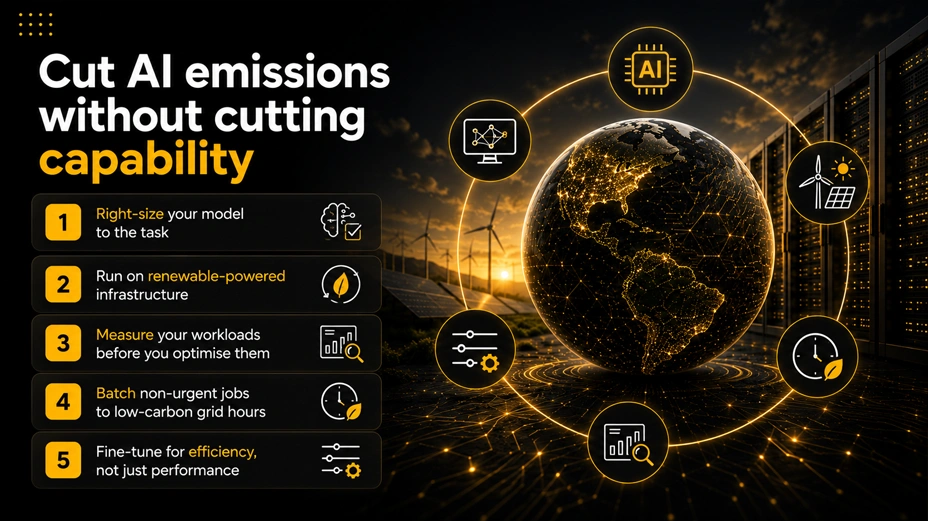
Reducing the environmental impact of AI in a product is shaped by a small number of architecture decisions made early in the build. Getting them right lowers both emissions and infrastructure cost, often by a substantial margin.
Select the smallest capable model for each task. Over-specifying is the most common source of unnecessary emissions in AI products. A retrieval-augmented generation (RAG) pipeline for customer support does not need a 175 billion parameter model to answer routine queries accurately. Benchmarking smaller, fine-tuned models against actual task requirements before committing to a large foundation model is standard practice for any production system AI deployment that takes cost and sustainability seriously. When building AI applications for production, the habit of defaulting to the most capable available model is expensive and frequently unnecessary.
At Spark Eighteen, we worked with an e-commerce platform building an AI recommendation and support system. The initial architecture defaulted to a large frontier model for every interaction, including straightforward FAQ lookups that a purpose-built classifier could handle at a fraction of the compute. Reconfiguring the pipeline to route queries by complexity, and reserving the large model for genuinely open-ended interactions, reduced inference costs by more than 60% and cut the estimated carbon output for those workloads proportionally. The user experience remained unchanged.
Choose infrastructure with a credible renewable energy commitment. The same model on a coal-powered grid versus a renewable-powered one carries an order-of-magnitude difference in the impact of AI on the environment. Major cloud providers publish carbon-free energy percentages by region: this is a first-order infrastructure decision, not a secondary sustainability consideration.
Build measurement in from the start. Most teams building AI-powered tools have no baseline for the carbon intensity of their AI workloads. Tools such as CodeCarbon, cloud provider sustainability dashboards, and emerging production-level AI carbon accounting frameworks make this measurable. You cannot optimise what you have not measured.
Batch non-urgent workloads. Scheduling compute-heavy AI jobs during low-carbon grid hours, when renewable supply is higher, is a practical intervention that requires no changes to the model or the product. It is already standard practice among well-run AI operations teams.
Prioritise model efficiency over raw capability. Model distillation, quantisation, and task-specific fine-tuning can preserve 90%+ of performance at a fraction of the compute and carbon cost. For any AI product in sustained operation, a regular review of model selection against actual task requirements is a cost and sustainability discipline worth building into your engineering cadence.
Using AI to reduce carbon footprint: the other side of the equation
The narrative around AI and climate tends to stop at the cost side. The opportunity side is substantial, already operational, and frequently understated.
AI to reduce carbon footprint has the most credible evidence base in energy, logistics, and materials science. Research published in Nature’s npj Climate Action by the Grantham Research Institute (LSE) and Systemiq estimates that AI applications could reduce global annual emissions by 3.2 to 5.4 billion metric tonnes of CO₂e by 2035, a reduction larger than the European Union’s entire current annual output.
In energy management, AI-powered tools are being used to optimise renewable grid dispatch, improving the integration of intermittent solar and wind generation. DeepMind trained a neural network on historical weather and turbine data to predict wind power output 36 hours in advance, increasing the economic value of that wind energy by 20%. This allows renewable output to be committed to the grid more predictably, reducing dependence on carbon-intensive backup generation.
In logistics and manufacturing, AI applications for route optimisation, demand forecasting, and load planning reduce fuel consumption across enormous transaction volumes. Efficiency gains in global supply chain routing have a compounding effect at scale: even marginal improvements translate into significant avoided emissions across millions of shipments.
In climate research and materials science, AI to reduce carbon footprint is being applied to accelerate the discovery of new battery chemistries, improve carbon capture system design, and advance climate modelling at a pace that would have taken human researchers decades to replicate.
Using AI to reduce carbon footprint is not a rebuke to concerns about AI’s own emissions. It is the reason responsible deployment matters: the same technology that can be a net positive for the climate, built without regard for its own footprint, compounds the problem it is trying to solve.
The AI carbon paradox: the tool creating the problem may be the best instrument for solving it
The carbon footprint of AI is not a fixed property of the technology. It is the product of decisions made at architecture time: which model, which infrastructure, which energy source, which workload routing logic. Teams that treat these as engineering constraints alongside performance and cost will build products that are cheaper to run, more defensible under scrutiny, and better positioned as scrutiny of AI’s environmental costs intensifies among regulators and enterprise buyers.
The organisations building the most durable AI products are not necessarily those with the largest models. They are the ones that match capability to task requirement, measure what they deploy, and treat energy efficiency as a first-class engineering concern from the start.
If you are navigating AI architecture decisions and want to think through the sustainability angle alongside performance, cost, and scalability, Spark Eighteen has found that these conversations produce better outcomes before infrastructure commitments lock in a trajectory that is difficult to revisit. Start that conversation at coffee@sparkeighteen.com.