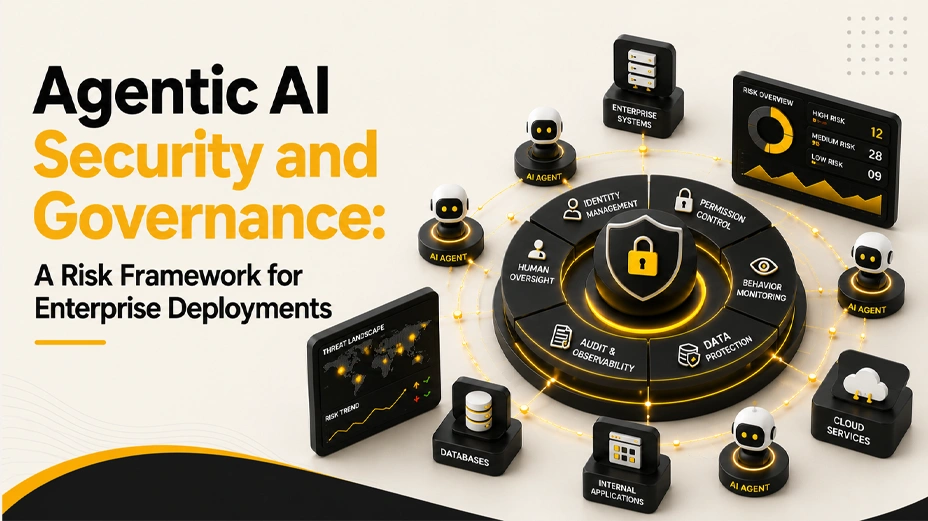
When most security teams think about AI risk, they picture a chatbot giving a wrong answer. Agentic AI is a different problem entirely. These are systems that log into live enterprise APIs, retain memory across sessions, plan multi-step actions without a human reviewing each step, and operate inside pipelines alongside other autonomous agents. A 2025 EchoLeak exploit (CVE-2025-32711) against Microsoft Copilot showed exactly how dangerous this gets: a single engineered prompt embedded in an email triggered automatic data exfiltration with zero user interaction required. (Source: EchoLeak)
Agentic AI security is not about filtering model outputs. It is about whether your agentic AI governance framework was designed for systems that act, plan, and persist, rather than simply respond.
This guide breaks down the distinct attack surfaces autonomous agents introduce, the OWASP framework for categorizing agentic security risks, and the governance of AI controls enterprises need in place before scaling autonomous agent deployments.
Key Takeaways
- Agentic AI security differs fundamentally from traditional AI security because agents maintain memory, call external tools, and act without per-step human oversight
- The OWASP Top 10 for Agentic Applications (December 2025) identifies 15 distinct threat categories mapped to specific architecture components: memory, planning, tool usage, and inter-agent communication
- Only 42% of executives balance AI development with appropriate security investment, and only 37% have formal processes to assess AI tool security before deployment (Source: MIT Sloan Management Review)
- Only 10% of organizations have formal strategies for managing non-human and agentic identities
- Effective agentic AI governance framework design covers five layers: risk classification, permission scoping, behavioral monitoring, supply chain controls, and human-in-the-loop requirements
What Makes Agentic AI Security Different from Traditional AI Security?
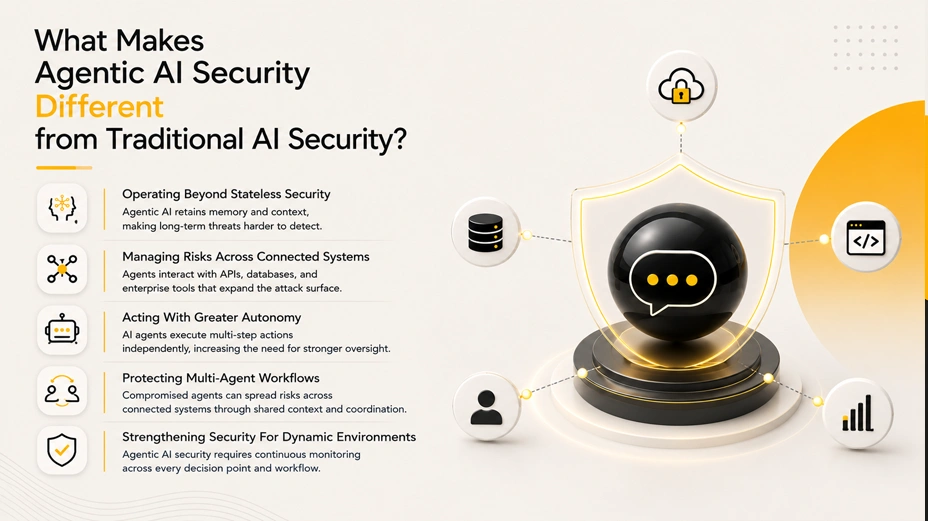
Standard input-output controls fail in agentic environments. Traditional security focused on blocking malicious inputs and filtering outputs for stateless models that reset after every interaction. Agents are a different architecture entirely.
Here is why the threat model changes:
- Persistence: Agents retain conversation history and operational state across sessions. A stateless model forgets when a session ends. An agent builds on prior context, meaning malicious data injected into memory can influence decisions days or weeks after the initial compromise.
- Tool access: Agents connect to enterprise APIs, databases, code repositories, calendars, and communication platforms. Broad API scopes combined with weak authentication allow privilege escalation through agent workflows that appear, from the outside, as fully authorized activity.
- Autonomy: Agents interpret high-level goals and plan action sequences without human sign-off at each step. McKinsey research on agentic AI deployment found that this autonomy amplifies foundational risks, including data privacy violations, systemic integrity failures, and unintended data sharing, at speeds that manual oversight alone cannot contain.
- Multi-agent coordination: When agents communicate and share context inside orchestrated pipelines, a compromise in one agent can propagate laterally across every downstream agent with shared access.
The attack surface for agentic AI security is not a single endpoint. It spans every decision node an agent can reach across connected enterprise systems.
The OWASP Top 10 for Agentic Applications
The OWASP Top 10 for Agentic Applications, released in December 2025, is the most comprehensive reference framework for categorizing agentic AI security risks. It was built from input from over 100 security researchers across industry, academia, and government, drawing from real incidents at early enterprise agentic adopters.
Each of the 10 categories maps to a distinct architecture component, meaning no single security control addresses multiple risks simultaneously.
| Risk ID | Risk Name | What It Targets | Primary Mitigation |
| ASI01 | Goal Hijacking | Agent objective manipulation via prompt injection | Semantic intent classification and goal-drift monitoring |
| ASI02 | Tool Misuse | Abuse of authorized permissions to access unauthorized systems | Least-privilege, time-bound permission tokens |
| ASI03 | Identity Abuse | Credential theft and session hijacking | Short-lived tokens and session isolation |
| ASI04 | Supply Chain Vulnerabilities | Malicious code in agent frameworks or plugin registries | Registry vetting and cryptographic integrity verification |
| ASI05 | Memory Poisoning | Corruption of persistent agent memory to influence future behavior | Memory integrity checks and behavioral baseline monitoring |
| ASI06 | Cascading Failures | Single-agent compromise propagating across multi-agent systems | Agent isolation boundaries and shared access auditing |
| ASI07 | Inter-Agent Communication Risks | False information injected into coordination protocols | Authenticated message signing and monitoring |
| ASI08 | Excessive Agency | Overly broad permissions enabling out-of-scope actions | Risk-based permission scoping |
| ASI09 | Rogue Agent Behavior | Agent drifts from intended operational boundaries | Continuous behavioral monitoring with deviation thresholds |
| ASI10 | Insufficient Observability | Lack of visibility into agent actions prevents detection | Full traceability covering prompts, decisions, tool usage |
Goal Hijacking and Prompt Injection
Prompt injection embedded in documents, emails, or API responses redirects agents from their intended objectives without triggering any access violation. The agent processes the content as legitimate input, follows the embedded instruction, and appears to be functioning normally throughout. Semantic intent classification systems can detect goal drift before it escalates, but only when behavioral baselines are established before deployment.
Tool Misuse: The Authorized-Credential Problem
In August 2024, a prompt injection attack against Slack AI enabled sensitive data extraction from private channels through instructions injected into message content the agent was authorized to read. The agent used permissions it legitimately held, directed by instructions it was never authorized to receive. This asymmetry between valid credentials and manipulated intent is the defining challenge of agentic AI security for systems connected to real enterprise tools.
Identity and Credential Compromise
Research from Aembit found that only 10% of organizations have formal strategies for managing non-human and agentic identities. Agents operate with delegated credentials and persistent sessions, meaning that when an agent’s session is hijacked, attackers bypass multi-factor authentication entirely because the session is already authenticated. Short-lived, task-scoped tokens close this exposure gap. Most enterprises are still issuing persistent, system-wide credential grants. (Source: Aembit: Agentic AI Cybersecurity Risks)
Memory Poisoning
Memory poisoning injects malicious data into persistent agent memory, which carries forward across sessions and accumulates into behavioral context over time. A successfully poisoned memory entry can influence agent decisions weeks or months after the initial injection, with no ongoing attacker access needed. Detecting this requires behavioral drift monitoring that compares current agent behavior against a verified historical baseline, not just real-time anomaly alerts.
Supply Chain Vulnerabilities
Agent supply chain risks target the frameworks, plugin libraries, and tool definitions that development teams install from public registries without structured security review. Malicious packages can embed backdoors that remain dormant until the agent calls a specific function. Autonomous AI threat modeling for supply chain exposure starts at the dependency manifest and registry verification layer, not at the agent runtime monitoring layer.
Cascading Failures in Multi-Agent Systems
When agents communicate and operate with delegated credentials inside orchestrated systems, a compromise in one agent can propagate laterally across every downstream agent with shared access. Cascading agent failures are most dangerous in automated pipelines where one agent’s output feeds directly into another agent’s input, creating attack paths that span multiple enterprise systems through a chain of trusted handoffs.
Building an Agentic AI Governance Framework for Enterprise
Enterprise agentic AI governance must span the full lifecycle of every agent deployment: design, production rollout, runtime monitoring, and incident response. The gap in most organizations is not awareness. It is enforcement. Most governance policies exist at the document level. What is missing is an enforcement layer that operates at agent runtime.
MIT Sloan Management Review research found that only 42% of executives balance AI development with appropriate security investment, and only 37% have formal processes to assess AI tool security before deployment. (Source: MIT Sloan Management Review: Agentic AI Security Essentials)
1. Risk-Based Agent Classification
KPMG’s AI governance research recommends classifying agents by autonomy level and operational complexity before assigning governance controls. An agent handling single-step data lookups carries a fundamentally different risk profile than an orchestrator coordinating multiple agents with shared access to live enterprise systems. Governance controls that do not scale with agent risk tier result in over-restricting low-risk agents while under-restricting high-risk ones. (Source: KPMG: AI Governance for the Agentic AI Era)
Practical classification tiers:
- Tier 1 (Low risk): Single-step, read-only agents with no write access to enterprise systems
- Tier 2 (Medium risk): Multi-step agents with write access to a single system, with defined escalation paths
- Tier 3 (High risk): Orchestrators coordinating multiple agents with cross-system write access, requiring human-in-the-loop approval at defined checkpoints
2. Least Privilege and Permission Scoping
AI agent permission management should operate at the individual task level, not the system level. Agents should receive time-bound tokens scoped to the minimum data and tool access their current operation requires, expiring when the task completes.
DataRobot’s enterprise deployment guidance recommends combining geographic data residency requirements with strict data minimization principles at the permission design stage. Persistent, system-wide API grants are a governance failure, not an acceptable deployment tradeoff. (Source: DataRobot: Agentic AI Governance Framework)
Key controls to implement:
- Time-bound API tokens that expire on task completion
- Scope restrictions limiting agents to the minimum dataset required
- Per-agent credential isolation preventing cross-agent session access
- Audit logging of every permission grant and tool call
3. Continuous Monitoring and Behavioral Observability
Effective governance of AI in production requires traceability systems that record prompts, decisions, tool usage, and intermediate reasoning steps. Without this infrastructure, most OWASP categories remain undetected until the business impact is already visible.
Real-time dashboards should track:
- Agent actions and tool usage per session
- Data access patterns and volume anomalies
- Behavioral drift from established baselines
- Inter-agent communication logs
This infrastructure is also required for compliance under the EU AI Act and equivalent regulatory frameworks.
4. Human-in-the-Loop Requirements by Risk Tier
Agents operating in healthcare, financial services, and other regulated industries need explicit governance frameworks defining which actions require human review before execution. Hong Kong PCPD guidance published in 2025 specifies manual review requirements for high-risk agent actions involving personal data processing decisions.
Oversight thresholds should be calibrated per use case, per agent class, and per data sensitivity level. Multi-agent security frameworks that embed human oversight at defined decision checkpoints prevent the compliance and regulatory exposure that fully autonomous operations create in sensitive environments.
5. Supply Chain Security Controls
A structured security review process for every agent component before production deployment is non-negotiable:
- Vetting all third-party agent frameworks and plugin registries before installation
- Cryptographic integrity verification of tool definitions and dependency manifests
- Dependency scanning integrated into the CI/CD pipeline for agent codebases
- Documented approval workflows for any new external tool integration
The Five Conditions That Determine Whether Your Agentic AI Governance Framework Actually Works
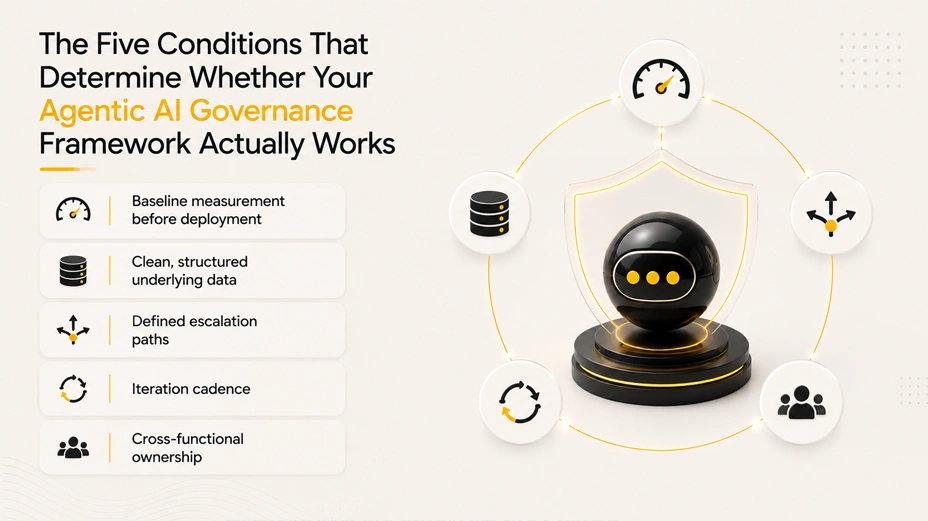
Most agentic AI governance frameworks fail not because the policies are wrong, but because the conditions required to enforce them are not in place.
- Baseline measurement before deployment: You cannot detect behavioral drift without a documented baseline of what normal agent behavior looks like before production.
- Clean, structured underlying data: Agents deployed on fragmented, inconsistent, or stale data produce fragmented outputs, regardless of how well-designed the governance layer is.
- Defined escalation paths: Governance frameworks without documented escalation criteria leave agents making decisions they should not be making alone, creating liability exposure at scale.
- Iteration cadence: The first version of an agent governance configuration is almost never the production-ready version. Build in structured review cycles.
- Cross-functional ownership: Security, legal, compliance, and engineering must own governance controls jointly. Governance assigned exclusively to one team creates coverage gaps the others cannot see.
Conclusion
Agentic AI security requires a fundamentally different approach from traditional AI governance. Agents that act, plan, and persist across sessions need controls built around memory integrity, tool permission scoping, behavioral observability, and multi-system isolation. The OWASP Top 10 for Agentic Applications provides the most current and comprehensive reference framework for mapping these risks to specific architecture components.
Enterprises that classify agents by risk level, enforce task-scoped permissions, monitor behavioral baselines, and maintain human oversight at the right checkpoints will avoid the incidents early adopters are working through today. The governance of AI for agentic systems is not a compliance checkbox. It is the operational foundation that determines whether your autonomous agent deployments scale safely or create the kind of exposure that makes headlines.
If you need help building an agentic AI governance framework for your enterprise or want to assess your current deployment against the OWASP framework, you can reach out at coffee@sparkeighteen.com.