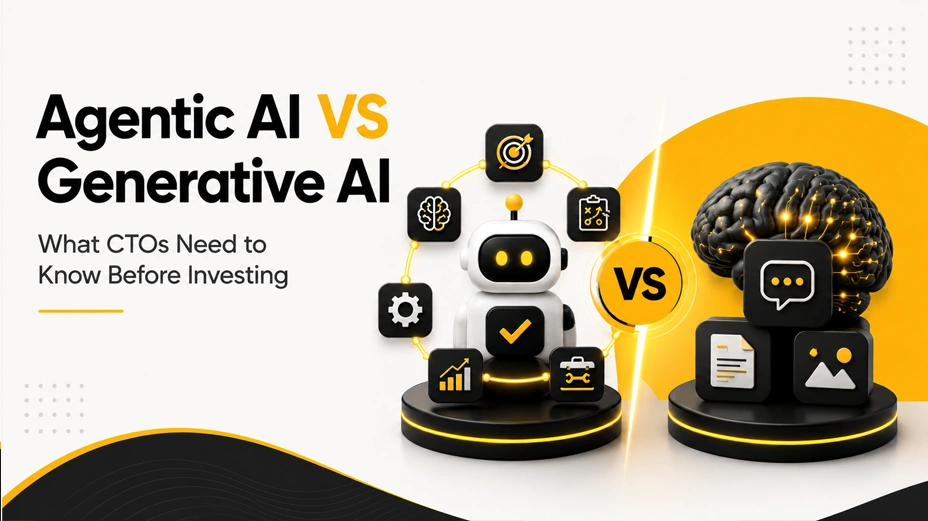
The budget conversation is happening in every enterprise right now. Generative AI tools have already landed inside most organizations, and now the pitch for agentic AI is arriving. CTOs sitting across the table from vendors need a clear, technical understanding of what separates agentic AI vs generative AI, because the deployment requirements, governance models, and ROI timelines are fundamentally different.
According to MarketsandMarkets, the global AI agents market is projected to grow from $7.84 billion in 2025 to $52.62 billion by 2030 at a 46.3% compound annual growth rate. The investment pressure is real. So is the risk of deploying the wrong architecture for the wrong problem.
This is not a “both are good in different contexts” overview. This is a decision framework. By the end of this blog, you will know exactly where each technology fits, what each demands from your infrastructure, and when to invest in one versus the other. Let’s get started.
The Core Difference: Output vs Action
Before getting into AI agent architecture, the distinction needs to be clear at the fundamental level.
Generative AI produces content when prompted. It generates text, code, images, or summaries. It operates statelessly: each prompt is independent, the model has no memory of prior interactions unless you explicitly pass that history, and it does not take actions in external systems. You still have to take its output and do something with it.
Agentic AI pursues a goal. It receives a high-level objective, builds a plan, uses tools like APIs, databases, and search to gather information, executes a sequence of actions, evaluates its own results, corrects errors, and continues until the goal is reached or escalation is required. Autonomous AI agents operate with persistent memory, tool access, and a feedback loop that generative models alone do not have.
The critical clarification for CTOs: these are not competing technologies. Agentic AI uses generative AI as its reasoning component. The agent architecture in artificial intelligence wraps a generative model with memory, planning, tool execution, and self-evaluation layers. Generative AI is the brain inside the agent, not an alternative to it.
AI Agent Architecture: What Is Actually Running Under the Hood
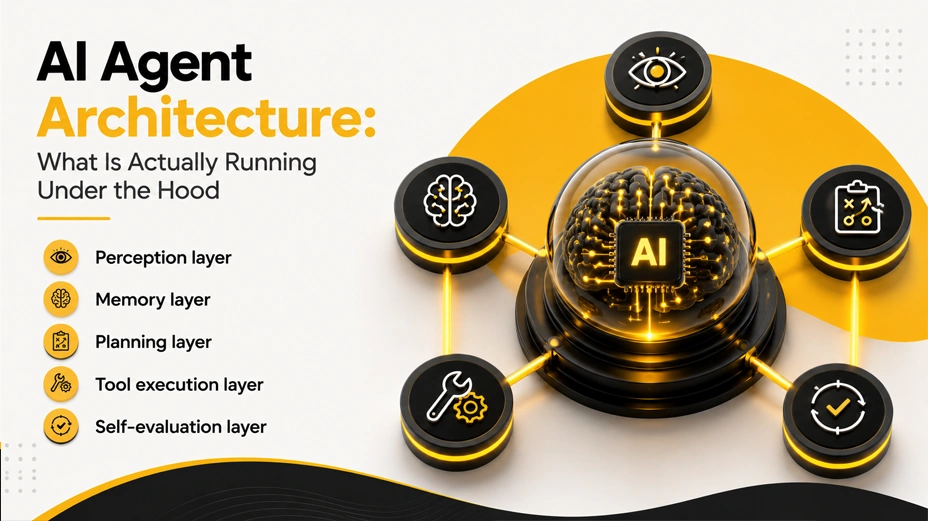
Understanding agent architecture in artificial intelligence is essential before evaluating any enterprise vendor claiming to offer “AI agents.” Most of what is sold as agentic AI is actually structured prompting with API calls. Genuine agentic systems have five layers:
- Perception layer: The agent receives inputs from its environment. This includes user instructions, API responses, database queries, and real-time data feeds.
- Memory layer: The agent maintains context across steps. Short-term memory holds the current task state. Long-term memory stores prior interactions, account history, or learned preferences.
- Planning layer: The agent breaks a high-level goal into a sequence of sub-tasks. This is where the generative model does its work, reasoning about what steps are needed and in what order.
- Tool execution layer: The agent calls external tools, writes and runs code, queries databases, sends API requests, and interacts with third-party systems. This is what separates an autonomous AI agent from a chatbot.
- Self-evaluation layer: The agent checks whether its last action succeeded, adjusts its plan if it failed, and decides whether the goal is complete or whether escalation is required.
Intelligent agent architecture in AI that is genuinely production-grade includes all five. Platforms that skip the memory and self-evaluation layers produce systems that are brittle: they fail on exceptions and require human intervention at the same frequency as traditional automation.
Types of Agent Architecture in AI: The Enterprise Decision Matrix
There are several types of agent architecture in AI relevant to enterprise deployment. Understanding which architecture fits which problem determines whether your deployment delivers ROI or requires a rebuild.
| Architecture Type | How It Works | Best Enterprise Use Case |
| Simple Reflex Agent | Responds to inputs using fixed condition-action rules | Tier-1 support triage, spam filtering |
| Model-Based Agent | Maintains internal state to handle incomplete information | Inventory management, logistics monitoring |
| Goal-Based Agent | Plans multi-step sequences to reach a defined target | Research automation, procurement workflows |
| Utility-Based Agent | Selects actions by maximizing a defined performance metric | Bid optimization, resource allocation |
| Learning Agent | Improves behavior over time through outcome feedback | Fraud detection, personalization engines |
| Multi-Agent System | Specialized agents coordinate to complete distributed tasks | End-to-end sales pipeline, supply chain orchestration |
For most enterprise deployments, multi-agent systems represent the most capable architecture. A research agent gathers data. A scoring agent evaluates it. A communication agent drafts the output. An orchestrating agent manages the handoffs. No single agent handles everything, but the coordinated system executes workflows that would previously have required multiple human roles.
Where Generative AI Fits Today (and Where It Stops)
Generative AI has clear, demonstrable value in the enterprise for tasks that are:
- Self-contained: the output of one prompt does not depend on the output of another
- Human-reviewed: someone reads and acts on the generated content before it goes anywhere
- Non-transactional: the model is not taking actions in live systems
High-fit generative AI use cases:
- Drafting emails, reports, and meeting summaries
- Generating code suggestions within an IDE
- Summarizing research documents or support transcripts
- Creating first-draft marketing copy for human editing
Where generative AI consistently underdelivers:
- End-to-end process automation requiring multiple system interactions
- Real-time decision-making against live data
- Workflows that must recover from errors without human intervention
- Tasks requiring persistent memory across sessions
The ROI of generative AI is well-documented. According to McKinsey, generative AI could add $2.6 trillion to $4.4 trillion annually to the global economy across use cases. But that value is concentrated in individual productivity gains, not in process automation. That is where agentic AI vs generative AI becomes the real investment question.
Where Agentic AI Delivers And Generative AI Cannot
Autonomous AI agents unlock a different category of value: process automation for workflows that are too complex and adaptive for traditional RPA and too multi-step for a single generative model to handle.
High-fit agentic AI use cases:
- Autonomous sales development: prospect research, outreach, follow-up, and CRM logging without SDR involvement
- Fraud detection and transaction monitoring with real-time decisioning
- IT operations: alert triage, first-line diagnostics, and standard remediation
- Supply chain exception management: monitoring thresholds, triggering purchase orders, coordinating logistics via API
- Employee onboarding: document collection, IT provisioning, training enrollment, and reminder management
These are not productivity gains from writing faster. These are structural reductions in operational cost.
Agentic AI vs RPA: The Comparison CTOs Actually Need
When presenting agentic AI to boards or procurement committees, the question that comes up most often is how it differs from Robotic Process Automation. The answer matters because RPA is already in most enterprise stacks.
| Dimension | RPA | Agentic AI |
| Instruction type | Fixed rules, explicit steps | High-level goals, interpreted in context |
| Adaptability | Breaks when UI or data structure changes | Adjusts behavior based on new context |
| Exception handling | Requires human intervention for every exception | Handles most exceptions, escalates edge cases |
| Learning | Does not improve without reprogramming | Improves through outcome feedback |
| Multi-system coordination | Limited; one system at a time | Native; calls APIs, runs code, queries databases |
| Best for | Stable, repetitive, rule-bound processes | Complex, adaptive, multi-tool workflows |
RPA remains the right tool for processes that are genuinely stable and rule-bound. Agentic AI is the right tool for processes that require interpretation, exception handling, or multi-system coordination. Replacing RPA with agents indiscriminately is as much of a mistake as avoiding agents where they clearly outperform.
De-Risking AI Investments: A CTO Due Diligence Checklist
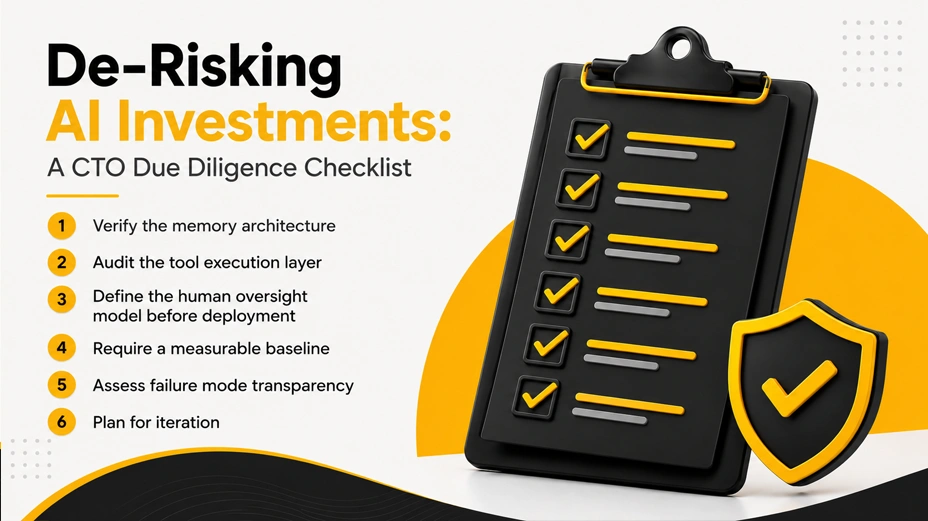
The architecture of an agent in artificial intelligence is sophisticated enough that vendor claims need rigorous evaluation. Here is the due diligence framework:
1. Verify the memory architecture
Does the system maintain state across steps within a task and across sessions? A system without persistent memory is not a genuine autonomous agent. It is a wrapper.
2. Audit the tool execution layer
Which external tools does the agent actually call? Can it write and run code? Does it have native CRM and ERP integrations, or does it rely on manual data export? Autonomous AI systems that cannot access your enterprise data cannot automate your enterprise processes.
3. Define the human oversight model before deployment
Which decisions does the agent make autonomously? Which require human confirmation? Which automatically escalates? This is not optional governance: it is the structure that keeps agents operating within liability boundaries at scale.
4. Require a measurable baseline
Define the metric before deployment: cost per transaction, time per workflow, error rate, or escalation frequency. Agents that cannot be measured against a defined baseline cannot be evaluated for ROI.
5. Assess failure mode transparency
Can the system explain why it took a particular action? Can you audit the decision log? Intelligent agent architecture in AI at enterprise scale requires explainability, especially in regulated industries.
6. Plan for iteration
The first deployment version is not the production-ready version. Budget for a 60 to 90-day iteration cycle that addresses edge cases and missing tool integrations surfaced by real usage.
The Investment Decision Framework
Use this matrix when deciding where to direct budget:
Invest in generative AI when:
- The task is self-contained and human-reviewed
- The ROI is measured in individual productivity: faster drafting, faster summarization, faster coding
- The workflow does not require multi-system interaction or persistent memory
- The timeline to value is measured in weeks, not quarters
Invest in agentic AI when:
- The workflow is high-volume, multi-step, and currently requires significant human coordination
- The task involves multiple systems: CRM, ERP, databases, external APIs
- The workflow has clear success criteria that can be measured before and after deployment
- The ROI is measured in process cost reduction, not individual productivity
- The organization has clean, API-accessible data to support agent operation
Most enterprise stacks need both. The mistake is treating them as substitutes rather than complements or deploying agentic AI on undefined workflows where the complexity exceeds the organization’s readiness to govern them.
Conclusion
The agentic AI vs generative AI question is not about which technology is better, but it is more about which architecture is right for the specific workflow you are trying to transform. Generative AI delivers individual productivity at low deployment cost. Agentic AI delivers process automation at a scale and adaptability that neither traditional RPA nor generative models alone can match.
The CTOs making the highest-confidence investments right now are the ones who have done three things: defined the specific workflow they are automating, validated that their data infrastructure supports agent operation, and built the governance model before deployment, not after.
The autonomous AI agents market is moving at 46% annually. The gap between organizations with working agent deployments and those still running evaluations will be difficult to close in two to three years. The time to move from evaluation to deployment is now, provided the architectural foundations are in place.
If you are working through an agentic AI investment decision and want an objective framework for evaluating vendor claims or identifying the right workflows for your first deployment, you can reach out at coffee@sparkeighteen.com.