A manufacturing business integrates an AI forecasting layer into its ERP system. The model goes live. Predictions are unreliable. The project is shelved within six months. The AI worked exactly as designed. The problem was 3 years of inconsistent cost-centre coding in the underlying data. No one checked before the build began.
The AI in ERP market is valued at $5.82 billion in 2025, growing at 26% annually. Yet 64% of CEOs face pressure to accelerate AI adoption while well over half of their organisations lack a consistent implementation approach.
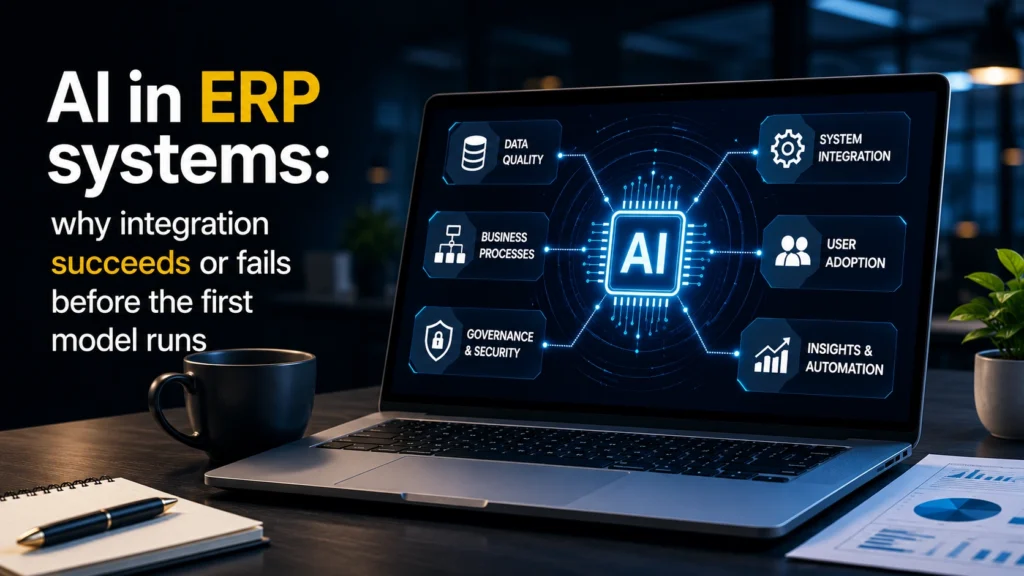
The core argument: AI does not transform your ERP. It transforms what your ERP data can do. The real pre-condition for success is not choosing the right AI feature. It is knowing whether your data is ready for AI to act on.
Note: What is ERP, and what does it mean in healthcare?
ERP stands for Enterprise Resource Planning: integrated software that connects and manages core business functions through a single platform. In healthcare, it handles the operational backbone, not patient care.
- Finance and budgeting: cost tracking, financial reporting, and vendor payments
- Procurement and supply chain: medical inventory, supplier contracts, and stock management
- HR and workforce: payroll, staff scheduling, and compliance
- Facilities and operations: resource allocation and department coordination
Where clinical software manages patient data, ERP manages everything that keeps the organisation running around it.
Key takeaways
- You will understand how AI in ERP systems works across the 6 highest-value use cases, with examples from finance, supply chain, HR, and procurement.
- You will get a phased integration process that reduces cost and implementation risk, with clear guidance on sequencing.
- You will see what AI-powered ERP systems actually cost, with realistic ROI benchmarks from published research.
- You will understand the 4 most common reasons AI-ERP integrations stall, and what to do differently.
- You will know what data readiness means in practice and how to assess yours before committing to a build.
What AI integration in ERP systems actually means
AI in ERP refers to embedding machine learning (ML), natural language processing (NLP), robotic process automation (RPA), and predictive analytics into existing ERP workflows so the system can automate, predict, and recommend rather than just record and report.
This is different from the AI features ERP vendors add to dashboards. A toggle in a vendor interface is not integration. Genuine AI-ERP integration means the AI is working at the data and process layer of your system, not sitting as a reporting skin on top of it.
The key AI technologies in use across ERP systems today:
- Machine learning for demand forecasting, anomaly detection, and predictive maintenance. ML models improve over time as they process more organisation-specific data, which means early deployment is not always the highest-value one.
- Natural language processing (NLP) for document processing, invoice matching, and user queries in plain language. NLP makes ERP more accessible to non-technical users and eliminates manual text-processing tasks across finance and procurement.
- Robotic process automation (RPA) for repetitive workflow tasks: data entry, report generation, document distribution, and file migration. The real gains compound when RPA is combined with ML, automating not just rule-based steps but adaptive decision points.
- Generative AI for report generation, scenario planning, and business communications. SAP’s Joule assistant and Microsoft Dynamics 365 Copilot are live, at-scale examples. This is the fastest-growing segment of the AI-ERP market.
The ERP software industry is a $44 billion annual market. The AI layer is now its primary growth driver, not the base platform. That creates genuine opportunity and significant vendor marketing pressure. The organisations that benefit most are those that can tell the difference.
The 6 use cases where AI in ERP delivers measurable impact
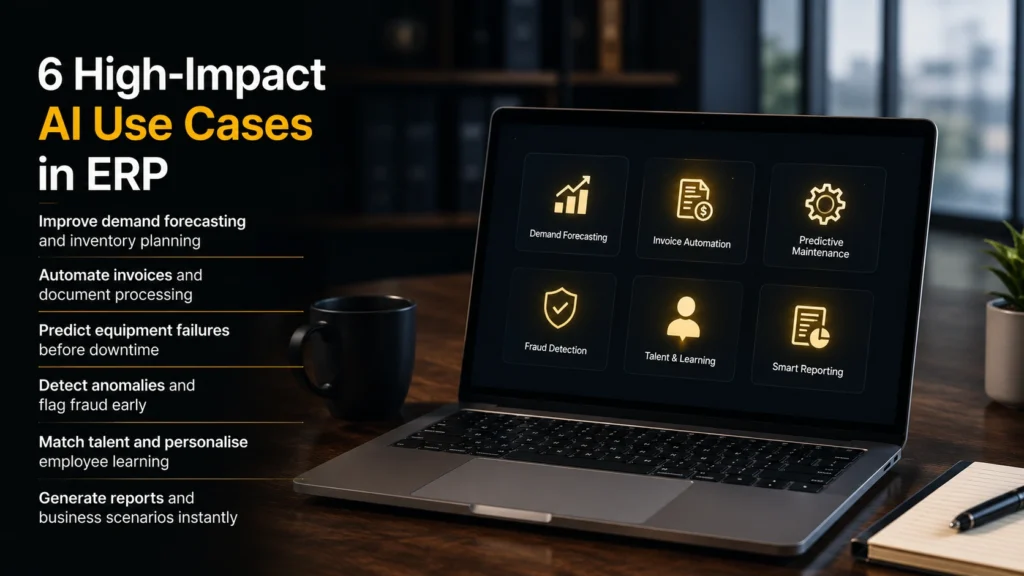
AI delivers the strongest evidence of ROI in 6 areas of ERP systems today. Which one you start with should follow your data readiness, not your ambition.
- Demand forecasting and inventory optimisation. Organisations report demand forecasting accuracyimprovements of 30 to 50% by analysing historical sales data, seasonal patterns, and external market signals. Supply chain optimisation is reported to reduce transportation costs by up to 30% and inventory expenses by 25%. For businesses managing complex supplier networks or tight stock levels, this is consistently the highest-ROI starting point.
- Automated invoice and document processing. NLP and RPA eliminate manual invoice matching, receipt verification, and ledger reconciliation. SAP’s ERP modules automate receipt and invoice verification for production-site deliveries; Oracle’s AI tools process supplier invoices using document recognition and intelligent entry. The accuracy gain is real; the larger gain is hours returned to finance teams.
- Predictive maintenance. IoT (Internet of Things)-connected ERP with ML models flags equipment failures before they occur by detecting performance degradation patterns in sensor data. In manufacturing, energy, and infrastructure, where unplanned downtime has severe cost consequences, this use case delivers a return that is straightforward to quantify.
- Anomaly detection and fraud flagging. One of the most established AI use cases in ERP, anomaly detection automatically surfaces unusual transactions, KPI deviations, and compliance exceptions. Originally most common in financial services, it now applies across any organisation with complex approval chains or high-volume procurement.
- HR talent matching and personalised learning. SAP SuccessFactors delivers personalised learning recommendations to 4 million client employees monthly and automatically matches candidates to specific job descriptions. This use case often sits outside the traditional AI-ERP conversation, but its impact on hiring quality and employee development cost is direct and measurable.
- Scenario planning and generative reporting. Generative AI produces business scenarios, regulatory impact assessments, and financial summaries from raw ERP data on demand. A task that previously occupied an analyst for a day returns in minutes for human review and refinement.
How to integrate AI into an ERP system: a phased process
Successful AI implementation in ERP follows a phased approach: assess data readiness first, pilot one high-value use case, validate results, then scale. Organisations that attempt to roll out AI across all ERP modules simultaneously consistently overrun budgets and timelines.
Phase 1: Data audit and readiness assessment
Before any AI is activated, the ERP data must be assessed for completeness, consistency, and structure. AI amplifies what is already in the data. If the data is inconsistent, the AI output will be confidently wrong, which is worse than no AI at all.
The audit should answer:
- Which ERP modules have clean, well-governed data, and which do not?
- Are master data records (products, suppliers, customers, cost centres) standardised across business units?
- How much historical data exists, and is it structured in a way that ML models can be trained on?
- Where are the data silos, and what does it take to connect them?
This phase is almost always underestimated. It is also the phase that determines whether everything that follows works.
Phase 2: Use case selection and scoping
Prioritise the 1 or 2 use cases with the highest data readiness and the clearest return path. Build a minimum viable product (MVP) integration, not a full deployment. This is not about thinking small; it is about building proof of value that funds the next phase.
Phase 3: Integration architecture
3 primary options, each with a different cost and risk profile:
- Native vendor AI features: Lowest disruption, fastest deployment, vendor-dependent roadmap. Suitable when your ERP is a modern cloud platform with active AI development (SAP, Oracle, Microsoft Dynamics).
- Third-party AI tools via API: More flexibility, higher integration complexity. Suitable when the specific capability you need is not on the vendor’s roadmap.
- Custom ML models built on ERP data: Highest control, highest cost and build time. Suitable when the business problem is unique and off-the-shelf models cannot be trained on your specific data patterns.
Phase 4: Change management and training
82% of manufacturers plan to increase AI budgets. Few are budgeting proportionally for the change management that determines whether those tools are actually used. User adoption is the most frequently cited AI-ERP implementation failure factor. The technical build is half the project.
Phase 5: Monitor, measure, and expand
Define KPIs before go-live, not after. Track forecast accuracy, processing time, error rates, or whichever metric the use case was built to move. Use those results to justify and guide the next integration phase.
What AI integration in ERP systems actually costs
Adding AI capabilities to an ERP system typically costs between $25,000 and $500,000 or more for the AI layer alone, representing 25% to 60% of the total ERP implementation budget. The range is wide because it depends entirely on whether you are extending a vendor platform, integrating third-party tools, or building custom models.
A realistic cost breakdown:
- AI feature layer: $25,000 to $500,000+ depending on complexity. Native vendor AI sits at the lower end for existing customers; custom ML model development sits at the higher end.
- Data preparation and cleansing: Often the largest hidden cost. Organisations frequently discover during the data audit that 12 to 18 months of data work are needed before the AI can function reliably.
- Integration and API development: $10,000 to $150,000+ for non-native integrations.
- Change management and training: 15% to 20% of total project cost is a reasonable planning benchmark.
- Ongoing model monitoring and maintenance: AI models degrade over time as real-world data distributions shift. Budget for retraining and monitoring from day one.
The average ERP budget per user is $7,200 over 5 years, roughly $170,840 annually for a 100-user business. When AI is layered on, the per-user economics improve because automation reduces the labour cost per transaction.
ROI benchmarks worth knowing:
Industry benchmarks suggest the average ROI for ERP projects is around 52%, with most businesses recovering investment within 16 months. A Forrester study of a manufacturing organisation, as cited by industry research, found 106% ROI over 3 years with payback in 17 months, including $8.9 million in productivity improvements and $3.9 million in IT infrastructure savings. Organisations applying AI to their ERP data report improvements of around 30% in productivity and 23% in operational cost reduction, though results vary by implementation quality and use case.
The organisations that overspend are not those that invested too much in AI. They are those that underinvested in data preparation and then spent the rest of their budget trying to fix it mid-project.
Why AI-ERP integrations stall: the 4 challenges worth naming
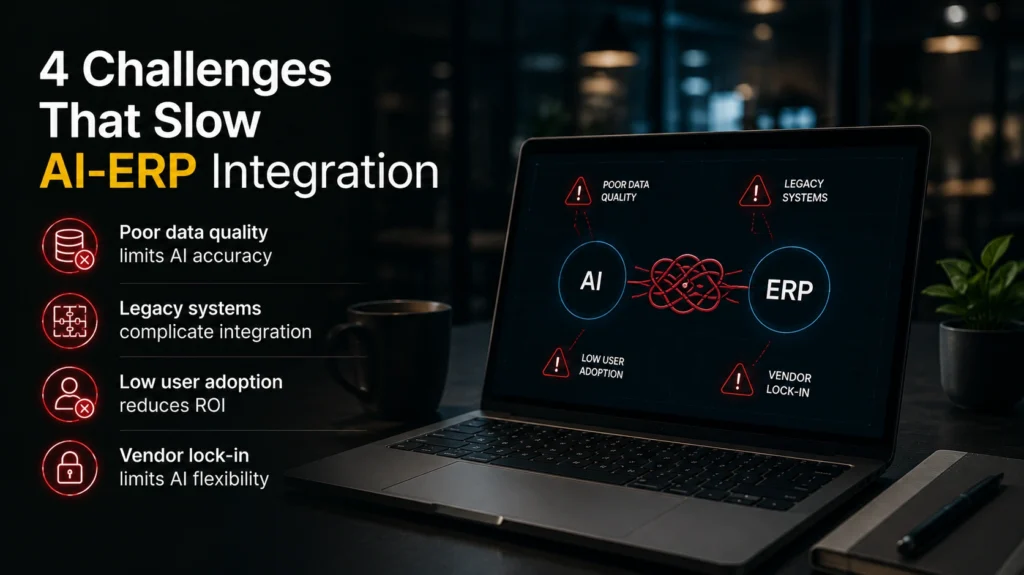
The primary barriers to successful AI integration in ERP are not technology problems. They are execution and governance problems.
Poor data quality
AI in ERP is only as reliable as the data it runs on. Inconsistent master data, duplicate records, unmapped fields across business units, and legacy data structures are the most common blockers. Fixing them costs time and money. It is non-negotiable. No model sophistication compensates for unreliable input data.
Legacy system integration complexity
Many ERP deployments still run on on-premise infrastructure or heavily customised instances of SAP or Oracle that were not designed to expose data through modern APIs. Connecting AI tools to these architectures requires custom middleware layers that add cost, timeline, and integration risk. SaaS-based ERP now accounts for 82% of the market precisely because cloud-native ERP is significantly more compatible with AI integration. If you are running an on-premise ERP with heavy customisation, the AI integration conversation starts with an honest assessment of migration, not model selection.
Change management gaps
A well-built AI-ERP integration that no one uses delivers zero ROI. The pattern that repeats: AI features are switched on, adoption is low, the team concludes “AI doesn’t work here,” and the actual issue (poor interface design, no workflow redesign, no training) was never addressed. Getting teams to trust and act on AI outputs requires intentional design. It does not happen automatically.
Vendor lock-in and roadmap dependency
Relying entirely on the ERP vendor’s native AI means your AI capability roadmap is determined by the vendor’s release cycle, not your business priorities. For some organisations, that is the right trade-off: less flexibility, less complexity. For others, a hybrid approach (vendor AI for standard workflows, custom models for proprietary processes) is the better architecture. The important thing is making that decision deliberately, not discovering it later.
What good AI-ERP integration looks like in practice
Responsible AI integration into an ERP system starts from a business outcome, not a technology feature. It is grounded in validated data. And it is designed to be interrogatable: the teams using it understand why the system is making a specific recommendation, not just what it is.
At Spark Eighteen, we integrated an AI-driven demand forecasting module into the ERP system of a mid-market distribution business. The initial brief was broad: “make our ERP smarter.” The actual work began with a 4-week data audit that surfaced 18 months of inconsistent product category coding across 3 regional warehouses. Before a single model was built, that data was cleaned and standardised. The forecasting module went live 3 months later. Within 6 months, the client had reduced overstock across its top 20 SKUs by 34% and cut emergency procurement orders by 40%.
The technology was not the hard part. The data was.
The principles that consistently separate successful AI-ERP integrations from stalled ones:
- Start with one use case, not the full roadmap. Prove value at a scoped level, then use that proof to fund and guide the next phase.
- Define success metrics before go-live. “Better forecasting” is not a metric. “Forecast accuracy above 85% within 6 months” is.
- Treat data governance as part of the integration project, not a prerequisite someone else handles. It is the same budget, the same timeline, and the same team.
- Design the interface before the model. If the output is not usable in the way your team actually works, the accuracy of the model is irrelevant.
Before you integrate AI, fix your data
The organisations that extract the most from AI in their ERP systems are not those with the most advanced models. They are those that spent the most time on their data before the AI was ever activated. Data governance is not the unsexy precursor to AI integration. It is the work that makes AI integration possible.
AI-enabled ERP systems are genuinely effective at the process level: faster forecasts, fewer manual errors, earlier anomaly detection, smarter procurement. But none of that is accessible to a business that approaches AI implementation in ERP as a technology purchase rather than a data strategy. The model is the last thing you build. It should be.
If you are evaluating AI integration in your ERP system and want to think through the data architecture and implementation approach before committing to a vendor or a build, reach out at coffee@sparkeighteen.com.