A practical guide for business leaders and technology decision-makers: what conversational AI actually delivers across industries, what it costs at each deployment tier, and how to evaluate vendors before signing a contract.
The phrase ‘conversational AI’ covers a remarkably wide range of technology, from a basic FAQ bot on a website to a fully autonomous voice agent that handles complex multi-turn patient intake calls for a hospital system. That range is one reason so many businesses either underinvest in the category or overbuy a conversational AI platform they are not ready to use. The technology is genuinely transformative when matched to the right problem. It is genuinely wasteful when deployed as a generic overlay on a process that was not designed for it.
According to Grand View Research, the conversational AI market was valued at $14.29 billion in 2025 and is projected to reach $41.39 billion by 2030, growing at a CAGR of 23.7%. More than 50% of enterprises have already invested in conversational AI for contact centers, and another 40% are planning to adopt. Full market data is available at Grand View Research: Conversational AI Market Report.
That adoption trajectory reflects something real: conversational AI chatbot and voice agent deployments are delivering measurable outcomes across customer service, healthcare, financial services, and HR when the right conversational AI framework is in place. Klarna’s conversational AI agents handled the equivalent workload of 853 full-time customer service employees and saved $60 million in 2025.
This guide covers what conversational AI models actually power these results, which use cases are delivering the clearest ROI by industry, what enterprise deployment costs look like at each tier, and the specific vendor evaluation criteria that separate conversational AI platforms that perform from ones that produce impressive demos and limited operational impact.
Key Takeaways
- Conversational AI for enterprise is not a single product category: it ranges from rule-based chatbots to LLM-powered autonomous agents handling complex multi-step interactions.
- The conversational AI market reaches $41.39 billion by 2030, growing at 23.7% CAGR, with customer service accounting for 42.4% of the chatbot market.
- 82% of customers say they would rather talk to an AI chatbot than wait for a human rep, reflecting a fundamental shift in service expectations (Source: Nextiva: 50+ conversational AI statistics for 2026).
- Conversational AI in healthcare is one of the highest-ROI deployment sectors, with documented outcomes including 25-50% cost reductions in administrative areas and 58% reductions in patient wait time.
- Vendor evaluation must go beyond demo quality: integration depth, NLU accuracy on domain-specific inputs, and escalation architecture are the three criteria that most directly predict production success.
- The most common cause of failed conversational AI deployments is not the technology. It is deploying against the wrong use case, or without the integration infrastructure to make the agent genuinely useful.
What Conversational AI Actually Is (And Why the Definition Matters)
Most vendor marketing uses ‘conversational AI’ as a catch-all for any system that allows a user to have a text or voice interaction with software. For a business making a procurement decision, that definition is too broad to be useful. There are at least three meaningfully different levels of conversational AI capability, and the level you buy determines what your deployment can and cannot do.
The Three Levels of Conversational AI
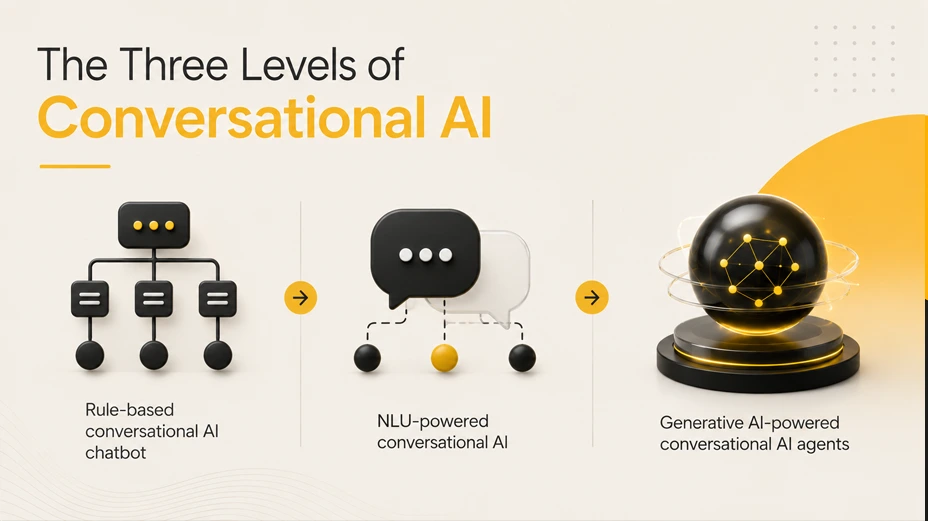
- Rule-based conversational AI chatbot: operates on decision trees and keyword matching. It follows predefined paths and fails gracefully to a human agent when the user’s input falls outside the defined scripts. Fast and cheap to deploy. Limited to simple, predictable queries. Still useful for FAQ deflection and basic triage.
- NLU-powered conversational AI: uses Natural Language Understanding to interpret user intent rather than matching exact phrases. It can handle more varied inputs, manage context across a conversation turn or two, and integrate with backend systems to retrieve account-specific information. This is the category most mid-market businesses deploy for customer service and helpdesk applications.
- Generative AI-powered conversational AI agents: use large language models as the reasoning engine, enabling genuinely flexible, context-aware multi-turn conversations that adapt to what the user actually says rather than what the system expected them to say. These systems can handle complex queries, reason across multiple data sources, and escalate with full context preserved. This is the category behind the Klarna and hospital deployment results cited in this guide.
The conversational AI platform decision is not simply about which vendor has the best demo. It is about which level of capability matches the specific use case, the query complexity of the real users, and the integration requirements of the business systems the agent needs to access.
Selection principle: Start by defining the 10 most common queries your agent will handle and the 5 most complex edge cases it will encounter. The right conversational AI model for your deployment is the one that handles both well at a cost that makes sense for your query volume.
Use Cases by Industry: Where Conversational AI Delivers Measurable ROI
| Industry | Primary Use Case | Measured Outcome | Conversational AI Maturity |
| Customer Service | Tier-1 and tier-2 query resolution, ticket routing | Klarna: handled 853 FTE equivalent, saved $60M in 2025 | High (widely deployed) |
| Healthcare | Appointment scheduling, prior auth, patient triage | Tampa General: 58% reduction in patient wait time | High (growing fast) |
| Financial Services | Account queries, fraud alerts, loan applications | 50%+ of contact center inquiries handled autonomously | High (regulated compliance required) |
| Retail / E-commerce | Order tracking, returns, product recommendations | 23% boost in conversion rate vs non-chatbot sites (Source: Experro: Conversational commerce statistics 2025) | High (widely deployed) |
| HR / Internal Ops | Policy Q&A, onboarding, IT helpdesk self-service | 30-50% reduction in HR ticket volume in enterprise (Source: Neon Health: Conversational AI in healthcare 2026) | Medium (growing rapidly) |
| Real Estate | Property inquiries, viewing scheduling, lead qualify | Lead qualification at scale without agent involvement | Medium (growing rapidly) |
| Legal | Document Q&A, intake, contract status inquiries | Salesforce: $5M in legal cost reduction via AI automation | Medium (emerging) |
| Government / Public | Citizen inquiry resolution across multiple agencies | 800,000+ monthly inquiries resolved without human triage | Medium (selected deployments) |
Conversational AI in Healthcare: The Sector with the Fastest Measurable ROI
Conversational AI in healthcare deserves specific attention because the ROI documentation in this sector is more detailed and more independently verified than in most others. The use cases that are generating the clearest returns are administrative, not clinical: scheduling, prior authorization, patient intake, and billing inquiry. These are the processes that consume the most administrative staff time and have the most clearly defined rules that a conversational AI framework can execute.
Houston Methodist implemented conversational AI agents in 2025 specifically targeting scheduling, revenue cycle operations, and prior authorization processes, projecting 25-50% cost reduction in these administrative areas. For healthcare organizations, conversational AI in healthcare is no longer an innovation project. It is an operational efficiency initiative with documented payback periods under 12 months in several published case studies.
Customer Service: The Most Mature Conversational AI Deployment Category
Customer service is where conversational AI for enterprise has the longest track record and the most benchmarked data. The business case is straightforward: a well-configured conversational AI agent handles tier-1 and tier-2 queries autonomously, routes complex cases to human agents with full context, and operates at unlimited volume without the staffing overhead that scales linearly with interaction volume.
Klarna’s conversational AI agent handled the equivalent workload of 853 full-time employees in customer service and saved $60 million in operating costs by Q3 2025. Equally important: the company’s first fully automated deployment was later refined to reintroduce human agents for emotionally complex queries. That hybrid model, agent-first with human escalation for complexity and sentiment, is now the standard architecture recommended by most enterprise conversational AI practitioners.
Conversational AI Costs: What Enterprise Deployment Actually Costs
Cost is one of the most opaque aspects of the conversational AI market because vendors price differently: per conversation, per minute, per user, or as a flat platform fee. The table below maps realistic cost ranges to deployment tiers, based on current market data and published vendor pricing.
| Tier | Monthly Cost Range | What You Get | Best For |
| Starter / SMB | $50 – $500/month | Pre-built conversational AI chatbot, limited integrations, no-code setup, basic analytics | Small businesses, single-channel (web chat), low volume |
| Mid-Market | $500 – $5,000/month | Multi-channel deployment (web, mobile, WhatsApp), CRM integration, custom intents, live agent handoff | Growing businesses with CRM stack and moderate query volume |
| Enterprise Licensed | $5,000 – $50,000+/month | Full conversational AI platform with NLU, omnichannel, ERP/CRM/HRIS integration, custom models, dedicated CSM | Large enterprises needing deep integration and compliance |
| Custom Build | $80,000 – $500,000+ total | Purpose-built conversational AI framework, domain-specific model fine-tuning, proprietary integrations | Organizations with highly specific compliance or workflow needs |
The Hidden Costs That Most Budget Estimates Miss
The license or subscription fee is rarely the largest cost in a conversational AI deployment. The costs that most budget estimates undercount are:
- Integration development: connecting the conversational AI platform to your CRM, helpdesk, ERP, or electronic health record system is the most time-consuming part of most enterprise deployments. For mid-market integrations, budget 150 to 300 hours of development time. For complex enterprise integrations with multiple backend systems, budget 500 to 1,000+ hours.
- Intent training and conversation design: a conversational AI agent that handles hundreds of intent types requires structured conversation design work, including intent mapping, entity extraction configuration, and edge case handling. This is a skilled service engagement, not a configuration task.
- Content and knowledge base preparation: generative AI-powered conversational AI models retrieve information from knowledge bases. The quality of that knowledge base, its accuracy, completeness, and structure, directly determines answer quality. Preparing that content is labor-intensive and is almost always underestimated.
- Ongoing maintenance: conversational AI models require regular review as products, policies, and procedures change. Budget for at least 2 to 5 hours per week of ongoing maintenance for a mid-market deployment, scaling with conversation volume and scope.
- Overage charges: usage-based pricing models can produce unpredictable costs during high-volume periods. Ask every vendor about overage pricing before contracting. Some vendors charge two to three times the base rate for conversations beyond the contracted volume.
Vendor Selection Criteria: What Actually Predicts Production Success
The conversational AI platform market is crowded with vendors who produce compelling demos on clean, curated inputs. What predicts whether a platform performs in production, on the messy, variable, emotionally charged inputs of real users, is a different set of criteria that most vendor evaluation processes do not assess rigorously enough.
| Evaluation Criterion | What to Ask the Vendor | Red Flags to Watch For |
| NLU accuracy and language support | What is the benchmark accuracy in your specific domain? How many languages are supported? | Demos that only show clean inputs; no accuracy data for edge cases |
| Integration depth | Which CRM, ERP, and helpdesk platforms have native connectors? What is the API documentation quality? | ‘We integrate with everything’ without specific named connectors or documentation |
| Omnichannel support | Which channels are fully supported (web, voice, WhatsApp, mobile)? Are they on the same platform? | Channel support that requires separate deployments or separate pricing |
| Live agent handoff quality | How does the system hand off context to a human agent? What is the average handoff time? | Handoffs that drop conversation context and force the customer to repeat themselves |
| Security and compliance | What certifications does the platform hold? How is customer data handled and retained? | Vague answers about data retention; no named compliance certifications |
| Analytics and reporting | What conversation analytics are provided? Can you track resolution rate, CSAT, and deflection rate? | Reporting limited to volume and session counts, no resolution quality metrics |
| Escalation and override controls | What are the mechanisms for human override? How are edge cases flagged? | No defined escalation path; agent operates without human oversight options |
| Vendor stability and support model | How long has the platform been in production? What is the SLA for enterprise support? | No named enterprise customers; support only via ticket with multi-day SLA |
The Four Criteria That Most Directly Predict Production Success
- NLU accuracy on your specific domain: General NLU benchmarks are not useful for evaluating a conversational AI chatbot for a specialized domain. Ask the vendor to run a pilot on a sample of your actual historical queries, including the edge cases and the queries that most often result in escalation to a human agent. The accuracy on your data is the only relevant accuracy number.
- Integration architecture: The conversational AI agent’s value depends almost entirely on its ability to retrieve real data from your systems and take actions in them. Request detailed technical documentation on every integration the vendor claims to support. If documentation is thin or requires a custom professional services engagement for every integration, the deployment will be significantly more expensive and slower than the vendor’s initial estimate suggests.
- Human escalation quality: The moment a conversational AI agent hands off to a human agent is the moment the customer is most likely to notice the seam. Platforms that preserve and pass full conversation context to the receiving human agent produce measurably better post-escalation CSAT scores than those that do not. Test the escalation flow specifically, not just the automated conversation flow.
- Governance and audit controls: In regulated industries, every conversation the conversational AI agent conducts may need to be logged, reviewed, and auditable. Confirm that the conversational AI framework provides the logging depth and data residency options your compliance requirements demand before evaluating any other feature.
Top Conversational AI Platforms Worth Evaluating
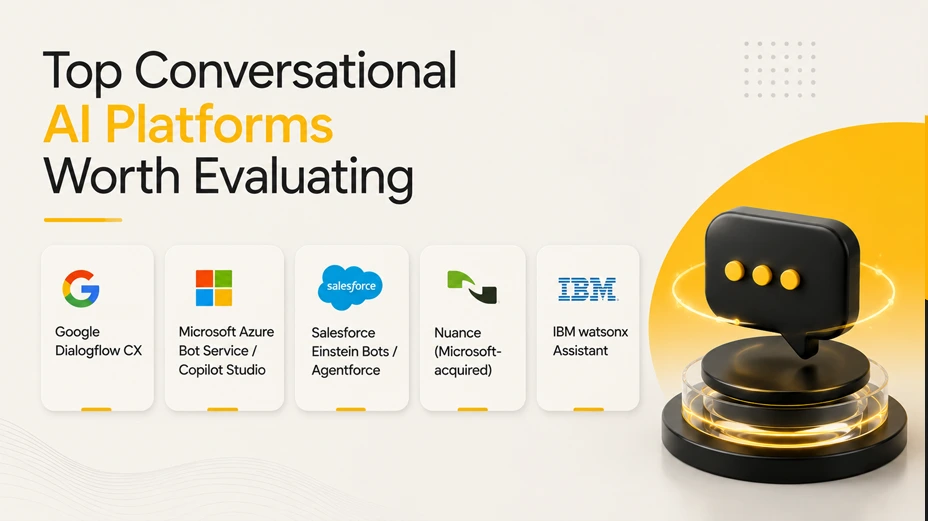
The conversational AI market in 2025 and 2026 is served by several well-established platforms and a growing number of specialist vendors for specific industries. The leading enterprise-grade conversational AI platforms include:
- Google Dialogflow CX: strong NLU, robust omnichannel support, deep Google Cloud integration. Best for enterprises already in the Google ecosystem.
- Microsoft Azure Bot Service / Copilot Studio: native Microsoft 365 and Teams integration, strong for internal enterprise deployments. Best for Microsoft-stack organizations.
- Salesforce Einstein Bots / Agentforce: native Salesforce CRM integration, strongest for sales and service teams already using Salesforce.
- Intercom (Fin AI): generative AI-powered conversational AI chatbot, strong for SaaS customer support. Best for product-led growth companies with in-app support needs.
- Nuance (Microsoft-acquired): industry-leading in healthcare and financial services conversational AI, with strong voice AI capabilities. Best for regulated industry deployments.
- IBM watsonx Assistant: enterprise-grade, strong on security and compliance, good for organizations with existing IBM infrastructure.
Final Thoughts
Conversational AI for enterprise has crossed the threshold from experimental technology to operational infrastructure. The businesses that get the most from conversational AI agents are not necessarily the ones with the largest budgets or the most sophisticated technology stacks. They are the ones that start with a specific, high-volume use case where the queries are well-defined, the integration requirements are clear, and the success metric is measurable. They evaluate vendors against production readiness rather than demo quality. And they build the conversation design and knowledge base quality that the agent depends on, rather than assuming the platform will compensate for poor underlying content.
The conversational AI market is maturing fast. The businesses building well-integrated, well-governed conversational AI platform deployments now are compounding operational advantages that will be increasingly difficult to close for organizations that wait for the technology to mature further before acting.
If you need guidance on selecting the right conversational AI platform for your business use case or want to evaluate your current deployment against production readiness criteria, reach out at coffee@sparkeighteen.com.