There is a version of RPA automation that enterprises spent the last decade building, and there is a version of enterprise automation that is replacing it. The gap between the two is not just technical. It is structural. RPA and AI are no longer the same conversation, and understanding where robotic process automation ends and agentic AI workflows begin is now a genuine operational priority for any enterprise serious about efficiency.
This guide covers what that shift looks like in practice, where RPA systems still hold their ground, and where agentic AI workflows are delivering results that rule-based automation simply cannot.
The State of RPA Automation: What It Got Right (and Where It Cracks)
RPA automation earned its place in the enterprise stack. The core proposition was simple: take repetitive, rule-bound digital tasks, script a bot to replicate the keystrokes and data movements, and free up human time for higher-value work. For clean, stable, high-volume processes, the model worked well.
The numbers reflect the scale of adoption. According to Precedence Research, the global robotic process automation market was valued at $28.31 billion in 2025 and is projected to reach $35.27 billion in 2026. Large enterprises have led the charge, accounting for 70.12% of total RPA adoption in 2025.
But the ROI story has a footnote that does not always make it into vendor presentations. Ongoing RPA maintenance cost typically runs 15% to 20% of the initial development investment annually. Licensing for enterprise-grade bots runs between $8,000 and $15,000 per bot per year, before factoring in the cost of developer time to fix broken automations when upstream systems change (Source: Axrail).
The deeper problem is structural. RPA systems are brittle. They follow explicit if-then logic, which means any change to the underlying application, data format, or process step requires manual reprogramming. Every exception that falls outside the rule set triggers a failure and requires human intervention. At low volumes, this is manageable. At enterprise scale, it becomes a maintenance burden that eats a significant portion of the productivity savings the bots were supposed to generate.
Where RPA systems break down most often:
- UI or field-level changes in source applications break bot scripts without warning
- Unstructured data inputs (emails, PDFs, handwritten forms) cannot be processed reliably
- Multi-system processes requiring contextual judgment cause failures at every exception
- New regulatory requirements demand manual bot reconfiguration rather than autonomous adaptation
- Scaling volume requires proportional increases in bot licenses and maintenance overhead
This is the environment in which agentic AI workflow technology has found its footing.
RPA vs. Agentic AI: The Core Architectural Difference
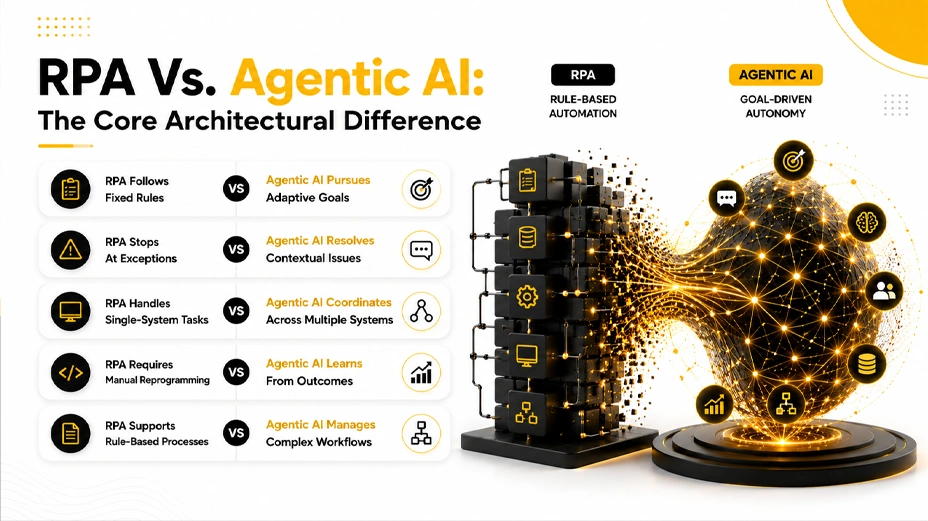
The RPA vs. agentic AI question is not about which technology is newer. It is about which architecture is suited to which category of work.
RPA follows instructions. An agentic AI workflow pursues goals.
That distinction sounds philosophical until you trace it through a real process. Consider an accounts payable workflow where an invoice arrives with a vendor name that does not exactly match the CRM record. An RPA bot flags the mismatch and stops, waiting for a human to resolve it. An agentic AI workflow reads the invoice, cross-references the vendor name against multiple data sources, identifies the likely match with high confidence, processes it, and logs the decision with a full audit trail. If confidence falls below a threshold, it escalates with context, not just an error code.
| Dimension | RPA Automation | Agentic AI Workflow |
| Instruction type | Fixed rules, scripted steps | High-level goals, interpreted in context |
| Exception handling | Stops and escalates every exception | Handles most exceptions, escalates edge cases |
| Adaptability | Breaks when inputs change | Adjusts behavior based on context |
| Multi-system coordination | Limited; one system at a time | Native; calls APIs, queries databases, runs code |
| RPA maintenance cost | 15-20% of initial build annually | Reduces over time as the agent learns |
| Learning | Does not improve without reprogramming | Improves through outcome feedback |
| Best for | Stable, structured, rule-bound tasks | Complex, adaptive, multi-tool workflows |
The practical implication: RPA with AI is increasingly how mature robotic process automation platforms are evolving, layering AI capabilities on top of existing bot infrastructure. But the underlying architecture of pure RPA was never designed for autonomous decision-making, and retrofitting it has limits.
What an Agentic AI Workflow Actually Looks Like
An agentic AI workflow is built on four components that work together to enable autonomous execution:
- LLM reasoning layer: The large language model interprets the goal, reads context from inputs, and determines the sequence of actions needed to reach the desired outcome.
- Memory system: The agent retains context across steps within a task and, in more sophisticated deployments, across sessions. This is what allows it to reference a prior interaction, a past decision, or an account history when making the next move.
- Tool execution layer: The agent calls external tools, APIs, databases, and systems as needed. This is the layer that separates an agentic AI workflow from a chatbot: it takes actions, not just generates text.
- Self-evaluation layer: After each action, the agent checks whether the result matches what was expected, adjusts its plan if it did not, and decides whether to continue, retry, or escalate.
This architecture is why uses of robotic process automation are increasingly being complemented or replaced by agentic deployments for processes that require any level of adaptive decision-making.
Where Agentic AI Workflows Outperform RPA Systems
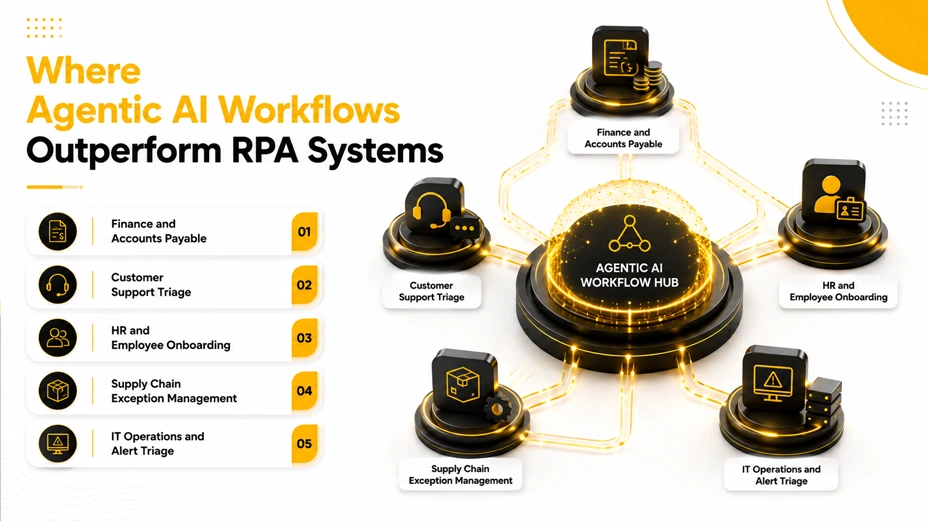
1. Finance and Accounts Payable
Invoice processing is one of the most common uses of robotic process automation, and it is also one of the clearest demonstrations of where RPA’s limitations surface. Invoice formats vary, vendor names do not always match CRM records exactly, and approval thresholds require contextual judgment.
An agentic AI workflow handles all of this: reading invoices regardless of format, cross-referencing vendor data, applying approval logic based on current policy, and escalating only when the invoice requires a human decision. The agent logs every action for audit purposes, reducing compliance overhead at the same time.
2. Customer Support Triage
AI agent support in customer service replaces tier-1 triage with a system that reads the full context of a support request, queries account history, identifies the issue type, and either resolves it directly or routes it to the right human team with full context already populated. Organizations deploying AI agents in customer support have reduced average call handling time by up to 25% and reduced call transfers by as much as 60%.
3. HR and Employee Onboarding
Employee onboarding involves collecting documentation, triggering IT provisioning, scheduling orientation sessions, enrolling in training, and sending reminders for outstanding items, all across multiple systems, all time-sensitive. RPA handles the steps that never change. An agentic AI workflow handles the steps that vary by role, location, start date, and employee type, coordinating across HR, IT, and management without requiring a human to orchestrate every handoff.
4. Supply Chain Exception Management
Supply chain operations generate a constant stream of threshold crossings, delivery exceptions, and vendor alerts that require a response. An agentic AI workflow monitors inventory levels, triggers purchase orders when thresholds are crossed, coordinates with logistics partners via API, and flags only the situations that require procurement team judgment. Early adopters of coordinated agent systems in logistics have cut processing delays by up to 40%.
5. IT Operations and Alert Triage
IT operations teams deal with large volumes of alerts, most of which follow recognizable patterns that do not require senior engineer attention. An agentic AI workflow triages incoming alerts, runs first-line diagnostics, applies standard remediations for known error types, and creates a prioritized escalation ticket for issues outside its defined competence. This is RPA and AI working in combination: the rule-based routing that RPA handles well, layered with the contextual judgment that agentic AI adds.
RPA with AI: The Hybrid Path Most Enterprises Are Actually Taking
The practical reality for most large enterprises is that full replacement of existing RPA systems is not a near-term option. The better framing is RPA with AI: layering agentic capabilities on top of existing automation infrastructure where the process complexity warrants it, while keeping pure RPA automation in place for the stable, rule-bound workflows where it performs well.
The leading robotic process automation platforms, including UiPath, Automation Anywhere, and Blue Prism, have all moved in this direction. Each has added AI-powered process mining, exception handling, and conversational interfaces that expand what their underlying bot infrastructure can handle. This is not the same as a purpose-built agentic AI workflow, but it extends the useful life of existing RPA systems while organizations build toward more capable architectures.
The right framework for deciding which approach applies to a given workflow comes down to three questions:
- How often does the process encounter exceptions? High exception rates signal agentic AI workflow territory.
- How many systems does the process touch? Multi-system coordination is where agentic architectures compound their advantage.
- How frequently do upstream applications change? High change frequency drives RPA maintenance cost up and makes adaptive AI more cost-effective over a two- to three-year horizon.
The Business Case: What the Numbers Actually Say
The cost side of this conversation is often presented as a straightforward comparison, but the full picture requires looking beyond licensing.
RPA total cost of ownership breakdown:
- Licensing: $8,000 to $15,000 per bot per year (enterprise grade)
- Initial development: $5,000 to $15,000 per automated process
- Ongoing RPA maintenance cost: 15% to 20% of development cost annually
- Exception handling: requires human intervention for every out-of-scope scenario
Agentic AI workflow outcomes (aggregated from enterprise deployments):
- 20 to 30% faster workflow cycle times for multi-step business processes
- Up to 40% reduction in logistics delays
- Up to 25% reduction in customer support handling time
- Maintenance requirements reduce over time as agents learn from outcomes
According to Gartner, 40% of enterprise applications will include task-specific agents by end of 2026, up from less than 5% in 2025. The infrastructure shift is happening now, not in three years.
What a Successful Transition Requires
Moving from RPA automation to agentic AI workflows is not a rip-and-replace exercise. The organizations getting the best results are following a structured path:
- Audit existing RPA systems for exception rates and maintenance burden. Processes with high exception rates and rising RPA maintenance costs are the first candidates for agentic replacement.
- Define the goal before selecting the architecture. The clearer the success criteria, the more precisely you can specify what the agentic AI workflow needs to accomplish.
- Ensure data accessibility. Agents that need to query CRM records, inventory systems, or contract databases can only operate if that data is clean and API-accessible. Poor data quality is the most common reason agentic deployments underperform.
- Build a human oversight model. Define which decisions the agent makes autonomously, which require human confirmation, and which escalate automatically. This is not optional governance: it is the structure that keeps the system operating within liability boundaries.
- Measure before and after. Establish baseline metrics for cycle time, error rate, and cost per transaction before deploying the agent, so ROI is demonstrable rather than assumed.
Conclusion
RPA automation solved a real problem, and for stable, rule-bound processes, it continues to solve it. But the category of work that organizations need to automate has expanded well beyond what scripted bots can reliably handle. The rise of agentic AI workflows is not a rejection of what RPA systems built. It is the next architecture for the processes that fell outside RPA’s boundaries.
The enterprises making the transition now, with clear use cases, measurable baselines, and proper oversight models, are the ones that will have the most capable automation infrastructure as the technology matures. The ones still absorbing rising RPA maintenance costs on brittle, high-exception processes are the ones paying the most for the least.
If you are evaluating the right automation architecture for your enterprise workflows and want to map which processes are ready for an agentic AI workflow deployment, you can reach out at coffee@sparkeighteen.com.