Most marketing teams upgraded from spreadsheets to automation platforms and called it a day. The teams consistently outperforming them in 2026 made a different move: they deployed AI agents for marketing that plan, execute, and self-correct across their entire pipeline without anyone micromanaging every step.
The numbers reflect where this is heading. According to Gartner, 40% of enterprise applications will include task-specific agents by the end of 2026, up from less than 5% in 2025. Teams already running AI marketing agents report 15.7% cost savings and 24.69% productivity gains across lead generation and content distribution.
This guide breaks down 9 purpose-built AI tools for marketing, the 4 highest-ROI workflows behind those numbers, and the practical criteria for choosing an AI marketing platform that actually fits your operation.
What Is an AI Marketing Agent, and Why Does It Matter?
A standard AI marketing tool responds when prompted. You give it a task, it outputs a result, and the loop ends. An AI marketing agent operates on an entirely different logic: it receives a goal, perceives what data and tools are available, decides the next action, executes it, checks the result, and repeats, without a human directing each step.
The practical difference is significant. A campaign manager using a generative AI tool still has to pull analytics, interpret signals, write copy variants, and manually reallocate budget. An AI marketing agent does all of that in a single autonomous workflow. It is the difference between a tool you use and a system that works for you.
This is what makes agentic AI for marketing a genuine shift, not just an upgrade. It removes the operational ceiling that previously came with human attention as the bottleneck.
9 AI Agents for Marketing Tools Worth Using in 2026
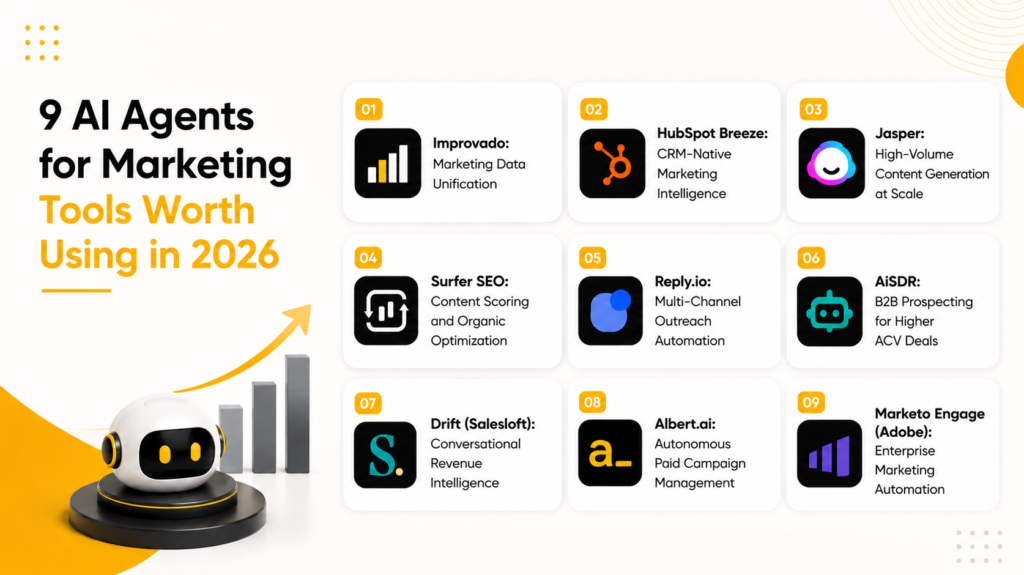
The tools listed below are purpose-built. Each one addresses a specific marketing bottleneck.
1. Improvado: Marketing Data Unification
Best for: Enterprise analytics teams managing data across 500+ sources
Improvado acts as the data backbone for teams running on fragmented analytics. It pulls marketing data from paid channels, CRM platforms, and web analytics into a single normalized layer, then surfaces insights through an AI-driven dashboard. For teams where reporting eats 10+ hours a week, this is where the time goes.
Key capabilities:
- Automated data ingestion from 500+ connectors
- AI-generated campaign performance summaries
- Custom KPI dashboards without manual data prep
- Anomaly detection and spend alerts in real time
2. HubSpot Breeze: CRM-Native Marketing Intelligence
Best for: SMBs and mid-market teams already on HubSpot CRM
HubSpot Breeze is an AI marketing agent embedded directly into the HubSpot ecosystem. It enriches contact records automatically, suggests next-best actions for leads, drafts outreach copy, and flags deal risks before they become losses. For teams that live in HubSpot, it is the fastest path to agentic AI for marketing without adding another platform.
Key capabilities:
- Automatic contact and company enrichment
- AI-drafted email sequences based on CRM context
- Deal health scoring with recommended actions
- Integrated across Marketing Hub, Sales Hub, and Service Hub
3. Jasper: High-Volume Content Generation at Scale
Best for: Content teams producing across multiple formats and brand voices
Jasper is one of the most widely deployed AI tools for marketing content. It generates long-form articles, ad copy, product descriptions, and social posts using brand voice profiles that prevent the generic output problem most teams hit with basic generative tools. For teams producing 50+ pieces of content a month, it compresses production time considerably.
Key capabilities:
- Brand voice training and enforcement across outputs
- 50+ templates for different content formats
- Multi-language content generation
- Campaign brief to draft in minutes, not hours
4. Surfer SEO: Content Scoring and Organic Optimization
Best for: SEO and organic growth teams focused on search-driven traffic
Surfer SEO is among the highest-rated AI marketing tools for organic search. It analyzes top-ranking pages for any target keyword, generates a content structure optimized for that SERP landscape, and scores content in real time as you write or edit. Teams using Surfer consistently reduce the gap between content production and search performance.
Key capabilities:
- Real-time content score against top 20 SERP results
- Keyword density guidance and NLP term recommendations
- Topical map generation for content cluster planning
- Integration with Google Docs, WordPress, and Jasper
5. Reply.io: Multi-Channel Outreach Automation
Best for: SDR teams running high-volume multi-channel sequences
Reply.io is an AI marketing agent built for outbound. It automates personalized email, LinkedIn, SMS, and WhatsApp sequences, adjusts follow-up timing based on prospect behavior, and routes engaged leads directly to sales reps. The AI layer handles personalization at scale: a task that would take an SDR team hours to do manually.
Key capabilities:
- Jason AI agent for autonomous prospect research and outreach
- Behavior-based sequence branching
- Meeting booking integrated into outreach flow
- Native CRM sync with HubSpot, Salesforce, and Pipedrive
6. AiSDR: B2B Prospecting for Higher ACV Deals
Best for: B2B SaaS teams with ACV above $10K
AiSDR runs ICP-targeted prospecting autonomously. It finds qualified prospects, pulls relevant company context, writes personalized outreach referencing that context, and manages follow-up cadence, all without SDR involvement until a prospect replies. For teams where a qualified pipeline is the primary constraint, this is one of the sharper AI marketing solutions available.
Key capabilities:
- ICP-based prospect discovery and list building
- Personalized outreach using LinkedIn and company data
- Autonomous follow-up management
- CRM logging with full activity history
7. Drift (Salesloft): Conversational Revenue Intelligence
Best for: B2B teams converting high-intent web traffic
Drift, now part of Salesloft, deploys conversational AI on the website to engage qualified visitors in real time. It qualifies leads through structured conversation, books meetings directly into sales rep calendars, and routes high-value accounts to the right team member immediately. This is generative AI in marketing applied to real-time conversion, not just content.
Key capabilities:
- Account-based chat routing for target accounts
- Automated meeting scheduling within conversation
- Intent data integration for real-time personalization
- Full conversation history synced to CRM
8. Albert.ai: Autonomous Paid Campaign Management
Best for: Performance marketing teams running paid at scale across channels
Albert.ai is one of the most mature AI marketing automation platforms for paid media. It manages Google, Facebook, Instagram, and Bing campaigns autonomously: testing creative combinations, reallocating budget across top-performing segments, and pausing underperformers without waiting for a human to run the analysis.
Key capabilities:
- Autonomous A/B testing and budget reallocation
- Cross-channel campaign orchestration
- Audience segmentation and bid optimization
- Weekly performance reports with recommended actions
9. Marketo Engage (Adobe): Enterprise Marketing Automation
Best for: Large enterprises managing complex, multi-touch campaign operations
Marketo Engage remains one of the most capable AI marketing platform options for enterprise scale. It handles lead scoring, nurture automation, account-based marketing orchestration, and campaign attribution across long, complex buyer journeys. The Adobe Sensei AI layer adds predictive scoring and content personalization that improves engagement rates over time.
Key capabilities:
- Advanced lead scoring with behavioral and firmographic signals
- Account-based marketing playbooks at enterprise scale
- Predictive content recommendations via Adobe Sensei
- Multi-touch revenue attribution modeling
What to Look for in an AI Marketing Platform?
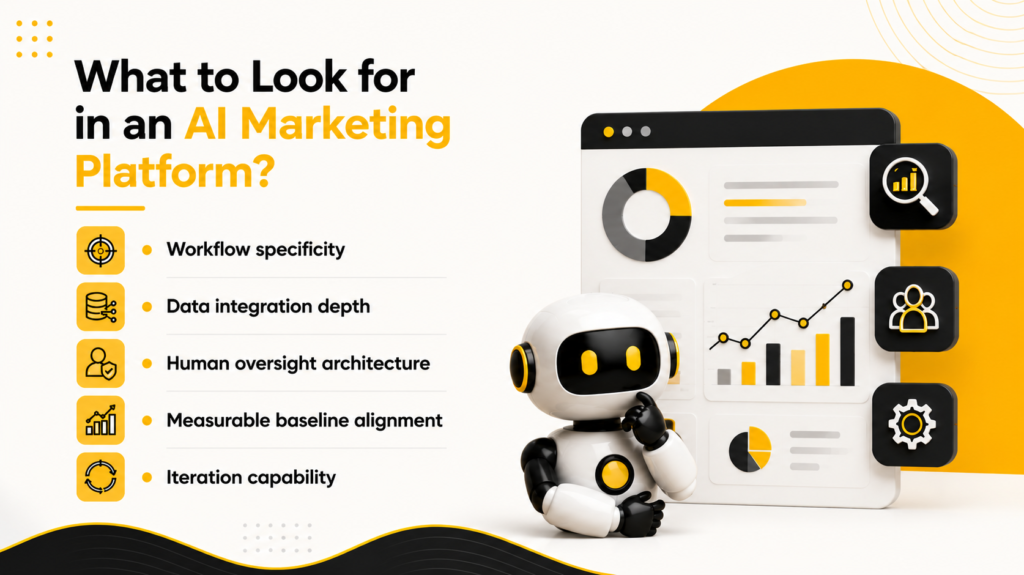
Not every AI marketing platform delivers at the same level. Before committing budget, evaluate any tool or system against these five criteria:
- Workflow specificity: Does the platform solve a defined workflow problem, or is it a general-purpose tool looking for use cases? Purpose-built agents outperform general-purpose ones in operational settings.
- Data integration depth: Can the platform connect to your CRM, ad platforms, analytics stack, and content systems? Agents that cannot access your data cannot act on your behalf.
- Human oversight architecture: Does the platform define which decisions it makes autonomously and which require human confirmation? This is a governance requirement, not a feature preference.
- Measurable baseline alignment: Can you track the metric you care about before and after deployment? If the platform cannot demonstrate impact against your baseline, you cannot evaluate its ROI.
- Iteration capability: Does the platform provide mechanisms for reviewing failures and refining agent behavior over time? First deployments are rarely the final configuration.
High-ROI Marketing Workflows Powered by AI Agents
The tools above deliver the most value when organized into coordinated workflows, not used as isolated point solutions. These four workflows represent the highest-ROI applications of ai tools in marketing today.
Workflow 1: Autonomous Lead Research and Enrichment
The problem it solves: SDRs spend 15 to 20 minutes per prospect on manual research before they can write a relevant outreach message.
How the workflow runs:
- A new lead enters the CRM via form submission or list import
- An ai marketing agent pulls company data, funding history, and role context from public sources
- The agent checks CRM history for prior contact or account-level activity
- It scores the lead against the ICP and assigns a priority tier
- A personalized outreach draft is generated and queued for the SDR to send or approve
Result: Research time drops from 15-20 minutes to under 60 seconds per prospect, at unlimited volume.
Workflow 2: Generative AI Content Production Pipeline
The problem it solves: Content teams bottleneck on research and first-draft production, not on editorial judgment.
How the workflow runs:
- A keyword cluster or campaign brief is submitted
- An ai marketing agent runs competitor content analysis and identifies structural gaps
- It generates an SEO-optimized content brief with recommended headings, NLP terms, and supporting data points
- A draft is produced and scored against Surfer SEO targets
- Human editors handle tone, accuracy review, and final publishing
This is generative AI for marketing applied correctly: the agent handles the research-intensive labor, and the editor handles the judgment calls.
Workflow 3: Multi-Channel Campaign Optimization
The problem it solves: Paid media teams lose performance time waiting for manual analysis cycles before reallocating budget.
How the workflow runs:
- Albert.ai or a similar ai marketing automation agent monitors campaign performance in real time across all channels
- It identifies underperforming ad sets based on CPC, CTR, and conversion thresholds
- Budget is automatically reallocated from low performers to high performers
- New creative variants are tested against the current winning combination
- A summary report with performance deltas is delivered weekly
Result: Teams recover budget efficiency that would otherwise be lost during reporting lag.
Workflow 4: Behavioral Trigger-Based Customer Journey Automation
The problem it solves: Customer journey management requires coordinating dozens of signals and touchpoints that no human team can track at scale.
How the workflow runs:
- Behavioral triggers are defined: a user views pricing 3 times, starts a trial, goes inactive after day 5, or opens but does not click an email
- An ai marketing agent detects each trigger in real time via web analytics or product usage data
- It determines the next best action for that user: a targeted email, an in-app message, a personalized case study, or a sales alert
- The communication is executed automatically across the appropriate channel
- Response behavior updates the user’s journey stage in the CRM
This is where AI marketing automation closes the gap between what marketing teams know and what they can actually act on.
Conclusion
Marketing teams that have moved to coordinated AI agents for marketing are not just saving time on individual tasks. They are executing workflows that were previously impossible at their team size. A 5-person marketing team running AI tools for marketing in coordinated workflows can produce campaign output that would have required a 15-person team two years ago.
The teams building the operational infrastructure now, with clear use cases, measured baselines, and coordinated workflows, are the ones that will have the largest competitive advantage as the technology matures.
Agentic AI for marketing is not a future trend. It is the current operating model for teams serious about performance. The tools exist. The workflows are proven. The question is whether your marketing operation is structured to take advantage of them.
If you want help identifying the right AI marketing agent workflows for your business or building a deployment strategy around your specific funnel, you can reach out at coffee@sparkeighteen.com.