Every AI agent demo looks impressive. The agent chains tool calls together, reasons through a multi-step problem, and surprises the room. Then the session ends and the real question arrives: how do you run this in production?
88% of AI agents that work in controlled demos fail when deployed to real enterprise workflows. The problem is rarely the model; it is the architecture, data access, and governance infrastructure that a proof of concept never has to demonstrate. This guide covers what actually has to change when agentic AI moves from demo to production.
AI agents in production: what does it take to move beyond the demo?
A production-ready AI agent is a governed system: a defined objective, bounded tool access, enterprise data connections, observable behaviour, and human oversight at critical decision points. Most agentic AI projects fail because they optimise for demo speed and treat governance, monitoring, and data infrastructure as things to sort out later.
Key takeaways
- 88% of AI agents that work in demos fail in production: the gap is architectural and operational, not a model quality problem
- Gartner predicts 40% of agentic AI projects will be cancelled by end of 2027
- The biggest production barrier is trust, reliability, and security, cited by 44% of enterprise practitioners ahead of integration, cost, and organisational readiness
- Small, specialised agents with named owners consistently outperform “do-everything” agents in production
- Companies deploying AI agents report an average ROI of 171% when the production foundations are right
What are AI agents?
AI agents are AI-powered systems that can understand goals, plan tasks, use tools, and take actions to complete multi-step workflows with varying levels of autonomy. They often use large language models (LLMs) to interpret information, make decisions, interact with APIs or business applications, and evaluate results. Unlike basic chatbots that primarily generate responses, AI agents can carry out tasks such as researching information, analyzing documents, managing customer support requests, and coordinating business processes. Their level of autonomy depends on their design, permissions, and human oversight.
AI agents vs generative AI
The main difference between AI agents and generative AI is that generative AI creates content, while AI agents can use AI models, tools, and workflows to pursue a goal through multiple steps. Generative AI can produce text, images, summaries, or code in response to a prompt. An AI agent can use generative AI to interpret a request, retrieve relevant information, call external tools, evaluate results, and decide what to do next. For example, generative AI can draft a customer email, while an AI agent can retrieve the customer’s order details, draft a personalized response, and route it for approval before sending it.
AI agents vs traditional automation
AI agents differ from traditional automation in how they handle decisions and changing inputs. Traditional automation follows predefined rules and workflows to execute predictable tasks consistently, such as transferring data, generating reports, or processing standardized forms. AI agents can interpret unstructured information, handle variations in requests, and select actions based on context. For example, traditional automation can route support tickets using fixed keywords, while an AI agent can interpret the customer’s issue, assess its intent, and recommend the appropriate next step. Traditional automation is generally preferable for stable, rule-based processes, whereas AI agents are useful when workflows require contextual understanding and flexible decision-making.
AI agents vs RPA
The difference between AI agents and Robotic Process Automation (RPA) is that RPA primarily automates predefined, repetitive tasks, while AI agents can handle workflows that require reasoning and adaptation. RPA is well suited to structured processes such as copying data between applications, entering invoice details, and submitting forms. AI agents can interpret documents, understand natural-language requests, evaluate exceptions, and choose appropriate actions. For example, an RPA bot can transfer approved invoice data into an accounting system, while an AI agent can analyze an invoice, identify potential discrepancies, and recommend whether it needs human review. Businesses can also combine both technologies to achieve intelligent decision-making and reliable process execution.
How AI agents work
AI agents work by receiving a goal, gathering relevant information, planning actions, using available tools, and evaluating the results until the task is completed or requires human intervention. Although implementations vary, a typical AI agent follows these steps:
- Goal identification: The agent interprets the user’s request or assigned objective.
- Planning: It determines the steps needed to achieve the goal.
- Information gathering: It retrieves relevant data from documents, databases, websites, or APIs.
- Tool use and execution: It performs permitted actions through connected applications and systems.
- Evaluation: It checks the results and determines whether further action is needed.
- Completion or escalation: It finishes the task when appropriate or requests human approval when uncertainty, risk, or predefined limits require intervention.
This process allows AI agents to manage multi-step workflows rather than simply generate a single response. In production environments, access controls, monitoring, validation, and human oversight help ensure that agent actions remain reliable, secure, and aligned with business requirements.
What changes when AI agents move from prototype to production?
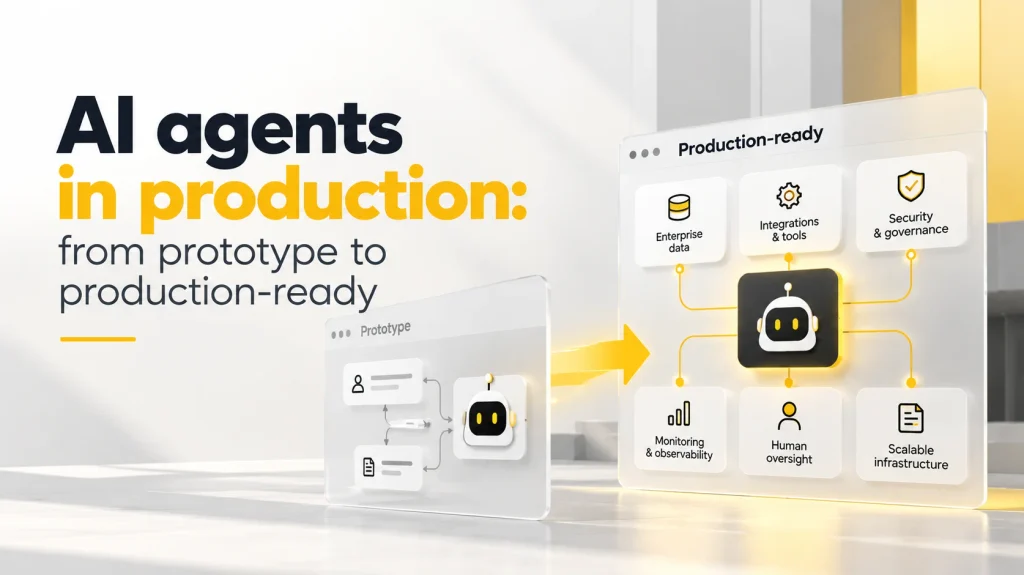
The demo worked because every condition was controlled. Production removes those controls, and what was abstracted away in the POC becomes the hardest engineering problem on the team’s plate.
Prototype data vs production data
POCs run on manually curated clean data designed to make the demo work. Production agents need a unified, governed, real-time data layer spanning business units, the most common blocker between a successful demo and a scalable agentic AI deployment.
Controlled workflows vs real-world conditions
Demo environments test the happy path. Production surfaces edge cases, malformed inputs, timeout errors, conflicting data, and adversarial prompts the demo never encountered. Agents must be designed and tested for failure modes, not just the path that makes the demo impressive.
Limited tools vs enterprise integrations
A POC connects to two or three pre-configured tools. A production agent may interact with CRMs, ERPs, compliance systems, and third-party APIs, all through access controls that mirror the permissions of the human the agent is acting for.
Human testing vs continuous monitoring
In a demo, humans evaluate every output. In production, automated observability (reasoning traces, tool call logs, escalation rates, drift detection) replaces manual evaluation as the primary quality signal.
Experimentation vs governance
POCs operate outside formal governance because speed is the priority. Production agents require a named owner, risk classification, compliance review, audit trails, and a tested rollback plan. Governance added post-demo is the most common reason agentic AI projects stall before launch.
AI agent production readiness checklist: key requirements at a glance
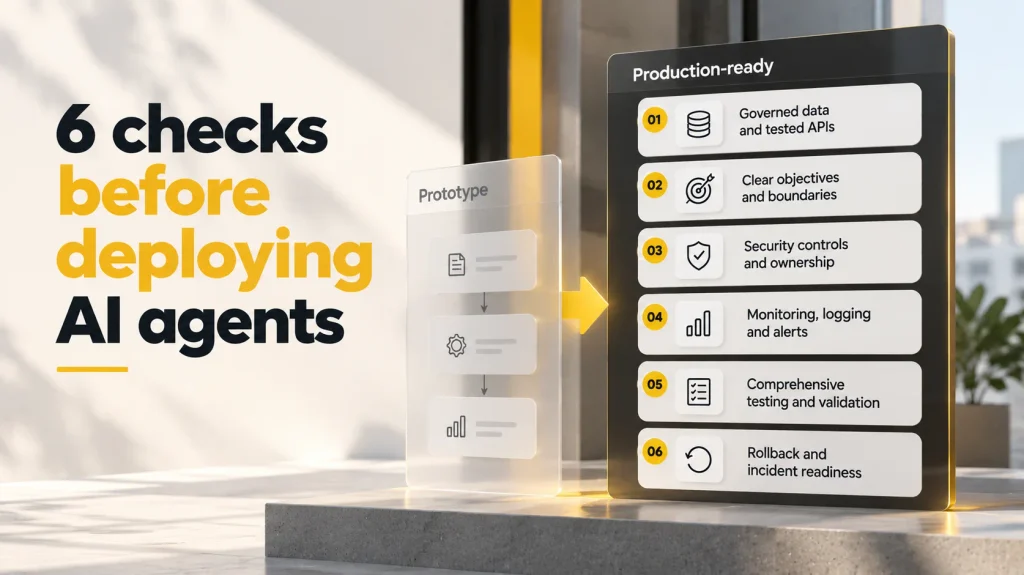
Before declaring an agentic AI system production-ready, confirm each of the following is in place.
- Unified governed data layer in place; APIs tested with production-representative data
- Single measurable objective per agent; decision boundaries and allowed tools documented
- Agent inherits identity of the user it acts for; prompt injection protections active; model gateway logging enabled; agent risk classification and named owner assigned
- Reasoning traces, tool call logs, cost monitoring, and escalation rate alerts all active
- Functional, adversarial, prompt injection, tool-use, load, and human acceptance testing completed
- Shadow mode testing completed; rollback procedure documented and tested; incident response plan defined
The architecture of a production-ready AI agent
A production agent is not a single system but a stack of interconnected layers, each with a defined responsibility, and each a potential failure point if not built and governed deliberately.
Agent orchestration and model layer
The orchestration layer manages the reasoning loop: planning steps, routing tool calls, evaluating results, triggering escalation or termination. Model versioning and regression testing are required: a silent model update that changes behaviour without governance review is a production risk.
Memory, context, and tool layer
Agent state must survive restarts and timeouts; long-running agents should checkpoint state so a failure mid-task resumes from the last known good step. Every tool must be explicitly registered and whitelisted, and tools should be idempotent to prevent duplicate side effects on retries.
Enterprise data and guardrails layer
A context convergence layer (such as MCP) connects agents to business data while applying governance at the wrapper; a new use case requires no new plumbing. The guardrails layer enforces input sanitisation, output validation, rate limiting, and tool-call whitelisting, the control plane that makes the architecture defensible.
Observability and human escalation layer
Captures reasoning traces, decision audit trails, tool call logs, and cost per task using OpenTelemetry semantic conventions for generative AI. The human escalation layer defines when the agent stops and hands off; escalation paths must be designed and tested before production, not after the first live failure.
Designing AI agents for production
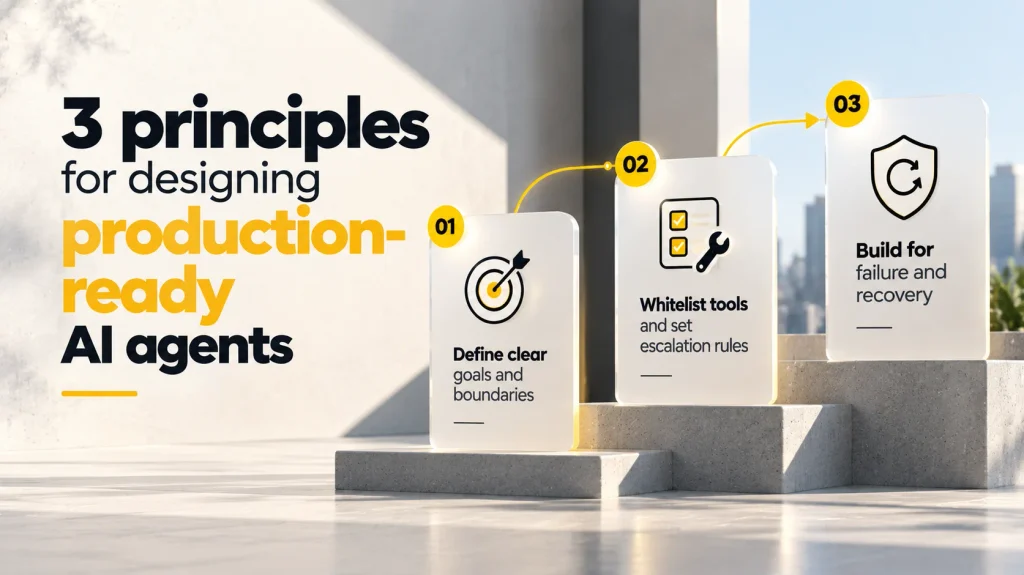
How you design an AI agent determines whether it scales reliably in production or fails at the first edge case it was not built to handle.
Define a single measurable objective and clear boundaries
If each step in a five-step agent chain has a 70% success rate, the chain succeeds only 17% of the time. A focused, bounded agent is more reliable and easier to govern. Without explicit boundaries, agents drift as context windows expand and write access creeps into areas the agent was never intended to touch.
Define allowed tools and establish escalation rules
Every tool must be explicitly whitelisted; irreversible actions require human confirmation unless the risk classification specifically permits autonomous execution. Define escalation triggers before launch (confidence below threshold, action risk above permitted bound, contradictory data) and test every escalation path before go-live.
Design for failure and recovery
Implement checkpointing for long-running tasks, idempotent tool calls wherever possible, and a recovery path that resumes from the last checkpoint or hands off cleanly to a human when the agent cannot continue.
Single-agent vs multi-agent architecture
The right architecture depends on workflow complexity, the number of systems involved, and the governance overhead the team can sustain.
| Dimension | Single agent | Multi-agent system |
| Complexity | Lower, simpler reasoning loop | Higher, orchestration required |
| Governance | One owner | One owner per agent, shared orchestration accountability |
| Reliability | Fewer failure points | Failure compounds across agents |
| Best for | Focused, bounded workflows | Complex, multi-system, multi-step tasks |
When to use single vs multi-agent
Use a single agent when the workflow has a clear bounded objective and the tool count is small; most organisations should have one agent in stable production before considering multi-agent architecture. Multi-agent architectures suit workflows requiring parallel reasoning across separate domains, but compound reliability risk: in a three-agent chain where each succeeds 70% of the time, the chain succeeds only 34% of the time.
Agent ownership and governance
Every agent requires a named owner accountable for performance, compliance, and escalation paths. A governed agent registry tracking every deployed agent is essential as agent count grows.
Data foundations for production AI agents
Data is the most common reason a successful AI POC fails to reach production, and the most consistently underestimated part of the build.
Unified data layer and real-time access
A siloed data environment that needed manual curation for the demo produces unreliable agent behaviour in production. A unified governed data layer is a prerequisite, not a future improvement, and most production agentic AI use cases require real-time or near-real-time data access, not batch-refreshed stores.
APIs, integrations, and RAG
A context convergence layer abstracts integrations so governance controls apply at the wrapper; a new use case does not require new plumbing. RAG grounds outputs in verified internal content, but is not a silver bullet: if retrieved data is incomplete or semantically inconsistent, hallucinations persist.
Data quality and access permissions
Agents amplify data quality problems: implement validation at ingestion and confidence scoring on retrieved content. Agents should access only the data the human they act for would access, using the platform’s existing identity model with all access logged.
Security and governance for AI agents
Security and governance are not additions to an agentic AI system; they are the foundation it runs on, and retrofitting them after deployment is the most expensive way to learn that lesson.
Least-privilege access and identity management
Agents should access only the tools required for their specific objective and authenticate using the identity of the human or service account they act for, not a separate elevated agent identity.
Prompt injection and memory security
Prompt injection is the most common production attack: mitigate with input sanitisation, semantic guardrails, and system prompt protection. Implement access controls on memory stores to prevent adversarial content injected into persistent memory from influencing future agent behaviour.
Human-in-the-loop controls and audit trails
Require human review for agents influencing customer-facing decisions, irreversible actions, or regulated workflows. Every agent action, tool call, and output must be logged to an immutable audit trail; the EU AI Act makes this a legal requirement for high-risk AI systems.
Agent risk classification
Classify every production agent: low (internal tools, annual review), medium (customer-adjacent, quarterly review), high (regulated decisions, mandatory human override, monthly review), critical (autonomous action in regulated domains, continuous monitoring, third-party audit).
AI agent observability and monitoring
You cannot govern what you cannot see: observability is the operational backbone of every production-grade agentic AI system, and the primary early-warning system when something starts to drift.
Agent action logs and tool-call monitoring
Log every tool call, parameter, response, and outcome, the primary resource for audit and incident response. Tool misuse and failures account for approximately 31% of observed production failures; track success rate, failure mode, latency, and cost per call with alerts on elevated failure rates.
Reasoning traces and cost monitoring
Reasoning traces capture how the agent arrived at its decision, essential for explaining outcomes to auditors. Track token consumption per task and set budget alerts; cost belongs on the same operational dashboard as error rates.
Error monitoring and behavioural drift detection
Define acceptable error rate thresholds before launch and distinguish transient failures (tool timeout) from systematic ones (reasoning errors, data quality issues). Rising escalation frequency or declining task completion signals that an agent needs governance review; establish baseline metrics at launch and monitor continuously.
How to test AI agents before production
AI agents require a testing approach that goes beyond standard software QA: the non-deterministic reasoning layer introduces failure modes that functional tests alone will not surface.
Functional and adversarial testing
Test the agent across expected scenarios, boundary conditions, and known edge cases, then test with malformed inputs, contradictory instructions, and data designed to confuse the reasoning loop; production surfaces adversarial conditions that demo environments never encounter.
Prompt injection and tool-use testing
Attempt to override the agent’s system prompt through user messages, retrieved documents, and tool responses; verify guardrails detect and block injection attempts. Test every tool with production-representative API responses including errors and timeouts, not mocked APIs that always return the expected result.
Load testing and human acceptance testing
Simulate production traffic volume under concurrent agent instances and degraded downstream APIs. Have domain experts evaluate a representative sample of outputs before launch; they identify plausible-but-wrong outputs that automated testing routinely misses.
How to deploy AI agents safely
A staged deployment sequence protects production from failures that testing cannot always anticipate; each stage is a controlled gate, not a formality.
Sandbox, shadow mode, limited pilot
Start in a fully isolated sandbox, then run the agent in parallel with the live process (shadow mode), capturing outputs without acting on them; advance to a limited pilot with human review of every output before it influences a decision.
Canary deployment and production rollout
Roll out to a small percentage of live traffic, monitoring error rates, escalation rates, and cost against established thresholds; expand to full production only after canary metrics are stable for a defined observation period.
Human approval and rollback
Require explicit human approval for write actions or customer-facing decisions at every stage; define and test the rollback procedure before go-live so operations can execute it without specialist data science involvement.
How to measure AI agent performance and ROI
Companies deploying AI agents report an average ROI of 171%. The organisations achieving that return define success metrics before deployment, not after.
| KPI | What it measures | Target direction |
| Task completion rate | % of tasks completed without escalation or error | Higher |
| Successful tool-call rate | % of tool calls returning usable results | Higher |
| Escalation rate | % of tasks escalated to human | Monitor (too high or too low both signal problems) |
| Error rate | % of tasks producing incorrect or non-compliant outputs | Lower |
| Cost per task | Token and API cost per completed task | Lower over time |
| Cycle-time reduction | Time saved vs pre-agent baseline | Higher |
| Human intervention rate | % of tasks requiring unplanned human involvement | Lower over time |
Task completion rate and tool-call success rate
Task completion rate measures the percentage of tasks completed without human rescue or error termination; tool-call success rate identifies integration or data quality gaps. Both need acceptance thresholds set by risk tier before launch.
Escalation rate and error rate
Escalation rate too high means the agent lacks context; too low warrants a review of whether required human oversight is being bypassed. Define “error” precisely before launch so the metric is consistently measured.
Cost per task and human intervention rate
Deployments that look successful in limited pilots become economically unsustainable when infrastructure, token, and human costs are fully attributed at volume. Human intervention rate captures failure modes not anticipated in agent design, providing the feedback needed to expand capabilities responsibly.
When should businesses NOT use AI agents?
Not every workflow benefits from an AI agent; recognising the wrong use cases before building is as important as identifying the right ones.
Deterministic or low-volume workflows
If the process always follows the same steps and produces the same output, rule-based automation or RPA is more reliable and easier to audit. Low-volume processes rarely justify the implementation and governance cost of an agentic AI project.
High-risk irreversible decisions without human oversight
Agentic AI should not be the final decision-maker for irreversible, high-stakes actions (loan approvals, financial trades, employment decisions) unless mandatory human review is built into the workflow.
Poor data environments or undefined success metrics
An agent operating on incomplete or poorly governed data produces unreliable outputs regardless of model quality. If the team cannot define what a successful output looks like, they cannot evaluate whether the agent is working or degrading. Both problems must be resolved before building begins.
AI agents vs RPA: which approach should you choose?
The right tool depends on whether the workflow requires judgment or only execution, and the most effective implementations often combine both.
| Dimension | RPA | AI agents |
| Input type | Structured, predictable | Unstructured, variable |
| Process variability | Low: fixed steps | High: reasoning required |
| System interaction | UI-based | API and semantic layer |
| Maintenance | Breaks on interface changes | Adapts within guardrails |
| Best for | Stable, structured, high-volume | Judgment-intensive, multi-system workflows |
When RPA is better than AI Agents?
Robotic Process Automation (RPA) is better than AI agents for repetitive, rule-based tasks that follow a fixed workflow and use structured data. It is ideal for high-volume processes such as invoice processing, data entry, report generation, system-to-system data transfers, and form submissions. RPA delivers consistent results when inputs, business rules, and process steps remain predictable, making it a cost-effective solution for automating routine business operations.
When AI agents are better than RPA?
AI agents are better than traditional RPA when workflows require reasoning, contextual understanding, or decisions based on unstructured or changing information. They can interpret documents, understand natural-language requests, gather information from multiple sources, and determine the next action based on the situation. Common use cases include customer support, document analysis, intelligent research, and handling exceptions that cannot be managed effectively through fixed automation rules.
Can RPA and AI Agents Work Together?
Yes, RPA and AI agents can work together in a hybrid automation workflow. AI agents can interpret unstructured data, evaluate information, and make context-dependent decisions, while RPA executes predefined, rule-based actions across business applications. For example, an AI agent can extract and validate information from an invoice, flag potential discrepancies, and direct the workflow, while RPA enters approved data into an accounting system. This approach combines intelligent decision-making with reliable process execution, provided that appropriate validation, access controls, and human oversight are in place.
How to move an AI agent from POC to production
The path from a working prototype to a governed production agent follows a repeatable sequence; shortcutting any stage is the most reliable way to accumulate technical and governance debt that surfaces at the worst possible time.
Identify the business workflow: Select a high-volume, judgment-intensive workflow narrow enough to govern confidently and impactful enough to justify the investment.
Define agent boundaries and build guardrails: Document what the agent can decide, what it must escalate, and what it must refuse, then implement the policy layer (input sanitisation, output validation, tool whitelisting, escalation triggers) before the agent connects to production systems.
Test and evaluate: Complete the full testing sequence, document results, and resolve all critical findings before advancing to the next deployment stage.
Launch a controlled pilot: Deploy to a limited scope with human review of all outputs; define the pilot duration, success metrics, and criteria for advancing or pausing.
Monitor and scale: Track all KPIs from day one, review data weekly during the pilot, and apply the same architecture, governance, and testing process to each subsequent agentic AI project; each new agent benefits from the infrastructure already built.
Real-world AI agent implementation
The following example illustrates how the architecture, governance, and testing principles in this guide apply to a financial services compliance workflow.
Business problem: A financial services operations team spent 60% of analyst time triaging compliance alerts across three internal databases.
Agent architecture: A single agent reads each alert, retrieves relevant data through the enterprise data layer, applies the compliance classification logic, and produces a structured recommendation with a confidence score, escalating low-confidence cases automatically.
Integration strategy: The agent connects via a context convergence layer, inheriting the read-only permissions of the compliance analyst role, with all tool calls logged to the central audit system.
Governance controls: Every recommendation was reviewed by a human analyst for the first 60 days, then shifted to a sample-based audit with mandatory review above a defined risk threshold.
Results and learnings: Alert triage time fell 68%. A data quality gap in one database produced systematic errors in a specific alert category that shadow mode missed; continuous monitoring caught it within two weeks of production launch, before it reached customers.
Conclusion
Most companies can demo an AI agent. Few can operate one. The gap between a compelling AI POC and a production agentic AI system is not a model quality gap: it is an architecture, governance, and operational readiness gap. Build the data layer, the guardrails, the observability stack, and the governance framework first. A narrow, well-governed agent that works reliably in production delivers more value than an ambitious demo that never leaves the pilot environment.
Need help building production-ready AI agents?
If you are moving an agentic AI project from proof of concept to production and want an IT solution company that understands both the engineering and governance requirements, our team builds production agent systems with the architecture, security, and observability that enterprises need to deploy with confidence.
Talk to our team about your agentic AI project.