
How to build a disaster recovery plan that holds up under real conditions; test it without surprise bills; and detect the scaling signals that change your risk profile before an outage forces your hand.
Most businesses treat disaster recovery planning the way most people treat home insurance: they know they need it, they are vaguely aware they probably have not done enough, and they would rather not think about it until something goes wrong. The problem with that approach, in both cases, is that the moment something goes wrong is precisely the worst moment to discover the policy does not cover what you assumed it did.
The cost of unplanned downtime is not abstract. IBM’s research estimates the average cost of a data breach in 2023 at $4.45 million, the highest figure recorded in the 18-year history of the report. For smaller businesses and startups, the figures are proportionally lower, but the relative impact is often more severe: a 48-hour outage for a business processing £50,000 per day in transactions is a material event.
What makes disaster recovery planning genuinely difficult is not the technical complexity. The tooling for backup, replication, and failover is mature and, for most businesses, affordable. What makes it difficult is the combination of three problems that compound on each other: plans that are written but never tested, testing approaches that either avoid realistic scenarios or generate unexpected infrastructure bills, and a failure to update the recovery strategy when the underlying system grows past the point where the original plan is still valid.
This guide addresses all three. It covers how to build a disaster recovery plan that is specific enough to act on; how to test that plan cost-effectively without disrupting live services; and how inflection point detection keeps the plan aligned with the actual risk profile of the system as it scales.
Key Takeaways
- Disaster recovery planning requires two documented answers before any incident: how much data the business can afford to lose, and how long it can afford to be unavailable.
- An untested recovery plan is not a recovery plan. It is a document that generates false confidence.
- Disaster recovery testing does not require live service disruption or large infrastructure bills when the right testing method is matched to the right objective.
- Inflection point detection is the practice of monitoring the signals that indicate a system has outgrown its current recovery architecture before an incident confirms it.
- Scaling disaster recovery solutions is not primarily a cost decision. It is a decision about what level of data loss and downtime the business can genuinely sustain at its current stage.
- Business continuity planning and disaster recovery planning are related but distinct disciplines: the former covers how the business operates during an outage, and the latter covers how the system recovers from one.
1. The Two Questions Every Disaster Recovery Plan Must Answer First
Before any technical decisions are made about backup frequency, replication strategy, or failover architecture, a disaster recovery plan needs to answer two questions. These are not questions for the engineering team alone. They require input from whoever understands the business impact of downtime and data loss, whether that is a founder, a CFO, or an operations lead.
The first question defines the Recovery Point Objective, known as ‘RPO’: the maximum age of the data that can be restored to without causing serious business impact. In practical terms, this is the answer to the question: if the system fails right now and we restore from the most recent backup, how old can that backup be before the gap between the backup and the present moment creates an unacceptable problem?
The second question defines the Recovery Time Objective, known as RTO: the maximum acceptable duration of downtime before the business impact becomes unacceptable. This is the answer to the question: if the system fails right now, how long do we have to get it back before the damage to customers, revenue, or reputation crosses a threshold we cannot accept?
These two numbers drive every subsequent technical decision in the disaster recovery plan. A business with an RPO of 15 minutes needs continuous or near-continuous replication. A business with an RPO of 24 hours needs a well-maintained daily backup. The difference in infrastructure cost between those two requirements is substantial, and the only legitimate way to choose between them is to know which one the business actually requires.
RPO and RTO Reference Benchmarks by Business Type
| Business Type | Acceptable RPO | Acceptable RTO | Backup Frequency | DR Tier |
| Real-time financial / payments | Minutes | < 1 hour | Continuous / near-real-time | Tier 1 (Hot) |
| E-commerce / SaaS platform | 1–4 hours | 2–4 hours | Every 1–4 hours | Tier 2 (Warm) |
| B2B SaaS (non-critical ops) | 4–12 hours | 4–8 hours | Every 4–12 hours | Tier 2 (Warm) |
| Internal tools / back-office | 24 hours | 4–24 hours | Daily | Tier 3 (Cold) |
| Marketing / content sites | 24–48 hours | 12–48 hours | Daily | Tier 3 (Cold) |
The table above is a starting framework, not a prescription. The correct RPO and RTO for any given business depend on the specific contractual, regulatory, and commercial context. A B2B SaaS platform with enterprise clients on SLAs may have contractually mandated recovery objectives that sit well above what the table suggests as a typical benchmark. These targets should be documented, agreed upon with the relevant stakeholders, and reviewed whenever the business model or customer base changes materially.
Business continuity planning principle: RPO and RTO are not technical targets. They are business decisions expressed in technical terms. The engineering team’s job is to build a system that meets the targets. The business’s job is to set targets that reflect the actual cost of downtime and data loss.
2. Building a Disaster Recovery Plan That Is Actually Actionable
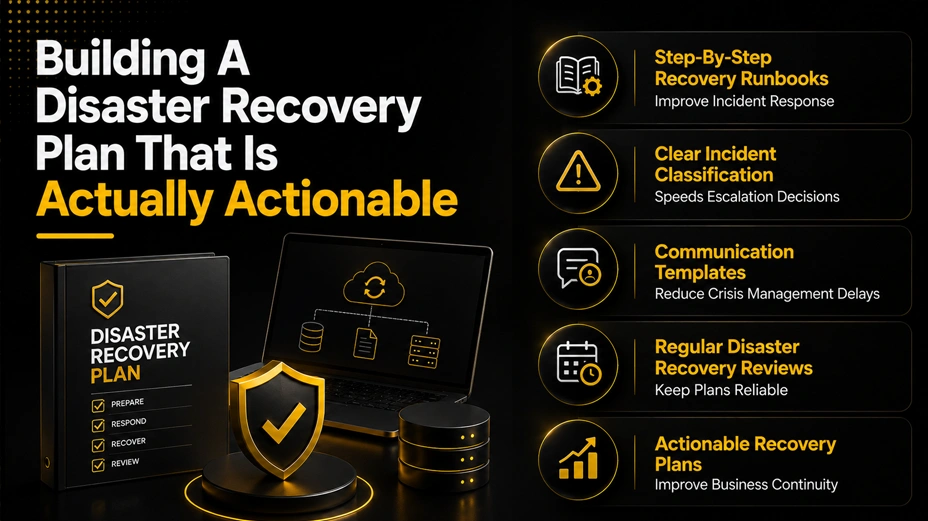
The most common problem with disaster recovery plans is not that they are wrong. It is that they are too abstract to act on during an incident. A plan that says ‘restore from backup’ is not a plan. A plan that says ‘log into the AWS console, navigate to RDS, select the most recent automated snapshot, restore to a new instance in eu-west-2, update the DNS record, and notify the on-call lead via PagerDuty’ is a plan.
The difference matters most in the first 30 minutes of an incident, when the people executing the plan are under pressure, potentially operating without their usual tools, and may not be the most experienced person on the team. A plan written for that person, in that moment, is what produces fast recovery. A plan written to satisfy a compliance requirement produces documents that nobody reads until after the incident.
The Five Components of an Actionable Disaster Recovery Plan
- Incident classification: a simple matrix defining what constitutes a minor incident (handled by on-call, no escalation), a major incident (full recovery procedure activated, stakeholders notified), and a critical incident (business continuity planning invoked, external communication required). This classification should be decided before an incident, not during one.
- Recovery runbooks: step-by-step instructions for each recovery scenario, written at the level of detail that a competent engineer who has never performed the procedure can follow without improvisation. Runbooks should be stored somewhere accessible without depending on the primary system being up: a printed copy in the office, a shared drive, or a secondary document management system.
- Communication templates: pre-written messages for each incident tier, covering internal notification (who gets told, through which channel, at what point in the incident), customer notification (what is communicated, when, and by whom), and external stakeholder notification where relevant. Writing these under pressure produces inconsistent, often damaging communication.
- Contact and access directory: a single document listing the on-call contacts for each system, the credentials required to access recovery infrastructure (stored securely, not in the primary system), and the escalation path if the primary contact is unavailable. This document should be reviewed and updated every quarter.
- Post-incident review process: the mechanism by which each incident, including each disaster recovery test, generates documented learning. A recovery plan that is not updated after incidents becomes progressively less accurate as the system evolves.
Scaling Disaster Recovery Solutions as the Business Grows
A disaster recovery plan written for a 10-person startup with a single-region deployment will not be the right plan for a 50-person business with multi-region infrastructure and enterprise clients. Scaling disaster recovery solutions is not a one-time project. It is an ongoing process of matching the recovery architecture to the current risk profile, which changes as the system grows, as the customer base grows, and as the regulatory environment changes.
The trigger for reviewing and updating the disaster recovery plan should not be an incident. It should be a scheduled review cadence, typically quarterly for fast-growing businesses, combined with the inflection point detection signals described in section 4 of this guide.
3. Disaster Recovery Testing Without Surprise Bills
There is a genuine tension in disaster recovery testing that most guides do not address honestly: the tests that most accurately simulate a real disaster are also the ones most likely to generate unexpected infrastructure costs, cause service disruption, or both. The result is that many teams either test too infrequently, test in ways that do not reflect realistic failure scenarios, or skip testing entirely and rely on the assumption that the plan will work when needed.
The cost-effective approach to disaster recovery testing is not to avoid realistic scenarios. It is to match the testing method to the specific objective of each test so that the most disruptive and expensive methods are used only when there is no cheaper way to validate the same thing.
The Five Testing Methods, Matched to Their Objectives
| Test Method | What It Validates | Approximate Cost | Disruption Risk |
| Tabletop exercise | Team roles, communication, decision logic | Negligible (time only) | None |
| Backup restore test | Data recoverability, RPO compliance | Low (infra time) | None |
| Component failover test | Single service resilience | Low–Medium | Very Low |
| Chaos engineering (limited) | Partial system behaviour under failure | Medium | Low (scoped) |
| Full DR simulation | End-to-end recovery against RTO/RPO targets | Medium–High | Medium (controlled) |
Avoiding Surprise Infrastructure Bills
The infrastructure cost of disaster recovery testing comes primarily from two sources: spinning up recovery environments that are not immediately torn down, and data transfer costs associated with restoring large backups across regions or cloud providers. Both are controllable with the right habits:
- Use infrastructure-as-code for all recovery environments. A Terraform or Pulumi configuration that spins up the recovery environment on demand and tears it down after the test eliminates the risk of a forgotten running instance generating days or weeks of unexpected costs. The time to write this configuration is before the first test, not after the first surprise bill.
- Test backup restoration on a subset of data before running a full restore. For very large databases, a full restore test can generate significant data transfer costs. Testing the restore procedure on a representative 10 to 20 GB subset validates the process, the tooling, and the timing estimates at a fraction of the cost of a full restore.
- Schedule tests during off-peak hours to reduce the risk of any service impact and to take advantage of lower compute pricing on spot instances or preemptible VMs where the test environment can run on them.
- Document the expected cost of each test before running it. Cloud cost calculators for AWS, GCP, and Azure provide reliable estimates for the compute, storage, and transfer costs associated with a specific test scenario. A test budget, agreed in advance, prevents the surprise.
Recovery plan testing principle: A backup that has never been restored is not a backup. It is a file that has never been proven to contain what it claims to contain. Testing restoration is not optional. It is the only mechanism by which the recovery plan can be trusted.
How Often Should Disaster Recovery Testing Happen?
The UK National Cyber Security Centre recommends that organisations test their disaster recovery and business continuity plans at least annually, with more frequent testing for critical systems or following significant infrastructure changes. In practice, fast-growing startups and scale-ups should test more frequently: quarterly backup restoration tests, six-monthly component failover tests, and an annual full DR simulation aligned with the business continuity planning review cycle.
The teams that test most reliably are the ones that schedule tests as recurring calendar items rather than periodic intentions. An intention to test quarterly becomes a test once a year in practice. A scheduled quarterly test on the first Tuesday of March, June, September, and December becomes a genuine habit.
4. Inflection Point Detection: Knowing When the Plan Needs to Change
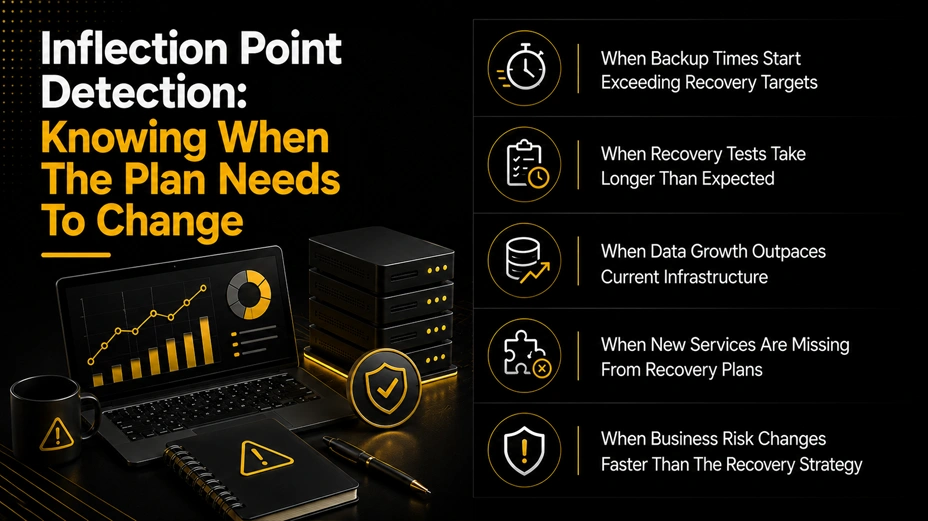
Disaster recovery planning is not a one-time exercise. A plan calibrated for a system processing 10,000 requests per day may be completely inadequate for the same system processing 500,000 requests per day, even if the underlying architecture appears similar. Inflection point detection is the practice of monitoring the signals that indicate a system has grown past the point where its current recovery architecture is sufficient.
The value of inflection point detection is that it allows the recovery architecture to be updated proactively, during a period of normal operation, rather than reactively, during or after an incident that reveals the gap. The cost of updating a disaster recovery plan during normal operations is a fraction of the cost of discovering its inadequacy during a real incident.
The Six Signals That Indicate a Recovery Architecture Review Is Needed
- Backup duration approaching or exceeding the RPO window: if a full backup takes 6 hours to complete and the RPO target is 4 hours, the backup strategy is no longer compatible with the recovery objective. This signal is often visible in monitoring before anyone notices the mismatch.
- Recovery test times exceeding the RTO target: if the most recent DR test took 6 hours to restore service and the documented RTO is 4 hours, the recovery architecture needs to change. Testing regularly is the only mechanism for detecting this before a real incident.
- Data volume growth outpacing backup storage capacity: a backup configuration that was adequate at 100 GB becomes inadequate at 2 TB. Storage costs and backup durations both scale with data volume, and both need to be recalibrated at regular intervals.
- Introduction of new services or integrations not covered by the existing plan: a third-party payment processor, a new microservice, or a new data source added to the stack represents a gap in the recovery plan if it is not explicitly included. New services should trigger a review of the plan, not wait for the next scheduled review.
- Changes to the regulatory or contractual environment: a new enterprise client with SLA commitments, a move into a regulated industry, or a change to the applicable data protection requirements may all impose recovery objectives that differ from the current architecture.
- Significant increase in concurrent users or transaction volume: systems that are stable at one order of magnitude of load often behave differently at the next. A sudden increase in peak load, even without an architectural change, can affect recovery times because the amount of data to be recovered and the load on the recovery system both increase.
Building Inflection Point Detection Into Normal Operations
The most reliable way to detect inflection points before they become incidents is to track the metrics that matter for recovery as part of the standard engineering dashboard rather than as a separate, occasionally reviewed report. The specific metrics worth tracking on a weekly basis are:
- Backup completion time and success rate, tracked as a time-series so that gradual drift is visible before it becomes critical.
- Data volume growth rate, compared against backup storage capacity and backup duration projections.
- Recovery test results from the most recent test of each type, with the date of the last test and the next scheduled test visible.
- RTO and RPO targets for each critical system, displayed alongside the most recent measured recovery time from testing.
When these metrics are visible in normal operations, inflection points are detectable weeks or months before they produce a recovery failure. When they exist only in quarterly reports or annual review documents, the detection window is much narrower and the response options are more limited.
The Uptime Institute’s 2023 Global Data Center Survey found that 55% of data centre outages caused significant financial, reputational, or regulatory impact in that year, up from 45% in 2019. The finding reflects a broader pattern: systems are becoming more interconnected, and the blast radius of any single failure is increasing. Inflection point detection is the mechanism that keeps the recovery architecture ahead of that growth.
Scaling disaster recovery solutions principle: The best time to update a disaster recovery plan is when there is no pressure to do so. The signals for when an update is due are visible in the metrics. Monitoring those metrics is cheaper than discovering the gap during an incident.
5. Cost-Effective Disaster Recovery: Tier Your Infrastructure to the Risk
One of the most persistent misconceptions about disaster recovery is that it requires either expensive enterprise tooling or a compromise on resilience. In practice, the most cost-effective disaster recovery strategies are the ones that apply the right level of redundancy to each system based on its actual recovery requirements, rather than applying the same approach to everything.
Cloud providers have formalised this as a tiered model. AWS describes four disaster recovery strategies of increasing cost and decreasing recovery time: backup and restore, pilot light, warm standby, and multi-site active/active. The correct strategy for any given system depends entirely on its RTO and RPO requirements, not on the size of the engineering budget.
Matching the Strategy to the Requirement
- Backup and restore: the lowest cost option, appropriate for systems with RTO measured in hours and RPO of 24 hours or more. Automated daily backups to a separate region or storage account, with a tested restore procedure, provide an adequate safety net for internal tools, marketing sites, and non-critical back-office systems.
- Pilot light: a minimal replica of the critical system components is kept running in a secondary region at low cost. In a failure event, the pilot light is scaled up to full capacity. This approach suits B2B SaaS platforms with RTO targets of 2 to 4 hours and is significantly cheaper than a warm standby at low data volumes.
- Warm standby: a scaled-down but fully functional version of the production system runs continuously in a secondary region. Failover involves scaling up the secondary and redirecting traffic. This approach suits higher-traffic platforms and systems with RTO targets below 2 hours.
- Multi-site active/active: traffic runs simultaneously across multiple regions, with no failover step required because both sites are always serving production traffic. This approach is appropriate for platforms where even a short failover window is unacceptable, and it carries the highest infrastructure cost of the four strategies.
For most startups and scale-ups, the backup and restore or pilot light strategies provide a cost-effective disaster recovery posture that is genuinely appropriate to the actual risk. The mistake to avoid is paying for warm standby or active/active resilience for systems whose RPO and RTO requirements would be adequately met by a well-implemented backup and restore approach.
Final Thoughts
Disaster recovery planning is not a project that gets done once. It is a discipline that needs to be maintained, tested, and updated in line with the system it is designed to protect. The teams that handle incidents well are not the ones with the most sophisticated infrastructure. They are the ones who wrote down the plan, tested it before they needed it, and updated it when the system changed.
The two core commitments that make disaster recovery planning genuinely effective are straightforward: define the RPO and RTO before any technical decisions are made, and test the recovery procedure before an incident forces the test. Everything else, the tiered infrastructure strategies, the inflection point detection signals, and the cost-effective testing methods, builds on those two foundations.
Scaling disaster recovery solutions does not require an enterprise budget. It requires honest answers to the right questions, applied consistently, and revisited whenever the system or the business changes in a way that affects the risk profile. The businesses that discover their recovery plan does not work are the ones that wrote it once and trusted it indefinitely. The ones that never face that discovery are the ones that test.If your team is working through a disaster recovery plan or wants to think through the right testing strategy for your current infrastructure, reach out at coffee@sparkeighteen.com.