Six months into a new product build, a team realises their marketing pages are invisible to search engines, their routing layer needs a complete rewrite, and their API calls are happening entirely on the client. Nothing is technically broken. But every new feature costs more to ship than it should, because the architecture is quietly fighting the product’s requirements. The team chose React because they knew it. They are now rebuilding, inside Next.js, what Next.js would have given them on day one.
This is the most predictable outcome in the Next.js vs React debate: not a deliberate choice, but a default that compounds. The question “which framework is better?” is the wrong frame. The question that matters is “which one matches what my product needs to show users first, and what it needs to become in the next 18 months?” The answer to that, not framework familiarity or team preference, should be making the decision.
Key takeaways
- React is a JavaScript library for building user interfaces. Next.js is a framework built on top of React that adds file-system routing, server-side rendering, static site generation, data fetching strategies, and API handling as built-in capabilities, none of which React provides by default.
- The difference between Next.js and React that matters most in production is not the component model or syntax, which are identical. It is where rendering happens, who handles routing, and how data arrives before the user sees anything.
- Next.js is the right default for products with public-facing pages, search-engine optimisation (SEO) requirements, content-heavy routes, or complex server-side data fetching needs.
- React without Next.js is the right choice for single-page applications (SPAs), authenticated internal tools, dashboards, and products where SEO is not a concern and routing complexity is low.
- The cost of the wrong choice is not in the framework itself: it is in the rework required when the product outgrows what the original architecture was designed to handle.
What is Next.js?
Next.js is a full-stack React framework created by Vercel that extends React with built-in routing, server-side rendering (SSR), static site generation (SSG), incremental static regeneration (ISR), API routes, and React Server Components. It is not a replacement for React: it is React with a production-grade application shell already built around it.
Where plain React leaves the developer responsible for wiring together a router, a server rendering setup, a data-fetching strategy, and an API layer, Next.js provides all of these out of the box. The framework is opinionated about where files live and how pages are structured, and that opinion pays dividends in development velocity. A developer who knows React can ship a server-rendered Next.js page without needing to understand webpack, Babel configuration, or server middleware. The conventions handle it.
Next.js is used across a significant portion of large-scale web products in 2026. OpenAI’s ChatGPT web interface, Netflix’s marketing site, and thousands of SaaS products where server-side rendering and SEO are non-negotiable are built on it. According to the Stack Overflow Developer Survey 2025, Next.js is used by 21.5% of professional developers worldwide, a number that has grown steadily as teams default to it for new public-facing product builds.
What is React?
React is an open-source JavaScript library, originally developed by Meta, for building user interfaces through reusable components. It is a view layer: React handles what appears on screen, how the interface updates in response to state changes, and how components are composed from smaller, independent parts.
React does not prescribe routing, data fetching, server rendering, or API handling. That flexibility is intentional. React can run in a browser, on a server via a framework like Next.js, in a mobile application via React Native, or embedded inside an existing server-rendered application. The wide ecosystem of libraries built around React (React Router, TanStack Query, Zustand, Redux, SWR) exists precisely because React deliberately leaves these decisions to the developer.
According to the Stack Overflow Developer Survey 2025, React is used by 46.9% of professional developers worldwide, making it the most widely adopted web framework in the ecosystem. More than double the adoption of Next.js. That gap reflects not a deficiency in Next.js but the reality that React serves a broader set of contexts: it is the foundation on which Next.js and React Native are both built.
The difference between Next.js and React that actually matters

| Category | React | Next.js |
| Type | JavaScript library | Full-stack React framework |
| Creator | Meta | Vercel |
| Routing | External (React Router) | File-system based (built-in) |
| Rendering modes | Client-side rendering (CSR) only | CSR, SSR, SSG, ISR, React Server Components |
| SEO | Poor by default (empty HTML shell) | Excellent (pre-rendered HTML) |
| Data fetching | Client-side (fetch, Axios, SWR) | Server-side at route level (built-in) |
| API routes | Requires separate backend | Built-in (app/api directory) |
| Bundle optimisation | Manual configuration | Automatic code splitting |
| Image optimisation | Manual | Built-in (next/image) |
| TypeScript | Optional | Optional (excellent built-in support) |
| Learning curve | Lower | Moderate (requires React knowledge first) |
| Best for | SPAs, dashboards, authenticated apps | Public pages, SEO-critical, full-stack products |
| Developer adoption (2025) | 46.9% (Stack Overflow) | 21.5% (Stack Overflow) |
The most common explanations of how Next.js is different from React focus on rendering modes: client-side rendering (CSR) for React, server-side rendering and static generation for Next.js. That is accurate, but it is the symptom, not the root difference.
The root difference is this: React is a building material. Next.js is a structure built from that material, with the architectural decisions already made.
React gives you components, state, props, hooks, and a virtual document object model (DOM) reconciler. Everything else (how pages are organised, how URLs map to views, how data arrives before render, how the application is served) is your responsibility to design and implement. This is not a limitation; it is a deliberate design choice that makes React composable across a wide range of contexts and team preferences.
Next.js makes those choices for you, and makes them well. Routes are files: a file at app/about/page.tsx becomes the /about route automatically. Data fetching happens at the page level, on the server, before the user sees anything. The API layer lives inside the same codebase in the app/api directory. React Server Components allow components to fetch their own data on the server, with zero JavaScript sent to the browser for that work. The result is a development experience that is both faster to start and closer to production-grade by default.
Understanding this distinction (React as material, Next.js as structure) is the starting point for making the right Next.js vs React decision for your product.
Next.js vs React performance: what changes in production
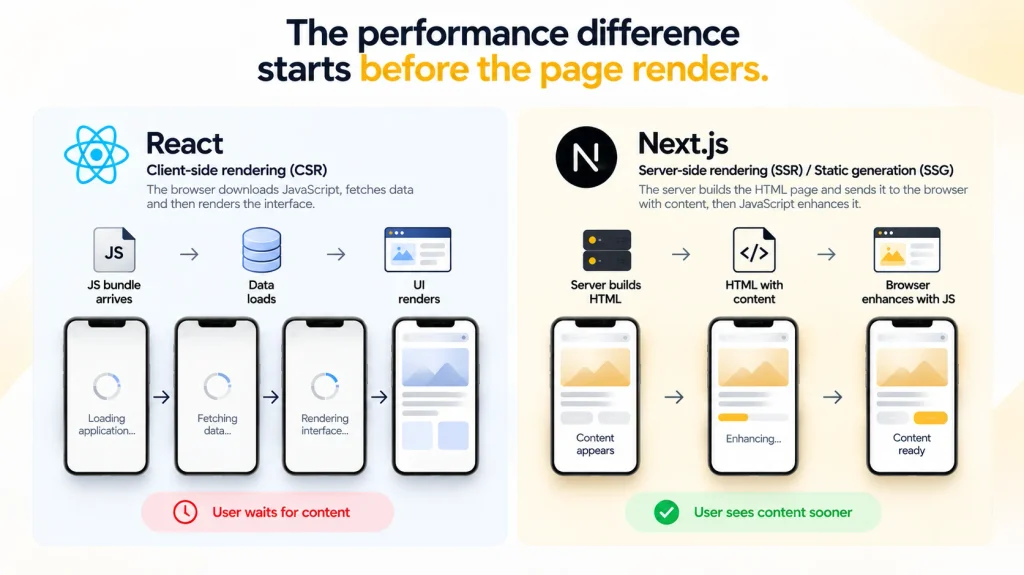
A React application using client-side rendering sends a JavaScript bundle to the browser, which then fetches data, processes the response, and renders the interface. On a fast connection with a powerful device, this sequence is invisible. On a mid-range device on a 4G connection in any market where connection quality varies, it produces a blank screen while the bundle loads, followed by a second wait while data arrives. The user experience suffers before a single line of your application code has run.
Next.js addresses this by default. With server-side rendering, the server builds the complete HTML page before sending it to the browser. The user sees content on first load, not a loading state. With static site generation, pages are pre-built at deploy time and served as static assets from a content delivery network (CDN), eliminating server processing time entirely. With incremental static regeneration, static pages are rebuilt in the background on a schedule, keeping content fresh without the latency of full SSR on every request.
In Next.js vs React performance terms, this translates to meaningful differences in real metrics. Largest Contentful Paint (LCP) improves because visible content is present in the initial HTTP response rather than waiting for JavaScript execution. Time to First Byte (TTFB) improves for static routes because the CDN serves pre-built HTML directly. Core Web Vitals scores, which affect both user experience and search ranking in Google’s algorithm, reflect the difference between serving a populated HTML document and serving an empty shell.
A comparative study published on arXiv in 2025, evaluating Next.js against client-side React across performance, SEO, and network equity dimensions, found consistent advantages for server-side rendering in LCP and crawlability metrics. For most public-facing web products, Next.js vs React performance is the decisive factor.
When React without Next.js is the right choice
React is the right default for products where server-side rendering provides no meaningful benefit. The clearest cases are predictable:
Authenticated single-page applications where every user is logged in before seeing anything. If the entire product lives behind an authentication wall, search engines will never crawl its pages, and client-side rendering carries no SEO cost. Internal tools, admin dashboards, customer relationship management (CRM) platforms, analytics views, and most enterprise back-office products fall into this category. Adding Next.js would introduce server infrastructure and routing conventions that deliver no benefit.
Highly interactive products where state changes constantly and the interface behaves more like a native application than a document. A collaborative whiteboard, a code editor, a real-time trading interface, a drag-and-drop pipeline builder: these are products where the rendering model is fundamentally client-driven. Every meaningful interaction triggers a state update. Server rendering adds complexity and latency for an interface that is going to update immediately regardless.
React Native mobile applications. Next.js does not apply here. React is the native choice for cross-platform mobile development, and no framework substitution is relevant.
Embedding React components inside an existing server-rendered application. When you are adding interactive components to a Django, Rails, or Laravel application, plain React is the integration path. Next.js assumes ownership of the full application and does not compose easily into an existing backend-rendered page structure.
In each of these cases, the debate between React vs Next.js is irrelevant: plain React with the appropriate router and state management library is the correct foundation, and adding Next.js would add architectural complexity without a product-level payoff.
When Next.js is the right choice
Next.js is the right choice for any product where at least one of the following is true:
The product has public-facing pages that need to rank in search results. E-commerce sites, SaaS marketing pages, documentation, content platforms, and any product where organic search drives acquisition need server-side rendering or static site generation. The SEO advantage is structural: a server-rendered page delivers full HTML to the search crawler immediately, without JavaScript execution. Client-side React cannot match this, regardless of how it is optimised. This is why the question is Next.js better than React has a clear answer for public-facing products: yes, for this specific reason.
The product mixes public-facing and authenticated content in a single codebase. A SaaS product typically has marketing pages, pricing, and documentation alongside authenticated application views. Next.js handles both: static generation for the public routes served from a CDN, client-side rendering for the authenticated views. One codebase, one deployment, one framework managing both rendering modes.
The data fetching model is complex. Next.js allows data fetching at the route level, on the server, before the component renders. For products that aggregate data from multiple sources before displaying anything, server-side fetching produces a cleaner architecture than managing a cascade of client-side API calls with loading states, error states, and race conditions.
The team is starting a new product and wants sensible defaults without spending time on tooling decisions. For any IT software company or product team asking “how is Next.js different from React and which should we start with?”, the practical answer for a new public-facing web product in 2026 is: start with Next.js. You get everything React provides, plus routing, server rendering, and API handling without additional configuration. If your product later turns out to be a pure SPA, turning off Next.js’s server features costs nothing.
Next.js vs React for SEO: why this is not a debate
Search engine optimisation is the clearest case where Next.js wins over client-side React, and the reason is architectural rather than incidental.
When a search crawler visits a client-side React application, it receives an HTML file with a near-empty body and a JavaScript bundle reference. Modern crawlers from Google can execute JavaScript, but their ability to do so is inconsistent across crawl budget, JavaScript complexity, and timing. A server-side rendered Next.js page delivers complete, parseable HTML immediately, in the first HTTP response. There is no ambiguity about what the page contains, because all the content is there before the crawler needs to do any additional work.
Static site generation extends this further: Next.js pre-builds every page at deploy time and serves them from a CDN, achieving HTML-fast delivery at global scale with no server processing on each request. For content platforms, marketing sites, and documentation, this is the performance and SEO ceiling: it cannot be made faster than pre-built HTML served from a CDN at the network edge.
Why Next.js is better than React for SEO is therefore not a framework preference. It is a consequence of where rendering happens. Client-side React, by its nature, delays content delivery to the browser. For products where organic search is a meaningful acquisition channel, the rendering decision is a product-level business decision with measurable consequences for ranking and discoverability.
What this looks like in practice: 2 products, 2 deliberate decisions
The right choice between React and Next.js becomes clearer through specific product contexts rather than abstract capability comparisons.
Spark Eighteen built the frontend for CustomerInsights.AI, a life sciences intelligence platform serving pharmaceutical clients. The product required a frontend capable of powering ciATHENA: an agentic AI assistant that answered complex market research questions in real time, rendered data visualisations progressively as the AI pipeline returned results, and supported public-accessible documentation alongside authenticated application views. Next.js was the only coherent choice for this product. React Server Components handled the data-heavy views on the server, reducing JavaScript sent to the browser. The file-system routing managed the mix of public and authenticated routes cleanly. Streaming allowed partial results to appear progressively without waiting for the full AI pipeline to complete. The frontend and backend API contract was defined early, and Next.js’s API routes allowed the team to co-locate backend endpoints with the frontend codebase during development, simplifying the integration phase.
System Two Security, a Palo Alto-based cybersecurity firm, presented a different set of product requirements. The platform is a security intelligence tool, fully authenticated, with no public-facing pages and no SEO requirement. Every user is logged in before seeing anything. The interface is highly interactive, state-driven, and updates frequently in response to security event data. SP18 rebuilt the frontend using React JS, pairing it with Cypress for automated quality assurance. The client-side rendering model was exactly right for this product: the user is always authenticated, the content is never indexed, and the interface behaves more like a native desktop application than a document. Adding Next.js would have introduced server infrastructure and routing conventions that the product would never use.
Two products, two different decisions. Both were deliberate, both were right, and neither was made on the basis of framework preference.
Conclusion
The Next.js vs React decision is not a developer preference question. It is an architectural one, and it is best made at the start of a project based on what the product needs, not revisited six months in when the cost of the wrong choice has already accumulated.
React is the foundation. Next.js is the structure built on that foundation, with routing, rendering, and data fetching decisions already made in a way that matches how most public-facing web products actually behave in production. The teams that make this decision deliberately, based on where content renders and for whom, rarely need to revisit it. The teams that defer it until the product’s requirements make the wrong choice visible are the ones rewriting routing layers instead of shipping features.
The more useful frame for any IT software company evaluating the Next.js vs React choice is this: if your product’s first screen needs to be crawlable, fast on first load, or served to unauthenticated users, you are building a Next.js product. If every user is authenticated before seeing anything and the interface behaves like an application rather than a document, you are building a React product. Neither answer is better. Both are deliberate.
If you are scoping a new product and want a second opinion on the frontend architecture, reach us at coffee@sparkeighteen.com.