The conversation usually starts the same way. A product team is scoping a new web application, or rebuilding an existing one, and the engineering lead recommends React. The project manager, the CTO, or the product owner asks the obvious follow-up: why React, and not something else? The engineer mentions something about components and virtual DOM. The stakeholder nods, the conversation moves on, and the decision gets made without anyone fully understanding what they are committing to.
That exchange happens across engineering teams every day. React JS usually is the right call. But the reasons go unexplained, which means teams proceed without knowing what React JS features actually produce in a real product, where React genuinely outperforms alternatives, and where it does not.
This guide is for the engineering lead who needs to articulate those reasons clearly, the product owner who wants to understand what they are approving, and the team evaluating a development partner that has recommended react front end development. Not a feature list. A working reference for decisions that matter.
Key takeaways
- React is used by 39.5% of developers globally and runs in production at 80% of Fortune 500 companies: it is the dominant react frontend framework by a wide margin
- React JS features like the Virtual DOM, component architecture, and JSX each solve a specific engineering problem: understanding the problem explains the value better than any benchmark
- The largest practical benefit of React for most teams is development velocity and long-term maintainability, not raw performance
- React is not the right choice for every project: it is the right choice for dynamic, data-driven, or interface-heavy applications that need to scale over time
- The React ecosystem, including Next.js, React Native, TypeScript, and TanStack, extends its reach from web to mobile, from client to server, and from prototype to production
What is React JS?
React is a JavaScript library for building user interfaces. Facebook created it in 2011 and open-sourced it in 2013. It is component-based, declarative, and unidirectional in its data flow: 3 properties that together make it more predictable and maintainable at scale than the DOM-manipulation approaches that preceded it.
React JS for web development occupies a specific position in the stack. It is not a full framework. It handles the UI layer. Routing, data fetching, server-side rendering, and state management are handled either by React’s own hooks or by libraries and frameworks built on top of it: Next.js, React Router, Redux, Zustand, TanStack Query. This library architecture is deliberate. It makes React more composable, and easier to integrate into existing applications without requiring a full rewrite.
The Stack Overflow Developer Survey 2025 reports that React is used by 39.5% of all developers globally, the most-used web framework by a significant margin. 80% of Fortune 500 companies run React in production. React 19, the most recent major version, achieved 48.4% daily usage among survey respondents within months of release.
These are not marketing statistics. They reflect the fact that React has become the practical default for react front end development in the same way Java became the enterprise backend default in the early 2000s. Understanding why means looking at what React JS features actually do.
React JS features: what they are and what they solve
The features most commonly cited in React documentation, including component architecture, Virtual DOM, JSX, and unidirectional data flow, each address a specific problem that made frontend development harder before React existed. Knowing the problem each feature solves explains its value for a real product far better than a description of the feature in isolation.
Component-based architecture
React apps are built from components: self-contained, reusable pieces of UI that each manage their own logic and state. A navigation bar, a data table, a user profile card, a notification banner: each is a component. Components compose into pages. Pages compose into applications.
For engineering teams, the practical consequence of component-based architecture is immediate. Once a component is built and tested, it can be used anywhere in the application without rewriting the same logic. In large applications, this reduces duplication substantially. It also means that when a component’s behaviour changes, through a design update, a rule change, or a bug fix, the change propagates everywhere that component is used, without hunting through every page that renders something similar.
For product teams, this translates directly into velocity. Features that reuse existing components ship faster than features that build everything from scratch. As a React apps product grows, the component library becomes an asset that accelerates future development rather than accumulated debt that slows it down.
Virtual DOM
The browser’s Document Object Model (the DOM) is expensive to update. Every time a change is made to a page, the browser recalculates layouts, repaints elements, and re-composites the page. In applications with complex, frequently-updating interfaces, this becomes a performance bottleneck that users notice.
React’s Virtual DOM addresses this by maintaining an in-memory representation of the DOM. When application state changes, React updates the Virtual DOM first, compares the new version against the previous version (a process called diffing), and calculates the minimum number of real DOM operations required to bring the browser in sync. Only the changed elements are updated.
The performance impact is measurable. Twitter Lite, rebuilt on a React-based architecture, cut data usage by 30% and increased pages per session by 65%. For React JS apps with high update frequency, such as dashboards, real-time data feeds, and multi-step forms with live validation, the Virtual DOM is not a theoretical advantage. It is why the application feels fast to users rather than sluggish and disjointed.
JSX
JSX is a syntax extension that allows developers to write HTML-like markup directly inside JavaScript files. It is optional, and React applications can be written without it, but in practice almost every production React codebase uses JSX, because it makes the relationship between a component’s logic and its visual output visible in a single file.
The practical consequence: developers see exactly what a component renders and why in the same place they see its logic. Debugging is faster. Code reviews are more efficient. Engineers joining a team can understand what a component does without switching between files or maintaining a mental model of which JavaScript functions correspond to which HTML templates. This is one of the less-discussed React JS features, but one with a clear effect on team productivity over time.
Unidirectional data flow
In React, data flows in one direction: from parent components to child components, via props. Child components cannot modify the data they receive. They can only request changes through callbacks. This one-way data binding makes application state predictable: at any point in a React codebase, you can trace where a piece of data came from, what controls it, and how it would change.
For teams maintaining large React apps, this predictability is significant. The class of bugs caused by state being modified from multiple directions, common in older bidirectional data-binding frameworks, is structurally prevented. When something breaks, the source of the change is easier to locate. This is a meaningful reason why enterprise teams building complex React JS apps over time tend to report fewer UI-related regressions than teams working in older frontend architectures.
The React ecosystem
React as a library does not handle routing, server-side rendering, or data fetching natively. Its ecosystem does, and the ecosystem is one of the strongest arguments for React’s longevity as a react js framework.
Next.js, the production standard for React JS for web development that requires SEO, server-side rendering, or edge delivery, is used by hundreds of thousands of production applications. React Native extends the same component model to iOS and Android, meaning teams that build a React web frontend can transition to mobile without learning a new paradigm. TypeScript is now effectively universal in serious React projects, adding static type checking that catches an entire class of bugs before they reach production. TanStack Query, Zustand, and similar libraries handle data fetching and state management in patterns that have been refined across millions of production deployments.
The depth of this ecosystem, including tooling, libraries, community resources, and developer availability, is practically more important than any individual React JS feature. It means that whatever a product requires, a well-maintained library for it almost certainly already exists. It also means that developers who know React are available, and that the patterns they bring are standardised across the community.
The practical benefits for engineering and product teams
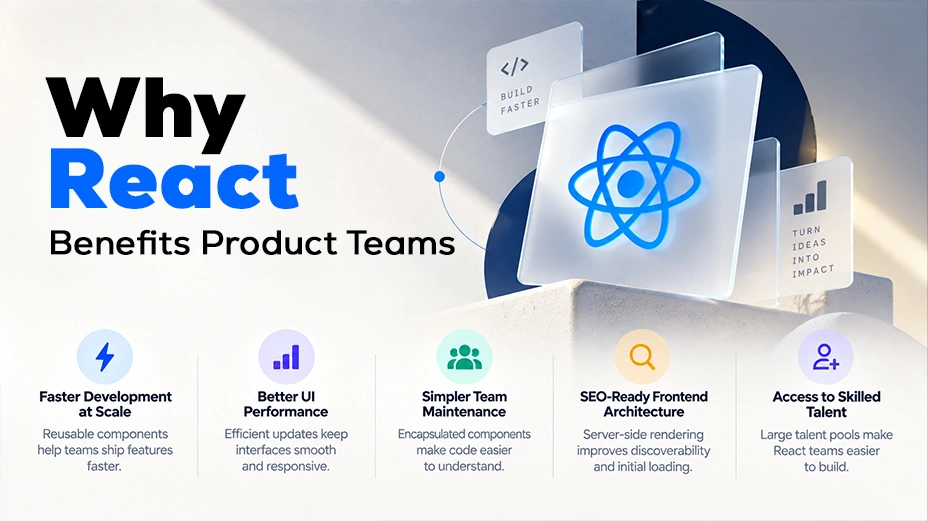
React JS features are means to specific ends. For engineering and product teams making decisions, the ends are what matter.
Faster development at scale
The component model reduces development time, and the effect compounds as the product grows. An early-stage team building a new React frontend writes components that, three months later, the same team is reusing across multiple new features. A mature React codebase with a well-organised component library ships faster than a codebase without one, not because React is magic, but because the architecture makes reuse systematic rather than accidental.
Teams building on top of established component libraries, such as Material UI, Chakra UI, Ant Design, and Radix, start with a baseline of well-tested, accessible components and focus engineering effort on the product-specific layer rather than rebuilding primitives. This is one of the most commercially significant benefits of react for front end development: development velocity on the features that differentiate the product.
UI performance that users notice
The Virtual DOM’s diffing ensures that React apps update only what needs updating. A React application handling frequent data updates, such as a live dashboard, a real-time notification system, or an interface updating on websocket messages, performs better than an equivalent application doing full DOM re-renders on every state change.
Users do not articulate this, but they experience it. A slow interface that jumps and repaints on every update increases abandonment. A fast, smooth interface that updates precisely and predictably keeps users engaged. For frontend frameworks evaluated by the people who use the products they render, the Virtual DOM’s performance advantage has a direct product consequence.
Maintainability at team scale
Unidirectional data flow and component encapsulation make React codebases easier to maintain as teams and products grow. A new engineer joining a team can read a component, understand its inputs and outputs, and make a change without needing to understand the full application state. Senior engineers can review pull requests efficiently because the surface area of any change is bounded by the component.
This is one of the most commercially significant React JS benefits, and one of the least discussed in standard comparisons of frontend frameworks. A frontend codebase that is straightforward for new engineers to contribute to shortens onboarding time and reduces the risk of regressions introduced by engineers who do not yet fully understand the system they are modifying.
SEO and server-side rendering
Client-side React applications, by default, send a minimal HTML shell to the browser and render the full page in JavaScript. This creates problems for search engines that struggle to index JavaScript-rendered content, and for users on slow connections who see a blank screen until the JavaScript executes.
Next.js solves this by rendering React on the server and delivering complete HTML to the browser. Server-side rendering with Next.js is the standard for react front end development in contexts where search visibility or initial load performance is a requirement: e-commerce, marketing sites, content-driven SaaS products. It means teams can choose React as their frontend without sacrificing the SEO properties that would previously have pushed them toward server-rendered alternatives.
CustomerInsights.AI, whose ciATHENA conversational AI interface was built on Next.js and D3.js by Spark Eighteen, required a frontend that could handle real-time data visualisation while remaining performant across complex, data-rich market intelligence queries. Next.js provided the React foundation with the server-side rendering capability the product required.
A hiring pool that is ready to build
React’s dominance in the frontend job market is practical in ways that framework benchmarks do not capture. When a team needs to hire a frontend engineer, the React hiring pool is orders of magnitude larger than the Vue, Angular, or Svelte pool. React developers are more available, command comparable market rates, and arrive with a community-standardised set of practices and tools.
For companies working with an IT software development company that recommends React: the choice has a direct consequence on team ramp-up time, continuity risk, and the client’s ability to bring development in-house later. A product built on a widely-adopted react js framework is a product whose codebase the next development team can work in without a prolonged transition.
How Spark Eighteen uses React in production
The most useful way to understand what React JS features produce in practice is to look at what they enable in real products. Two examples from Spark Eighteen’s work illustrate this at different product scales and in different industries.
A cybersecurity company based in Palo Alto came to Spark Eighteen with a problem that is more common than its specifics suggest. System Two Security automates detection engineering, threat hunting, and security investigations for enterprise security operations teams. Their platform was doing the right things, automating detection workflows that had previously required hours of manual analyst effort, but the frontend had accumulated instability that was slowing the engineering team down and affecting the reliability that a security product demands.
Spark Eighteen rebuilt and refined the frontend experience using React JS. The component architecture allowed the team to restructure the interface into independently testable, independently reusable pieces, which meant that modifying one part of the platform no longer carried the risk of inadvertently breaking another. Cypress automation was implemented alongside it, reducing the manual testing burden and giving the team release confidence they had not had before. React’s predictable data flow and its ecosystem of developer tooling gave the engineering team a codebase they could move faster in, not just one that looked cleaner. In a domain where the cost of instability is not abstract: security teams depend on detection platforms to respond to real threats, the maintainability that React provided had a direct operational consequence.
A different kind of complexity presented itself with ClaritasRx, a specialty-pharmacy data platform serving pharmaceutical brands including Gilead, GSK, BeiGene, Amicus, and Ionis. Each client is a fully isolated tenant on a single shared codebase, with patient data governed under HIPAA at every layer of the application.
When Spark Eighteen rebuilt the platform as Ascend 2.0, the frontend was built on React 19. The rationale was architectural. ClaritasRx required 5 distinct product surfaces, namely Patient Watchtower, a CRM, analytics, self-serve reporting, and the Ask Ascend AI assistant, all drawing from the same tenant-scoped data model. React’s component architecture made it possible to build and maintain those surfaces as a coherent system rather than as 5 separate frontends with their own conventions and their own failure modes. The TanStack ecosystem provided type-safe data fetching and state management at a level of precision appropriate for interfaces that render Protected Health Information. React’s maturity and tooling depth gave the team confidence in a codebase that pharmaceutical clients would depend on for years.
In both cases, the choice of React was not about which framework scored highest on a benchmark. It was about which frontend framework gave the engineering team the architectural foundation, the ecosystem depth, and the community-tested tooling to build and maintain a complex product reliably over time.
When React is the right choice, and when it is not
React JS for web development is not the right framework for every project. Understanding when it fits and when it does not is more useful than a list of its strengths in isolation.
React tends to be the right choice for:
Applications with complex, dynamic interfaces that update frequently: dashboards, data platforms, SaaS products, real-time feeds. Products that will grow over time and need a component library that scales with them without becoming a maintenance liability. Teams that need to share developers and components between web and mobile products via React Native. Products where server-side rendering matters for SEO or initial load performance, handled through Next.js. Organisations that want to hire frontend engineers from the largest available pool.
React is often not the right choice for:
Simple content sites or landing pages with minimal interactivity, where a static site generator or plain HTML is faster to build and less costly to maintain. Projects where performance requirements genuinely exceed what a JavaScript-rendered frontend can provide, even with the Virtual DOM. Teams with strong existing expertise in a different react js framework, such as Vue, Svelte, or Angular, and no compelling reason to switch. React’s advantages do not outweigh the switching cost for a team that is already productive and building well in another paradigm.
The decision should be made on the basis of the product’s requirements, not React’s popularity. React is popular because it is well-suited to a large category of products. If your product falls into that category, React’s maturity, ecosystem, and tooling give you a reliable foundation. If it does not, the framework that fits the requirements is the right choice, regardless of which of the available frontend frameworks has the most GitHub stars.
Conclusion
React is the most widely adopted react frontend framework in production today, not because it was first or cheapest, but because its core design decisions address the specific problems that make frontend development difficult at scale: unpredictable state, expensive DOM updates, slow iteration cycles, and codebases that become harder to modify as they grow.
Understanding React JS features through what they solve, rather than what they are named, gives engineering and product teams a clearer basis for the decisions that matter most: whether to build on React, how to organise a React codebase, what to expect from an IT software development company that recommends it, and how to evaluate the quality of the React apps they commission.
For teams building serious products, React remains the reliable default, not as a matter of fashion, but as a consequence of 13 years of production use, a deep ecosystem, and a development community that has had to solve most of the problems a product team will encounter.
Build something real with React
Spark Eighteen has delivered React frontends for products across cybersecurity, healthcare SaaS, and AI-powered life sciences: rebuilding System Two Security’s platform in React JS with Cypress automation, building ClaritasRx’s multi-tenant Ascend 2.0 on React 19, and shipping CustomerInsights.AI’s ciATHENA interface on Next.js with D3.js data visualisation. If you are scoping a React-based product and want to think through the right architecture, or evaluating a development partner’s React capability, we are worth a conversation.
Read the work at sparkeighteen.com/work or reach us at coffee@sparkeighteen.com.