A practical guide to test pyramid optimisation, contract testing, and cutting automation maintenance costs by up to 70% without sacrificing quality.
Most engineering teams reach a point where their test suite becomes the problem rather than the solution. What started as a sensible investment in quality assurance is now a 75-minute CI pipeline, a weekly rota of flaky test investigations, and a growing suspicion among developers that the tests are doing more to slow down delivery than protect it.
This is not a sign that test automation was the wrong investment. It is a sign that the test strategy was never optimised and that the team is now paying the compounding cost of that oversight in engineering time, cloud compute, and delayed releases.
Test automation ROI is not fixed at the point of implementation. It degrades over time when test suites grow without structure, when end-to-end tests multiply because they feel thorough, and when no one is applying quality assurance best practices to the tests themselves. The good news is that this degradation is recoverable. Test pyramid optimisation and contract testing, applied together, consistently produce maintenance reductions of 60–70% and pipeline time reductions that return meaningful engineering hours to productive work.
This guide covers how to diagnose a broken test strategy, how to restructure it around the right layer ratios, and how contract testing closes the integration confidence gap that teams try and fail to fill with end-to-end tests.
Key Takeaways
- Test automation ROI deteriorates predictably when E2E tests dominate the suite, and it is recoverable with the right optimisation strategy.
- Test pyramid optimisation targets a 60–70% unit test base, 20–30% integration layer, and 5–10% E2E: a ratio that dramatically reduces maintenance cost.
- Contract testing fills the integration confidence gap between unit tests and E2E tests at a fraction of the maintenance cost.
- Flaky tests are not a tooling problem. They are a structural problem caused by testing at the wrong layer.
- Engineering time management improves measurably when maintenance burden drops: teams typically reclaim 6–10 engineer-hours per week from a well-optimised suite.
- A continuous testing framework built around the right pyramid ratios compounds in value over time, unlike an E2E-heavy suite that compounds in cost.
1. The Test Automation Problem Most Teams Will Not Name
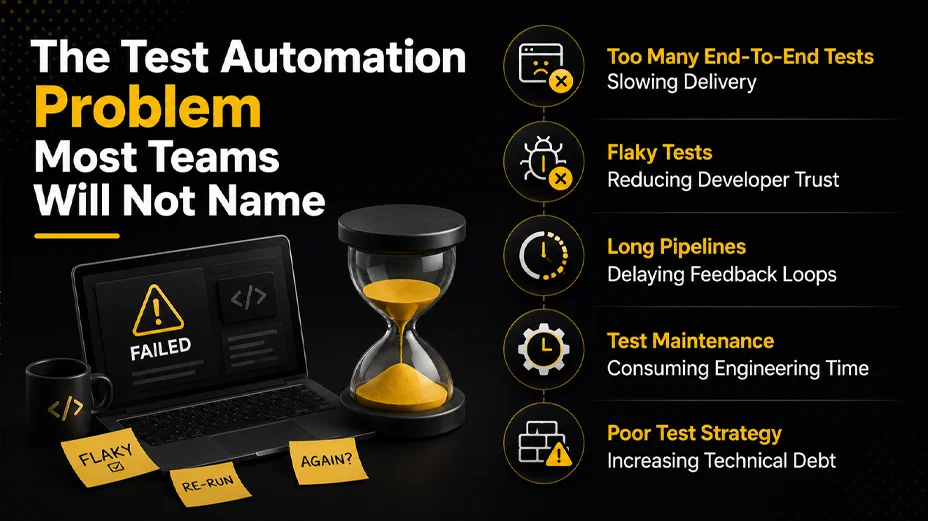
The conversation around test automation benefits rarely includes an honest accounting of what happens when automation grows without strategy. The assumption is that more tests equal more confidence. In practice, more tests of the wrong type equal slower pipelines, higher maintenance costs, and lower developer trust in the suite, which leads to tests being ignored rather than fixed.
According to research published by Google’s engineering team in their Testing on the Toilet series and engineering productivity reports, teams whose test suites are dominated by end-to-end tests spend disproportionately more time on test maintenance relative to teams with well-structured pyramids, often several times more per new feature shipped.
The specific failure modes that indicate a test strategy needs restructuring are recognisable to most senior engineers, even when they are not named as such:
- Flaky tests that fail intermittently without a corresponding code change: the team learns to re-run them rather than fix them.
- Pipeline run times exceeding 30 minutes, which causes developers to push multiple changes before seeing results, reducing the diagnostic value of failures.
- Test maintenance consuming more than 20% of sprint capacity, i.e., time spent on tests rather than on features.
- New feature development skipping test coverage because adding tests to the existing suite feels more burdensome than the feature itself.
- Integration failures that are only detected by E2E tests, meaning failures are caught late, in expensive environments, with slow feedback loops.
Each of these failure modes has the same root cause: a test suite that grew at the wrong layer. Fixing it requires test pyramid optimisation, not more tooling.
2. Test Pyramid Optimisation: The Structure That Cuts Maintenance by 70%
The test pyramid, first described by Mike Cohn in his 2009 book Succeeding with Agile and later expanded by Martin Fowler, is a model for distributing test coverage across three primary layers: unit tests at the base, integration tests in the middle, and end-to-end tests at the top. The ratios matter as much as the layers themselves. (Source: Mike Cohn, Succeeding with Agile)
The reason most teams end up with an inverted pyramid – heavy at the top, thin at the base – is not poor engineering judgement. It is that E2E tests feel like the most complete form of confidence. They test the whole system. They mimic real user behaviour. They catch things that unit tests miss. All of that is true, and none of it accounts for the maintenance cost that accumulates as the E2E suite grows.
Test pyramid optimisation is not about removing E2E tests. It is about ensuring that the coverage those tests provide is not duplicated at a layer where the same confidence can be achieved at a tenth of the maintenance cost.
The Optimised Pyramid in Practice
| Layer | Scope | Speed | Maintenance Cost | Ideal Ratio |
| Unit Tests | Single function / class | Milliseconds | Very Low | 60–70% |
| Integration Tests | Services / DB / APIs | Seconds | Medium | 20–30% |
| Contract Tests | Service boundary contracts | Seconds | Low | 5–10% |
| E2E / UI Tests | Full user journey | Minutes | Very High | 5–10% |
The 70% maintenance reduction that test pyramid optimisation produces comes from two compounding effects. First, unit tests are cheap to write, fast to run, and almost never flaky; the behaviour of a single function is deterministic. Second, reducing E2E test volume eliminates the category of test that generates the most maintenance work: tests that fail because of UI changes, environment instability, timing issues, and third-party service behaviour, none of which reflect a genuine product defect.
How to Restructure an Inverted Suite
- Audit the existing suite by layer. Count unit, integration, and E2E tests. Calculate the percentage each layer represents. If E2E tests exceed 30% of the total, the suite is inverted.
- Identify E2E tests that are covering functionality already tested at the unit or integration layer. These are the first candidates for deletion, not migration.
- For each E2E test that covers unique integration scenarios, specifically the interactions between services at their boundaries, evaluate whether contract testing can provide the same confidence at lower cost.
- Set a target ratio and treat it as a team standard: new features must add unit tests first, integration tests where service interactions are involved, and E2E tests only for critical user journeys not covered elsewhere.
- Track pipeline run time as a primary metric for test strategy health. A well-optimised pyramid should complete CI in under 15 minutes for most product codebases of moderate size.
Engineering time management principle: Every E2E test that can be replaced by a contract test or an integration test reclaims approximately three to five times its own maintenance cost in engineering hours per quarter. This is not a theoretical saving; it shows up directly in sprint capacity.
3. Contract Testing: Closing the Integration Confidence Gap
Contract testing is the layer of the optimised pyramid that most teams have not yet adopted — and it is the one that does the most to reduce the reliance on E2E tests for integration confidence. Understanding what it is and how it differs from integration testing is the prerequisite for using it correctly.
A contract test verifies that a service honours the agreement, the contract, and what it has made with the services that consume it. In a microservices architecture, Service A calls Service B. The contract between them defines the shape of the request and the shape of the response. Contract testing verifies that this agreement is honoured on both sides, independently, without requiring both services to be running simultaneously in a shared environment.
Pact, the most widely adopted contract testing framework, describes this as consumer-driven contract testing: the consumer defines what it needs from a provider, and the provider verifies it can deliver that.
Why Contract Testing Reduces E2E Test Volume
The majority of E2E tests in an over-rotated suite exist to answer one question: if Service A calls Service B, will it get back what it expects? Contract testing answers that question faster, more reliably, and without the environment overhead of a full E2E run.
- Contract tests run in isolation — no shared test environment required, no timing dependencies, no third-party service stubs.
- They fail at the point of change — when a provider modifies an API response, the contract test fails immediately, before that change is deployed into an integration environment.
- They are not flaky — the test result is determined entirely by the contract definition and the provider’s implementation, not by network conditions or environment state.
- They produce precise failure messages — when a contract breaks, the error identifies exactly which field, which endpoint, and which consumer is affected.
For teams running continuous testing frameworks across microservices architectures, contract testing is the difference between catching integration failures in seconds (during a local build) and catching them in hours (during an E2E run in a staging environment).
Where Contract Testing Fits in the Optimising Test Strategies Process
Contract testing is not a replacement for integration tests. It is a complement to them that targets a specific gap: the boundary between services. An integration test verifies that a service integrates correctly with its database or message queue. A contract test verifies that the API contract between two services is honoured. Together, they provide integration confidence at the two levels that matter: internal and external, without requiring the E2E layer to carry that responsibility.
ThoughtWorks, whose engineering teams publish extensively on this topic, consistently list contract testing as a recommended technique in their Technology Radar for teams managing service mesh complexity. See their radar entry at thoughtworks.com/radar for current guidance on adoption maturity.
4. Automated Testing Cost Analysis: Measuring What You Are Actually Spending
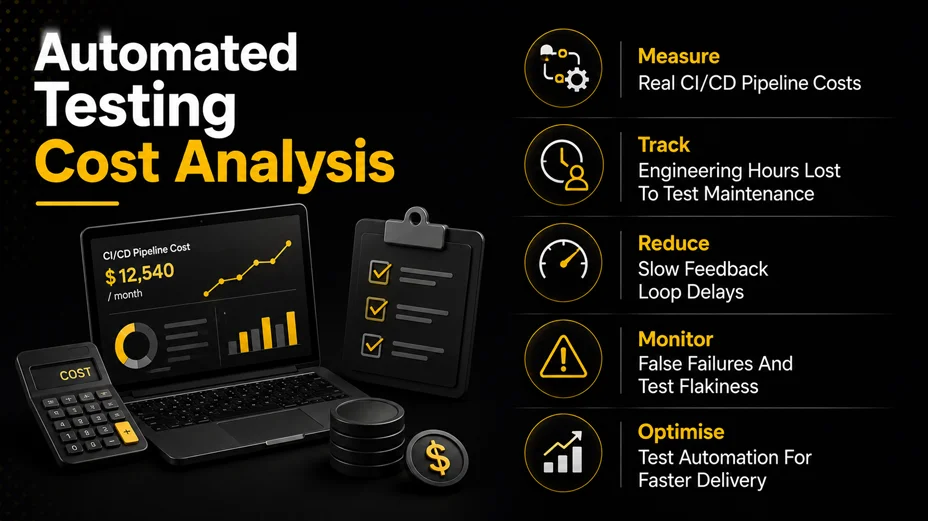
Most teams can tell you how many tests they have. Very few can tell you what those tests cost in compute time, in engineer hours, in delayed feedback cycles, and in the opportunity cost of features not shipped because maintenance consumed the sprint. Automated testing cost analysis is the foundation of improving test automation efficiency, because you cannot optimise what you have not measured.
The Four Cost Dimensions to Track
- Pipeline compute cost — The total CI/CD compute time consumed by the test suite per week. For cloud-hosted CI environments (GitHub Actions, CircleCI, GitLab CI), this translates directly to a monetary cost. A 60-minute pipeline running 20 times per day across a team of eight engineers costs between £3,000 and £6,000 per month in compute alone, depending on the provider and instance type.
- Engineer maintenance hours — The time spent each week investigating test failures, fixing broken tests, updating tests after UI changes, and managing test environment issues. This should be tracked as a sprint metric. Anything above 15% of total engineering capacity is a signal that the test strategy needs optimisation.
- Feedback loop delay — The time between a code push and a meaningful test result. Pipelines exceeding 30 minutes produce feedback delays that cause developers to batch changes, which reduces the diagnostic precision of failures and increases the cost of debugging.
- False failure rate — The percentage of test failures in a given week that did not correspond to a genuine defect. A false failure rate above 5% indicates a flakiness problem serious enough to undermine developer trust in the suite.
Before and After: What Optimisation Actually Produces
| Scenario | Inverted Pyramid (E2E-Heavy) | Optimised Pyramid |
| Test suite run time | 45–90 minutes | 8–15 minutes |
| Flaky test rate | 15–30% | < 3% |
| Weekly maintenance hours | 8–12 hrs per engineer | 2–3 hrs per engineer |
| Integration failure signal | Hours post-merge | Minutes post-merge |
| CI pipeline cost (cloud) | High (long compute time) | Low–Medium |
| New feature test coverage | Slow, often skipped | Fast, consistently added |
5. Building a Continuous Testing Framework That Compounds in Value
A continuous testing framework is not a tool. It is a set of practices, ratios, and standards that ensure the test suite improves with every new feature rather than degrading. The distinction matters because most teams treat their test suite as a static asset, something built once and maintained, rather than as a living system that needs its own quality standards.
The practices that define a continuous testing framework with positive compounding value are not complicated. They are:
Five Practices of a High-ROI Continuous Testing Framework
- Test coverage standards enforced at code review — every pull request must include unit tests for new logic, integration tests for new service interactions, and contract test updates for any modified API boundary. This is a team standard, not an aspiration.
- Flaky test triage as a first-class workflow — any test that fails without a corresponding code change is quarantined, investigated, and either fixed or deleted within one sprint. Flaky tests that are tolerated become the norm; flaky tests that are quarantined are eventually eliminated.
- Pipeline run time as a team KPI — reported weekly, with a target of under 15 minutes for the full suite. When run time exceeds the target, it triggers a review of test distribution rather than a hardware upgrade.
- Regular test pyramid audits — quarterly reviews of the unit/integration/E2E ratio, with a team commitment to delete rather than migrate E2E tests that are covered at lower layers.
- Contract test broker integration — using a tool like Pact Broker to manage contract versions across services, ensuring that provider changes are verified against all registered consumer contracts before deployment.
The compounding value of this framework comes from the direction of change. Each new feature adds fast, cheap, low-maintenance tests. Each quarter’s audit removes expensive, slow, high-maintenance ones. Over 12 months, a team that applies this consistently will have a test suite that is both more comprehensive and cheaper to run than the one they started with.
Reducing Test Maintenance Costs: The Long-Term Picture
A study by the CISQ (Consortium for Information and Software Quality) estimated that poor software quality — including costs attributable to inadequate testing and high defect escape rates — cost US organisations approximately $2.41 trillion in 2022. While this figure encompasses a broad definition of quality failure, the underlying data supports the engineering community’s view that investment in well-structured test automation returns significant cost savings over unstructured approaches. The full report is available at it-cisq.org.
For individual teams, the maths is more immediate. An engineer spending 10 hours per week on test maintenance at a fully loaded cost of £80 per hour represents £41,600 per year in maintenance overhead for one person. A team of five engineers with the same maintenance burden represents over £200,000 annually before accounting for the opportunity cost of features not shipped. Reducing that burden by 70% through test pyramid optimisation and contract testing returns £140,000 of engineering capacity per year to productive work. That is the test automation ROI case, stated plainly.
Quality assurance best practices reminder: Test automation ROI is not a one-time calculation made at the point of implementation. It should be reviewed quarterly alongside test suite metrics. A suite that was positive ROI at 500 tests may be negative ROI at 2,000 if the distribution has not been maintained.
Final Thoughts
Test automation ROI is not guaranteed by the act of automating tests. It is determined by the structure of the test suite, the distribution across layers, and the discipline applied to keeping that distribution healthy as the product grows.
The teams that get strong, sustained test automation benefits are not the ones with the most tests. They are the ones who have applied test pyramid optimisation rigorously enough to keep the expensive layers thin, adopted contract testing to close the integration confidence gap without E2E overhead, and treated automation maintenance reduction as a genuine engineering metric rather than a background cost.
The 70% maintenance reduction is achievable. The pipeline time improvements are measurable within weeks. The engineering time management benefits developers spending time on features rather than chasing flaky tests – compounded over every subsequent sprint. None of it requires new tooling or a complete rewrite. It requires an honest look at what the current suite is actually costing and the willingness to act on that analysis.
Optimising test strategies is one of the highest-leverage investments an engineering team can make in its own productivity, and unlike most productivity investments, this one has a clear, quantifiable return.
If your team is working through a test suite audit or wants to think through a contract testing implementation, reach out at coffee@sparkeighteen.com