Mobile is no longer just a channel for eCommerce. It is the main event.
According to Statista, global eCommerce sales are projected to surpass $6.88 trillion in 2026, with mobile commerce accounting for roughly 59% of all online retail transactions. Backlinko reports that mobile devices now drive approximately 70% of all online shopping traffic in the US. And high-performing eCommerce mobile apps retain 32% of users after 90 days, compared to just 15% for apps with poor UX.
None of this is surprising to anyone running a retail or direct-to-consumer business in 2026. What is less clear for most business owners is the actual process of eCommerce app development: what it involves, what it costs, what features matter, and how to find an eCommerce app developer who delivers something built to scale. This guide covers all of it, end to end. Let’s get started with the importance of eCommerce mobile apps in 2026 first.
Why Build an eCommerce Mobile App in 2026?
Before getting into the how, it is worth being clear on the why. A lot of businesses still treat their mobile app as a nice-to-have, something to build after the website is proven. That thinking is increasingly outdated.
Here is what the data actually shows about dedicated eCommerce apps versus mobile websites:
- According to Appverticals, apps deliver conversion rates 3x higher than mobile browsers.
- AI-powered eCommerce apps generate 20 to 30% more revenue than mobile websites, with personalized features driving up to 40% uplift.
- Push notifications with AI-driven targeting achieve 3x higher engagement versus standard alerts, per a 2025 Localytics report (cited by 8ration).
- Many businesses recoup eCommerce app development costs within 6 to 18 months, with ROI reaching 10x for brands with strong retention and loyalty programs.
An eCommerce mobile app is not just a shopping interface. Done well, it becomes a direct channel to your most valuable customers, a loyalty engine, a behavioral data source, and a competitive differentiator that a generic mobile website simply cannot replicate.
Types of eCommerce Mobile Apps
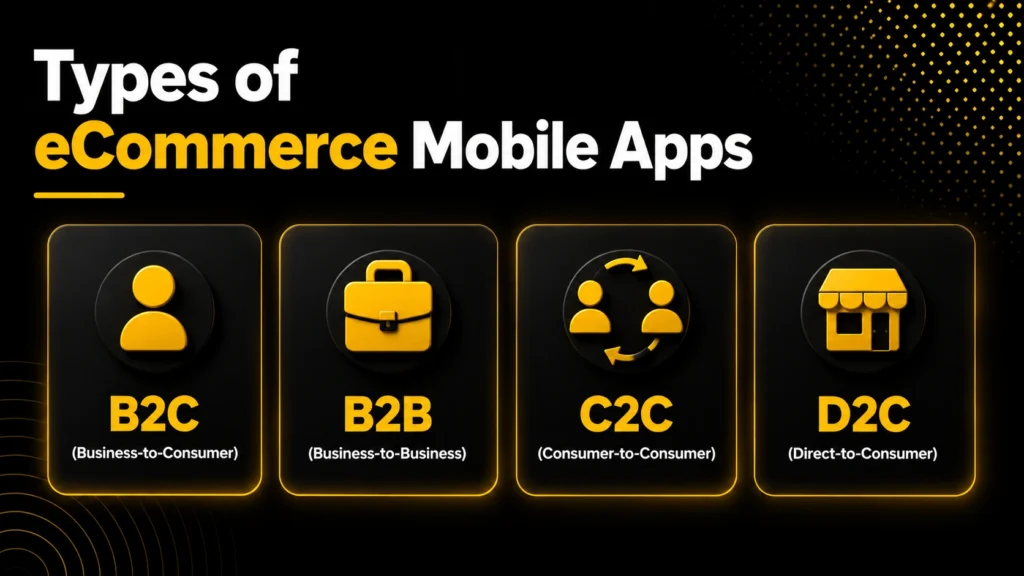
Not all eCommerce apps serve the same audience or solve the same problem. Before you decide to build an eCommerce app, understanding the type you need is a critical first step.
B2C (Business-to-Consumer): The most common model. These apps sell directly to individual shoppers, think Amazon, Target, or your favorite DTC brand. B2C apps prioritize discovery, personalization, and frictionless checkout.
B2B (Business-to-Business): Apps designed for companies selling to other companies, like Alibaba or a wholesale distribution platform. B2B apps typically involve bulk ordering, account-level pricing, and approval workflows.
C2C (Consumer-to-Consumer): Marketplace apps where users both buy and sell, like eBay or Poshmark. These require seller onboarding, trust systems, and two-sided experience design.
D2C (Direct-to-Consumer): Brand-owned apps that bypass retailers to sell direct. D2C eCommerce mobile apps often integrate deeply with loyalty programs, subscriptions, and owned data infrastructure.
Knowing your model upfront shapes everything: architecture, payment systems, user flows, and total eCommerce app development cost.
Must-Have Features for an eCommerce Mobile App
This is where a lot of development projects go sideways. Teams either try to build everything at once (and run over budget) or launch with too little (and see poor engagement). Here is a practical breakdown of what your eCommerce mobile app needs, organized by priority tier.
Core Features (Required at Launch)
- User registration and login: Social login via Google and Apple, two-factor authentication, and guest checkout options. Cost estimate: $2,000 to $10,000 depending on security requirements
- Product catalog and search: Filtered search, category navigation, high-quality image galleries, and detailed product pages. A well-built catalog with complex search logic can run $10,000 to $80,000
- Shopping cart and checkout: Persistent cart, address management, promo code functionality, and a streamlined multi-step or one-page checkout flow
- Payment gateway integration: Support for major cards, digital wallets (Apple Pay, Google Pay), and buy-now-pay-later options. PCI compliance is non-negotiable
- Order tracking: Real-time status updates, push notifications for key milestones, and order history in the user account
- Push notifications: For order updates, restocks, and promotional campaigns. Apps with AI-driven push notifications show 3x more engagement
Mid-Tier Features (High Impact on Retention)
- Personalized recommendations: AI-driven product suggestions based on browsing and purchase history. McKinsey research (cited by 8ration) shows a 20 to 30% growth in average order value when AI recommendations are implemented well
- Loyalty and rewards programs: Points systems, tiered rewards, referral incentives
- Wishlist and save for later: Simple but consistently high-engagement
- Ratings and reviews: Social proof drives purchase confidence
- Multi-language and multi-currency support: Essential for any brand with international ambitions
Advanced Features (Competitive Differentiation)
- Augmented reality (AR) product preview: Virtual try-on and room visualization for fashion, beauty, and home goods. According to Shopify data (cited by 8ration), AR features reduce returns by 25% and boost conversion by 40%. Cost range: $10,000 to $50,000 depending on complexity
- Voice search: Growing in relevance as smart speakers and voice assistants become habitual
- Real-time analytics dashboard: For business owners to monitor sales, inventory, and customer behavior live
- Subscription and recurring billing: Critical for brands selling consumables, subscriptions, or membership programs
How to Build an eCommerce App: Step by Step
Whether you are working with an eCommerce app developer or managing development in-house, the process follows a logical sequence. Skipping steps is how projects end up over budget and under-delivered.
Step 1: Define your scope and audience. Know exactly who you are building for, what problem the app solves, and which features are in version one versus future releases. Scope creep is the single biggest driver of cost overruns.
Step 2: Choose your platform. Will you build native iOS, native Android, or cross-platform (React Native or Flutter)? Cross-platform reduces cost and keeps parity between platforms; native gives maximum performance and device integration but costs more to maintain.
Step 3: Select your development approach. There are three main paths to create an eCommerce app:
- Custom development: Built from scratch to your exact specifications. Most flexible, highest quality, highest cost. Range: $80,000 to $300,000+
- Platform-based (Shopify, WooCommerce, Magento mobile): Faster to launch, lower upfront cost, but limited in customization. Range: $1,000 to $15,000
- White-label solutions: Pre-built app frameworks customized to your brand. Middle ground on cost and flexibility. Range: $20,000 to $60,000
Step 4: Design the UX. This is where most of the business decisions get translated into user experience. Invest here. Mobile apps with intentional UX design drive significantly higher checkout completion rates compared to standard templates (Metaappdesigns). Custom UI/UX design adds $8,000 to $30,000 depending on screen count and complexity.
Step 5: Develop, starting with the backend. Backend development sets up your database, server logic, payment processing connections, and third-party integrations (ERP, CRM, analytics). This phase heavily influences total cost and is not the place to cut corners.
Step 6: Build the frontend. The user-facing screens and interactions. This is where your design specs become functional interfaces.
Step 7: Test thoroughly. Unit testing, integration testing, performance testing, and security audits before any public release. This step is routinely underbudgeted and almost always matters.
Step 8: Launch and optimize. Submit to app stores, monitor crash reports and user behavior, and iterate based on real data. Maintenance and ongoing updates typically run 15 to 20% of initial development cost annually.
eCommerce App Development Cost: A Realistic Breakdown
The eCommerce app development cost question gets asked constantly, and the honest answer is: it depends on what you are building, for whom, and where your team is located. Here is a realistic framework based on current 2026 market data.
By App Complexity
| App Type | Cost Range (2026) | Timeline |
| MVP / Basic | $15,000 to $50,000 | 2 to 4 months |
| Mid-range | $50,000 to $150,000 | 4 to 8 months |
| Enterprise / AI-driven | $150,000 to $500,000+ | 8 to 14+ months |
By Team Location
Hourly development rates vary significantly depending on where you hire:
- US/Canada/Western Europe: $100 to $200+ per hour
- Eastern Europe: $50 to $100 per hour
- India/Southeast Asia: $20 to $60 per hour
Many companies split the work: strategy and UX in-market, development offshore. This can reduce total cost by 40 to 60% while maintaining output quality if managed carefully.
Hidden Costs to Budget For
Beyond the build itself, a complete eCommerce mobile app budget needs to include:
- App store fees: Apple Developer Program ($99/year), Google Play ($25 one-time)
- Payment processing: typically 1.5% to 3.5% per transaction depending on provider
- Hosting and cloud infrastructure: $200 to $2,000+ per month depending on traffic
- Ongoing maintenance and updates: 15 to 20% of initial build cost per year
- Marketing and user acquisition: a commonly cited rule of thumb is to budget 2.5x your development cost for launch-year marketing
Choosing the Right eCommerce App Developer
This decision shapes everything else. The wrong developer can cost you twice: once in the initial build and again when you have to rebuild what did not work.
Here is what to evaluate when you are vetting an eCommerce app developer or agency:
Portfolio specificity: Have they built eCommerce mobile apps before? Not just apps in general. eCommerce has specific complexity around catalogs, inventory sync, payment security, and checkout optimization that general mobile developers often underestimate.
Discovery process: A good developer asks as many questions as they answer before giving you a quote. If you get a firm number in the first meeting without a discovery phase, treat that as a warning sign.
Post-launch support: How do they handle bugs discovered after launch? What does their maintenance model look like? What is included versus billed hourly?
References from comparable projects: Ask to speak with clients who had similar budgets and scope, not just the agency’s biggest wins.
Communication structure: Who is your day-to-day contact? Will you have direct access to the technical lead? Time zone overlap matters more than most people expect on a 6-month project.
Key eCommerce App Development Trends in 2026
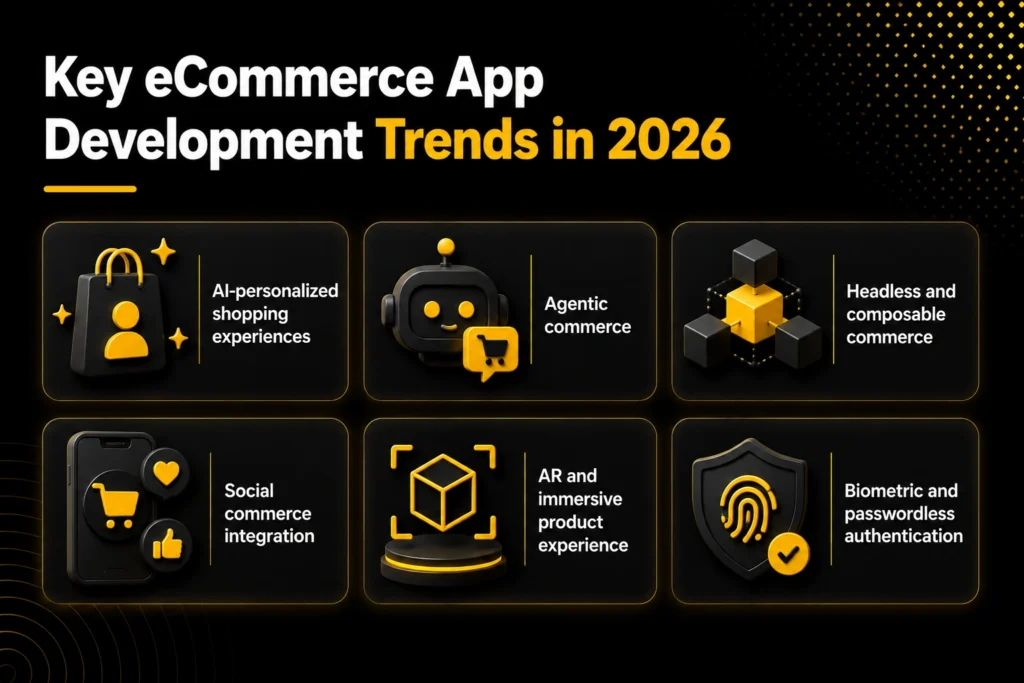
Beyond the fundamentals, there are several directions where eCommerce mobile app development is heading this year that are worth understanding before you finalize your roadmap.
AI-personalized shopping experiences: Product recommendations driven by machine learning are moving from a premium feature to a baseline expectation. The gap between apps with smart personalization and those without is widening in conversion rates and repeat purchase behavior.
Agentic commerce: AI shopping assistants that can browse, compare, and complete purchases on behalf of users are moving from concept to early deployment. This changes how app architecture needs to handle sessions and decisions.
Headless and composable commerce: More brands are decoupling the frontend presentation layer from backend commerce logic, allowing faster iteration on the user experience without rebuilding infrastructure.
Social commerce integration: TikTok Shop, Instagram Shopping, and live-stream selling features are increasingly expected to connect directly with mobile apps, not just websites.
AR and immersive product experience: Growing beyond early adopters in fashion and furniture into mainstream retail, especially as smartphone camera hardware continues to improve.
Biometric and passwordless authentication: Face ID and fingerprint login are becoming the default, replacing friction-heavy password flows at checkout and account access.
Conclusion
To build an eCommerce app that actually performs in 2026, you need more than a list of features and a development quote. You need a clear understanding of your customer, a phased approach that prioritizes the right things at the right time, a realistic budget that accounts for the full picture (not just development), and a team, whether internal or external, that has done this before.
The market is large, the technology is mature, and the bar for what users expect from an eCommerce mobile app has never been higher. That is not a reason to hesitate. It is a reason to plan carefully and build with intention.
Ecommerce app development is not a one-time project. It is an ongoing product investment. The businesses treating it that way are the ones pulling ahead.
If you need help planning or building your eCommerce mobile app, you can reach out at coffee@sparkeighteen.com.