
A practical guide to user experience research methods: how to choose the right approach, read the output correctly, and use evidence rather than assumption to drive design decisions.
There is a version of design that feels productive but produces nothing useful: the one where the team spends three weeks debating which colour scheme to use, whether the navigation should sit on the left or at the top, and what the call-to-action button should say. These conversations run in circles because they are built on preference rather than evidence. Nobody in the room actually knows what the user thinks, because nobody has asked.
This problem is more common than most teams admit. Forrester Research has found that every dollar invested in UX returns between $2 and $100 depending on the product context, yet most organisations still dedicate less than 10% of project budgets to user research. The full ROI analysis is referenced at forrester.com/report/the-six-steps-for-justifying-better-ux.
User experience research methods are the tools that replace preference with evidence. They are how a product team finds out what users actually do rather than what they say they do, what confuses them rather than what the team assumes is obvious, and what would make them stay rather than what the team hopes will work. The difference between a product built on research and one built on assumption is usually visible within the first month of user data.
This guide covers the full landscape of user experience design methods: what each one is, when to use it, how to read the output, and how to choose the right combination for the specific question a team is trying to answer.
Key Takeaways
- UX design research methods are not a single thing: they range from qualitative interviews that uncover motivation to quantitative tests that measure behaviour at scale.
- The right user experience research methods depend on the question being asked, the stage of the product, and the time available, not on which methods the team is most comfortable with.
- User experience testing should happen throughout the product lifecycle, not only at the end when changes are expensive.
- Qualitative and quantitative methods answer different questions and work best in combination rather than in isolation.
- A user experience design agency brings both the research expertise and the independent perspective that internal teams often cannot provide for their own products.
- The UX research process is most valuable when its outputs directly inform a specific design decision, not when it produces a report that sits unread in a shared drive.
The Full Map of UX Research Methods
The breadth of user experience research methods available to product teams is wider than most people realise. The field extends well beyond usability testing, which is the method most teams default to, into a range of approaches that answer different questions at different stages of a product’s development.
The table below maps the most commonly used UX research methodologies against their type, best application stage, typical sample size, and what they produce. Understanding this map is the starting point for the UX research process, because choosing the wrong method for a given question wastes both time and the goodwill of the users recruited for the study.
| Research Method | Type | Best Stage | Typical Sample Size | Output |
| User interviews | Qualitative | Discovery / Generative | 5–12 participants | Insights, mental models |
| Usability testing | Qualitative | Evaluative | 5–8 participants | Task completion, friction points |
| Surveys | Quantitative | Generative / Validation | 50–500+ responses | Attitudes, priorities, scale data |
| Card sorting | Mixed | Information architecture | 15–30 participants | Navigation taxonomy |
| Tree testing | Quantitative | Information architecture | 50–100 participants | Findability success rate |
| A/B testing | Quantitative | Optimisation | Statistical minimum | Conversion, engagement rates |
| Heatmaps / session recording | Quantitative | Evaluative | 100+ sessions | Attention, click, scroll patterns |
| Diary studies | Qualitative | Longitudinal | 5–15 participants | Behaviour over time |
| First-click testing | Quantitative | Evaluative | 50–100 participants | Navigation intent accuracy |
| Contextual inquiry | Qualitative | Discovery | 5–10 participants | Real-environment behaviour |
The most important distinction in this table is the stage column. Using a discovery method like user interviews to validate a nearly-finished design produces different output from using it to understand an unmet need before design begins. Using A/B testing before there is enough traffic to reach statistical significance produces misleading results. The UX research process delivers the most value when the method is matched to the stage.
Practical principle: Before choosing a UX research method, write the specific question it needs to answer. If the question is ‘why do users abandon the checkout?’, that is a qualitative usability problem. If the question is ‘which of these two checkout flows converts better?’, that is a quantitative A/B test. The question determines the method, not the other way around.
Qualitative vs Quantitative: Understanding the Difference
One of the most persistent confusions in UX research is between qualitative and quantitative methods and particularly about which one is ‘better’. Neither is better in general. They answer different types of questions and produce different types of evidence. The user experience design methods that produce the most reliable design direction use both in sequence: qualitative research to understand the problem and quantitative research to measure the scale and validate the solution.
| Dimension | Qualitative Research | Quantitative Research |
| Core question | Why and how? | How many, how often, how much? |
| Data type | Words, observations, behaviour | Numbers, percentages, rates |
| Sample size | Small (5–15 typical) | Large (50–500+) |
| Output | Themes, insights, mental models | Statistical patterns, benchmarks |
| Best used for | Understanding motivation, uncovering hidden needs | Measuring impact, validating at scale |
| Risk | Not generalisable without validation | Misses the ‘why’ behind the numbers |
| Common methods | Interviews, contextual inquiry, usability testing | Surveys, A/B tests, analytics, tree testing |
The Danger of Using Only One
A product team that relies only on qualitative research risks making decisions that are deeply understood but not broadly validated. The insights from ten user interviews may be accurate for those ten users and completely wrong for the other ninety. A product team that relies only on quantitative research risks fixing the wrong things: the data tells them that users drop off on step three of the onboarding, but it cannot tell them why. Combining both produces decisions that are both well understood and broadly applicable.
The most effective UX research process follows a consistent pattern: qualitative first to generate the hypothesis, quantitative to test it at scale, and qualitative again to understand any unexpected quantitative findings. This cycle is not unique to UX; it is the same logic underlying most good research, but it is applied less consistently in product development than in other fields.
The Five Most Impactful User Experience Research Methods in Practice
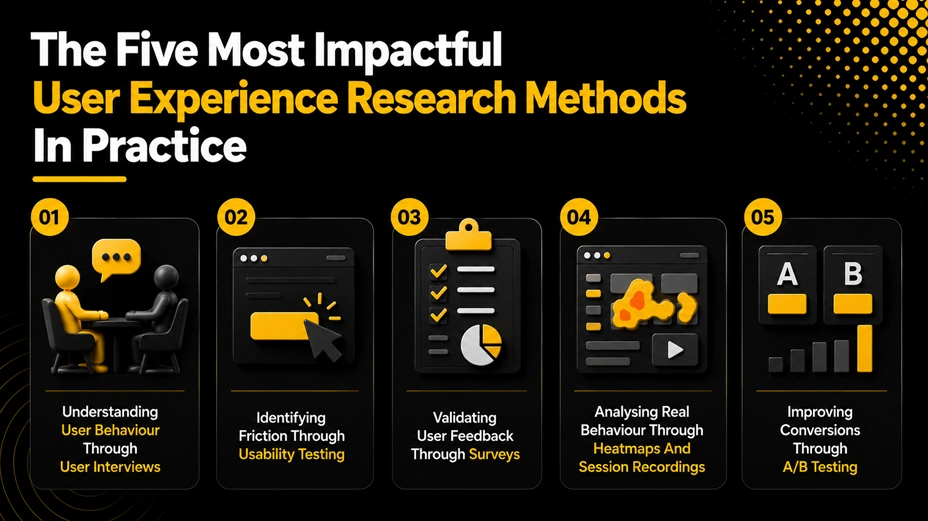
Of the full range of user experience research methods available, five produce the most consistent impact across the widest range of product types and stages. Each is described below in terms of what it actually involves, what makes it useful, and the practical conditions under which it works best.
User Interviews
A user interview is a structured or semi-structured conversation with a person who represents the target user, conducted to understand their mental model, their current behaviour, their frustrations, and their goals. The key discipline in a well-run user interview is asking about what users have done rather than what they would do. ‘What did you do the last time you needed to [task]? ‘ Produces far more reliable data than “What would you want a product to do for you?”
- Best for: understanding motivation, uncovering unmet needs, and building empathy before design begins.
- Sample size: 5 to 8 users per distinct segment is sufficient to identify the major themes. Nielsen Norman Group’s research on diminishing returns in qualitative research found that five participants reveal approximately 85% of usability problems.
- Pitfall to avoid: leading questions that confirm what the team already believes rather than uncovering what is actually true.
Usability Testing
Usability testing places real users in front of the product (or a prototype) and asks them to complete specific tasks while thinking aloud. The team observes where users hesitate, where they make errors, where they express confusion, and where they give up. User experience testing of this kind is the most direct method for identifying friction in an existing interface.
- Best for: identifying specific points of confusion or failure in a designed interface, validating prototypes before development, reducing the cost of fixes by catching problems early.
- Moderated vs unmoderated: moderated sessions (with a facilitator present) allow follow-up questions and produce richer insights. Unmoderated sessions (using tools like UserTesting or Maze) scale more easily and cost less per participant.
- Remote vs in-person: Remote testing via tools like Lookback or UserZoom reaches a wider participant pool. In-person testing allows observation of body language and environmental context.
Surveys
Surveys are the most scalable of the user experience research methods and the most commonly misused. They work well for measuring attitudes, gathering demographic data, understanding feature prioritisation, and validating quantitative hypotheses at scale. They work poorly for understanding motivation, uncovering unexpected behaviour, or gathering nuanced feedback on complex topics.
- Best for: measuring satisfaction (NPS, CSAT, CES); validating feature priorities across a large user base; and segmenting users by behaviour or attitude.
- Sample size: the minimum for statistically meaningful results depends on the total user base and the acceptable margin of error. For most SaaS products, 100 to 200 complete responses provide a reliable directional signal.
- Question design matters enormously: a poorly worded survey question produces data that is worse than useless because it appears credible but is not. Every survey should be piloted with five to ten users before distribution.
Heatmaps and Session Recording
Heatmaps aggregate click, tap, and scroll data from many user sessions to show where attention is concentrated and where users interact with a page. Session recordings capture individual user journeys through the product for qualitative review. Both tools are part of a class of passive analytics that capture real behaviour without requiring users to participate in a study, making them highly scalable and free from self-reporting bias.
- Best for: understanding how users actually navigate a page versus how it was designed to be navigated; identifying ignored CTAs; finding scroll depth patterns that indicate content engagement; reviewing individual sessions to understand edge-case behaviour.
- Tools: Hotjar, Microsoft Clarity (free), FullStory, and Heap all provide heatmap and session-recording capabilities. Microsoft Clarity is free with no session limits, making it a practical first choice for teams with limited research budgets.
A/B Testing
A/B testing presents two variants of an interface element to randomly assigned user groups and measures which variant produces better performance on a defined metric: conversion rate, click rate, time on task, or error rate. It is the most rigorous of the quantitative user experience research methods because it controls for confounding variables through randomisation and produces a statistically testable result.
- Best for: optimising specific interface elements once the broader design direction is validated, measuring the impact of copy changes, CTA placement, form design, and page layout on conversion.
- Critical requirement: statistical significance. A/B tests require sufficient traffic to produce reliable results. Running a test on 200 total visitors does not produce statistically meaningful data. The required sample size depends on the baseline conversion rate and the minimum detectable effect: tools like Evan Miller’s sample size calculator provide a quick estimate.
- Pitfall to avoid: testing too many variables simultaneously. Each test should change one element. Multivariable tests require exponentially larger sample sizes to produce reliable results.
The UX Research Process: From Question to Decision
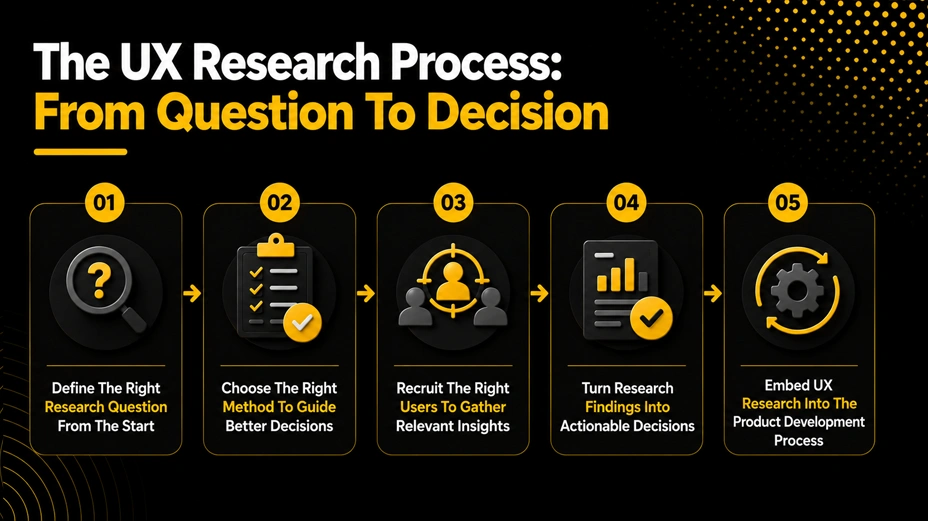
User experience research methods are tools. A tool without a process is just something sitting on a shelf. The UX research process is what connects a design question to a research method, a research method to an output, and an output to a decision. Without that connection, research produces interesting findings that do not change anything.
A Six-Stage UX Research Process
- Define the question: articulate the specific design decision the research needs to inform. ‘We need to understand users better’ is not a research question. ‘We need to understand why users who complete onboarding do not return in week two’ is a research question.
- Choose the method: select the method or combination of methods that most directly answers the question, given the stage of the product and the time available.
- Recruit participants: identify and recruit users who accurately represent the target segment for the research. Recruiting the wrong participants is the most common cause of research that produces irrelevant findings.
- Conduct the research: run the sessions, collect the data, and document findings in a consistent format that allows patterns to be identified across participants.
- Synthesise the findings: identify the themes, patterns, and insights that emerge across the data. For qualitative research, affinity mapping is the standard synthesis method. For quantitative research, statistical analysis and visualisation.
- Make the decision: present findings directly against the design question, with a clear recommendation. Research that produces a list of observations without a recommendation has not completed the process.
Research process principle: The UX research process is complete only when a specific design decision has been made or changed as a result of the findings. If the output is a report rather than a decision, the loop has not closed.
Embedding Research in the Product Development Cycle
The most effective user experience design methods are not the ones conducted in isolation before design begins and never revisited. They are the ones embedded into the product development cycle at the points where design decisions are actually being made: during discovery, during design review, before development begins, and after launch when real user behaviour is available to analyse.
According to the Design Management Institute’s Design Value Index, design-led companies outperformed the S&P 500 by 228% over a ten-year period. Companies that embed user experience research methods into their product development process consistently, rather than conducting research as a one-off project, drive more of this value. The DMI index methodology is available at dmi.org/page/DesignValue.
When to Work With a User Experience Design Agency
Many product teams reach a point where the combination of limited internal research capacity, difficulty recruiting the right participants, and the cognitive bias that comes from being too close to a product makes independent research support genuinely valuable. A user experience design agency brings three things that are difficult to replicate internally: specialist research expertise, a participant recruitment network, and the independent perspective of someone who has not been living with the product for two years.
Situations Where a User Experience Design Agency Adds Distinct Value
- Foundational research before a major product redesign: when the scope of change is large and the cost of a wrong direction is high, independent user experience testing conducted by a specialist team provides a level of rigour and objectivity that internal teams typically cannot achieve for their own products.
- Research in a new or unfamiliar market: a user experience design agency with experience in the relevant sector brings knowledge of the user population, existing mental models, and known friction patterns that would take an internal team months of research to develop independently.
- Stakeholder credibility: research conducted and presented by an independent agency often carries more weight in internal decision-making than equivalent research produced internally, particularly when the findings challenge existing assumptions.
- Specialist methods: diary studies, contextual inquiry, and large-scale quantitative research all require resources and infrastructure that are difficult to maintain for a team that conducts research periodically rather than continuously.
The distinction worth drawing is between a user experience design agency used for ongoing research support and one engaged for a specific, bounded research project. The former requires a close working relationship and strong knowledge transfer. The latter is more transactional but can deliver significant value at specific inflection points in a product’s development.
Final Thoughts
User experience research methods are not a luxury for well-resourced teams. They are the mechanism by which product decisions get made on the basis of what users actually need rather than what the team hopes they need. The distinction sounds simple, but its practical consequence is significant: products built on research reach product-market fit faster, retain users more effectively, and require fewer expensive redesigns than products built on assumptions.
The UX research process described in this guide is not complex. Define the question, choose the method, recruit the right participants, synthesise the findings, and make the decision. What makes it difficult in practice is the discipline of following the process when there is pressure to move quickly and a strong internal opinion about what the answer should be. Research does not always confirm what teams expect, and the willingness to act on unexpected findings is what separates the product teams that improve from the ones that iterate without progress.
Whether a team runs user experience testing internally or works with a user experience design agency, the underlying principle is the same: the user’s actual behaviour is more reliable evidence than any internal discussion, and the user experience design methods described here are the tools for collecting it.
If your team is working through a research challenge or wants to discuss the right user experience design methods for your current product stage, reach out at coffee@sparkeighteen.com.