Most startup founders treat data debt the same way they treat technical debt — something to deal with later, after the next funding round, or once the team is bigger. That instinct is understandable, but it is also expensive.
Here is what is rarely said clearly: data debt is not sitting quietly in the background waiting to cause a compliance headache. It is actively eroding your revenue impact right now. Every orphaned table collecting dust in your data warehouse, every disconnected event log that nobody queries, every user journey siloed in a product analytics tool that never speaks to your CRM — these are not just operational inefficiencies. They are revenue opportunities you are walking past every single day.
This blog is about flipping that narrative. Instead of treating data debt as a cost centre or a risk to manage, we are going to look at how growth-focused startups can weaponise it, turning dormant data into cross-sell signals, revenue multipliers, and competitive intelligence.
Key Takeaways
- Data debt is not just a technical liability — it is a direct drag on startup revenue, often hiding in orphaned tables and disconnected pipelines.
- Orphaned tables carry dormant behavioural signals that, when surfaced, can unlock precise cross-sell signals and uncover untapped customer segments.
- Data arbitrage — the practice of extracting value from underused internal data — is one of the most capital-efficient revenue strategies available to early-stage startups.
- Startups that address data debt systematically see measurable improvements in customer lifetime value, conversion rates, and operational margins.
- Managing data debt is not a one-time clean-up exercise. It requires a structured, ongoing approach to data-driven decision-making.
What Is Data Debt? A Definition That Actually Matters for Startups
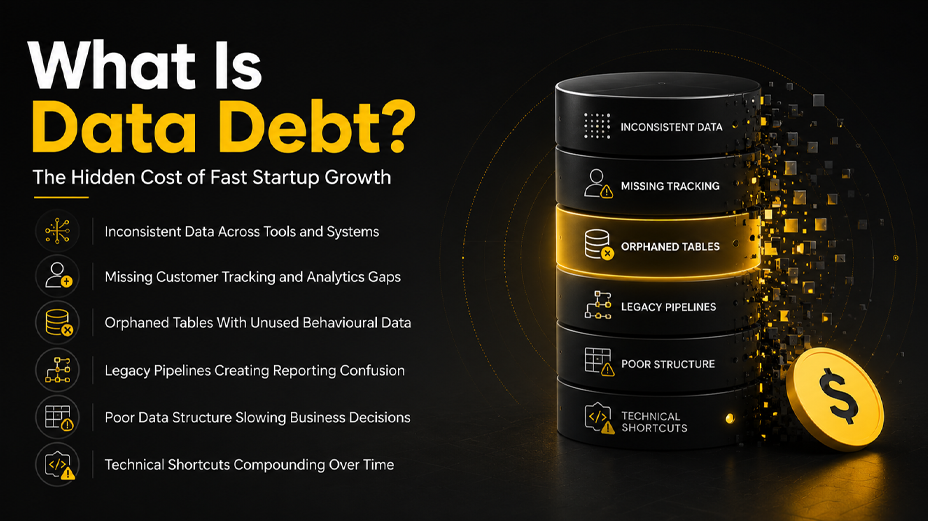
Most definitions of ‘data debt’ focus on quality: stale records, inconsistent schema, missing documentation. Those are real problems, but they are downstream symptoms of something more fundamental.
Data debt, at its core, is the accumulated cost of decisions made to move fast at the expense of data coherence. It builds up whenever a team ships a new feature without updating the tracking plan, migrates from one tool to another without reconciling historical records, or builds a new pipeline without deprecating the old one.
For startups, data debt accumulates in three primary forms:
- Structural debt — schema inconsistencies, deprecated tables still referenced in live queries, event schemas that were never standardised across product versions.
- Coverage debt — customer interactions that were never instrumented and journeys that exist in product but are invisible in analytics.
- Orphaned data debt — tables, datasets, or event streams that were created for a specific sprint or experiment, never cleaned up, and now sit disconnected from any active reporting layer.
The third category: orphaned tables is where most startup revenue impact conversations should begin. Because buried inside those tables is behavioural data that, in many cases, no living analyst has ever properly queried.
Why Orphaned Tables Are a Revenue Problem, Not Just a Storage Problem
Let us be direct about what an orphaned table actually is. It is a database table or data object that was created at some point during your product’s life, often for an A/B test, a deprecated feature, or a legacy integration, and now sits in your warehouse with no active downstream consumers and no entry in your data catalogue.
The storage cost is trivial. The revenue impact of ignoring what is inside them is not.
Consider a common scenario: a B2B SaaS startup ran a beta cohort eighteen months ago for a feature that was eventually sunset. The events from that cohort session – depth, feature interactions, support ticket correlation, and contract renewal timing, all landed in a set of tables that nobody actively maintains. Those tables are orphaned. But the behavioural patterns inside them are gold.
Here is what orphaned tables often contain that directly links to revenue impact:
- Pre-churn behavioural sequences — the exact sequence of product interactions that reliably preceded cancellation. If you surface this, you have a churn prediction model with almost no model-building cost.
- Feature affinity clusters — groups of users who used a combination of features that no longer exists but maps neatly onto a current premium tier. These are your warmest upsell targets.
- Latent cross-sell signals — usage patterns that suggest a customer was trying to solve a problem your current product does not fully address, but a product you now sell does.
- Segment-level willingness-to-pay markers — companies from specific verticals or firmographic profiles that stayed longer, expanded faster, or raised fewer support tickets.
None of these signals require new data collection. They require someone to go back and look at what is already there.
What Is Data Arbitrage, and Why Should Startups Care?
Data arbitrage is the practice of extracting disproportionate commercial value from data that already exists within your organisation but has not yet been connected to revenue outcomes. The term borrows from financial arbitrage exploiting a pricing gap between two markets. In the data context, the gap is between the value locked inside your internal data and the value your go-to-market teams are currently capturing from it.
This is one of the most capital-efficient startup revenue strategies available. You are not buying new data. You are not running expensive enrichment programmes. You are finding the delta between what your data already knows about your customers and what your sales, marketing, and success teams are acting on.
Here is a practical breakdown of how data arbitrage works across the funnel:
| Data Source | What It Knows | What Teams Are Missing | Revenue Opportunity |
| Orphaned feature-usage tables | Which free users hit paywalled actions repeatedly | Sales has no visibility into these signals | Direct outbound trigger for upgrade conversations |
| Deprecated integration logs | Which customers previously connected a tool you now natively support | CS team is unaware of the connection intent | Re-engagement campaign with a clear value hook |
| Archived support transcripts | Language patterns indicating a need for a product your startup now offers | Marketing is not targeting this intent | Cross-sell campaign seeded by NLP analysis of support data |
| Beta cohort data | Which user profiles correlated with highest lifetime value | Acquisition targeting ignores historical LTV signals | Lookalike audience model built on actual revenue data |
Every one of these examples represents a data arbitrage opportunity. The data exists. The revenue is not being captured. Closing that gap is the entire exercise.
How to Link Orphaned Tables to Revenue Impact: A Practical Framework
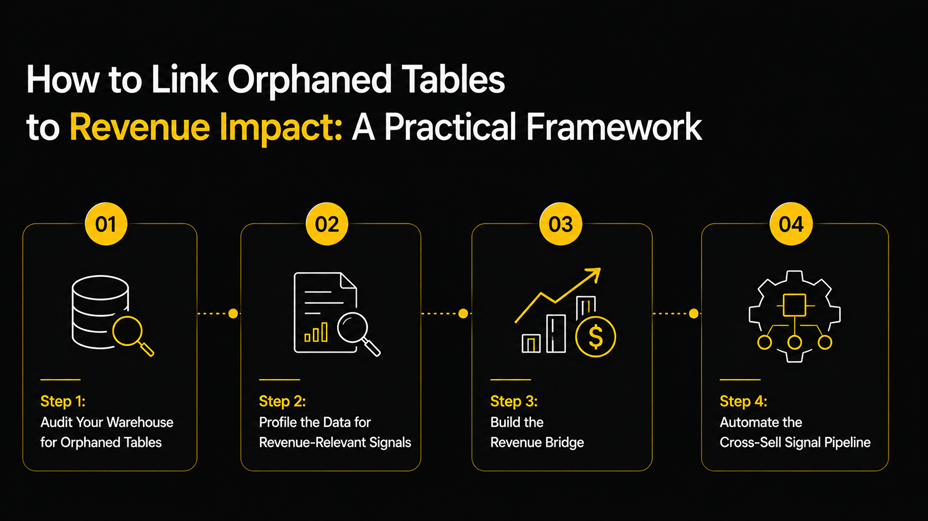
Managing data debt for revenue impact is not a theoretical exercise. It requires a structured process. Here is how growth-focused startups can approach it:
Step 1: Audit Your Warehouse for Orphaned Tables
Before you can extract value, you need to know what you have. A basic orphaned table audit involves:
- Query your query logs — identify tables that have not been queried in 90+ days across your BI tools, dbt models, and ad hoc scripts.
- Cross-reference your data catalogue — if you do not have a catalogue, even a shared spreadsheet listing table names, creation dates, and owners is a starting point.
- Tag tables by lineage — which pipeline created them, which feature or experiment they were tied to, and whether that context still has business relevance.
The output is a prioritised list of orphaned datasets ordered by estimated signal value, not by size or age.
Step 2: Profile the Data for Revenue-Relevant Signals
Not every orphaned table contains something useful. The profiling step is about quickly answering, ‘Does this data contain behavioural, firmographic, or transactional signals that map to a current revenue motion?’
Look specifically for:
- User or account identifiers that can be joined back to your current customer database
- Event timestamps that align with known churn or expansion inflection points
- Feature interaction data that maps to your current product packaging
- Any signal that correlates with contract value, renewal rate, or support volume
Step 3: Build the Revenue Bridge
Once you have identified the signal, the next step is building what we call the revenue bridge — a clear, documented path from the data signal to a specific commercial action.
This is where data-driven decision-making becomes concrete:
- Signal: Former beta users who interacted with Feature X more than 8 times in a 30-day window showed a 34% higher conversion rate to paid tiers.
- Bridge: Build a segment of current free users who exhibit the same interaction pattern using your active product data.
- Action: Trigger a targeted in-app message or SDR outreach sequence for this segment.
The bridge turns a data observation into a revenue motion. Without it, the signal sits in a dashboard nobody acts on.
Step 4: Automate the Cross-Sell Signal Pipeline
The goal of managing data debt is not to run a one-off analysis. It is to build a durable infrastructure that continuously surfaces cross-sell signals from your existing data.
This involves:
- Reverse ETL tooling — pushing enriched segments from your warehouse directly into your CRM, so sales reps see the signal without having to log into a BI tool.
- dbt models for behavioural scoring — building transformation layers that score accounts against known expansion or churn patterns on a scheduled cadence.
- Alerting on threshold breaches — setting up notifications when a free user or existing customer crosses a behavioural threshold that historically predicts upgrade intent.
Done well, this pipeline converts your data debt from a liability into a continuous source of cross-sell signals, running quietly in the background and feeding your revenue teams with qualified, timely intelligence.
The Revenue Impact of Ignoring Data Debt: Real Numbers
Let us ground this in figures that should make any founder or revenue leader uncomfortable.
- A 2023 Monte Carlo survey (Source: TDWI) found that data downtime periods, where organisational data is missing, inaccurate, or unreliable, nearly doubled year over year, with more than half of respondents reporting that at least 25% of revenue was impacted by data quality issues.
- According to McKinsey, companies that are strong data utilisers are 23 times more likely to outperform competitors in customer acquisition and 6 times more likely to retain customers (Source: McKinsey & Company).
The revenue impact of data debt compounds over time. Each quarter you leave orphaned tables unexamined is a quarter where your cross-sell motion runs on incomplete intelligence, your churn models are trained on partial behavioural histories, and your acquisition targeting ignores the LTV signals already embedded in your historical data.
Illustrative Scenario: How Data Arbitrage Can Drive Cross-Sell Revenue
The following example is hypothetical but reflects common patterns seen in SaaS data environments.
A SaaS startup selling a project management tool to mid-market engineering teams had been running for three years. Their data warehouse contained, amongst other things:
- A set of orphaned tables from a deprecated time-tracking feature that was removed 18 months prior
- Event logs from an early integration with Jira that had since been rebuilt and re-released as a premium add-on
Nobody had touched these tables since the features were deprecated. They sat in the warehouse accumulating storage costs and nothing else.
A data engineer, prompted by a quarterly data debt review, ran a basic profiling exercise. The findings were striking:
- 67% of accounts that had used the deprecated time-tracking feature heavily (more than 20 sessions per month) were in company segments that the current sales team was actively targeting for the new premium tier.
- The Jira integration logs showed that 39 current free accounts had attempted to connect Jira during the deprecated integration period — meaning they had demonstrated intent to use a feature that was now a paid add-on.
The revenue bridge was straightforward:
- The 39 accounts with historical Jira connection intent were flagged in the CRM and handed to the CS team with context.
- A targeted email sequence was built for accounts matching the time-tracking affinity profile, referencing the specific workflow problem the premium tier solved.
Within 60 days, this exercise contributed to 11 upgrade conversions and reopened conversations with 4 accounts that had previously gone dark. Total incremental ARR from a single data arbitrage sprint: meaningful, and achieved without a single new data source or additional headcount.
That is the power of treating data debt as a revenue lever, not a maintenance task.
What Good Looks Like: Data Utilisation in Startups That Get This Right
Startups that are strong at data utilisation share a few common operational habits:
1. They have a living data catalogue
Not a perfectly governed enterprise system, even a Notion page or a Confluence space that documents what data exists, where it lives, and who owns it. The goal is discoverability.
2. They run quarterly data debt reviews
A structured process, typically led by a data lead or engineering manager, that identifies newly orphaned tables, deprecated pipelines, and coverage gaps. It treats data debt the same way most teams treat technical debt sprints.
3. They have a defined revenue signal library
A documented set of behavioural signals that are known to correlate with upgrade intent, churn risk, or cross-sell readiness. This library is built iteratively and feeds directly into CRM automation.
4. They connect warehouse to CRM without manual hand-off
Using reverse ETL tools such as Hightouch or Census, enriched segments and scores flow directly from the data warehouse into the sales and success tools – no spreadsheet exports, no manual tagging.
5. They treat data-driven decision-making as a cross-functional discipline
Revenue, product, and data teams share a common understanding of which signals matter and why. Data is not produced by one team and consumed occasionally by another; it is a shared operational layer.
The Risks of Leaving Data Debt Unmanaged
If the revenue opportunity is not sufficient motivation, it is worth being clear about what happens when data debt is left to compound:
- Model degradation — your churn and propensity models slowly become less accurate as they are trained on increasingly incomplete data histories.
- Attribution failures — orphaned event tables mean that revenue touchpoints are invisibly missing from your attribution models, leading to budget misallocation in paid channels.
- Compliance exposure — orphaned tables containing PII that nobody is actively governing are a GDPR liability waiting to surface at the worst possible moment.
- Analyst fatigue — teams that routinely encounter broken pipelines and unreliable data lose trust in their tooling and default to intuition over evidence, defeating the purpose of the data stack entirely.
Managing data debt is not optional once your data stack reaches a certain level of complexity. The question is whether you manage it reactively when something breaks or a regulator asks or proactively, in a way that generates revenue impact.
Conclusion
Data debt is not a back-office problem. For startups with any meaningful product history, it is one of the most underexplored sources of revenue leverage available.
The core argument of this blog is simple: orphaned tables contain signals that your revenue teams are not acting on. Data arbitrage is the discipline of closing that gap. And the startups that build structured habits around managing data debt, cataloguing what they have, profiling it for commercial relevance, and building revenue bridges from signal to action consistently find that their best cross-sell signals were sitting in their warehouse the entire time.You do not need more data. You need to properly use the data you already have. Want to turn dormant data into revenue opportunities? Reach out at coffee@sparkeighteen.com.