A practical, no-hype guide to AI agents: the types, the real-world applications in business and marketing, and what separates agents that deliver value from those that disappoint.
For the past few years, businesses have been implementing AI for specific, bounded tasks: generating copy, classifying support tickets, and summarizing documents. These are useful applications, but they are still fundamentally reactive. A human identifies a task, hands it to an AI tool, reviews the output, and moves on to the next step. The AI is a tool, not a collaborator.
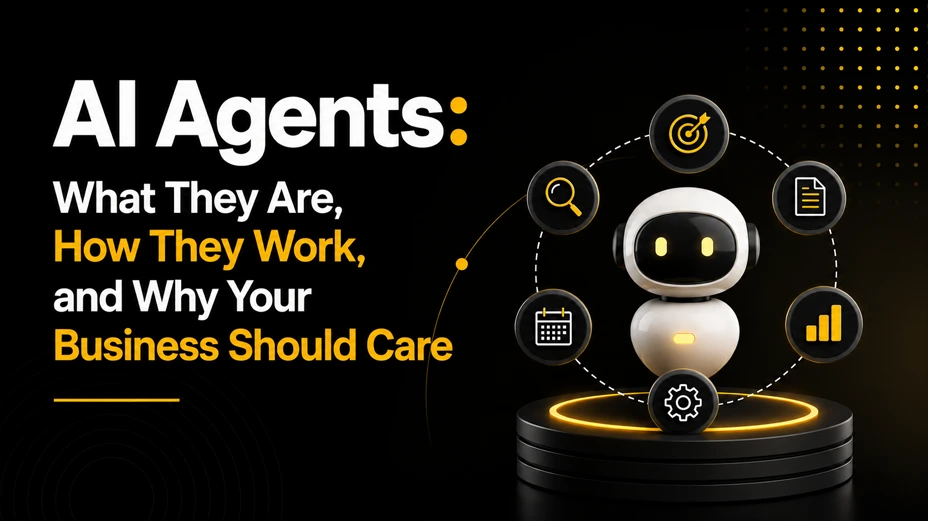
AI agents are a different category. An AI agent is a system that perceives its environment, makes decisions, takes actions using tools like search, code execution, or API calls, and pursues a defined goal over multiple steps without requiring a human to direct every move. The distinction sounds subtle, but its practical implications for business are significant. An AI virtual agent that can research a prospect, draft a personalized outreach email, check the CRM for prior contact history, and schedule a follow-up task is not just an AI tool. It is an autonomous workflow participant.
The market has taken notice. The global AI agents market was valued at approximately $7.84 billion in 2025 and is projected to reach $52.62 billion by 2030, growing at a compound annual rate of 46.3% (MarketsandMarkets). What that growth rate reflects is not hype: it is businesses discovering that AI and automation, when combined in an agent architecture, produce outcomes that neither approach achieves independently.
This guide covers what AI agents actually are, the distinct types of agents in AI, and what each one is suited for. In addition, it will also cover how AI in business and marketing is being transformed by agent technology and what separates deployments that generate real return from those that generate impressive demos with limited operational impact.
Key Takeaways
- An AI agent is not a chatbot. It is an autonomous system that perceives context, plans a sequence of actions, uses tools, and pursues a goal across multiple steps without step-by-step human direction.
- The types of agents in AI range from simple rule-based systems to learning agents and multi-agent systems capable of coordinating complex, distributed workflows.
- AI automation enabled by agents is qualitatively different from traditional automation: it handles exceptions, adapts to changing conditions, and executes non-linear, multi-tool workflows.
- AI in marketing has been one of the fastest adoption areas for agent technology, with agents handling prospect research, content personalization, campaign optimization, and customer journey management.
- Most of the enterprises plan to integrate AI agents within three years, according to recent market research, making this a foundational technology decision rather than an experimental one.
- The businesses that get the most value from AI in automation are those that identify specific, high-volume, multi-step workflows with clear success criteria, not those that deploy agents as a general-purpose solution.
What Is an AI Agent and How Is It Different from a Chatbot?
The term “AI agent” is used loosely in commercial contexts, which has created confusion about what the technology actually is and what it can do. The clarifying distinction is between a system that responds and a system that acts.
A chatbot, in its standard form, responds to a specific prompt with a specific output. It does not take actions in external systems, does not maintain context across unrelated sessions, and does not pursue goals that require multiple interdependent steps. It is a useful tool for specific, bounded interactions.
An AI agent operates differently. It receives a goal, perceives the current state of its environment through sensors, data feeds, or tool outputs, decides what action to take next based on that perception, executes the action using tools such as web search, code execution, database queries, or API calls, observes the outcome, and repeats the process until the goal is achieved or an escalation is required. This perceive-decide-act loop, executed autonomously over multiple steps, is what distinguishes an agent from a simpler AI tool.
AI Agent vs Traditional Automation: The Core Differences
| Dimension | Traditional Automation / Bots | AI Agent |
| Instruction type | Fixed rules, explicit if-then logic | Natural language goals, interpreted in context |
| Adaptability | Breaks when conditions change outside the rules | Adjusts behavior based on new context or feedback |
| Task complexity | Single-step or linear multi-step processes | Multi-step, branching, non-deterministic workflows |
| Tool use | Operates within one system | Calls external APIs, searches the web, runs code |
| Learning | Does not improve without reprogramming | Can learn from feedback and improve over time |
| Human oversight | Requires human intervention for every exception | Handles most exceptions autonomously, escalates edge cases |
| Best example | Email auto-reply, form submission, scheduled export | AI sales development rep, autonomous research agent |
Practical framing: The right question is not, ‘Should we use an AI agent instead of traditional automation?’ ‘ It is, which tasks require the adaptability and multi-step reasoning of an agent, and which are better served by a simple, predictable automated rule?’ Both have a place. The mistake is using one where the other is more appropriate.
Types of Agents in AI: From Simple Reflex to Multi-Agent Systems
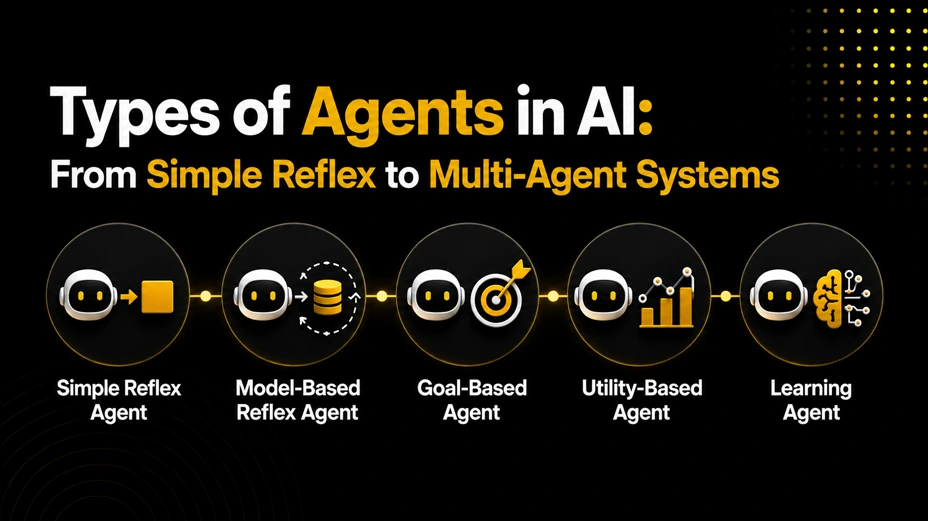
Not all AI agents are the same, and understanding the types of agents in AI is important for choosing the right architecture for a specific business problem. The classification framework developed in academic AI research, and now widely applied in commercial deployments, maps agents by their increasing capability and complexity.
| Agent Type | How It Works | Real-World Example | Best Used For |
| Simple Reflex Agent | Reacts to current input using predefined condition-action rules | Spam filter, thermostat, basic chatbot | Narrow, rule-bound tasks with predictable inputs |
| Model-Based Reflex Agent | Maintains an internal model of the environment to handle partial information | Robot vacuum, adaptive cruise control | Environments where inputs are incomplete or changing |
| Goal-Based Agent | Plans sequences of actions to reach a defined goal state | Route planning, chess engine | Tasks requiring multi-step planning toward an outcome |
| Utility-Based Agent | Maximizes a utility function, choosing the best among competing options | Recommendation engine, ad bidding | Trade-off decisions where multiple outcomes are possible |
| Learning Agent | Improves performance over time through feedback from the environment | LLM-based copilots, fraud detection models | Complex, evolving tasks where patterns shift over time |
| Multi-Agent System | Multiple autonomous agents collaborate, compete, or divide tasks | AI supply chain coordination, agent swarms | Large-scale, distributed tasks requiring specialization |
The Rise of Multi-Agent Systems in Enterprise
The most significant development in agent architecture over the past two years has been the emergence of multi-agent systems as a practical enterprise deployment model. Rather than one agent trying to handle all aspects of a complex workflow, a multi-agent architecture assigns specialized agents to specific subtasks, with an orchestrating agent coordinating the overall process.
A sales pipeline example illustrates this clearly. A research agent gathers prospect data and firmographics. A scoring agent evaluates fit against ideal customer profile criteria. A copywriting agent drafts the first personalized outreach. A scheduling agent manages the follow-up cadence. An orchestrating agent coordinates the handoffs between them. No single agent does everything, but together they execute a workflow that would previously have required multiple human steps across multiple tools.
Early adopters of multi-agent systems report 20 to 30% faster workflow cycles and significant cost reductions in back-office operations. Logistics teams using coordinated agent systems have cut delays by up to 40% (Salesmate.io).
AI in Business: Where Agents Are Delivering Measurable ROI
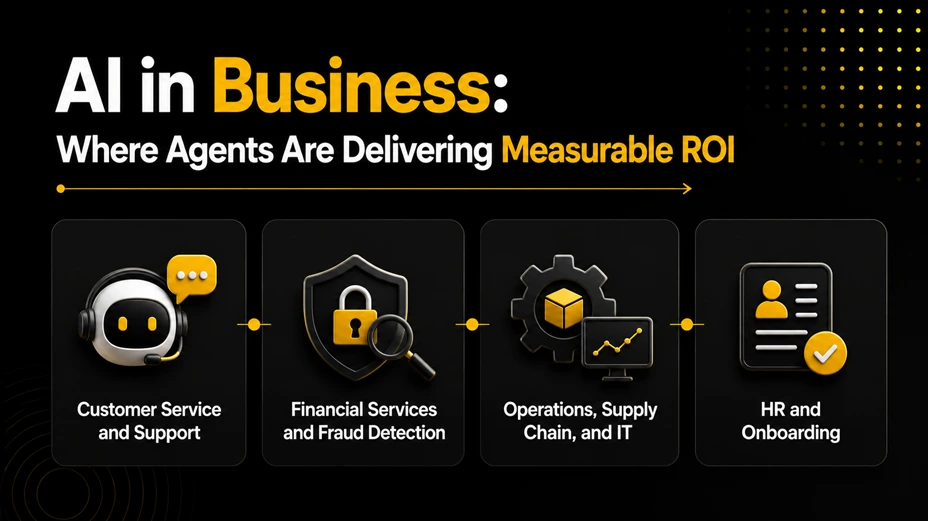
The commercial deployment of AI agents spans every major business function, but the highest-impact applications share a common profile: they are high-volume, multi-step workflows with clear success criteria, large amounts of semi-structured data to process, and a meaningful cost of human handling per unit of work.
- Customer Service and Support
AI virtual agents in customer service handle tier-1 and tier-2 support queries autonomously, routing to human agents only when the query falls outside the agent’s defined competence or when the customer explicitly requests escalation. Unlike static chatbots, AI agents can look up account information, process refund requests, update records in the CRM, and send follow-up communications, all within a single interaction.
According to aggregated deployment data from Salesmate.io, organizations deploying AI agents in customer support have reduced average call handling time by up to 25% and reduced call transfers by as much as 60%.
- Financial Services and Fraud Detection
AI in business applications in financial services has been among the earliest and most mature deployments of agent technology. Fraud detection agents monitor transaction streams in real time, applying a combination of rule-based filters and learned behavioral models to flag anomalous activity before the transaction is processed, not after.
According to research compiled by Nevermined.ai, approximately 70% of financial institutions are already using AI agents for fraud detection and risk analysis. The application works because fraud detection meets the agent deployment profile precisely: high volume, real-time data, clear success criteria, and a very high cost of both false negatives (missed fraud) and false positives (blocked legitimate transactions).
- Operations, Supply Chain, and IT
AI automation through agent systems is reshaping operations and IT functions by handling the class of tasks that are too complex for simple automation but too repetitive to justify constant human attention. In the supply chain, agents monitor inventory levels, trigger purchase orders when thresholds are crossed, coordinate with logistics partners via API, and flag exceptions that require procurement team input. In IT, agents handle alert triage, run first-line diagnostics, apply standard remediations, and escalate tickets that require human expertise.
The ROI case in operations is straightforward: a workflow that previously required a human to review a dashboard, interpret a signal, and take a manual action across three systems can be handled end-to-end by an agent in seconds, at any volume, at any hour.
- HR and Onboarding
AI agents are being used to automate the multi-step, time-sensitive workflows involved in employee onboarding: collecting documentation, triggering IT provisioning, enrolling new hires in training, scheduling onboarding meetings, and sending reminders for outstanding items. The agent handles the coordination; humans handle the judgment calls.
AI in Marketing: The Function Where Agents Are Moving Fastest
AI in marketing has been one of the most active areas for agent adoption, driven by three characteristics that make marketing workflows particularly well-suited to agent architectures: very high task volume, large amounts of customer and behavioral data to process, and clear performance metrics against which agent outputs can be evaluated and improved.
- Prospect Research and Lead Enrichment
AI virtual agents can be configured to research a prospect automatically upon form submission or list import: pulling company data from public sources, identifying the prospect’s role and likely priorities, checking the CRM for prior contact history, and scoring the lead against the ideal customer profile. A task that takes a sales development representative 15 to 20 minutes per prospect is completed by an agent in seconds, at unlimited volume.
- Personalized Content and Campaign Execution
Content personalization at the individual level has historically been constrained by the human time required to create variants. AI and automation through agent systems removes that constraint: an agent can generate personalized email subject lines, body copy, and calls to action for each segment or individual in a campaign, test variants autonomously, and reallocate budget toward the top-performing versions without waiting for a human to review results.
- SEO, Content Research, and Production
Marketing teams are deploying AI agents to handle the research-intensive phases of content production: identifying high-opportunity keyword clusters, analyzing competitor content gaps, pulling supporting data from research sources, and drafting structured content briefs or first drafts for human review. The agent does the groundwork; the human does the editorial judgment.
- Customer Journey Automation
AI in marketing now extends to managing entire customer journey sequences: detecting behavioral triggers in product usage or web activity, determining the next best communication for each user, executing that communication across the appropriate channel, monitoring the response, and adjusting the next touchpoint based on the outcome. This is AI for automation applied to the full marketing lifecycle rather than to individual campaign tasks.
Marketing application principle: The highest-value AI in marketing deployments are not those that replace marketing teams. They are those that remove the operational burden of campaign execution and data processing, allowing marketing professionals to focus on strategy, creative direction, and the customer relationships that require human judgment.
What Separates Successful AI Agent Deployments from Expensive Experiments
The AI agents market is growing at nearly 46% annually, which means a lot of businesses are implementing agents, and a lot of those implementations are not delivering on their initial expectations. The gap between a successful deployment and an expensive experiment is almost never about the technology. It is about the conditions under which the technology is applied.
The Five Conditions That Determine Whether AI and Automation Actually Work
- A specific, well-defined workflow:
Agents perform well when the goal is clear, the tools they need access to are identified, and the criteria for a successful outcome are measurable. ‘Improve our customer experience’ is not a deployable agent goal. ‘Handle tier-1 support queries about billing, with escalation to a human agent when the query involves a disputed charge above $500’ is one.
- Clean, accessible data:
AI agents that need to look up customer information, query a knowledge base, or pull product data from a catalog can only do so if that data is well-structured, accessible via API or retrieval system, and up to date. Agents deployed on top of fragmented, inconsistent, or stale data produce fragmented, inconsistent outputs.
- Human oversight architecture:
Successful agent deployments define clearly which decisions the agent makes autonomously, which require human confirmation, and which automatically escalate. This is not a limitation on the agent’s capability. It is the governance structure that allows agents to operate at scale without creating liability exposure from decisions they should not be making alone.
- Measurable success criteria:
If there is no baseline measurement of the current state of the workflow and no defined metric for what a successful agent deployment looks like, there is no way to evaluate whether the deployment is working. Define the metric before deploying the agent, not after.
- Iteration cadence:
The first version of an AI agent deployment is almost never the production-ready version. Successful deployments build in a structured review and improvement cycle, using early outputs to identify failure modes, edge cases, and missing tool capabilities, and addressing them iteratively rather than expecting the initial configuration to be correct.
Final Thoughts
AI agents represent a genuine shift in how business processes can be structured, not a marginal improvement on existing automation but a different category of capability. The businesses that understand this distinction and deploy accordingly will find that AI and automation, combined in an agent architecture, unlock workflows that were previously constrained by human time and attention.
The market numbers are clear: $7.84 billion in 2025, projected to $52.62 billion by 2030. But market size does not tell a business whether an agent deployment will work for them. What determines that is the specificity of the workflow, the quality of the underlying data, and the governance structure that keeps the agent operating within appropriate boundaries.
AI in business and AI in marketing are both at an early stage of what agents can do. The teams building the operational foundations now, defining clear use cases, measuring baselines, and iterating on real deployments, are the ones who will be best positioned as the technology matures and the competitive differentiation of agent capability becomes more pronounced.
If you need help identifying the right AI agent use cases for your business or want to think through an agent deployment strategy, reach out at coffee@sparkeighteen.com.