In 2026, 93% of QA (quality assurance) teams are doing something with AI (artificial intelligence) in their testing workflows. Almost none are doing it systematically. In practice, that looks like this: a team adopts a self-healing testing tool, maintenance on their UI (user interface) test suite drops for one sprint, and then the AI tool starts generating tests that nobody on the team fully understands. The CI/CD (continuous integration and continuous delivery) pipeline is still slow. The flaky test count is not meaningfully lower. And the QA lead has added a third automation framework to an estate that already had two.
The technology is not the problem. The decision-making that preceded it is.
Gartner published its first Magic Quadrant for AI Augmented Software Testing Tools in October 2025. Forrester renamed the category to “Autonomous Testing Platforms” in Q3 2025. Both decisions signal that AI in test automation has matured from experiment to enterprise buying decision. What neither framework tells you is which capability to buy first, or whether your current test architecture is ready to benefit from any of them. Only around 1 in 7 teams that are experimenting with AI testing have operationalised it at scale. That gap is not reluctance. It is the predictable result of buying tools before defining the problem they are meant to solve.
This guide covers what AI automation testing actually does at each layer of the testing process, which tools deliver which capabilities, what the honest ROI looks like versus vendor claims, and the decisions that come before any tool evaluation should start.
Key takeaways
- AI in test automation is 4 distinct capabilities: self-healing execution, AI test generation, visual AI regression detection, and intelligent failure triage. Each solves a different bottleneck. Buying the right one requires identifying your most expensive problem first.
- Real-world benchmarks are 40 to 60% reduction in test creation time and 20 to 30% improvement in code coverage, on a 6 to 12-month ROI horizon. Vendor claims run higher but reflect idealised conditions.
- 75% of QA teams already run 2 or more automation frameworks. Adding an AI testing layer without a clear consolidation plan adds cost, coordination overhead, and skills complexity.
- AI in test automation introduces 4 challenges that vendor materials consistently underemphasise: testing AI-generated code for non-deterministic behaviour, tooling sprawl, the trust and explainability gap when AI-generated tests fail, and data privacy risks.
- The decisions that determine whether AI testing delivers value are made before the first tool demo: which bottleneck to address, whether the current architecture is ready, who will own AI-generated tests, and how quality improvement will be measured.
What AI automation testing actually means
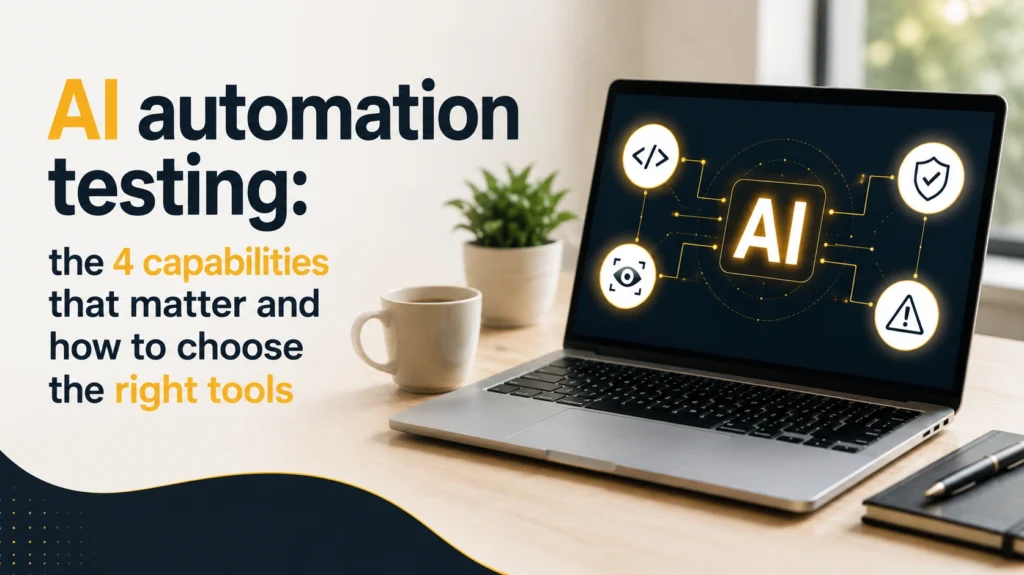
AI in test automation is not a single product or a single capability. It is 4 distinct capabilities applied at different stages of the testing process: self-healing test execution that adapts when application elements change; AI-assisted test generation that produces test cases from user flows, specifications, or existing code; visual AI regression detection that identifies UI changes functional tests miss entirely; and intelligent failure triage that distinguishes real defects from environment noise in CI/CD pipelines.
Each capability addresses a different bottleneck. Self-healing addresses maintenance overhead. Test generation addresses coverage gaps and authoring time. Visual AI addresses the class of regression that scripted tests cannot see. Intelligent triage addresses pipeline credibility. Teams that buy a platform covering all 4 capabilities when their actual bottleneck is only one of them will spend significant money on features they do not need and attribute the ROI failure to the technology rather than to the selection process.
The terminology sprawl around this topic reflects the market’s genuine fragmentation. “AI automation tools,” “ai driven test automation,” “automation testing with ai,” and “ai test automation tools” often point at different products solving different problems. That fragmentation is also what makes generic “best tools” comparison lists so limited in practice: a ranked list of AI testing platforms tells you which tools are well-regarded, not which one addresses your specific cost.
The analyst context is worth understanding. Traditional scripted automation has plateaued at roughly 25% test coveragefor most teams, according to Gartner and Forrester analysis from 2025. AI is the primary mechanism both firms identify for expanding coverage cost-effectively. But expanding coverage is only valuable if the coverage is of the right things. The 25% ceiling is partly a tooling problem and partly a strategy problem. AI tools address the tooling dimension; the strategy dimension still requires human decisions.
The 4 AI testing capabilities and the problems each one solves
Each of the 4 AI testing capabilities addresses a specific, measurable cost in a QA programme. Matching the capability to the problem produces ROI. Adopting a capability without a corresponding problem produces overhead and a belief that AI testing does not work.
Self-healing test execution
Self-healing addresses the maintenance cost of UI test fragility. In a traditional automation suite, when an application’s front end changes, test scripts break because the element IDs, CSS (cascading style sheet) selectors, or XPath expressions they use to locate interface elements no longer match the current DOM (document object model). A single front-end release can break dozens of tests that have no logical errors, only stale locators. Teams spending 40 to 60% of automation engineering time on maintenance see the most immediate ROI from self-healing capabilities.
Self-healing AI monitors locator changes across builds, updates test scripts automatically when it can resolve the change with high confidence, and flags ambiguous changes for engineer review. The workflow shifts from reactive patching after every release to reviewing and approving a smaller set of healing decisions that require human judgment. The maintenance overhead does not disappear, but it drops substantially and shifts from unscheduled interruption to managed exception review.
Two important caveats. First, self-healing fixes tests that break because the application’s surface changes; it does not fix tests that are architecturally unstable, logically incorrect, or written against the wrong requirements. Second, self-healing produces the most value in UI and end-to-end (E2E) test suites. API (application programming interface) tests, which do not depend on DOM locators, break for different reasons and are addressed by different tooling. Buying a self-healing platform to improve API test stability is applying the wrong solution to the wrong problem.
AI test generation
AI test generation addresses the coverage gap and the time cost of writing test cases. Most QA teams have more surface area to test than they have time to write tests for. Manual test authoring is the bottleneck, not the understanding of what needs to be tested. AI test generation tools remove that bottleneck by producing draft test cases that QA engineers review, edit, and approve rather than write from scratch.
AI test generation works in 3 primary modes: generating test cases from specification documents or user stories, converting recorded user sessions into reusable automated test scripts, and inferring test cases from existing code through static analysis. Productivity benchmarks place the improvement at 40 to 60% reduction in test creation time, with 20 to 30% improvement in code coverage for teams that adopt this capability systematically. Vendor claims run higher (some cite 9x faster test creation), but these typically reflect idealised conditions rather than enterprise production environments.
The essential caveat is the one that no tool vendor leads with: AI-generated tests require human review. A 2026 academic study of AI coding agents found that test-writing volume alone has no statistically significant effect on defect resolution rates. Tests that are syntactically valid but logically incorrect, or that validate the wrong expected behaviour, produce false confidence. A test suite that passes with 80% coverage but was generated against incomplete specifications is telling you the implementation matches a flawed brief. AI test generation accelerates the first draft. It does not replace the QA engineer’s judgment about what constitutes correct software behaviour.
Visual AI regression detection
Visual AI addresses the class of UI regression that functional tests cannot detect. A functional test verifies that a button exists, is in the expected enabled state, and returns the expected API response when clicked. It does not verify that the button is visually overlapping with another element on a mid-range Android device, that a colour change has reduced contrast below WCAG (Web Content Accessibility Guidelines) accessibility thresholds, or that a layout shift has moved a critical call-to-action below the fold on a specific viewport. All 3 of those are real product defects. None of them would fail a standard functional test.
Visual AI testing tools use computer vision models trained on large datasets of UI screenshots to compare the current application state against an approved visual baseline and flag differences that indicate regressions rather than intentional changes. The sophistication of this comparison is what differentiates visual AI from simple pixel-level diffing: pixel diffing flags every anti-aliasing change and every font-rendering variation as a failure; visual AI distinguishes between visual changes that are meaningful and visual noise that is not. Applitools is the established leader in this category and has the most extensive evidence base for the accuracy of its Visual AI engine in production environments.
Visual AI testing delivers the most incremental value for consumer-facing applications where visual consistency directly affects user trust, accessibility compliance, and conversion. For internal tools and developer-facing interfaces, the ROI is lower because the user tolerance for visual inconsistency is higher and the accessibility compliance requirements are typically less stringent.
Intelligent failure triage
Intelligent failure triage addresses the signal-to-noise problem that undermines confidence in CI/CD pipelines. In a pipeline running a large test suite, a failure notification could indicate a real product defect that needs immediate investigation, a flaky test that will pass on re-run, an environment configuration issue that has nothing to do with the code, or a data isolation problem from parallel test execution. Without AI triage, every failure requires the same manual investigation process. Engineers learn very quickly that most failures are noise, and they stop treating failure notifications as urgent signals. The quality gate that the automation was built to enforce breaks down incrementally and silently.
AI failure triage classifies failures by root cause across these categories and prioritises the queue for engineer action. When the triage layer surfaces a clear message — “this failure is a new product defect in the payment flow, these 4 are known flaky tests, this one is an environment timeout on the staging database” — the pipeline becomes a reliable quality signal rather than a source of interruptions. The ROI is in the engineering hours saved on investigation and the faster response time to real defects.
Intelligent triage works best when it is trained on a team’s specific codebase, infrastructure, and historical failure patterns. Generic triage models produce generic results; models calibrated to the team’s actual failure taxonomy produce actionable ones. This calibration period — typically 4 to 8 weeks — is the reason most enterprise teams report a 6 to 12-month ROI horizon for AI testing tools rather than immediate returns.
AI automation testing tools in 2026: the market by capability
The right AI automation testing tool is the one that addresses the capability your team most needs. There is no universal best; there is a best fit for a specific bottleneck. Evaluating tools against a comprehensive feature comparison matrix is less useful than evaluating 2 to 3 tools against the single capability you have identified as your priority.
For self-healing UI automation: Testim, now part of the Tricentis platform, is the established option for web and cloud-native application testing, with AI-powered stability features designed for teams with high UI test maintenance burden. Functionize takes a different approach: tests are authored in plain English, which the platform converts into executable automation, lowering the technical barrier to QA contribution from product managers and business analysts who understand what should be tested but cannot write test scripts.
For AI test generation: Mabl and Blinq.io lead in autonomous test creation with integrated auto-healing. Mabl covers smoke testing, regression testing, multi-factor authentication validation, and end-to-end user journey testing without requiring extensive coding. It integrates accessibility and performance checks into the same suite. Blinq.io takes an agent-based approach, generating and maintaining tests from live application observation.
For visual AI regression detection: Applitools is the category leader by a meaningful margin, with its proprietary Visual AI engine and the most extensive production validation data. It integrates with Selenium, Cypress, Playwright, and most major test frameworks, which means visual AI can be added to an existing test architecture without replacing it.
For intelligent failure triage and integrated QA platforms: Katalon and Tricentis both offer platform-level coverage across multiple capability areas, which is the right choice for teams whose primary goal is consolidating a fragmented framework estate rather than adding a point tool. Both platforms are enterprise-grade with the support, compliance, and integration expectations that enterprise procurement requires.
For teams with existing Playwright investment and engineering capacity: Playwright with AI-assisted test generation (via GitHub Copilot integration, AI-powered element detection, or community tools built on large language models (LLMs)) provides a lower-cost entry point. The capability is real but less packaged than commercial platforms; the trade-off is engineering time to integrate and maintain the AI layer versus paying a platform vendor to manage it.
One point worth making explicitly: tool vendor claims should be tested against team-specific benchmarks before any purchase decision. The 2026 market has credible tools across all capability categories. The differentiator is fit to your specific problem and your team’s capacity to adopt and govern whatever is introduced.
What actually changes in the QA workflow when you introduce AI
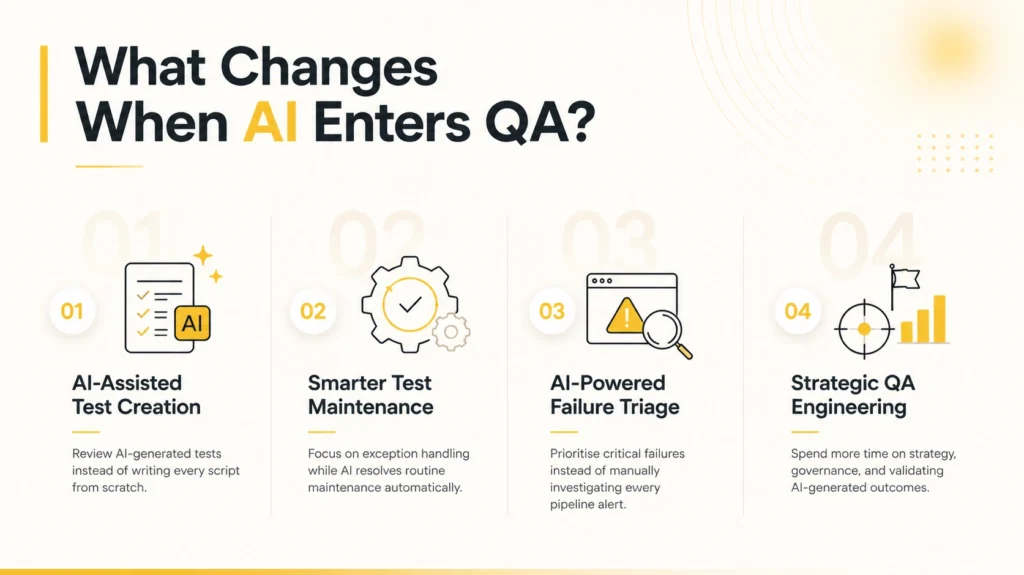
Introducing AI into a test automation workflow changes 4 things in a QA team’s day-to-day work. Understanding the changes in advance is what separates teams that adopt AI smoothly from teams that experience adoption friction and conclude that the tools do not work.
How tests are created shifts from writing test scripts from a blank canvas to reviewing, editing, and approving AI-generated draft tests. This is a meaningful productivity improvement, but it requires a different skill set. A QA engineer reviewing an AI-generated test needs to evaluate it for logical correctness — does this test actually validate what it claims to validate, under the edge cases that matter? — not just syntactic validity. Reviewing is faster than writing, but it is not passive. Teams that treat AI-generated tests as finished work without review are creating an unreviewed test backlog that will produce false confidence and deferred defect discovery.
How the suite is maintained shifts from reactive patching — finding and fixing every broken test after each release — to exception management: reviewing the smaller set of cases where AI healing decisions are uncertain and require human judgment. The total maintenance volume decreases substantially. The judgment required per item increases. This is a better use of QA engineering time, but it requires process design: clear criteria for which healing decisions the tool auto-approves versus which it escalates, and an engineer with allocated time to review the escalated queue.
How CI/CD pipeline failures are handled shifts from manual investigation of every failure notification to acting on an AI-triaged priority queue. This change only produces value if the team has built the habit of trusting the triage model. Building that trust takes time and calibration. In the first weeks of deployment, QA engineers should validate the triage classifications against their own investigation to confirm the model is accurate on their specific infrastructure and codebase. Trusting a triage model that has not been validated is not better than investigating every failure manually; it is just faster at reaching wrong conclusions.
What the QA engineer’s primary work becomes is the most significant shift and the one most consistently underestimated in tool evaluations. As test creation and routine maintenance become increasingly AI-assisted, the QA engineer’s primary contribution moves towards test strategy design (deciding what should be tested and at which layer), AI output evaluation (reviewing generated tests for correctness and coverage), and quality system governance (owning the metrics that tell the team whether the automation is working). Gartner and Forrester both document growing demand for QA engineers with these skills. Teams that invest in developing them will extract significantly more value from AI testing tools than teams that treat automation as a headcount reduction mechanism.
The honest ROI picture for AI based automation testing
ROI from AI automation testing tools is real, measurable, and unevenly distributed. The teams that see the clearest returns in the shortest time are those with a specific, expensive bottleneck that one of the 4 AI capabilities directly addresses. The teams that see limited returns are those that adopt tools without identifying the bottleneck first, or that adopt AI testing into a programme that has fundamental strategy and architecture problems the tools cannot fix.
The vendor claims versus real-world benchmarks: Vendor materials routinely cite dramatic improvements in maintenance reduction and test creation speed. These figures represent idealised conditions, typically from a single case study or a vendor’s internal benchmarking methodology. The more conservative, independently documented benchmarks from 2026 research place the improvement at 40 to 60% reduction in test creation time and 20 to 30% improvement in code coverage. Both ranges describe a real productivity gain; neither is universal. The right benchmark is what your team measures in the first 90 days of adoption on your specific test suite, not a vendor’s best-case headline.
ROI timeline: Most enterprise teams hit ROI in 6 to 12 months. The clearest ROI trigger is a maintenance overhead above 0.5 hours per test per month: at that rate, the productivity savings from self-healing and AI-assisted triage accumulate faster than the tool cost. Smaller teams, or teams with lower-maintenance suites, will see longer payback periods, which is relevant to the “buy now or wait” decision that many QA leads are navigating.
The operationalisation gap: 93% of companies are actively using AI in their testing workflows; only around 14% have operationalised it at scale. The gap is not reluctance or scepticism. It is that experiments run on one project or one team do not automatically scale to the wider engineering organisation. Scaling AI testing requires process standardisation (how AI-generated tests are reviewed and approved), tooling governance (which platforms are used where and by whom), and training investment that individual pilot programmes do not include. Teams closing the gap between experimentation and scale are the ones that treated operationalisation as a project in its own right, not as a natural consequence of the tool purchase.
When AI testing tools do not deliver ROI: the most consistent pattern in failed AI testing adoptions is tools purchased before problems were defined. A self-healing tool adds no value to a team whose bottleneck is coverage gaps, not maintenance overhead. An AI test generation tool adds no value if the engineers who receive the generated tests do not have a process to review and approve them. An intelligent triage tool adds no value if the pipeline it is monitoring does not enforce quality gates. AI amplifies a good testing programme. It does not substitute for one.
The challenges AI in automation testing introduces
AI in test automation introduces 4 challenges that vendor materials consistently underemphasise. None of them are blockers to adoption, but all of them require proactive architectural and governance decisions. Teams that discover them after adoption spend significant engineering time in remediation.
Testing AI-generated application code is a new test design category that 2026 QA teams are still developing practice for. Software teams using generative AI to write application code produce code that passes surface-level functional tests but fails at edge cases, boundary conditions, and integration points in ways that are harder to anticipate than bugs in hand-written code. Testing AI-generated application outputs requires validating behavioural consistency across varied inputs, assessing response stability in edge cases, and detecting hallucinated logic that passes syntactic checks but produces incorrect behaviour in production. Standard regression suites do not cover this by default. QA teams building products that incorporate AI-generated or AI-powered components need to develop specific test patterns for this class of defect.
Tooling sprawl is the most immediate operational risk. 75% of QA teams already run 2 or more automation frameworks. Adding an AI testing platform to an estate that includes Selenium, Cypress, and Playwright, each with their own CI/CD integrations and ownership responsibilities, adds coordination overhead, integration complexity, and skills fragmentation. The correct evaluation question before any AI tool purchase is not “which tool should we add?” but “which existing framework does this capability replace or extend, and what is the net change in complexity?” If the answer is “net increase,” the case for adoption needs to account for the overhead cost explicitly, not just the capability benefit.
Trust and explainability determine whether AI testing scales beyond the initial adoption team. When an AI-generated test fails, an engineer who did not write the test needs to investigate it. If the test has no clear documentation of what it was testing and why, the investigation starts from the same point as investigating an unknown piece of legacy code: time-consuming and frustrating. Clear naming conventions, inline documentation requirements, and peer review processes for AI-generated tests are the governance decisions that make AI testing sustainable. They are not default behaviours of the tools; they are practices the team needs to design and enforce.
Data privacy is the risk that is most likely to create regulatory exposure if not addressed at adoption. 67% of QA teams report concern about sensitive data exposure when using AI testing tools. AI-based automation testing tools that process application data through external APIs or cloud platforms need to be evaluated against GDPR (General Data Protection Regulation), HIPAA, and sector-specific data handling requirements before any real user data enters the tool’s training or processing pipeline. Most enterprise-grade AI testing platforms offer data anonymisation, on-premise deployment, or dedicated cloud instances to address these requirements; confirming which configuration is required and which is available is a pre-sales evaluation step, not a post-purchase discovery.
How to evaluate AI tools for test automation before committing
The most useful pre-evaluation framework for AI automation testing tools is 4 questions asked in sequence before any vendor conversation or platform trial. These questions are designed to match tool capability to team bottleneck and to surface whether the current test architecture is ready to benefit from AI capabilities before the investment is made.
Question 1: Which of the 4 AI testing capabilities addresses my most expensive bottleneck?
Identify the specific cost first. If the team’s biggest expense is UI test maintenance after each release, the answer is self-healing execution. If the biggest cost is coverage gaps and slow test authoring, the answer is AI test generation. If visual regressions are reaching production that functional tests missed, the answer is visual AI. If CI/CD pipeline noise is causing engineers to distrust failure notifications and skip investigation, the answer is intelligent failure triage. The bottleneck identification step takes a day of honest analysis and eliminates most of the platform evaluation work that follows.
Question 2: Is my current test architecture ready to benefit from AI capabilities?
AI capabilities add value on top of a functioning test programme. Self-healing tools require a stable test suite with meaningful tests to heal. AI test generation requires defined specifications or user flows to generate from. Intelligent triage requires a pipeline that people are actually monitoring and acting on. If the test architecture has fundamental problems — investment concentrated at the wrong layer, no clear ownership of the suite, no quality metrics beyond coverage percentage — those problems need to be addressed before AI capabilities are introduced. AI testing tools added to a poorly architected programme amplify the existing problems rather than resolving them.
Question 3: What does ownership of AI-generated and AI-maintained tests look like in our team?
AI-generated tests need a reviewer and a named owner. AI healing decisions need an engineer with allocated time to review and approve the escalated queue. If the team does not have the capacity or the process for this, AI automation tools will generate an unreviewed, unowned test backlog within weeks of adoption. This is not a hypothetical risk; it is the most common cause of AI testing pilots that are quietly abandoned 3 months after launch. Define ownership before the first test is generated.
Question 4: How will we measure whether AI testing is improving product quality?
Define 2 to 3 outcome metrics before adoption and measure them for a baseline period. Useful metrics: defect escape rate (bugs that reached production that the automation suite should have caught), build stability rate (percentage of pipeline runs that produce reliable results without re-runs), and mean time to feedback (time from commit to a reliable pass/fail signal). If these metrics do not improve in the first 90 days of AI tool adoption, the tool is addressing the wrong bottleneck. Coverage percentage is not a useful primary metric; it measures what was tested, not whether the testing is catching real defects.
Building an AI driven test automation strategy: the decisions that come before tools
The decisions that determine whether AI test automation delivers value are made before the first tool demo. They are the same 3 decisions that determine whether any test automation investment delivers value: which bottleneck to address first, whether the current test architecture is stable enough to benefit, and how the team will govern what the tools produce. Teams that make these decisions explicitly and then select tools build testing programmes that improve. Teams that select platforms first and work backwards to strategy build expensive experiments that do not scale.
The test pyramid framework remains the most useful foundation for this thinking. AI capabilities add the most value at the API and integration layer, where self-healing and AI generation produce stable, fast, high-ROI tests that can gate every CI/CD build. Visual AI adds genuine incremental value at the UI layer for consumer-facing applications, on top of a functional test suite that already covers the logic. The E2E layer benefits from self-healing on critical user journeys but remains the most maintenance-intensive regardless of AI tooling. A team that has inverted the test pyramid — heavy E2E coverage, sparse API testing, minimal unit tests — will see lower AI testing ROI than a team that has the layer allocation right, because AI tools work best with a stable architecture underneath them.
In the McKesson Glide Health engagement, test automation was embedded in the architecture from the first sprint rather than retrofitted after the application was built. The microservices architecture gave each service bounded test responsibilities, which meant each service’s tests had a clear scope, a clear owner, and a clear definition of what a failing test meant. That kind of stable, well-bounded test foundation is what AI capabilities improve measurably. Self-healing reduces maintenance on a suite that was already stable and well-structured; AI generation expands coverage on a suite where the existing tests have clear, reviewable patterns to learn from. The architecture of the application and the architecture of the test suite have to be designed together for either to benefit from AI augmentation.
The QA engineer’s role in an AI-augmented testing programme is not smaller — it is different. The work shifts from scripting and patching to strategy, governance, and judgment. The teams that invest in developing these capabilities in their QA engineers will extract significantly more value from AI automation testing tools than teams treating the tools as a way to reduce QA headcount. Building that capability takes the same deliberate investment as building any other engineering skill: time, practice, and a team culture that treats quality as a product concern rather than a release-gate function.
Conclusion
AI in test automation is at the same inflection point cloud infrastructure reached around 2018: genuinely valuable technology, widely adopted as an experiment, rarely operationalised as a system. The 93% adoption figure and the 14% operationalisation figure together describe a market that has bought the tools and has not yet bought the discipline to make them work. The teams that will lead in product quality over the next 3 years are not the ones who adopted AI testing tools earliest. They are the ones who adopted them most deliberately — after identifying the specific bottleneck, after confirming the architecture was ready, after designing the ownership model, and after defining the metrics that would tell them whether quality was actually improving.
AI automation testing tools are not a shortcut past the thinking. They are a multiplier on top of it.
If your team is evaluating AI test automation tools, trying to close the gap between experimentation and operationalisation, or rebuilding a QA programme that has outgrown its current framework, write to us at coffee@sparkeighteen.com.