Most teams do not have an AI testing problem. They have an AI readiness problem.
The numbers make this uncomfortable to ignore. 89% of QA teams are running some form of AI in their testing workflow, piloting tools, experimenting with test generation, or trialling self-healing locators in a sandbox environment. Only 37% have moved those capabilities into production. The gap between “we’re exploring this” and “this is working at scale” is where most organisations are stuck, and it’s not because the tools aren’t good enough.
It’s because the infrastructure, data, and skill foundations were not in place before the tools were introduced.
This guide is for engineering leads and QA managers who are serious about AI in their testing practice, not as a demo, but as a production-grade capability. It covers the 3 readiness assessments you need to run before choosing a tool, the 6 capabilities that actually deliver measurable results, and a practical framework for evaluating AI testing tools without falling for marketing benchmarks.
Key takeaways
- 89% of QA teams are piloting AI in testing; only 37% have it in production — the gap is a readiness problem, not a tooling problem.
- There are 3 readiness assessments to complete before you select an AI testing tool: data quality, infrastructure maturity, and skill readiness.
- AI testing delivers measurable results in 6 specific capabilities: test case generation, self-healing locators, test prioritisation, visual AI testing, log anomaly detection, and synthetic test data generation.
- The QA function does not disappear with AI in the stack — it shifts from writing test scripts to designing quality systems and validating AI-generated outputs.
- Tool evaluation should focus on 4 criteria: integration depth, explainability, graceful degradation, and data residency.
Why most AI testing pilots stall before they scale
The honest answer is that AI testing tools are sold as plug-in solutions, but they are not plug-in solutions. Every capable tool in this space, whether it’s Testim, Mabl, Functionize, or a custom LLM-based test generator, relies on stable inputs to produce reliable outputs. Feed it a messy test suite, a legacy codebase with no consistent naming conventions, or a CI/CD pipeline that breaks unpredictably, and the AI will faithfully amplify every problem you already have.
The 89% pilot / 37% production gap is a symptom of this. Teams see a compelling demo, spin up a trial, and then discover that the self-healing locators can’t stabilise on their dynamically generated IDs, or that the AI-generated test cases produce false positives at a rate that’s slower than writing tests manually. The tools aren’t broken. The foundations weren’t there.
The fix is not to lower expectations for AI testing. It is to sequence the investment correctly: assess readiness first, build the foundations where they are weak, and then introduce the tools that your infrastructure can actually support.
The 3 readiness assessments to run before you choose a tool
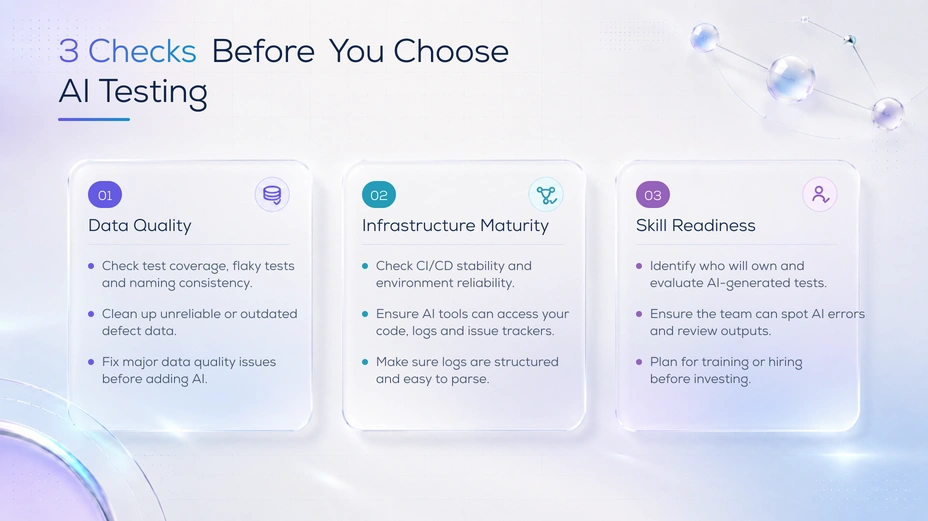
1. Data quality: what are you feeding the AI?
AI testing tools learn from your existing test data, your historical test results, your defect logs, and your code patterns. If that data is unreliable, inconsistent, or sparse, the AI’s ability to generate useful test cases, prioritise risk, or detect anomalies will be fundamentally limited.
Run this assessment before anything else. Audit your existing test suite for coverage gaps, flaky tests (any test with a pass/fail variability above 2% should be treated as a data quality issue), and inconsistent naming conventions across test files. If more than 20% of your existing tests are flaky, fix that before introducing AI tooling. You will spend more time managing AI-generated noise than you save on test authoring.
This also applies to defect history. AI-based test prioritisation tools use historical defect data to predict which areas of the codebase carry the most regression risk. If your Jira backlog has inconsistent severity labels, mixed-up defect types, or years of unresolved noise tickets, the prioritisation model will be unreliable from day one.
2. Infrastructure maturity: can your pipeline support AI in the loop?
AI testing capabilities are not lightweight. Self-healing locators require access to the live DOM at execution time. AI-based test generation requires integration with your codebase, not just your test files. Log anomaly detection requires a consistent, structured log output that the model can parse.
Audit your current CI/CD (continuous integration/continuous delivery) pipeline for 3 things: build stability (do builds pass consistently, or are there frequent environment-related failures?), integration access (can tools connect to your version control, issue tracker, and deployment pipeline in a single authorised flow?), and observability (are your logs structured and parseable, or are they a mix of formats and verbosity levels?).
A pipeline that breaks unpredictably is not a candidate for self-healing locators, because the tool cannot distinguish between a genuine UI change and a flaky environment. Fix the environment first, then introduce the AI layer on top of something stable.
3. Skill readiness: who owns the AI testing layer?
This is the assessment most teams skip, and it’s the one that causes the most failures at scale. AI testing tools require a different skill profile than traditional QA. The person who writes Selenium scripts does not automatically know how to tune an LLM-based test generator, interpret confidence scores from an AI anomaly detector, or design a quality system that validates AI-generated outputs.
The capability shift is specific. Your team needs people who can evaluate AI output quality (not just pass/fail, but “is this test case testing the right thing?”), configure model parameters without re-engineering the tool, and recognise when the AI is confidently wrong, a failure mode distinct from anything in a traditional test script, and know to route it to human review.
Before selecting a tool, map your current team against these skills. Identify the gaps. If you do not have anyone who can own the AI testing layer technically, factor training or hiring into the investment decision before licensing the software.
The 6 AI testing capabilities that actually deliver in production
Once your readiness foundations are in place, these are the 6 capabilities with the strongest production track record in 2026. Not every team needs all 6. The right starting point depends on where your current testing bottlenecks sit.
Test case generation
AI-assisted test case generation is the most widely adopted capability and, when the data quality foundations are in place, one of the fastest to deliver value. Tools in this category analyse your codebase, existing test coverage, and user behaviour data (where available) to generate candidate test cases, including edge cases that manual test authors routinely miss.
The practical ceiling here is important to understand. AI generates candidate tests. A QA engineer still reviews, selects, and refines them. Teams that treat generation as automation from start to finish end up with large test suites of low diagnostic value. The discipline is in curation: using AI to surface what to test, and human judgment to decide how and whether to write it.
Self-healing locators
Self-healing locators address one of the most labour-intensive problems in end-to-end (E2E) test maintenance: test breakage caused by UI changes that don’t represent actual bugs. When a button’s CSS class changes, a test that relies on that selector breaks. Without self-healing, a QA engineer investigates and manually updates the locator. At scale, this maintenance overhead can consume 30-40% of QA engineer time that could be spent on exploratory or integration testing.
Self-healing tools use visual AI and DOM analysis to detect the element the test was targeting even after the selector changes, update the locator automatically, and log the change for human review. The net effect is a significant reduction in false-positive failures. The caveat is that they require a stable application structure to work against: highly dynamic, JavaScript-rendered UIs with non-deterministic DOM generation are harder for these tools to handle reliably.
AI-based test prioritisation
AI-based test prioritisation uses historical defect data, code change patterns, and test execution history to rank which tests carry the most regression risk for a given build. The practical result is a risk-tiered test execution order: run the highest-risk tests first, so a critical regression surfaces early in the pipeline rather than after a full test suite completes.
Teams using this capability effectively report 25-40% reductions in mean time to detect critical regressions, by catching the failures earlier in the CI run. The dependency is data quality: the model’s prioritisation is only as reliable as the defect and execution history it trains on.
Visual AI for layout and design testing
Visual AI testing compares screenshots of UI components across builds and flags visual regressions that functional tests miss: elements that are technically present in the DOM but are cut off, overlapping, or misaligned. This is particularly valuable for design-system-driven products where a layout change in a shared component can produce visual bugs across dozens of pages without breaking a single functional assertion.
Tools like Applitools and Percy are the most mature in this category. They use perceptual hashing and neural comparison rather than pixel-by-pixel diff, which means they handle responsive layouts and minor rendering variations without generating noise.
Log anomaly detection
Log anomaly detection applies machine learning (ML) to your application logs to surface patterns that indicate an emerging failure before it produces user-visible errors. In a microservices architecture, where a failure in one service can cause cascading latency or errors in dependent services, anomaly detection provides an early warning layer that static log alerts cannot.
The infrastructure requirement here is significant: structured, consistently formatted logs at a volume high enough for the model to establish a reliable baseline. For teams below a certain scale, rule-based alerting is more appropriate than ML anomaly detection. This capability earns its investment at organisations with high-complexity distributed architectures and large log volumes.
Synthetic test data generation
Synthetic test data generation uses AI to create realistic, statistically representative datasets for testing without using production data. This is particularly valuable in regulated industries, including healthcare, financial services, and legal technology, where production data cannot be used in test environments without complex masking and anonymisation pipelines.
AI-generated synthetic data can reproduce realistic edge cases, boundary conditions, and rare data patterns that manually authored test data routinely misses. The maturity of this capability has advanced significantly; in 2026, tools in this space can generate relational datasets with referential integrity, which was a significant limitation 2 years ago.
What the QA function looks like when AI is in the stack
There is a version of this conversation that ends with “AI will replace QA engineers.” That version is wrong, and it misunderstands what QA does at organisations that take quality seriously.
The more accurate framing is this: AI in the testing stack shifts the QA function from executing tests to designing quality systems. The engineers who will be most valuable in an AI-augmented QA environment are the ones who can evaluate AI output, recognise when a confidence score is misleading, design the quality gates that AI-generated tests must pass before they enter the regression suite, and build the validation layer that sits between AI-generated results and the humans who act on them.
This last point is more concrete than it sounds. At Spark Eighteen, we built the GeneralMind platform, an autonomous document-to-ERP (enterprise resource planning) AI system used by companies including Hartmann, Sennheiser, and Bayer to extract purchase order data and write it directly into SAP. The core quality challenge was not “does the feature work?” It was “can an enterprise finance team trust what the AI extracted from a PDF?”
The answer required building a QA layer around the AI output itself: confidence scoring on every extracted field, source citations that let a finance reviewer trace each value back to its location in the original document, and a complete audit trail that surfaced the AI’s reasoning rather than just its conclusion. Every execution step was logged and traceable. The QA function here was not writing test cases. It was designing a system that made AI output legible, verifiable, and trustworthy to a non-technical finance user who needed to approve a six-figure purchase order.
That is what quality engineering looks like when AI is in the stack. The test is not “did the function return the right value?” The test is “can a human who needs to act on this output trust it enough to do so?”
This architectural shift does not mean manual testing disappears. The opposite is true. Exploratory testing, accessibility evaluation with real assistive technology, and AI output review all require human judgment that no tool, automated or AI-powered, can replicate. In an AI-augmented QA environment, these manual testing disciplines become more valuable, not less, because they cover the territory that automation and AI collectively cannot reach. The QA manual testing role evolves from executing scripted regression to owning the evaluation types that require context, judgment, and real-world interpretation: precisely the categories where a confident AI output is least trustworthy and where the manual testing process adds the most irreplaceable signal.
How to evaluate AI testing tools without being misled by benchmarks
AI testing vendors publish benchmark results that are, to varying degrees, constructed to be favourable. Ignore them as a primary decision input. Evaluate on 4 criteria that reflect your actual production environment.
Integration depth. A tool that doesn’t integrate natively with your version control, CI/CD pipeline, and issue tracker creates coordination overhead that erodes the time savings it claims to deliver. Before a proof of concept (PoC), verify that the integration requires no custom middleware, and that data flows bidirectionally: the tool reads from your pipeline and writes results back to your issue tracker automatically.
Explainability. When the AI flags a test failure or generates a test case, can it tell you why? A tool that produces outputs without reasoning is not useful in a QA context, because you cannot validate the output without understanding the basis for it. Prioritise tools that surface their reasoning, whether through confidence scores, source citations, or annotated diffs.
Graceful degradation. What does the tool do when the AI model is uncertain? The correct behaviour is to flag the item for human review and continue processing the rest of the suite. The wrong behaviour is to silently pass uncertain items or halt the pipeline. Test this explicitly in your PoC.
Data residency. If your product handles regulated data, verify that the AI testing tool’s data processing complies with your jurisdiction’s requirements. Some tools send code snippets or test artefacts to third-party model providers for inference. If that creates a compliance problem in your environment, it eliminates the tool regardless of its capabilities.
Conclusion
The maturity of AI testing tools in 2026 is not the bottleneck. The real constraint is that most engineering organisations have not built the infrastructure, data quality, and skill foundations that these tools require to operate reliably.
The teams that are succeeding with AI in their testing stack made a deliberate choice: they assessed their readiness, fixed their foundations, and introduced AI capabilities incrementally against a specific problem, whether that was E2E test maintenance overhead, regression detection latency, or test coverage gaps in a rapidly expanding codebase. They did not start with the tool. They started with the problem.
AI in software testing is not a destination. It is a capability that grows with the quality system around it. Build the system first, and the tools will have something worth running against.
If you’re working through what the right entry point looks like for your team’s testing infrastructure, the team at Spark Eighteen is happy to think through it with you. Drop a note to coffee@sparkeighteen.com with where you’re starting from.