A QA team at a fast-scaling fintech company has automated 70% of their regression suite. The CI/CD (continuous integration/continuous delivery) pipeline runs 4,000 tests in 22 minutes. Every green build deploys automatically. Then their most important enterprise client opens the onboarding flow on a mobile device with a screen reader and cannot complete step 3. The issue had existed for 3 consecutive sprints. Not a single automated test had caught it, because not a single automated test had thought to look for it.
This is not an automation failure. It is an allocation failure. The team had deployed automation where it performs best: known regression paths, speed, and scale. They had left unguarded the territory where automation is structurally weakest: the places that only a human can evaluate. No amount of additional automation coverage would have caught that screen reader issue. It required a tester who uses one.
The question “do we still need manual testing in 2026?” is the wrong question. The right question is: which parts of your quality assurance (QA) programme require human judgment, and are those parts currently staffed with people?
Manual testing accounts for more than 50% of the global software testing market in 2026, even as the overall market reaches $54.44 billion. 82% of teams use manual testing daily alongside their automation suite. The question is not whether to use it. The question is where to concentrate it.
Key takeaways
- Manual testing in 2026 is not the legacy alternative to automation. It is the deliberate allocation of human judgment to the evaluation types that automation cannot perform: exploratory testing, usability evaluation, accessibility auditing, AI output review, and early-stage product validation.
- Automated accessibility scanners catch only 20-40% of accessibility issues. The remaining 60-80%, including screen reader navigation flow, keyboard focus order, and cognitive load, requires a human using assistive technology. Accessibility testing is manual testing.
- Exploratory testing uncovers 25-40% more high-priority issues than scripted testing alone, particularly in UX and integration scenarios. It is not a backup when automation fails; it is the primary tool for finding the bugs you did not know to look for.
- The manual vs automation decision is a resource allocation question, not a philosophy debate. Automate stable, high-frequency tests with deterministic outcomes. Use manual testing wherever evaluation requires human context, judgment, or interpretation that a script cannot encode.
- The QA manual testing role has evolved from test executor to quality strategist. Manual testers in mature teams are increasingly responsible for exploratory test design, accessibility evaluation, and AI output review rather than scripted regression execution.
What manual testing actually means in 2026
Manual testing in software is not “a human clicking through screens because you haven’t automated yet.” It is human-led evaluation of software quality in areas where human judgment, contextual interpretation, and real-world experience produce results that automation cannot produce. The distinction matters because misdefining it leads directly to the wrong allocation decisions, and wrong allocation decisions produce QA programmes that have high automation coverage and critical blind spots.
There are 3 misunderstandings that generate more poor QA strategy than any tool decision. The first: manual testing is what you do until you can afford to automate. This is wrong because several testing categories should never be automated regardless of budget or tooling maturity. A usability evaluation of whether a flow feels intuitive to a first-time user is not a scripted test with a deterministic outcome; it is a human judgment. No increase in automation investment changes that. The second: manual testing is slower and less reliable than automation. This is wrong for the right use cases. Exploratory manual testing is faster than scripted automation at finding bugs you did not know to look for, because it does not require you to have anticipated the bug in order to write a test for it. The third: AI will eliminate manual testing within a few years. This is wrong, and the reasoning matters. AI-powered products introduce an entirely new category of manual testing: evaluating whether AI-generated outputs are accurate, appropriately toned, free of hallucinations, and unbiased. These evaluations require a human who understands the domain, the user, and the business context. AI tools create more demand for manual judgment in QA, not less.
Manual and automated testing are not on a spectrum from old to modern. They are complementary tools for different problems. The teams that treat them as interchangeable produce the worst outcomes of both: tedious scripted regression done manually at high cost, and exploratory, accessibility, and AI output testing skipped entirely because “we have automation for that.”
The 5 testing types that require human judgment
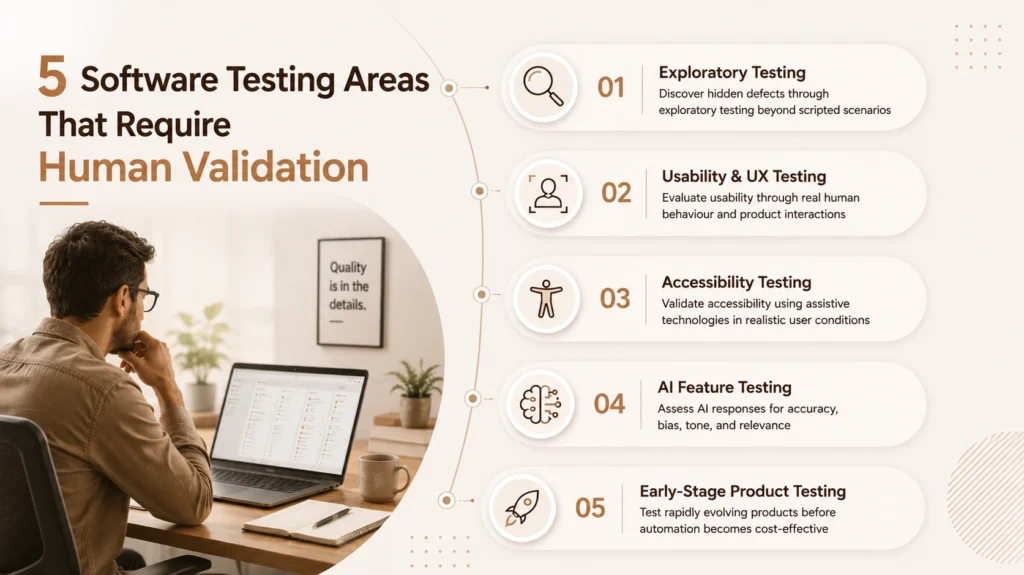
Automation is most reliable for testing known paths with deterministic expected outcomes. Manual testing is most reliable for evaluating context, interpreting subjective experience, and discovering what was not anticipated. There are 5 testing categories where this is not a preference but a structural requirement: the nature of the evaluation itself makes automation an inappropriate tool.
Exploratory testing is the most undervalued form of manual testing in teams that have invested heavily in automation. Where scripted tests validate what the team knows to check, exploratory testing discovers what the team did not know to check. A trained exploratory tester brings heuristics, product knowledge, and pattern recognition from past failures to each session. No scripted test can replicate this, because a scripted test encodes known behaviour. Exploratory testing uncovers 25-40% more high-priority issues than scripted testing alone, particularly in UX and integration scenarios. The output of a good exploratory session is not just a bug list; it is information about which areas of the product carry the most unexamined risk, which is arguably more valuable than the bugs themselves.
Usability and UX evaluation requires a human because it is asking a fundamentally subjective question: does this feel right to a person using it? Automation can verify that a button is present, has the correct label, and responds to a click. It cannot tell you whether the button is in a confusing location, whether the label creates the wrong expectation, or whether a flow requires a cognitive step that users consistently fail to complete. These are not edge cases; they are the difference between software that works technically and software that users actually complete their intended tasks on. Manual exploratory testing still catches 40-60% of critical usability and edge-case issues that automation misses.
Accessibility testing is where the gap between automated and manual coverage is most consequential and most quantifiable. Automated accessibility scanners catch 30-40% of WCAG (Web Content Accessibility Guidelines) issues: missing alt text, colour contrast failures, and missing ARIA (Accessible Rich Internet Applications) labels. The remaining 60-70%, including whether screen reader navigation flows logically, whether keyboard focus order makes sense to a keyboard-only user, and whether cognitive load is appropriate for the target audience, requires a tester using assistive technology in real conditions. No automated tool can evaluate whether the order in which JAWS or NVDA announces content makes sense to a screen reader user. A tester who uses a screen reader daily can evaluate this in a 90-minute session and find issues that would take months to surface through user feedback.
Testing AI-powered and AI-generated features is a category that did not exist at meaningful scale 3 years ago and has no automation equivalent today. When a product includes AI-generated content, conversational AI, or AI-assisted decision support, the testing questions include: does the output contain hallucinations? Is the tone appropriate for this context and user type? Does the AI response vary appropriately across different inputs, and does it vary in ways that are unintentionally biased? Does the advice reflect the business’s risk posture and regulatory context? These evaluations require human testers who understand the domain, the user, and the specific business context. AI-powered tools create more demand for this category of manual testing, not less.
Early-stage and rapidly changing products are the environments where manual testing is the only cost-effective quality strategy. Writing and maintaining a comprehensive automated test suite for a product that changes its core user flows every sprint is an investment that pays back slowly, if at all. In the first stages of product development, when architecture is unstable and the user journey is still being validated, exploratory manual testing delivers quality signal faster and at lower cost than automation setup. The right time to automate is when there is enough stability that the automation will not need to be rewritten before it has been run enough times to justify the setup cost. Teams that automate too early spend most of their automation engineering time maintaining tests, not extending coverage.
The difference between manual testing and automation testing: a practical decision framework
The manual vs automation testing decision is a resource allocation question with a structured answer, not a philosophy debate. Automate when tests are stable, run frequently, have deterministic expected outcomes, and the setup cost is recoverable within the test lifecycle. Use manual testing when evaluation requires human judgment, context, or interpretation; when a test runs once or infrequently; or when the product is changing too fast for automation to remain valid before it recoups its setup cost.
In practice, the allocation looks like this. Automate: regression suites for stable features, API (application programming interface) contract testing, performance benchmarks, data validation, cross-browser rendering checks, and smoke tests run on every deployment. Use manual testing for: exploratory sessions for new features, UX and usability review, accessibility audits using real assistive technology, AI output evaluation, edge-case investigation in complex integrations, and acceptance testing for new features with domain experts present.
The recommended split for most mature teams in 2026 is 60-70% automated and 30-40% manual. This mix is not fixed; it should be reviewed whenever the product’s rate of change, user base, or regulatory context shifts. Teams that treat the ratio as a one-time decision leave it misaligned with the actual product at every review cycle that does not happen.
The most important caution in this framework: increasing automation coverage without deliberately reallocating manual testing effort creates blind spots rather than closing them. If your automation coverage goes from 50% to 70% and your manual testers use the freed capacity to run more scripted regression rather than exploratory and accessibility testing, you have improved throughput without improving quality. The freed capacity needs to be redirected deliberately to the evaluation types that automation cannot reach.
Manual testing tools in software testing: what the market offers in 2026
Manual testing tools in software testing fall into 4 categories: test management platforms, bug reporting and visual feedback tools, cross-platform execution environments, and accessibility evaluation tools. The right combination depends on which parts of the manual QA process create the most friction: recording what was tested, communicating bugs clearly to developers, running tests on real devices and browsers, or evaluating accessibility with real assistive technology.
Test management platforms structure and track manual test cases, exploratory sessions, and results so that knowledge about what has been tested does not live in individuals’ heads or scattered spreadsheets. TestRail offers structured test case management with full traceability to requirements, making it well suited to regulated environments where an audit trail matters. Zephyr Scale integrates test management directly inside Jira, which reduces context switching for teams already working in Jira. Xray serves teams doing behaviour-driven development (BDD), allowing manual test cases to sit alongside Gherkin scenarios in the same tool. The practical decision criterion for this category is almost always the issue tracking tool your development team already uses.
Bug reporting and visual feedback tools reduce the friction between finding a bug and communicating it clearly enough for a developer to reproduce it. Marker.io is the standout tool for web-based manual testing: it lets a tester annotate a screenshot directly in the browser, attach console logs and session metadata automatically, and push the report to Jira or GitHub without switching tabs. This reduces the time between finding a bug and filing it from several minutes to under 60 seconds, which meaningfully increases the volume of issues that get documented rather than forgotten mid-session. Jira remains the universal bug tracking layer across most QA programmes regardless of which capture tool sits in front of it.
Cross-platform execution environments let manual testers evaluate software on real devices and browsers without maintaining a physical device lab. BrowserStack and LambdaTest both provide live, interactive access to a library of real devices, operating system versions, and browser configurations. This category has improved most significantly over the past 3 years: a tester evaluating a cross-browser interaction or a mobile accessibility flow can now do so on real hardware in minutes rather than requiring physical devices in-house. For accessibility testing specifically, running on a real device with a real screen reader is the only meaningful evaluation environment.
Accessibility evaluation tools combine automated scanning with human evaluation support. JAWS and NVDA are the primary screen readers used for accessibility testing in the Western market. axe DevTools provides the automated baseline scan that catches the 30-40% of WCAG issues that tooling can detect. The critical point is that these tools support human accessibility evaluation; they do not replace it. A tester who uses a screen reader to navigate a product end-to-end is doing something no automated scan can replicate, and the value of the tools in this category lies in making that human evaluation faster and more systematic.
The manual testing process: how a structured session actually works
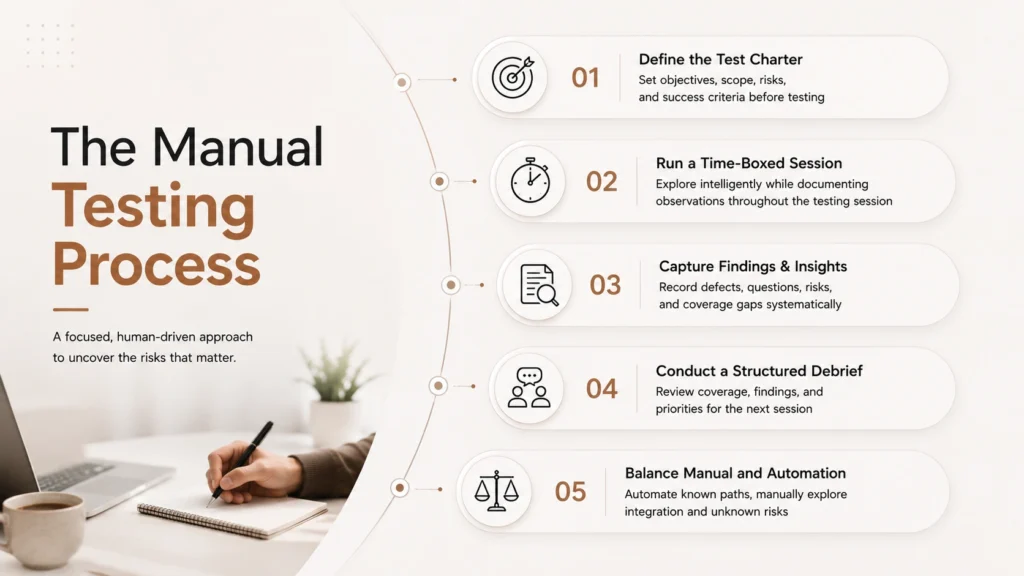
A structured manual testing process is not a tester clicking through screens until they find something wrong. It is an exploratory charter (what are we testing, what are we looking for, what are the time and scope boundaries?), a time-boxed session with concurrent note-taking, and a post-session debrief that translates findings into actionable quality information. This structure makes manual testing reproducible and auditable without removing the human judgment that makes it valuable.
The test charter defines scope before the session begins: which feature area, user flow, or risk area is being explored; which quality attributes are being evaluated (functionality, usability, accessibility, security); what the time box is; and what the entry criteria are (does a build need to be deployed, does test data need to be prepared?). A charter takes 15-20 minutes to write and prevents a 90-minute session from producing anecdotal findings with no clear coverage picture. Without a charter, a session produces a list of bugs but no information about what was not tested.
The session is time-boxed, typically 60-90 minutes. The tester follows the charter’s direction but applies judgment to pursue interesting findings that the charter did not anticipate. This is where the human value lies: a scripted test follows a predetermined path regardless of what it encounters; a manual tester follows interesting signals. Concurrent note-taking during the session rather than a writeup after is the discipline that produces useful session notes rather than a remembered approximation of what happened.
The post-session debrief covers 3 things: what was tested (coverage), what was found (bugs, open questions, and areas needing deeper investigation), and what was not covered (scope for the next charter). This is the step most teams skip, and it is the step that converts individual testing sessions into an accumulating body of quality knowledge. Without a debrief, each session is independent. With a debrief, sessions build on each other and the team develops a map of tested and untested product territory.
When Spark Eighteen built the QA programme for McKesson Glide Health’s revenue cycle management (RCM) platform, test-driven development (TDD) was established from the first sprint across the microservices architecture. Automated unit and integration tests covered known paths within each service boundary. Manual QA was reserved for exploratory sessions at service integration points: the places where 2 services interact in ways that neither service’s unit tests can predict, and where business logic crosses team boundaries. That deliberate allocation, automation for known regression paths and manual exploration for boundary behaviour, is why the QA programme scaled without a proportional increase in test maintenance burden as the architecture grew.
How the QA manual testing role has evolved in 2026
The QA manual testing role in 2026 is less about executing scripted test cases and more about directing human judgment to the places where it produces the most value. Manual QA testers in mature teams are increasingly responsible for exploratory test design, accessibility evaluation, AI output review, and quality strategy rather than scripted regression execution. This shift is not cosmetic; it reflects a genuine change in where manual testing effort creates the most return.
In teams with high automation coverage, manual testers who spend their time on scripted regression are the function most directly under pressure from increasing automation investment. Testers who own exploratory coverage, accessibility evaluation, and AI output review are occupying roles that automation investment makes more valuable, not less. An exploratory tester who finds a category of bug that no one had written a test for creates more business value than 20 additional automated regression tests for paths that have never failed. The leverage point for manual testing in 2026 is discovery, not execution.
The skills that matter most in this environment: exploratory testing techniques including charter-based and session-based testing approaches; WCAG 2.2 proficiency and hands-on experience with JAWS, NVDA, and VoiceOver; AI literacy for evaluating generative AI outputs against domain standards; and the ability to translate quality findings into architecture and design conversations before the cost of changing them escalates. These are not the skills that a manual testing job description that emphasises “experience executing test cases against requirements documents” selects for. Teams that have not updated their hiring criteria for manual QA roles in the past 2-3 years are likely hiring for the role as it was, not the role as it is.
Manual testing services: when to bring in an external QA team
External manual testing services make the most sense when the testing need is temporary, specialised, or requires an independence that an in-house team cannot credibly provide. The 4 use cases that most clearly justify external manual testing services: a pre-launch accessibility audit conducted by testers who use assistive technology as their primary interface; exploratory testing of a new feature by testers who have no context bias toward how the product is supposed to work; surge capacity for a release cycle where in-house team bandwidth is insufficient to cover the required scope; and an independent QA review of a product the in-house team built and cannot evaluate without the anchoring effect of having built it.
The question that filters manual testing services providers most efficiently is this: what does your testing process produce when the session finds no bugs? A well-run exploratory testing session always produces a coverage map, a list of open questions, and a view of which areas carry unexplored risk, even when no defects are found. A provider that only produces a bug list has not been doing exploratory testing; they have been doing unstructured ad-hoc testing and calling it exploratory. The coverage information is as valuable as the bugs, because it tells you what you can now be confident about and what still needs examination.
When evaluating accessibility testing providers specifically, ask whether the testers use assistive technology in their own daily work, not just as a testing tool. A tester who uses a screen reader to read their email and browse the web will evaluate a screen reader experience with a depth of contextual knowledge that a sighted tester running through an accessibility test script cannot match.
Conclusion
The teams getting quality right in 2026 are not the ones with the highest automation coverage percentages. They are the ones that know precisely what their automation does not cover, and have made a deliberate decision to staff that gap with the right kind of human judgment.
That is a harder problem to solve than increasing automation coverage, because it requires clarity about what each testing type is actually for. Automation handles volume, repeatability, and speed for known paths. Manual testing handles the judgment calls: the usability evaluation that requires a real user’s perspective, the accessibility audit that requires a real screen reader user’s experience, the AI output review that requires domain expertise, and the exploratory session that finds the bug no one had thought to write a test for.
The shift from “how much of our testing is automated?” to “is our manual testing effort concentrated in the places where human judgment is irreplaceable?” is a strategic shift, not a tooling upgrade. The organisations that make it deliberately build QA programmes that scale with confidence. The ones that do not end up with very fast pipelines that deploy very well-tested known paths, and blind spots in exactly the places that matter most to users.
If you are building or restructuring a QA programme, deciding where to draw the manual and automation line for a specific product, or building a QA function from the ground up in a regulated environment, reach out at coffee@sparkeighteen.com. We have built these programmes for enterprise-scale products where getting the allocation wrong has consequences beyond a bug report.