88% of organisations use AI, yet only 8% have a comprehensive governance framework in place. That gap is where data leaks, regulatory violations, and model failures happen. AI risk is different from traditional software risk — outputs are probabilistic, failure modes are contextual, and you cannot patch your way to trustworthy AI. You have to govern it.
This guide covers what AI risk management actually looks like in practice: the frameworks that matter, how to assess AI systems, and how to build a programme that holds under pressure.
Quick answer: what is enterprise AI governance?
Enterprise AI governance is the set of policies, structures, and controls that manage how AI systems are developed, deployed, and monitored. It defines who owns AI risk, how it is measured, and what technical and procedural controls prevent AI systems from failing, being misused, or violating regulatory obligations.
Key takeaways
- 88% of organisations use AI; only 8% have a comprehensive governance framework — the gap between adoption and governance is where enterprise AI risk lives
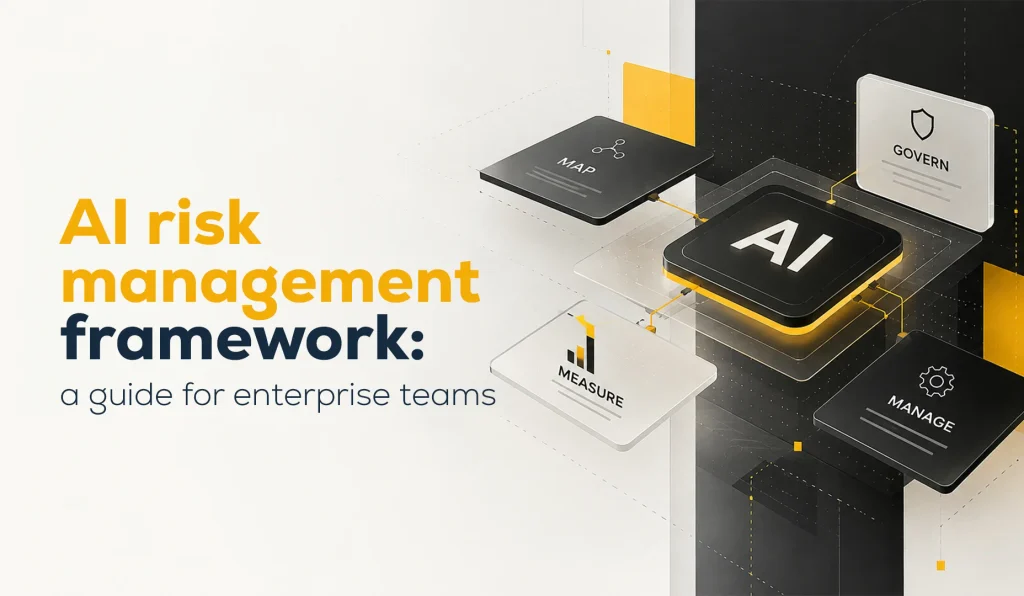
- The NIST AI Risk Management Framework (AI RMF) is the de facto standard, built around 4 functions: GOVERN, MAP, MEASURE, and MANAGE
- AI risk management, AI governance, and AI security are related but distinct disciplines — each requires different ownership and frameworks
- AI risk must be managed across the full lifecycle, from design and data collection through deployment, monitoring, and decommissioning
- Continuous adversarial testing, including AI red teaming, is a governance requirement — not an optional security exercise
What is AI risk management?
AI risk management is the systematic process of identifying, assessing, monitoring, and mitigating risks from AI systems. Unlike traditional IT risk management, it must account for the probabilistic and opaque nature of AI outputs: model drift, training data bias, adversarial manipulation, hallucination, and regulatory exposure — failure modes that conventional frameworks were not designed to handle.
The goal is not to eliminate all AI risk. It is to understand which risks are acceptable, which require mitigation, and which should block deployment altogether.
Common AI risks enterprises need to manage
The risk landscape for enterprise AI is broad and distinct from standard software risk. Data poisoning involves adversarial manipulation of training datasets, requiring cryptographic signing and AI Bill of Materials (AI BOM) tracking to verify provenance. Model drift is the gradual accuracy degradation as real-world data diverges from training distribution — caught through continuous monitoring and scheduled retraining. Prompt injection and jailbreak attacks manipulate model behaviour at inference time and demand semantic guardrails and input sanitisation at the application layer.
Beyond direct technical attacks, hallucination — confidently stated but factually incorrect outputs — remains one of the hardest failure modes to govern. Human review checkpoints and output confidence scoring are the primary controls. Supply chain risk, driven by third-party models and datasets, is addressed through AI BOM and vendor assessments. And 77% of employees use generative AI at work, yet only 28% of organisations have clear policies — which means shadow AI, the unsanctioned use of AI tools outside governance, is already a live risk in most enterprises, typically managed through CASB monitoring and sanctioned alternatives.
AI governance vs AI risk management vs AI security
These three disciplines are often used interchangeably, but they operate at different layers and require different ownership. Understanding where each begins and ends is the first step to building a governance structure that actually works.
| Dimension | AI governance | AI risk management | AI security |
| Definition | Policies and accountability mechanisms for how AI is used | Process of identifying, assessing, and mitigating AI system risks | Technical controls protecting AI systems from adversarial attack |
| Primary focus | Accountability, ethics, regulatory compliance | Risk quantification, tolerance, and operational controls | Threat modelling, vulnerability management, runtime protection |
| Who owns it | Board, legal, compliance, AI governance council | CISO, CRO, chief data officer | Security engineering, AppSec, red team |
| Key frameworks | NIST AI RMF (GOVERN), EU AI Act, ISO/IEC 42001 | NIST AI RMF (MAP, MEASURE, MANAGE) | MITRE ATLAS, OWASP Top 10 for LLM Applications |
| Key outputs | AI policy, risk tolerance definitions, model cards | Risk register, mitigation plans, residual risk decisions | Threat models, pen test reports, runtime controls |
The practical implication: all three must work together. Governance without risk management produces policy that cannot be operationalised. Risk management without security is theoretical. Security without governance is reactive.
The NIST AI Risk Management Framework explained
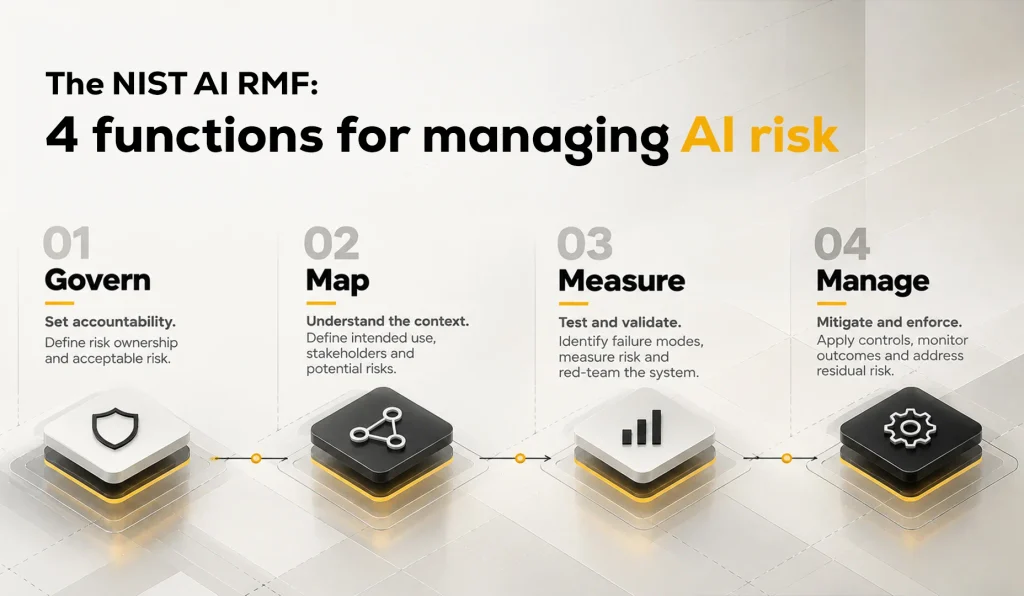
Released in January 2023, the NIST AI Risk Management Framework (AI RMF 1.0) is the de facto standard for AI governance in the United States and internationally. 33% of organisations now use it, and adoption is accelerating as regulatory pressure grows. The framework is built around 4 functions.
GOVERN establishes the organisational risk charter: who owns AI risk, what the risk tolerance is, and how accountability flows across developers, deployers, and auditors. Without a documented risk tolerance, engineering teams make deployment decisions without guardrails.
MAP documents the deployment environment, intended use case, potential misuse scenarios, and affected stakeholders for each AI system. Risk is contextual — MAP makes that context explicit before any technical assessment begins.
MEASURE translates qualitative risk into observable metrics. This is where adversarial testing enters the process: algorithmic red teaming stress-tests model behaviour under edge cases and adversarial inputs, establishing empirical evidence for governance decisions.
MANAGE is where governance meets architecture. Based on MEASURE outputs, organisations implement controls — input sanitisation, access constraints, AI firewalls, output monitoring — and determine the disposition of residual risk before deployment.
What makes an AI system trustworthy from a security perspective?
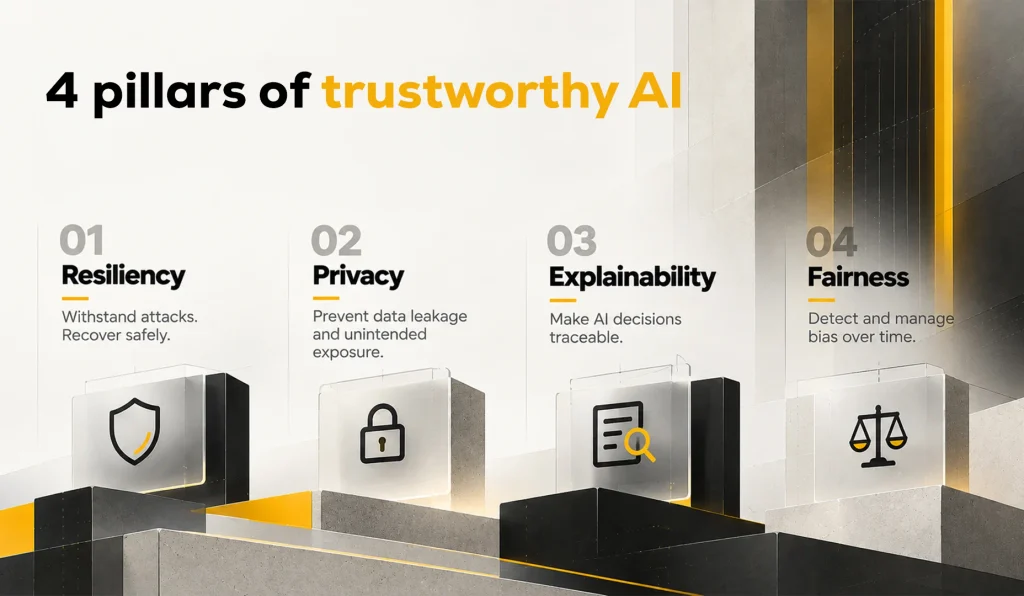
The NIST AI RMF defines trustworthiness through measurable system properties. From a security standpoint, 4 matter most.
Security and resiliency. AI systems must maintain functional integrity under adversarial conditions — data poisoning, model inversion, prompt injection — and fail safely rather than silently.
Privacy enhancement. Language models tend to memorise training data and can inadvertently expose PII or confidential business data. Differential privacy and cryptographic protections prevent this.
Explainability and interpretability. When an AI system influences a decision, reviewers and regulators must be able to understand why. Black-box models are not appropriate for regulated decision contexts.
Fairness with managed bias. Biased outputs create legal liability and cause real harm. Governance must include ongoing monitoring for algorithmic bias, not just a one-time pre-deployment assessment.
How to implement NIST AI RMF in an enterprise
- Establish the GOVERN structure. Form an AI governance council (CISO, CDO, legal, ethics leadership). Define and document organisational risk tolerance for AI.
- Inventory all AI systems. Capture system name, owner, deployment context, data inputs, outputs, and decisions influenced. This step often surfaces shadow AI deployments.
- Apply MAP to each system. Document deployment environment, intended use, misuse scenarios, affected stakeholders, and applicable regulations.
- Apply MEASURE. Define observable risk metrics, run red teaming and fairness benchmarking, establish drift detection thresholds.
- Implement MANAGE controls. Assign a run-state owner per system. Define override workflows and rollback procedures. Test rollback before production deployment.
- Embed in the MLOps pipeline. MAP and MEASURE checkpoints become required quality gates before any model moves from development to staging or staging to production.
- Establish review cadences. Monthly drift reports, quarterly risk reassessments for medium and high-risk systems, annual comprehensive audits for all systems.
AI risk assessment: how enterprises should assess AI systems
An AI risk assessment evaluates a specific AI system to determine its risk level and controls required before deployment. Every assessment should cover impact (what is the worst-case outcome?), probability (how likely are the identified failure modes?), detectability (how quickly would a failure surface?), reversibility (can the impact be undone?), data sensitivity (what are the privacy and regulatory implications?), and regulatory exposure (does the EU AI Act or a sector-specific regulation apply?).
These six dimensions determine the risk tier. Low-tier systems, such as internal tools with limited data sensitivity, need standard logging and an annual review. Medium-tier systems — customer-facing or regulatory-adjacent — require red teaming, compliance sign-off, and quarterly drift monitoring. High-tier systems that influence regulated decisions need mandatory human override workflows, explainability mechanisms, and monthly review. Critical systems with autonomous action in regulated domains require ethics review board sign-off, third-party audit, and continuous monitoring before and during production.
How MITRE ATLAS helps manage AI risk
MITRE ATLAS (Adversarial Threat Landscape for AI Systems) adapts the MITRE ATT&CK taxonomy to the AI domain, mapping how adversaries specifically target machine learning systems across the full attack lifecycle: reconnaissance, resource development, model manipulation, execution, and evasion.
ATLAS shifts security teams from abstract concern to specific, testable hypotheses. Instead of asking “is our AI safe?”, teams can ask “have we validated our defences against AML.T0020 (Poison Training Data)?” — which leads directly to a concrete control requirement: cryptographic dataset signing to verify data provenance.
ATLAS informs the MEASURE and MANAGE functions of the NIST AI RMF: it defines which adversarial scenarios to test against and which architectural controls are required before deployment.
OWASP and AI application security
The OWASP Top 10 for Agentic Applications 2026 examines the AI system’s exposed attack surface. Where MITRE ATLAS maps adversary behaviour, OWASP identifies the structural vulnerabilities adversaries exploit.
The highest-priority risks and their architectural controls: prompt injection requires input sanitisation, semantic guardrails, and system prompt protection. Insecure output handling needs output parsing and content filtering before downstream use. Training data poisoning demands provenance logging and cryptographic signing. Supply chain vulnerabilities require AI BOM documentation and vendor security assessments. Sensitive information disclosure is addressed through PII detection on outputs, differential privacy, and data minimisation at ingestion. Excessive agency — where an agentic AI acts beyond intended scope — requires explicit action whitelists and human-in-the-loop controls for any irreversible actions. Overreliance is managed through confidence indicators and mandatory human review on high-stakes outputs.
NIST AI RMF vs MITRE ATLAS vs OWASP
No single framework covers the full picture. NIST AI RMF operates at the governance layer, MITRE ATLAS at the threat intelligence layer, and OWASP at the application security layer. Used together, they give enterprise teams a complete view, from strategic risk tolerance down to specific architectural controls.
| Dimension | NIST AI RMF | MITRE ATLAS | OWASP Top 10 |
| Layer | Strategy and governance | Threat intelligence | Application security |
| Primary question | What is our risk tolerance and who is accountable? | How will an adversary attack this system? | Where is the application most likely to break? |
| Who uses it | AI governance council, CISO, compliance | Security engineers, red teams | AppSec engineers, DevOps, AI developers |
| Key outputs | Risk tolerance, model cards, governance charter | Threat models, red team TTPs | Architectural controls, security requirements |
| When to apply | Before any deployment; continuously | During threat modelling and red teaming | During design, development, and pre-deployment testing |
| Relationship | Sets governance rules that make ATLAS and OWASP findings actionable | Informs MEASURE and MANAGE functions | Provides specific controls for MANAGE function |
AI risk management across the AI lifecycle
Risk does not appear only at deployment. Every stage of the AI lifecycle, from the first design decision to the final decommission, introduces specific failure modes that require specific governance responses. The table below maps what can go wrong at each stage and what teams should do about it.
| Lifecycle stage | Key risks | Risk management actions |
| Design and scoping | Unclear use case, misaligned risk tolerance | MAP function: document intended use, stakeholders, regulatory requirements |
| Data collection | Training data bias, data poisoning, PII in training sets | Data provenance logging, AI BOM, PII scrubbing, bias detection |
| Model training | Memorisation of sensitive data, backdoor introduction | Differential privacy, training data audits |
| Testing and evaluation | Adversarial gaps missed, fairness not assessed | Red teaming, fairness benchmarking, OWASP vulnerability scanning |
| Deployment | Insufficient monitoring, no rollback plan | Canary deployment, shadow mode testing, rollback procedures tested |
| Production monitoring | Model drift, emerging adversarial threats | Statistical drift detection, continuous red teaming, override logging |
| Decommissioning | Data retention obligations, residual model exposure | Formal decommission process, data deletion verification, AI BOM closure |
AI red teaming and continuous adversarial testing
Standard penetration testing cannot detect that a language model reveals training data under adversarial prompts or bypasses safety guidelines through semantic manipulation. AI systems require dedicated adversarial validation that targets model behaviour, not just infrastructure.
AI red teaming covers prompt injection testing, jailbreak testing, data extraction attempts, semantic attack testing (natural language manipulation rather than syntactic exploits), bias and fairness probing, and adversarial robustness testing for classification or detection models.
There are three approaches: pre-deployment red teaming runs before launch but does not account for post-deployment environment changes; continuous red teaming runs as an ongoing programme but requires dedicated ownership; event-triggered red teaming runs after model updates or incidents but is reactive by nature and can miss slow-moving degradation. Best practice is to run all three under a defined cadence owned by the AI governance council.
Enterprise AI risk management checklist
Governance foundations
- AI governance council established with defined membership and authority
- Organisational risk tolerance for AI documented and approved at executive level
- All AI systems inventoried with assigned owners
Per-system pre-deployment
- MAP assessment completed: context, intended use, misuse scenarios, stakeholders, regulatory exposure
- Risk tier assigned (low / medium / high / critical)
- AI BOM produced: training data provenance, model architecture, third-party dependencies
- Red teaming completed against prompt injection, jailbreaks, and bias probing
- OWASP Top 10 vulnerabilities assessed; mitigations in place
- Human review checkpoints defined and tested
- Explainability mechanism in place for regulated decision contexts
- Rollback procedure documented and tested in staging
- Model card produced and reviewed by compliance
Production controls
- Drift detection monitoring active with alert thresholds
- Override logging in place; overrides reviewed on a defined schedule
- Audit trail for all AI outputs that influence regulated decisions
- AI-specific incident response plan in place
Periodic review
- Monthly drift reports reviewed by system owner
- Quarterly risk reassessments for medium and high-risk systems
- Red teaming repeated after model updates or significant data changes
How to build an enterprise AI risk management program
Phase 1 (months 1 to 3): Establish foundations. Form the AI governance council. Run an AI system inventory across the organisation. Define risk tolerance. Publish an AI use policy. Adopt the NIST AI RMF as the governing framework.
Phase 2 (months 3 to 6): Risk-tier all existing systems. Apply MAP to every inventoried system. Score each against the six risk dimensions. Assign risk tiers. For high or critical-risk systems already in production without controls, implement immediate remediation.
Phase 3 (months 6 to 9): Build assessment and testing capability. Develop red teaming capability internally or engage a specialist. Establish OWASP Top 10 as the baseline for AI application security reviews. Integrate MAP and MEASURE as required pipeline quality gates.
Phase 4 (months 9 to 12): Embed continuous monitoring. Deploy drift detection for all production models. Implement AI BOM for all new deployments. Establish quarterly review cadences. Produce model cards for all production systems.
Phase 5 (month 12 onward): Mature and scale. Close gaps identified in the first audit cycle. Expand red teaming to a continuous programme. Align governance documentation to emerging regulatory requirements. Report programme maturity to the board annually.
How an IT software development company like Spark Eighteen approaches enterprise AI governance
For organisations building AI with external partners, governance is a selection criterion, not a deliverable. An IT software development company that embeds NIST AI RMF functions into its development process, maintains AI BOM documentation, and runs adversarial testing before handoff fundamentally reduces the risk that governance failures surface in production. At Spark Eighteen, audit trail architecture, human review workflows, and drift monitoring are built into AI systems from the first sprint — not added after the fact.
Conclusion
Enterprise AI risk management is not a compliance exercise. It is an operational discipline that begins before a model is trained and continues for as long as the system is live. With $492 million projected to be spent on AI governance in 2026 and a 36% CAGR through 2033, the cost of ungoverned AI is far higher than the cost of getting governance right from the start.
Get in touch
If you are building or deploying AI systems and want governance embedded from the start, our team at Spark Eighteen works with engineering leaders to design AI systems that are traceable, auditable, and built to last.
Talk to our team about your AI development needs.