Engineering leaders who build AI systems face the same question at every inflection point: who owns the stack? Not in the legal sense, but in the operational one. Which parts do you build, which do you buy, and where does Python sit across all of it? This guide is written for teams that want to understand Python’s role across the AI development lifecycle, from data pipelines to production deployments, so they can make architecture and ownership decisions from a position of informed judgment rather than convention.
AI development with Python: Is Python the right choice?
Python is the right language for most AI development work. It has the deepest library ecosystem, the largest community of AI and ML practitioners, and integrates with every major cloud platform, model provider, and data infrastructure. For teams building AI applications, data pipelines, generative AI systems, or ML models, Python is the default choice for substantive reasons. The one exception is real-time systems with strict sub-100ms latency requirements, where Go, Rust, or C++ inference engines often sit below a Python service layer.
Key takeaways
- Stack Overflow’s 2025 developer survey found Python used by 57.9% of developers; 71.8% of learners choose it as their first language
- Every major AI and ML framework (PyTorch, TensorFlow, Hugging Face, LangChain) is Python-first
- PyTorch commands 55% of production AI deployments as of Q3 2025, with over 228,000 models on the Hugging Face Hub built in PyTorch
- Python is not the right tool for every layer; inference-critical paths often use compiled runtimes underneath a Python API layer
- Build-vs-buy decisions in AI development are architecture decisions, not procurement ones; the wrong answer here creates lock-in that is expensive to reverse
Why is Python popular for AI development?
Python’s position in AI development is not accidental. Its readable syntax, design philosophy, and ecosystem all converged at exactly the moment the field needed a common language that data scientists, researchers, and software engineers could all work in without translation layers.
Python’s AI and machine learning ecosystem
Every significant AI and ML framework is Python-first: PyTorch, TensorFlow, scikit-learn, Hugging Face Transformers, LangChain, and FastAPI were all built with Python as the primary interface, so engineers move between research, prototyping, and production without switching languages or tooling contexts.
This shared ecosystem also makes it easier for teams to reuse skills, testing practices, and deployment patterns across different AI projects. The best framework choice still depends on the task, available data, deployment environment, and the team’s ability to maintain it.
Python for generative AI
Every major LLM provider (OpenAI, Anthropic, Google, and Mistral) ships a Python SDK first. Orchestration frameworks including LangChain, LlamaIndex, and CrewAI are Python-native. Building a production generative AI application without Python at the core requires deliberate workarounds that add friction without adding capability.
Python also makes it practical to connect model APIs with retrieval, business rules, evaluation, and monitoring in one application layer. Teams should assess provider limits, data-handling terms, and fallback behaviour before choosing a production integration.
Python for data and model pipelines
Data pipelines that feed AI systems (ingestion, cleaning, transformation, and feature engineering) are dominated by Python tooling. Pandas, Polars, Apache Spark’s PySpark layer, and dbt’s Python model support make Python the coordination language across the entire data stack. Our guide to Python for data engineering covers how this plays out across a full production data stack.
Reliable pipelines should include data validation, lineage, access controls, and freshness checks alongside transformation logic. These controls help teams identify whether a quality issue originates in the source data, transformation step, or downstream model.
Python for AI application development
Python covers the full application development cycle, not just the model layer. FastAPI, Flask, and Django serve AI capabilities as production APIs. Celery handles async task queues for inference workloads. Docker and Kubernetes deployments use Python orchestration scripts throughout.
Python AI development stack at a glance
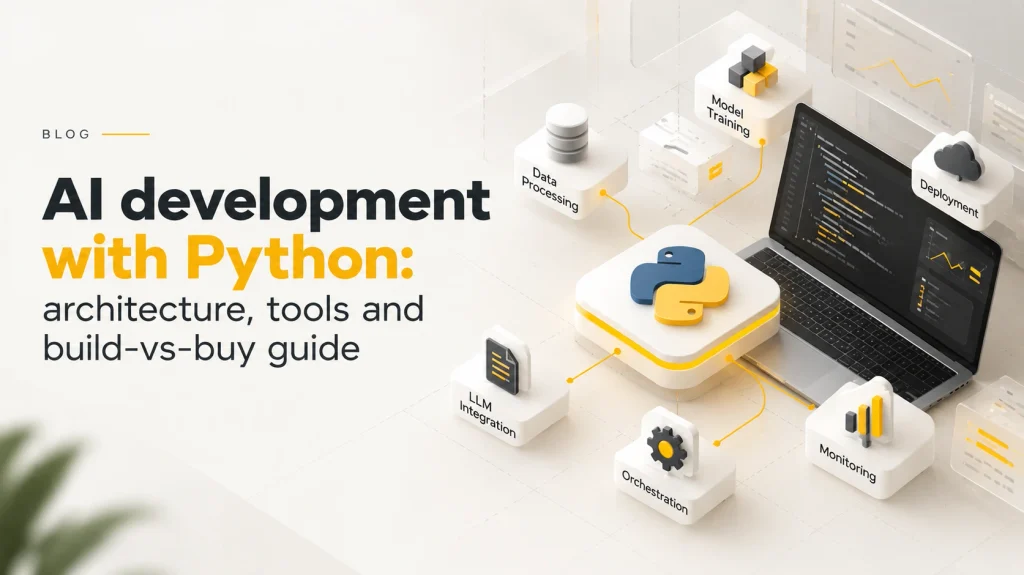
The table below maps each layer of a Python AI stack to its primary tooling, function, and when it matters most.
| Layer | Primary tooling | Function | When it matters |
| Data processing | Pandas, Polars, PySpark | Ingestion, cleaning, feature engineering | Every AI project |
| Model training | PyTorch, TensorFlow, scikit-learn | Model training and fine-tuning | Build path only |
| LLM integration | OpenAI SDK, Anthropic SDK, Hugging Face | Model inference via API or local | Generative AI builds |
| Orchestration | LangChain, LlamaIndex, CrewAI | Prompt chaining, RAG, agents | GenAI and agentic systems |
| API serving | FastAPI, Flask | Expose AI capabilities as endpoints | All production deployments |
| Evaluation | Ragas, DeepEval, LangSmith | Quality and performance testing | Pre-production and ongoing |
| Monitoring | Prometheus, Grafana, MLflow, Arize | Production observability | Post-deployment |
Python libraries and frameworks for AI development
NumPy and Pandas
NumPy provides the numerical computing foundation that nearly every Python AI library builds on; Pandas adds the DataFrame abstraction that makes tabular data manipulation practical for data scientists and engineers sharing a codebase.
The application layer should also define clear timeouts, retries, authentication, and error responses for dependent services. Keeping these concerns outside model code makes the system easier to test, secure, and operate.
Scikit-learn
Scikit-learn is the standard for classical machine learning (classification, regression, clustering, and preprocessing) with a consistent API that integrates cleanly with NumPy and Pandas; for many enterprise use cases, its models outperform deep learning approaches on cost and latency.
Its pipelines and preprocessing utilities help teams keep transformations consistent between training and inference. It is a strong starting point when a transparent, maintainable baseline is more valuable than model complexity.
PyTorch and TensorFlow
PyTorch leads production AI deployments at 55% as of Q3 2025 and hosts over 228,000 models on the Hugging Face Hub; TensorFlow remains the stronger choice for mobile deployment via TFLite and managed production on Vertex AI.
The decision should also account for the team’s existing expertise, model ecosystem, deployment targets, and serving requirements. Benchmark candidate models on representative data and hardware rather than relying on framework popularity alone.
Hugging Face
Hugging Face provides the central model hub, tokeniser library, and dataset infrastructure for modern NLP and multimodal AI work; for teams building on open models rather than proprietary APIs, the Transformers library and Hub are the practical starting point.
Teams should review model licences, supported hardware, model-card details, and evaluation results before adopting a hosted or open-weight model. A model’s availability in a hub does not by itself establish that it is suitable for a particular production workload.
LangChain and agent frameworks
LangChain, LlamaIndex, and CrewAI handle prompt chaining, RAG, tool use, memory, and multi-agent coordination; selecting the right framework depends on the application pattern being built, not on general reputation or community size.
Before adopting an orchestration framework, confirm that its abstractions expose enough control over retries, tool permissions, tracing, and evaluation. A small proof of concept using realistic workflows can reveal whether the framework reduces complexity or adds another layer to maintain.
FastAPI for AI APIs
FastAPI is the standard for exposing Python AI models as production APIs; its async-first design handles concurrent inference requests without blocking, and its Pydantic-based typing catches interface errors before they reach production.
For production use, teams should also document endpoint contracts and test authentication, concurrency, timeout, and failure behaviour. Load testing with realistic request sizes helps reveal bottlenecks that are not visible during local development.
Evaluation and observability tools
Ragas and DeepEval provide automated evaluation for RAG pipelines and LLM outputs; LangSmith and Arize offer tracing and production observability; without these, determining whether a generative AI system performs correctly at scale is a manual and unreliable process.
Python AI development architecture
Data layer
The data layer handles ingestion, transformation, validation, and storage using Pandas, Polars, SQLAlchemy, and Great Expectations or Soda for quality validation before any data reaches model inference.
Evaluation should combine automated checks with human review for outputs where correctness, safety, or business impact is significant. Traces should connect each result to the prompt, retrieved context, model version, and relevant application events.
Model layer
In most production systems the model layer is accessed via API rather than running locally; PyTorch, TensorFlow, and scikit-learn are standard choices for teams that build and own their own models.
Model selection should consider quality on representative tasks, inference cost, latency, licence conditions, and operational support. Versioning models and recording configuration changes makes it easier to reproduce evaluations and roll back a problematic release.
Application and API layer
FastAPI wraps model capabilities into versioned, documented endpoints and handles authentication, rate limiting, request validation, and response formatting: the boundary between the AI system and the rest of the product.
This layer should enforce authentication, authorisation, quotas, and input-size limits before requests reach a model or retrieval service. Consistent error handling and correlation IDs also make production incidents easier to investigate.
Retrieval and knowledge layer
For RAG applications, the retrieval layer manages vector stores, embedding models, and document chunking logic; LlamaIndex or LangChain coordinate retrieval over Pinecone, Weaviate, Chroma, or pgvector depending on scale.
Retrieval quality depends on source freshness, chunk boundaries, metadata filters, and the relevance of the embedding model to the content. Teams should evaluate retrieval separately from generation so they can locate the cause of incorrect or unsupported answers.
Evaluation layer
The evaluation layer runs quality checks against model outputs using Ragas, DeepEval, or custom test suites; without it, production quality is invisible until a user or compliance team surfaces a failure.
A useful evaluation suite should cover normal cases, edge cases, adversarial inputs, and known failure examples. Set acceptance thresholds before release and rerun the same suite whenever prompts, models, retrieval settings, or source data change.
Monitoring and MLops layer
MLflow manages experiment tracking and model versioning; Prometheus and Grafana cover infrastructure metrics; Arize or LangSmith monitor LLM-specific signals including hallucination rate and retrieval quality, converting an opaque runtime into a system engineering teams can reason about.
Build vs buy vs hybrid for AI development
The build-vs-buy decision in AI is an architecture and ownership question before it is a cost question; defaulting to build underestimates maintenance burden, defaulting to buy underestimates integration complexity and data control constraints.
The table below maps each approach to its trade-offs and the conditions that favour it.
| Approach | What you own | Advantage | Risk | Best suited for |
| Build | Model, data, infrastructure | Full control and customisation | High cost, slow, requires ML expertise | Differentiated AI capabilities |
| Buy | Outputs and integration | Fast to deploy, low upfront cost | Vendor lock-in, data exposure, limited customisation | Standard use cases without IP requirements |
| Hybrid | Integration and application layer | Balance of speed and control | Integration complexity | Most production enterprise AI systems |
When to build AI in-house
Building is right when the AI capability is a product differentiator, when data sensitivity prevents third-party models, or when the use case requires behaviour proprietary APIs cannot support, provided an ML engineering team is in place and a plan for ongoing maintenance.
A build decision should include the full lifecycle cost of data preparation, evaluation, infrastructure, security, and ongoing model maintenance. Teams should also identify the specific capability that creates differentiation and define measurable criteria for owning it internally.
When to buy AI platforms
Buying makes sense for standard capabilities such as document extraction, translation, speech-to-text, and classification, where off-the-shelf quality is sufficient; the key risk is data leaving your environment and dependency on vendor pricing and API stability.
Before committing, evaluate data residency, retention policies, service-level commitments, export options, and how pricing changes with usage. A time-boxed pilot with representative data can test product fit before the organisation makes a long-term commitment.
When a hybrid approach makes sense
Hybrid is the most common production architecture: provider APIs for foundational model capability, and the application layer, retrieval system, evaluation pipeline, and governance controls built in Python, preserving data control while avoiding the cost of maintaining base models.
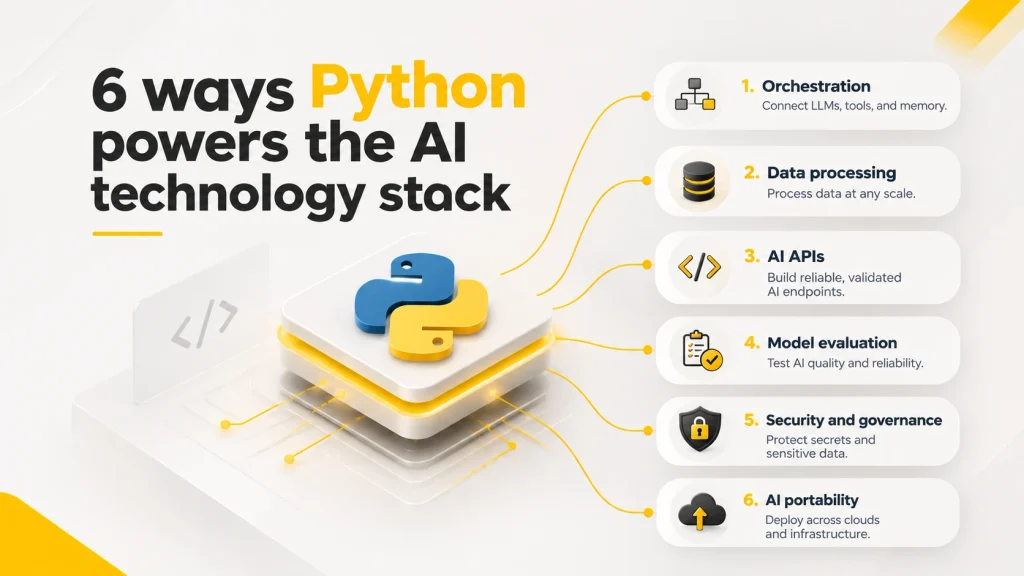
How Python fits into the AI technology stack
Python for orchestration
LangChain, LlamaIndex, and CrewAI use Python to coordinate LLM calls, tool invocations, memory retrieval, and reasoning chains, all of which are inspectable, testable, and version-controllable in ways proprietary no-code tools are not.
The boundary between purchased and owned components should be explicit, including responsibility for evaluation, incident handling, and version changes. Use provider-independent interfaces where they offer practical flexibility without creating unnecessary abstraction.
Python for data processing
PySpark, Pandas, and Polars handle data at different scales; Polars is the preferred choice for single-node high-volume processing, while PySpark handles distributed processing when data volume exceeds single-machine capacity.
Choose the processing engine based on measured data volume, memory constraints, and operational complexity rather than assuming that distributed processing is always better. For repeatable pipelines, include schema checks and tests for transformations.
Python for AI APIs
FastAPI supports async request handling, dependency injection, and automatic schema generation; Pydantic validates inputs and outputs, preventing malformed data from reaching model inference and catching response errors before they propagate.
API contracts should define request validation, response schemas, authentication, and predictable error behaviour. Versioning endpoints and running load tests before major releases reduces the risk of breaking downstream applications.
Python for model evaluation
Ragas evaluates RAG pipeline quality across faithfulness, answer relevance, and context recall; DeepEval provides unit-test-style LLM assertions; both integrate with Python CI pipelines so evaluation runs automatically on every model or prompt change.
Evaluation datasets should reflect real user inputs and include difficult examples, not only clean demonstration prompts. Track scores by model and prompt version so teams can distinguish a genuine improvement from a change in test coverage.
Python for security and governance
Python handles secrets management via AWS Secrets Manager, HashiCorp Vault, and Azure Key Vault; the Presidio library handles PII detection and redaction before data reaches model inference.
Access to secrets should follow least-privilege principles, with rotation and audit logging configured for the relevant environment. Privacy controls should be tested end to end because redaction alone does not replace retention, consent, and access policies.
Python for AI portability
Python-based AI systems run on any major cloud provider, on-premises infrastructure, or containerised deployments without language-level dependencies, making cloud strategy separable from AI application logic.
How to build an AI application with Python
Define the AI use case
Start with the specific decision or task the AI system needs to perform, the acceptable error rate, the latency requirement, and whether the output needs to be explainable; these constraints determine model choice, architecture, data requirements, and evaluation approach.
Portability still depends on external services, model formats, hardware support, and infrastructure-specific integrations. Document these dependencies and test deployment in the target environment before treating a system as cloud- or platform-independent.
Prepare the data
Data preparation includes schema validation, deduplication, format normalisation, and quality checks before any model work begins. Poor data quality at this stage produces models that appear to work in testing and fail in production. For a structured approach, see our guide on data preparation best practices for AI models.
Document data ownership, permitted use, retention requirements, and known limitations before the data enters the pipeline. Keep training, validation, and test data appropriately separated to reduce leakage and misleading evaluation results.
Select the model
Model selection should be driven by the use case, latency requirement, data sensitivity, and cost per inference, not by benchmark rankings; smaller, fine-tuned models regularly outperform frontier models on domain-specific tasks.
Compare a small set of candidates using the same representative evaluation dataset and operational constraints. Record why the selected model meets the quality, privacy, latency, and cost requirements for the use case.
Build the AI service
Wrap model inference in a FastAPI service with input validation, error handling, structured logging, and timeout management; the AI service should meet the same engineering standards as any other production service in the stack.
Add unit and integration tests for invalid inputs, provider timeouts, rate limits, and unexpected model responses. The service should also expose health and readiness checks that deployment infrastructure can use reliably.
Integrate APIs and enterprise systems
Python’s library ecosystem supports REST, GraphQL, gRPC, and most enterprise data source connectors; authentication, rate limiting, and circuit breaker patterns belong in the integration layer, not in model logic.
Use scoped credentials and explicit data contracts for each integration, and avoid passing unnecessary sensitive fields to model providers. Retries should be bounded and idempotency considered wherever a repeated request could trigger a duplicate action.
Evaluate the model
Run the model against a golden dataset representing real inputs before deploying; for generative AI, use Ragas or DeepEval to measure hallucination rate, groundedness, and answer quality, and fail the deployment automatically if thresholds are not met.
Evaluation should include both quantitative measures and review of representative failures by subject-matter experts. Establish release thresholds before testing and retain the results so future model changes can be compared consistently.
Deploy to production
Containerise with Docker, deploy on Kubernetes or a managed container service, and implement health checks, graceful shutdown, and rollback capability before the first production deployment; these are not steps to add later.
Use staged releases and a tested rollback path so a new model or prompt can be withdrawn without disrupting the wider product. Separate configuration by environment and verify that production permissions are no broader than necessary.
Monitor and improve
Instrument latency, error rates, cost per inference, and model-specific quality signals from day one; define retraining triggers before deployment so the response to performance degradation is a documented process rather than an ad-hoc decision.
Python for generative AI development
LLM application development
LLM applications use provider SDKs via Python to call model inference endpoints; application logic handles prompt construction, context management, output parsing, and error handling; the LLM is a service, and the Python application is what makes it useful.
Assign an owner to each critical quality and reliability signal, with a documented process for triage and remediation. Monitor changes in input data and user behaviour as well as service metrics, because a healthy API can still return lower-quality answers.
RAG applications
RAG applications combine a retrieval layer with a generation layer coordinated by LlamaIndex or LangChain; output quality depends on chunking strategy, embedding model selection, and retrieval configuration, none of which can be outsourced to the orchestration framework.
Measure whether the correct evidence is retrieved before assessing whether the model uses that evidence faithfully. Include source attribution and retrieval diagnostics where users need to verify the basis of an answer.
AI agents
Agentic systems built in Python use CrewAI, LangGraph, or AutoGen to define agents with tools, memory, and decision loops; production agents require careful design of failure modes and escalation paths before any customer-facing or regulated deployment.
Define allowed tools, maximum steps, spending limits, and escalation rules before an agent is connected to business systems. Test prompt injection and unintended tool use, and keep human approval for actions with material financial, legal, or operational consequences.
Prompt and evaluation pipelines
Systematic prompt management includes version control and automated evaluation against a test suite; teams that skip this build systems where prompt changes are undocumented and quality regressions are discovered by users rather than caught pre-production.
Treat prompts as versioned application assets and review their changes through the same release process as code. Automated regression tests should cover factuality, instruction following, formatting, and safety for the system’s intended use.
Guardrails and AI governance
Guardrails AI and NeMo Guardrails enforce output constraints, detect off-topic responses, and filter harmful content before it reaches users; these components belong in the application architecture from the start, particularly for regulated industries.
Python AI development for enterprise systems
Legacy system integration
Python connects to legacy databases via SQLAlchemy, mainframe data via JDBC adapters, and SAP or Salesforce via their Python SDKs; AI capability is only as reliable as the data pipeline feeding it.
Guardrails should be layered with access controls, retrieval restrictions, monitoring, and human review rather than treated as a complete security solution. Test how these controls behave on ambiguous, adversarial, and out-of-scope requests.
APIs and microservices
Enterprise AI systems are deployed as microservices behind an API gateway; FastAPI inference services communicate with conventional backend services via REST, gRPC, or message queues, with service boundaries drawn around capability rather than the AI/non-AI distinction.
Use clear service contracts and observability across model services, gateways, and downstream systems to trace failures end to end. Queue-based patterns can help absorb traffic spikes, but they should include back-pressure and dead-letter handling.
Cloud deployment
Python AI applications deploy on AWS, Azure, and GCP without platform-level changes to application code; Pulumi, which is Python-native, manages deployment configuration across environments.
Standardise infrastructure configuration and secrets handling across development, staging, and production environments. Validate scaling, regional availability, logging, and recovery requirements against the organisation’s operational needs.
Data security
Sensitive data processed by AI systems requires encryption in transit and at rest, access logging, and PII handling before reaching model inference; for healthcare and financial services, these are compliance requirements enforced at the data layer, not delegated to the model.
Apply least-privilege access and minimise the amount of sensitive data sent to each component or external provider. Retention, deletion, and incident-response procedures should be documented and tested, not left implicit in application behaviour.
Scalability and reliability
Production AI services require horizontal scaling, request queuing, and graceful degradation when model endpoints are unavailable; FastAPI’s async capabilities and Celery integration handle most scaling scenarios without language-level changes.
AI development with Python: performance and scalability
When Python is sufficient
For most AI applications Python’s throughput is sufficient; FastAPI with async handling manages hundreds to thousands of concurrent requests, and the latency bottleneck in LLM applications is almost always the inference call, not the Python application code around it.
Set service-level objectives for availability, latency, and error rates, then test them under expected and peak load. Graceful degradation may include a safe fallback, a queued request, or a clear message when model services are unavailable.
When to use distributed processing
When data volumes exceed single-node capacity, PySpark distributes computation across a cluster; Ray provides a lower-overhead alternative for parallelising Python workloads without the full Spark dependency.
Distributed systems introduce coordination, data-shuffle, and operational overhead, so they are most useful when the workload justifies it. Benchmark a representative job and monitor resource utilisation before migrating a pipeline to a cluster.
GPU and inference optimisation
Inference optimisation uses ONNX Runtime, TensorRT, or vendor SDKs below the Python service layer; quantisation reduces model size and latency without changing the Python API serving them.
Benchmark optimisations against both output quality and end-to-end latency, since compression can change model behaviour as well as resource use. Keep a repeatable evaluation set and a rollback option when changing quantisation or inference runtimes.
Latency considerations
For sub-100ms end-to-end latency the inference call must be served by a compiled runtime; for LLM applications where model response takes 500ms to 3 seconds, Python application overhead is not a measurable factor.
Measure latency at the user-facing endpoint and break it down into queueing, retrieval, provider response, and post-processing time. Streaming responses, caching, and smaller models may improve perceived responsiveness, depending on the task and quality requirements.
Cost optimisation
Cost comes from inference spend, compute, and storage; response caching, request batching, and routing lower-complexity queries to smaller models are all addressable in Python application code without infrastructure changes.
Track cost per successful task alongside raw token or compute spend so lower-cost responses are not rewarded when they fail the user need. Apply caching only where data freshness and privacy requirements allow it, and monitor routing decisions for quality regressions.
Security and governance in Python AI development
Data privacy
Data flowing through AI systems must be classified by sensitivity at each stage; Python’s Presidio library identifies and redacts PII before inputs reach model endpoints, and consent and retention logic should be enforced at the application layer, not left to the model.
Define which data categories may be processed, where they may be sent, and how long they may be retained before selecting providers. Validate redaction and access policies with test cases that reflect realistic sensitive inputs.
Secrets and credentials
API keys, database credentials, and service tokens should be managed via AWS Secrets Manager, HashiCorp Vault, or Azure Key Vault , not environment variables or configuration files, to eliminate static credential exposure.
Use short-lived credentials and restrict each secret to the minimum permissions needed by the service. Rotate credentials on a defined schedule and ensure logs, error messages, and repositories never expose secret values.
Access controls
Role-based access control for AI endpoints, training data, and model artefacts limits the blast radius of compromised credentials; FastAPI’s dependency injection makes per-endpoint access control practical without duplicating logic.
Review permissions regularly and test both allowed and denied access paths for sensitive endpoints and artefacts. Separate user identity, service identity, and model permissions so one compromised component cannot automatically access the entire system.
AI auditability
Audit logs should capture every inference request, the model version, the prompt, and the output in a tamper-resistant store; this is a regulatory requirement under the EU AI Act for high-risk applications and a practical requirement for any system with downstream consequences.
Record enough context to reconstruct important decisions, while applying privacy controls to prompts and outputs that may contain sensitive information. Define retention and access rules for audit records and verify the applicable legal obligations with qualified compliance experts.
Model and dependency security
Python AI systems carry supply chain risk via PyPI; pin dependencies to verified versions, run automated vulnerability scanning on every build, and review the dependency tree before adding new libraries to a production system.
Common mistakes in Python AI development
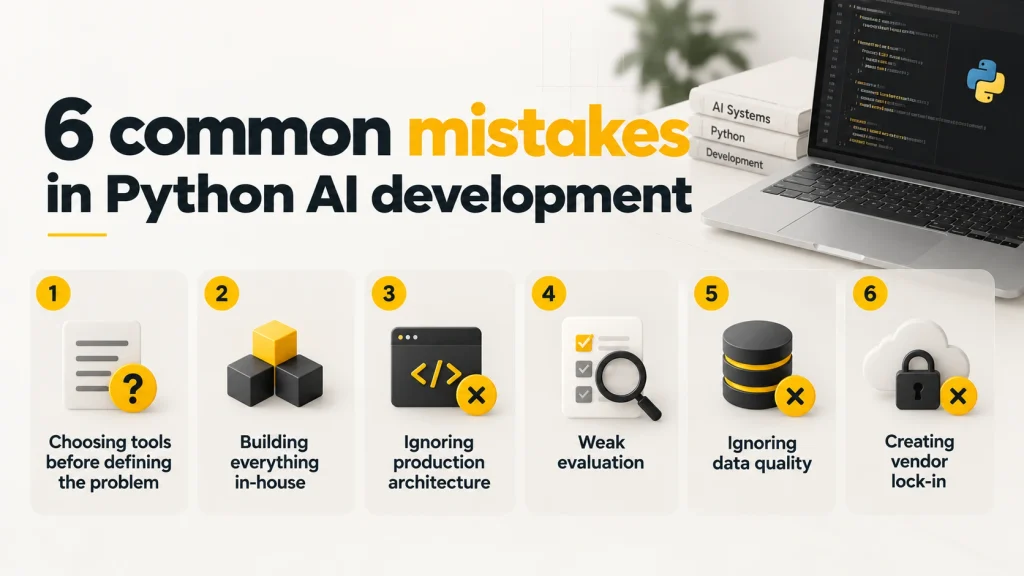
Choosing tools before defining the problem
Selecting a framework or model before defining the use case, error tolerance, and latency requirement forces the architecture to conform to the tool rather than the problem; start with the business requirement and work backward.
Pin and review dependencies, use trusted package sources, and scan builds for known vulnerabilities and suspicious changes. Maintain an inventory of model and software components so teams can respond when a dependency or model is found to be compromised.
Building everything in-house
Teams that build base models, embedding systems, and orchestration frameworks when proven alternatives exist spend engineering budget on undifferentiated infrastructure; in-house build should be reserved for genuinely differentiating capabilities.
Before building a component, compare its strategic value with the cost of maintaining it and the maturity of available alternatives. Ownership should be intentional: build where differentiation or control matters, and reuse proven capabilities elsewhere.
Ignoring production architecture
Many Python AI projects are architected for the demo, not production; missing components at the prototype stage include input validation, error handling, rate limiting, and rollback, all of which are more expensive to retrofit than to build in from the start.
Include operational readiness in the definition of done, covering monitoring, access controls, incident ownership, and rollback. A prototype should not be promoted to production until these controls have been tested under realistic conditions.
Weak evaluation
Deploying a generative AI system without a systematic evaluation pipeline means quality is unknown until a user reports a failure; Ragas and DeepEval exist specifically to prevent this.
A release checklist should include baseline scores, known limitations, and examples of unacceptable outputs. Continue evaluating after launch because real user inputs and source data can differ from the original test set.
Ignoring data quality
The most common cause of unexplained AI performance degradation is data quality, not model capability; validation checks, schema enforcement, and freshness monitoring should be in place before model work begins.
Monitor data completeness, validity, freshness, and distribution changes at the point where data enters the pipeline. When output quality falls, these checks help determine whether the issue is data-related before changing the model.
Creating vendor lock-in
AI systems built tightly around a single provider’s API surface are expensive to migrate when pricing changes or capability gaps emerge; abstraction layers that isolate model calls from application logic keep options open without adding significant complexity.
How to choose a Python AI development company
Python engineering expertise
The team should have production Python experience beyond notebooks; FastAPI service design, dependency management, testing, and deployment patterns are distinct from model training, and both skill sets should be present in the same team.
Document provider-specific dependencies and the effort required to migrate prompts, embeddings, evaluation, and observability. Keep an exit plan proportionate to the business risk, and periodically test whether key data and application logic can be moved.
AI/ML experience
Relevant experience includes production LLM applications, not just prototypes; ask how the team handles hallucination rate in customer-facing deployments and how they structure prompt versioning.
Request evidence of how the team evaluates model quality, handles failures, and monitors performance after launch. Experience should be relevant to the target use case and its risk level, not limited to demonstrations or generic proofs of concept.
Data engineering
AI systems are only as reliable as their data pipelines; the team should have experience building ingestion, transformation, and quality validation pipelines in the same Python tooling stack.
Look for explicit data quality checks, lineage, access controls, and ownership of upstream dependencies. A robust pipeline should make it possible to identify stale or invalid inputs before they affect model outputs.
MLops and cloud
Production AI systems require CI/CD for model and prompt updates, experiment tracking, and monitoring infrastructure; a team without MLOps capability delivers a working model, not a maintainable system.
Ask how model, prompt, and dataset versions are tracked and how a release can be rolled back safely. The team should define alert ownership and incident procedures rather than relying only on cloud dashboards.
AI security
The team should have a documented approach to PII handling, secrets management, and AI auditability; for regulated industries, ask specifically how they address compliance under the EU AI Act or NIST AI RMF.
Ask how the team tests prompt injection, data leakage, access boundaries, and third-party dependencies in the actual application. Security controls should be demonstrated through documented tests and remediation workflows, not described only as policies.
Production support
An AI system in production requires ongoing monitoring, incident response, and model updates as data distributions shift; understand what the engagement looks like after deployment, not just at launch.
Conclusion
Python’s position as the primary language for AI development is not a trend; it is a structural fact of how the AI ecosystem was built: the libraries, frameworks, model provider SDKs, and MLOps tooling that make production AI development practical are Python-first. Stack Overflow’s 2025 developer survey puts Python in use by 57.9% of developers and at the top of the most-wanted language list, not because of momentum alone, but because the ecosystem compounds with every new model release, framework update, and tool built around it.
The decisions that actually determine whether an AI system delivers business value are not language decisions. They are architecture, data quality, evaluation, and ownership decisions that happen to be implemented in Python. Teams that understand these layers, and where to build versus where to buy, build systems that perform reliably in production rather than only in controlled conditions.
Need help with Python AI development?
As an IT software development company specialising in Python AI engineering, SP18 works with teams building AI systems in Python, from LLM applications and data pipelines to agentic systems taken from prototype to production in regulated industries. Our engineers work at the full stack, from data layer to deployed API.
Talk to our team about your Python AI development needs.