Most AI projects do not fail at the model development stage. They fail when the model meets production traffic, real latency requirements, and real compliance obligations; and the platform it is running on cannot handle the load. The inference platform is the layer that determines whether a model actually works for your business, or just works in a demo. This guide helps engineering leaders, CTOs, and technical decision-makers evaluate AI platforms for business against real operational criteria, not marketing benchmarks.
What is an AI inference platform?
To define inference in artificial intelligence plainly: the inference procedure in artificial intelligence is the process by which a trained model receives a new input and produces an output. An AI inference platform operationalises this inference procedure in AI at scale, handling the compute, scaling, routing, and reliability required for production, ranging from managed cloud APIs to self-hosted engines running on your own GPU fleet.
Key takeaways
- AI inference is the production phase of AI: a trained model receiving inputs and returning outputs at scale.
- The inference market is growing from $106B in 2025 to a projected $255B by 2030 (MarketsandMarkets, 19.2% CAGR).
- Platform type; managed cloud, foundation model API, specialist provider, or self-hosted; determines your cost, latency, data control, and operational burden.
- No single platform is optimal across all dimensions; the right choice depends on workload type, data sensitivity, latency requirements, and where your team’s operational expertise sits.
- Vendor lock-in is a real risk; evaluate portability and abstraction strategies before committing.
AI inference explained: what happens after model development?
Inference is the operational half of AI. Training produces a model; the inference process in AI is what happens when that model is asked to do something useful. Inference in AI is a continuous, production-scale operation, unlike training, which runs once or periodically and then stops.
Training vs inference
Training adjusts a model’s parameters on large datasets to minimise prediction error; AI model inference passes new inputs through those fixed parameters and returns an output. Inference AI is the continuous operational layer that repeats this at whatever scale the application demands.
Why inference matters for production AI
A well-benchmarked model on poorly configured infrastructure will underperform a weaker model on infrastructure tuned for throughput, latency, and concurrency; the inference layer is the performance layer.
Managed vs self-hosted inference
Managed inference means paying a provider to handle GPU provisioning, scaling, and uptime; self-hosted means running an engine like vLLM or Ollama on your own infrastructure, where you own the cost structure and the operational complexity.
AI inference platforms: key evaluation criteria
Define the dimensions that matter before comparing platforms; platforms that lead on throughput often trade off on data isolation, and those with the broadest model variety often trail on latency.
| Criterion | What to measure |
| Model availability | Models accessible via the platform |
| Latency | Time to first token (TTFT) and end-to-end response time |
| Throughput | Tokens per second under concurrent load |
| Data privacy | Whether your data trains the provider’s models |
| Compliance certifications | SOC 2, HIPAA, ISO 27001, GDPR |
| Pricing model | Per-token, per-GPU-hour, reserved capacity |
| Fine-tuning support | Whether you can adapt models to your data |
| Scalability | Autoscaling behaviour under traffic spikes |
| Vendor lock-in risk | Portability of your application logic |
| SLA and uptime | Contractual availability guarantees |
Types of AI inference platforms
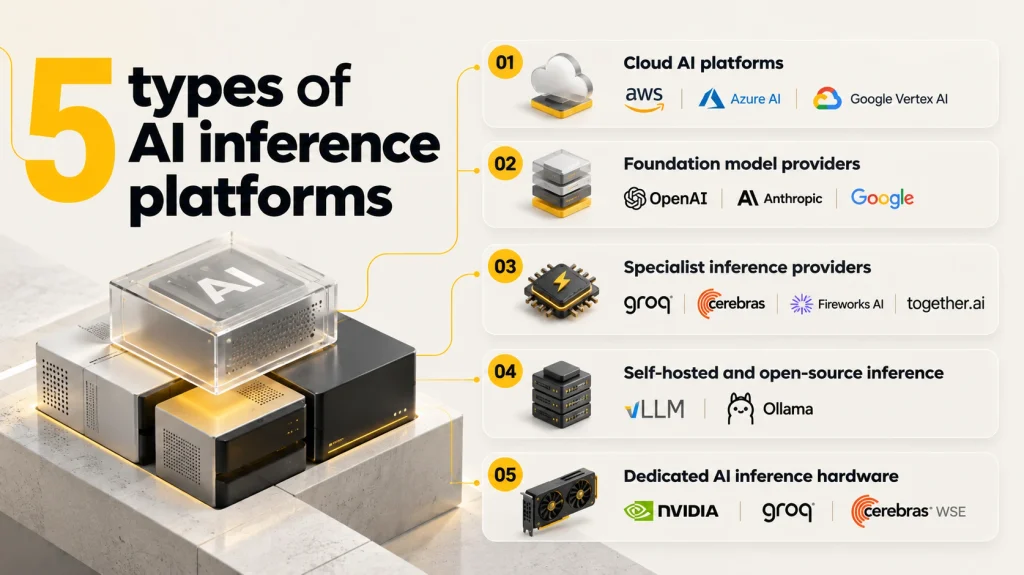
Cloud AI platforms: AWS Bedrock, Azure OpenAI Service (Microsoft Foundry), and Google Vertex AI are the dominant enterprise choices; they integrate inference into broader cloud ecosystems and are the natural default for teams already committed to a hyperscaler.
Foundation model providers: OpenAI, Anthropic, and Google provide direct API access to their proprietary models; these platforms optimise for access to frontier model capability and are the right choice when the specific model’s quality is the primary requirement.
Specialist inference providers: Groq (using custom LPUs), Cerebras, Fireworks AI, and Together AI are purpose-built for inference performance and model breadth; Artificial Analysis measured Cerebras at approximately 1,700 tokens per second sustained on gpt-oss-120B in July 2026, with Groq at approximately 478 tokens per second on the same model.
Self-hosted and open-source inference: vLLM is the production-standard self-hosted engine; Ollama is suited to single-developer use, not shared production environments.
Dedicated AI inference hardware: NVIDIA A100 and H100 GPUs, Groq LPUs, and Cerebras WSE chips are the hardware layer beneath inference software; self-hosted deployments require accounting for GPU procurement, depreciation, and capacity planning.
AI inference platform comparison
The table below compares the major platforms across the criteria that most directly affect production AI deployments.
| Platform | Model availability | Fine-tuning | RAG support | Batch inference | SOC 2 | Pricing model |
| AWS Bedrock | High (multi-model) | Yes | Yes (Knowledge Bases) | Yes | Yes | Per-token + provisioned |
| Azure OpenAI | OpenAI models + select others | Yes | Yes | Yes | Yes | Per-token + PTU |
| Google Vertex AI | Gemini + Model Garden | Yes | Yes (RAG Engine) | Yes | Yes | Per-token + committed |
| OpenAI API | OpenAI models | Yes | Limited native | Yes | Yes | Per-token |
| Anthropic API | Claude models | No (as of 2026) | No native | Yes | Yes | Per-token |
| Groq | Open models (Llama, Mixtral, etc.) | No | No native | Yes | Yes | Per-token |
| Fireworks AI | 150+ open models | Yes | Yes | Yes | Yes | Per-token + dedicated |
| Together AI | 200+ open models | Yes | Yes | Yes | Yes | Per-token + GPU cluster |
| vLLM (self-hosted) | Any open model | Yes | Via integration | Yes | Self-managed | GPU infrastructure cost |
Model availability: AWS Bedrock and Together AI offer the broadest multi-provider access; foundation model APIs (OpenAI, Anthropic) are limited to their own models.
Fine-tuning support: All major cloud platforms and specialist providers except Anthropic and Groq support fine-tuning.
RAG and grounding: Cloud platforms provide managed RAG infrastructure; specialist providers require you to build the retrieval layer separately.
API access: All platforms listed provide OpenAI-compatible or REST APIs; some expose gRPC for lower-overhead integrations at scale.
Streaming: All major platforms support streaming token output; TTFT varies significantly between platform types.
Batch inference: All platforms support asynchronous batch processing; discounts typically range from 25% to 50%.
Security: Cloud platforms carry enterprise compliance certifications by default; specialist and self-hosted options require additional configuration.
Scalability: Managed platforms autoscale by default; self-hosted inference requires explicit capacity planning.
Pricing model: Per-token pricing dominates; provisioned throughput options on major cloud platforms provide cost predictability for high-volume workloads.
Reliability: Cloud platform SLAs typically guarantee 99.9% availability; specialist providers vary, and self-hosted reliability is entirely self-managed.
What should businesses look for in an AI inference platform?
Model availability: The platform must provide access to the models your application needs today, with a roadmap that allows model upgrades without re-architecting the integration layer.
Model and API flexibility: An OpenAI-compatible API allows model swapping without application-level code changes; this has become the de facto standard across credible inference providers.
Data privacy: Verify whether the provider uses your inference data to train or improve their models; for most enterprise applications, data used at inference time should not leave your control or train third-party systems.
Security and compliance: Match the platform’s certifications against your regulatory environment before committing; healthcare applications require HIPAA eligibility, financial services applications require SOC 2 Type II at minimum, and EU-regulated deployments require GDPR-compliant data handling and, for high-risk AI, EU AI Act compliance.
Latency: Define your latency tolerance before evaluating platforms: customer-facing conversational applications typically require end-to-end responses under 3 seconds; internal tools and batch processes can tolerate much higher latency in exchange for lower cost.
Throughput: Measure peak tokens per second at your expected concurrency, not theoretical maximums; specialist providers like Groq and Cerebras can deliver 3x to 10x the throughput of standard GPU-backed managed platforms for open models.
Availability and SLA: A contractual SLA defines what the provider guarantees; for customer-facing production AI, 99.9% uptime is a baseline, not a premium feature.
Geographic availability: Healthcare, financial services, and regulated public-sector applications can mandate inference within specific geographic regions; verify that the platform’s infrastructure matches your residency obligations before onboarding.
AI inference pricing and cost optimisation
Cost per token: Output tokens typically cost two to four times more than input tokens across all major providers; this ratio makes output-heavy workloads such as code generation and long-form content significantly more expensive than classification or retrieval tasks.
Cost per GPU or compute time: Self-hosted inference costs are denominated in GPU-hours; accurate cost modelling requires accounting for GPU utilisation rates, idle capacity, and the engineering overhead of operating the infrastructure, not just the hardware cost.
Reserved capacity: Provisioned throughput options on AWS Bedrock, Azure (PTU), and Google Vertex AI trade flexibility for price predictability; they are cost-effective only when your token volume is high and consistent enough to justify the commitment.
Batch processing: Asynchronous batch inference runs at lower priority in exchange for a price discount, typically 25% to 50% depending on the provider; document processing, embedding generation, and offline evaluation are natural batch workloads.
Caching: Prompt caching reduces cost for applications with repetitive system prompts or shared context; providers including Anthropic and OpenAI offer caching at the API level, and self-hosted inference engines support KV-cache management directly.
Model selection for cost efficiency: Running a smaller, fine-tuned model instead of a frontier model can reduce inference cost by an order of magnitude for domain-specific tasks where the smaller model achieves equivalent accuracy; Groq’s Llama 4 Scout inference is priced at $0.11 per million input tokens and $0.34 per million output tokens, versus several dollars per million for frontier models.
AI inference performance and scalability
Latency: Time to first token (TTFT) and per-output-token latency are the two metrics that determine whether a generative AI application feels responsive; for streaming applications, TTFT matters more than end-to-end latency.
Throughput: Total tokens per second across concurrent requests determines how many users or jobs the platform can serve simultaneously; Cerebras WSE-based inference achieved approximately 1,700 tokens per second sustained on gpt-oss-120B in Artificial Analysis benchmarks from July 2026.
Concurrency: The platform must handle your peak simultaneous request count without queuing requests to the point that effective latency degrades; managed platforms handle this transparently while self-hosted setups require explicit configuration of worker processes and batching parameters.
Autoscaling: Managed platforms scale compute capacity automatically in response to traffic; self-hosted inference requires pre-provisioned capacity or integration with a Kubernetes autoscaler, adding operational complexity.
Traffic spikes: A platform that performs well at average load but queues requests during spikes creates user-facing degradation at exactly the moments when the application is most heavily used; test with traffic at 3x to 5x your expected peak before committing.
Real-time vs batch workloads: Real-time inference prioritises low latency at the cost of higher per-token price; batch inference prioritises cost efficiency at the cost of latency, and the two should be routed to separate endpoints or providers based on the application’s tolerance.
AI inference security and compliance
Data isolation: In multi-tenant managed platforms, your inference requests share infrastructure with other customers; for regulated data, verify whether the provider offers single-tenant or dedicated infrastructure with logical or physical isolation guarantees.
Encryption: Inference data in transit should be encrypted via TLS 1.2 or higher; data at rest should be encrypted with auditable key management, ideally through a bring-your-own-key (BYOK) option.
Access controls: API keys and authentication tokens are the primary attack surface; production deployments should use scoped credentials, rotate keys on a defined schedule, and enforce least-privilege access for each service that calls the inference endpoint.
Data retention: Confirm whether the provider retains request and response logs, for how long, and under what access controls; providers that retain inference data for abuse monitoring may store inputs that contain sensitive information, which creates a compliance risk for regulated industries.
Compliance certifications: SOC 2 Type II, HIPAA Business Associate Agreement (BAA) eligibility, ISO 27001, and GDPR data processing agreements are the baseline enterprise requirements; verify certifications are current and scoped to include the inference service, not just ancillary platform components.
Audit logging: Production AI deployments in regulated industries require an immutable record of every inference request, the model version used, and the response; this is a requirement under the EU AI Act for high-risk AI applications and a practical requirement for any deployment where model outputs have downstream legal or clinical consequences. For a broader governance framework, our guide on agentic AI security and governance covers the risk controls that apply across AI system types.
Managed AI inference vs self-hosted inference
| Dimension | Managed inference | Self-hosted inference |
| Operational burden | Low; provider handles infrastructure | High; team owns GPU ops, scaling, uptime |
| Data control | Shared infrastructure (unless dedicated tier) | Full control; data stays on your infrastructure |
| Cost at scale | Higher per-token at high volume | Lower at scale, but GPU capex and DevOps cost |
| Latency | Dependent on provider and region | Tunable; can optimise for your specific models |
| Setup time | Hours to days | Weeks to months |
| Model flexibility | Limited to provider’s catalogue | Any open model |
| Compliance | Provider certifications | Self-managed; you own the compliance posture |
| Uptime | Provider SLA | Self-managed; dependent on your infrastructure |
Advantages of managed inference
Managed inference eliminates GPU provisioning, capacity planning, software updates, and uptime management from your team’s scope; for organisations without dedicated ML infrastructure engineers, this is often the only practical path to production.
Advantages of self-hosted inference
Self-hosted inference keeps all inference data within your own infrastructure, removes per-token billing at high volume, and allows fine-grained control over model selection, batching strategy, and latency optimisation; vLLM on NVIDIA H100 hardware is the standard configuration for teams with the operational capacity to support it.
When hybrid inference makes sense
A hybrid architecture routes sensitive workloads through self-hosted inference while using managed APIs for less sensitive tasks; this approach preserves data control where it matters while keeping operational burden manageable across the full workload portfolio.
How to choose the right AI inference platform
Define your AI workload: Start by classifying your AI inference workloads: real-time conversational, batch document processing, embedding generation, or multi-step agent workflows; each creates different latency, throughput, and cost requirements that determine which platform category fits.
Define model requirements: Identify whether your workload requires a proprietary frontier model (GPT, Claude, Gemini), an open model that you can fine-tune, or a domain-specific model trained on your data; the model requirement determines which platform categories are viable before any other evaluation begins.
Estimate traffic: Model your expected token volume per day at average load and at peak, accounting for seasonal variation and growth; an accurate token volume estimate is the input that makes cost comparisons between providers meaningful rather than theoretical.
Set latency requirements: Define the maximum acceptable TTFT and end-to-end response time for each application before evaluating platforms; without a target, latency trade-offs against cost and data control cannot be made rationally.
Calculate total cost: Total cost of ownership for managed inference includes per-token spend plus provisioned throughput commitments; for self-hosted it includes GPU hardware, DevOps engineering time, monitoring tooling, and idle capacity cost during off-peak periods.
Assess security requirements: Map your data classification requirements, applicable regulations, and internal security policies to each platform before shortlisting; a platform that does not support HIPAA BAAs is not viable for healthcare AI regardless of performance.
Test with real workloads: Benchmark candidate platforms on a representative sample of your actual production inputs, not synthetic benchmarks; vendor-published benchmarks rarely reflect your specific workload’s token distribution or latency profile.
Review vendor lock-in and portability: Evaluate whether your application logic can be migrated to another provider or self-hosted infrastructure without a full rewrite; OpenAI-compatible API surfaces and abstraction layers are the primary mechanisms for preserving portability.
Best AI inference platform by business use case
The inference in AI examples below map common business workloads to the platforms with the strongest production track record for each.
Enterprise GenAI applications: AWS Bedrock, Azure OpenAI, and Google Vertex AI are the default choices for large enterprises that need multi-model access, enterprise compliance certifications, and integration with existing cloud infrastructure and identity management.
Real-time AI applications: Groq and Cerebras are the right choice when sub-second TTFT and high throughput are the primary requirements; their custom silicon delivers sustained inference speeds that GPU-backed managed platforms cannot match on open models.
High-volume batch workloads: Together AI, Fireworks AI, and the batch endpoints of major cloud platforms handle high-volume asynchronous processing at materially lower cost than real-time endpoints; route document processing, embedding generation, and offline evaluation jobs here. Our guide on data preparation best practices for AI models covers how to structure the data layer that feeds these pipelines.
AI agents: Agentic workloads make many rapid sequential inference calls per task; platforms with high throughput, low TTFT, and reliable tool-calling support, including Fireworks AI and Groq; are better suited than general-purpose cloud APIs that optimise for individual request quality over call-loop performance.
Healthcare AI: Healthcare inference requires HIPAA BAA eligibility, data residency controls, and audit logging for every inference request; AWS Bedrock and Azure OpenAI both offer HIPAA-eligible configurations, and self-hosted vLLM on private cloud is the option when data must not leave the organisation’s own infrastructure.
Financial AI: Financial services AI inference requires SOC 2 Type II, low-latency response for trading-adjacent applications, and robust access control and audit logging; Azure OpenAI (for Microsoft-stack shops) and AWS Bedrock (for AWS-native organisations) are the standard enterprise choices.
Common AI inference platform selection mistakes
Choosing by model quality alone: Benchmark rankings measure model quality in controlled conditions; production performance is determined by latency under load, cost at your token volume, and reliability under traffic spikes; none of which appear in most published model leaderboards.
Ignoring traffic patterns: A platform that handles your average traffic comfortably may queue or throttle requests during peak periods; test with spike traffic patterns before committing, and confirm whether rate limits apply per account or per model endpoint.
Ignoring total cost: Per-token cost is a single input to total cost of ownership; provisioned throughput commitments, data transfer costs, vector database fees, and for self-hosted deployments, GPU infrastructure and DevOps overhead, all add to the true cost of running inference in production.
Ignoring compliance: Selecting a platform on performance and cost without verifying its compliance posture against your regulatory obligations is a decision that can require a full platform migration once legal or security review surfaces the gap.
Ignoring portability: Tightly coupling your application to a single provider’s proprietary features; proprietary tool schemas, non-standard response formats, or provider-specific SDKs; creates migration costs that grow with every additional workload built on the platform; design for portability from the start, not as a retrofit.
Conclusion
The AI inference market is growing from $106B in 2025 to a projected $255B by 2030 (MarketsandMarkets, 19.2% CAGR), driven by the expansion of production AI deployments. The platform decision that precedes that deployment is not a commodity choice; it determines data control, cost trajectory, latency profile, and compliance posture for the duration of the workload. For most enterprise teams, the right starting point is a managed platform that matches your existing cloud footprint, with a clear evaluation framework for when self-hosted or specialist inference becomes the more viable path. Choose based on workload requirements, not on which platform has the largest press release or the highest benchmark score.
Need help designing and optimising AI inference infrastructure?
As an IT solution company specialising in production AI delivery, SP18 works with engineering teams building production AI systems; from selecting and evaluating inference platforms to designing the data, retrieval, evaluation, and monitoring layers around them. If you are at the stage of choosing an inference platform or refactoring one that is costing more than it should, we can help you make the decision from a position of informed judgment. Write to us at coffee@sparkeighteen.com.