Three years into a digital transformation programme, a mid-size retail organisation had a working mobile app, a new customer loyalty platform, and a data team that could finally see sales trends in near real time. What it did not have was the ability to act on any of it at the speed the business needed. Every new capability the product team wanted — personalised offers triggered by in-store behaviour, real-time inventory sync across 200 locations, an A/B test on the checkout flow — required a separate integration project against the on-premise ERP (enterprise resource planning) system. Each project took 3 to 4 months. The app was live. The transformation was not.
The constraint was not strategy, budget, or leadership commitment. It was infrastructure. The on-premise systems the organisation had run for 15 years made every business change a multi-month infrastructure event. Cloud infrastructure does not just reduce that cost — it changes the constraint entirely.
Global digital transformation spending is projected to reach $2.8 trillion by 2025 (Statista). Most of that investment will not deliver its intended outcome without the right infrastructure underneath it. This blog explains what cloud infrastructure actually enables for digital transformation, how to choose between public, private, and hybrid cloud deployment models, and what the most important decisions look like in practice.
Key takeaways
- You will understand why legacy on-premise infrastructure is a strategic constraint on digital transformation, not just a cost and operational inefficiency problem.
- You will learn the 6 cloud capabilities that directly enable transformation: elastic scaling, deployment speed, data at scale, global reach, business continuity, and AI-ready compute.
- You will understand the 3 cloud deployment models — public cloud, private cloud infrastructure, and hybrid cloud — and how to match each to the workloads and compliance requirements of a real transformation programme.
- You will see how cloud infrastructure is enabling digital transformation across healthcare, financial services, retail, manufacturing, and government, with specific outcomes rather than generic claims.
- You will know the real challenges of cloud-enabled transformation — security and compliance, vendor lock-in, legacy integration, and skills gaps — and the architectural responses that work.
Why infrastructure is the constraint most digital transformation programmes underestimate
Digital transformation is not a technology upgrade. It is a business model change: new ways of serving customers, new revenue streams, new operational capabilities that were not possible before. The reason most transformation programmes stall is that the infrastructure layer makes every meaningful change slow, expensive, and high-risk to reverse.
On-premise infrastructure has 3 structural constraints that work against transformation. First, fixed capacity: the organisation buys for a projected maximum load, then either under-provisions and hits a ceiling, or over-provisions and pays for headroom it rarely uses. Second, a procurement cycle measured in months: a team that needs new compute to test a product idea waits for a hardware purchase order, delivery, rack-and-stack, and configuration before the first line of code runs against it. Third, a high change cost: every integration added to a legacy system makes the next change more expensive, because more things can break.
Cloud infrastructure in cloud computing replaces all 3 of those constraints. Capacity is elastic and available in minutes. Compute is provisioned through code. Change cost stays flat rather than compounding, because cloud-native architectures are designed to be changed. Gartner forecasts global public cloud spending to exceed $830 billion in 2026 — driven largely by organisations rebuilding infrastructure foundations so the business model can actually change.
The McKinsey finding that organisations can reduce IT infrastructure costs by 20 to 40% through cloud migration is real. But cost reduction is the secondary outcome. The primary one is that the infrastructure layer stops being the reason transformation initiatives are delayed, descoped, or abandoned.
The 6 cloud infrastructure capabilities that enable digital transformation
Cloud infrastructure enables digital transformation through 6 specific capabilities. Each one addresses a constraint that blocked meaningful change in the legacy infrastructure model.
Elastic scaling means infrastructure scales up or down in minutes in response to demand, without pre-purchasing capacity. An e-commerce platform that needs to process 50 times its normal transaction volume during a sale event pays for that compute only when it needs it. On-premise, the same organisation either under-provisions (degraded performance at peak) or over-provisions (wasted capital for 48 weeks of the year). The transformation implication is direct: product teams can design for peak demand without infrastructure teams having to pre-build and pre-fund it.
Rapid deployment speed changes the economics of experimentation. New services deploy in hours or days rather than months. A 2026 peer-reviewed study on cloud computing’s role in digital transformation (Gayathri J and Dr. S. Manikandan, Journal of Advance and Future Research) confirms that cloud platforms enable rapid development, testing, and deployment of applications, allowing businesses to launch new products and services faster. In practice, a team can test a product feature against real users in days, fail fast, and iterate, rather than committing to a 6-month infrastructure project before any user feedback exists.
Data at scale is the capability that makes the analytics and AI workloads of transformation actually tractable. Customer behaviour data, product telemetry, and operational data require cloud-scale storage and processing to produce the insights that transformation initiatives depend on. Gartner forecasts that 75% of data and analytics workloads will be processed in the cloud by 2026. A standalone on-premise data warehouse can handle reporting; it cannot handle the real-time personalisation, fraud detection, or predictive maintenance use cases that define competitive digital products.
Global reach without global hardware means a product team can deploy a low-latency service across 3 continents without building or leasing physical infrastructure on each one. Cloud providers operate dozens of regions globally. For organisations pursuing international digital transformation, this is the only commercially viable path to global infrastructure. The alternative — co-locating servers in each market — requires capital, local teams, and years of lead time.
Business continuity and resilience are built into cloud infrastructure by default in ways that on-premise disaster recovery cannot match at equivalent cost. Multi-region redundancy, automated failover, and managed backup and recovery come standard with major cloud platforms. The 2026 JAAFR research confirms that cloud computing supports business continuity through backup and recovery solutions that maintain operations during system failures or cyberattacks. A comparable on-premise disaster recovery setup requires duplicate hardware in a separate physical location, with all the associated capital and maintenance costs.
AI and emerging technology readiness is what ties all the other capabilities together. The technologies powering the next generation of digital products — artificial intelligence (AI), machine learning (ML), Internet of Things (IoT) integration, big data analytics — all require cloud-scale compute and managed infrastructure services. A healthcare organisation deploying AI diagnostics, a bank running real-time fraud detection, or a manufacturer implementing predictive maintenance via connected machinery: none of these are practically achievable on on-premise infrastructure at the compute volumes and response speeds the use cases require.
Cloud deployment models: public, private, and hybrid
Digital transformation doesn’t rely on a single cloud deployment model. The right choice depends on each workload’s compliance requirements, performance needs, and cost considerations.
- Public cloud (AWS, Azure, GCP, Oracle Cloud) is ideal for modern applications, variable workloads, and rapid scaling. Gartner predicts that 70% of enterprises will use multiple public cloud providers by 2025.
- Private cloud provides dedicated infrastructure for organisations with strict regulatory, security, or data sovereignty requirements, making it a preferred choice for industries such as healthcare, finance, and government.
- Hybrid cloud combines public and private environments into a unified architecture, allowing organisations to keep sensitive workloads private while leveraging the public cloud for scalability and innovation. Gartner expects 90% of organisations to adopt hybrid cloud by 2027.
- Multi-cloud involves using services from multiple public cloud providers. It helps reduce vendor dependency and access best-of-breed services, but also increases operational complexity. Today, 89% of enterprises have adopted a multi-cloud strategy.
For a detailed comparison of public, private, and hybrid cloud infrastructure, including architecture, components, and trade-offs, see our guide to cloud infrastructure components and architecture.
Cloud and digital transformation by industry: where the outcomes are specific

Cloud infrastructure is enabling transformation differently across sectors, and the most measurable progress is in industries where data volume, real-time processing, and customer-facing digital products sit at the core of the business model.
Healthcare has seen cloud infrastructure underpin the shift from episodic, location-bound care to continuous, data-informed care pathways. Electronic health record (EHR) systems give clinicians access to patient data from any device, in any location. Telemedicine platforms operate at scale. AI-based diagnostic tools process imaging data and flag anomalies faster than manual review. HIPAA-compliant cloud services — AWS HealthLake, Azure Health Data Services — make this achievable without the compliance overhead of fully custom on-premise systems. The JAAFR paper notes that cloud-based medical record systems have reduced administrative workload and improved care delivery; the infrastructure that makes it possible is shared public cloud with managed compliance controls layered on top.
Banking and financial services depend on cloud infrastructure for real-time fraud detection, digital payment processing, and mobile banking platforms. The compute required to run ML models against millions of transactions per day in real time is only economical on elastic cloud infrastructure. The JAAFR research identifies AI-integrated cloud systems as the foundation of modern fraud detection. For transformation, the outcome is a bank that can launch a new digital product in weeks rather than years, because the infrastructure is programmable rather than procured.
Retail and e-commerce see the most immediate operational impact from cloud elasticity. Peak traffic events, personalisation engines driven by behavioural data, and supply chain analytics for demand forecasting are all workloads that require cloud-scale compute and fail or degrade on fixed on-premise capacity. The retailers that have built cloud-native infrastructure can launch, test, and iterate on digital products at a competitive pace; those still running on-premise systems are perpetually 6 months behind every infrastructure-dependent product decision.
Manufacturing is where IoT-connected cloud infrastructure is enabling Industry 4.0 in practice. Machine data from factory floors, processed through cloud analytics platforms, drives predictive maintenance that reduces unplanned downtime. McKinsey estimates that AI and cloud-based predictive maintenance can reduce manufacturing downtime by 10 to 20%. The JAAFR paper identifies real-time monitoring of production processes as a direct outcome of cloud-IoT integration. For manufacturers, the transformation is not just operational efficiency — it is the shift from reactive maintenance to continuous, data-driven production optimisation.
Government is using cloud infrastructure to move public services online at scale, from tax filing and identity verification to social services and health programme management. The transformation outcome is access equity: citizens in remote locations reach services without a physical office visit, and governments can update services in weeks rather than years. Private and sovereign cloud deployments address the data protection and national security requirements that public cloud alone cannot meet.
Media and entertainment are fully cloud-native at scale. Streaming video, music, and gaming platforms that serve millions of concurrent users globally are not architecturally achievable without cloud infrastructure, content delivery networks (CDNs), and elastic compute. For media companies, cloud infrastructure is not a transformation enabler; it is the product itself.
Building a cloud transformation strategy that works
The most common failure mode in cloud-enabled digital transformation is treating cloud migration as the transformation. Moving existing applications to the cloud unchanged — the lift-and-shift approach — delivers infrastructure cost reduction and sometimes improved reliability. It does not deliver business model change. A cloud transformation strategy that produces business outcomes starts with the business change required and works backwards to the infrastructure model that enables it.
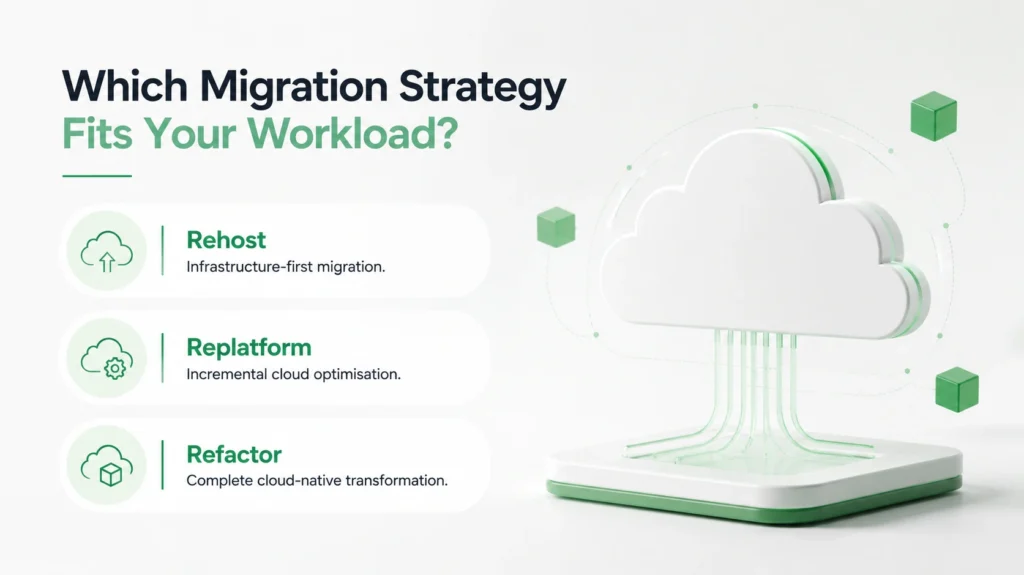
There are 3 established migration patterns, and the right one depends on the workload, not on a programme-wide preference.
Rehost (lift and shift) moves existing applications to cloud virtual machines (VMs) without modification. It is the lowest-risk, fastest-execution option and the right choice for legacy workloads with no near-term development investment, where the goal is infrastructure cost reduction and improved availability rather than capability expansion. It captures the economics of cloud without the transformation value.
Replatform moves applications to cloud with targeted changes to take advantage of managed services: replacing a self-managed MySQL database with Amazon RDS, replacing custom job scheduling with a managed orchestration service, or containerising an application without redesigning it. The effort is moderate; the operational improvement is meaningful; the business model change is limited but real.
Refactor (cloud-native redesign) rebuilds applications to be cloud-native from the architecture up: microservices with independent deployment, containerised workloads on Kubernetes, event-driven communication between services, stateless application design, and cloud-native data stores. It is the highest-effort option and the pattern that produces the elastic, rapidly-deployable products that cloud transformation strategies promise. The JAAFR (2026) research confirms that successful cloud-enabled transformation requires more than technology migration; it requires redesigning business processes around cloud capabilities.
Most programmes apply all 3 patterns to different workloads. The strategic discipline is deciding which workload warrants which pattern and not applying refactor effort to legacy systems that will be retired in 18 months.
In both the ClaritasRx and McKesson Glide Health engagements, the transformation outcome was determined not by the cloud provider selected but by whether the architecture decisions were made with the business goal in mind from the first scoping conversation. ClaritasRx needed a pharma data analytics platform that could onboard new enterprise clients without rebuilding the data layer for each one; client-level data isolation at the AWS infrastructure layer made that scalability possible from day 1. McKesson’s Glide Health needed revenue cycle management (RCM) claims processing infrastructure that could absorb continuous regulatory changes without platform-wide rebuilds; the microservices architecture made each regulatory change a targeted update to a bounded service. In both cases, the cloud transformation strategy was built around the business outcome. The cloud infrastructure followed.
The challenges of cloud-enabled digital transformation: what they are and how to address them
The challenges of cloud-enabled transformation are real, consistently under-resourced in programme planning, and all addressable with the right architectural and governance decisions made early. The organisations that fail at cloud transformation are not the ones that encounter these challenges — every programme does. They are the ones that discover them after go-live, when the cost of resolution is an order of magnitude higher.
Security and compliance as architecture inputs, not post-launch checklists. GDPR (General Data Protection Regulation), HIPAA, PCI DSS for payment card processing, and sector-specific regulatory frameworks impose specific requirements on data storage geography, access control, encryption, and audit logging. The most expensive compliance problem in cloud transformation is retrofitting these requirements after the platform is built. Addressed at scoping, they become architecture inputs: which regions data is stored in, how IAM (Identity and Access Management) policies are structured, what the encryption model looks like at rest and in transit, and how audit trails are retained and queried. Addressed at go-live, they become remediation projects.
Vendor lock-in is a real risk with a manageable architectural response. Proprietary cloud services — provider-specific databases, machine learning platforms, serverless frameworks — are faster to adopt but harder to migrate away from if the provider raises prices, discontinues the service, or acquires a competitor. The architectural response is not to avoid managed services; it is to use open standards where portability matters. Kubernetes for container orchestration, PostgreSQL-compatible databases for relational data, S3-compatible object storage, and Apache Iceberg for data lake tables are all cloud-deployable and cloud-provider-portable. Use proprietary services deliberately, for workloads where the productivity gain is clear and the migration cost, if it ever came to that, is low.
Legacy integration is the most consistently underestimated barrier. The new cloud-native application is rarely the hard part. The hard part is connecting it to the legacy ERP, CRM, or data warehouse that holds the organisation’s master data. Custom integrations against legacy systems are expensive to build, expensive to maintain, and brittle when either side changes. Integration architecture — event streaming (Kafka, AWS Kinesis), API gateways, managed ETL (extract, transform, load) pipelines — must be scoped as first-class components of the transformation programme, not follow-on projects that will be addressed “after the platform is stable.”
The skills gap limits what the cloud infrastructure can deliver. Cloud infrastructure can be provisioned in minutes; building the team that can operate, govern, secure, and continuously improve it takes longer. McKinsey consistently identifies talent and organisational capability as the top constraint on digital transformation outcomes. Cloud transformation programmes that invest in migration without investing in team capability tend to produce cloud infrastructure that reverts to manual management patterns within 12 months of go-live: manual deployments instead of CI/CD (continuous integration and continuous delivery), shared credentials instead of IAM policies, no cost governance until the bill is a problem.
The future of cloud infrastructure and digital transformation
The cloud infrastructure landscape is converging around 4 developments that will require organisations to revisit transformation strategies built on today’s assumptions.
AI-native cloud infrastructure is the most immediate shift. AWS, Azure, and GCP are building GPU (graphics processing unit) and TPU (tensor processing unit) compute clusters, managed AI and ML services, and AI-assisted development tools directly into their platforms. The organisations that built cloud-native data infrastructure now have the foundation to move AI workloads into production; those still on-premise must first complete the infrastructure migration before AI use cases are tractable. This is the second-order argument for cloud transformation strategy: it is not just about the products you are building now, but about the AI-era products you will need to build in 3 years.
Edge computing extends cloud infrastructure capabilities to locations and devices that cannot rely on centralised data centres. IoT deployments on factory floors, retail locations managing real-time inventory, and autonomous vehicle systems that require sub-10-millisecond response times all need compute closer to the data source. AWS Outposts, Azure Arc, and Google Distributed Cloud extend the same cloud infrastructure management model to edge locations, making edge-cloud an integrated architecture rather than a separate deployment decision.
Sovereign cloud is the fastest-growing deployment model for government and regulated enterprise workloads. Gartner forecasts worldwide sovereign cloud IaaS (infrastructure as a service) spending will reach $80 billion in 2026. Sovereign cloud infrastructure meets national data residency, data sovereignty, and regulatory requirements for specific geographies. Teams building digital transformation strategies for multi-national organisations need to design for sovereign cloud requirements at scoping, not discover them when a regulatory authority asks where the data is stored.
Green cloud is moving from a CSR (corporate social responsibility) reporting item to a material factor in enterprise procurement decisions. Major cloud providers have committed to 100% renewable energy targets; some organisations are beginning to include carbon efficiency alongside cost and performance in cloud architecture decisions. The JAAFR research identifies green cloud as a key future trend, with cloud providers optimising energy consumption through efficient data centre design and renewable energy sourcing. For transformation programmes with ESG (environmental, social, and governance) reporting obligations, cloud infrastructure choices increasingly feed directly into carbon accounting.
Conclusion
The organisations that will lead their sectors over the next decade are not necessarily the ones with the largest digital transformation budgets. They are the ones that understood, early enough, that cloud infrastructure is not the outcome of digital transformation — it is the precondition for it. Every business model change that transformation promises (faster product iteration, real-time customer intelligence, global reach, AI-powered operations) depends on infrastructure that can change at the speed of a product decision rather than a procurement cycle. A well-architected cloud foundation does not just host digital products; it makes the business model itself programmable.
The organisations still running fully on-premise are not just running outdated infrastructure. They are running a system that makes every future decision harder, more expensive, and more reversible-averse. The longer that constraint stays in place, the more valuable the compounded infrastructure decisions of their cloud-native competitors become.
If your team is working through a cloud transformation strategy — scoping which workloads to migrate first, choosing between public, private, and hybrid deployment models, or designing the integration architecture that will connect new cloud-native services to legacy systems — write to us at coffee@sparkeighteen.com.