A practical, no-nonsense guide to enterprise app development, the real business value behind it, and what it actually takes to build a business app that delivers.
There is a version of enterprise technology adoption that happens slowly, reluctantly, and only after competitors have already pulled ahead. And then there is the version where leadership sees what mobility can do for their teams, their customers, and their bottom line and moves with purpose.
Enterprise mobile app development is no longer a “nice to have” conversation in boardrooms. It is a strategic decision that directly shapes how fast a business can operate, how well its people can collaborate, and how much of the market it can realistically capture. The numbers back this up: the global mobile enterprise application market was valued at USD 136.84 billion in 2024 and is projected to reach USD 385.56 billion by 2032, growing at a CAGR of 15.25% (Verified Market Research). That is not a trend. That is a structural shift in how businesses build and run their operations.
This guide covers what enterprise app development actually means, the concrete ways a mobile app for business accelerates growth, the types of enterprise applications worth investing in, and the factors that separate a successful deployment from an expensive mistake.
Key Takeaways
- Enterprise app development is not about digitizing existing workflows. It is about redesigning them for speed, access, and real-time decision-making.
- A well-built mobile app for business can increase employee productivity by over 34%, according to research.
- Cost savings from enterprise mobile apps average $2.1 million per 1,000 employees annually.
- 90% of enterprise digital transformation initiatives are expected to use mobile apps as a core component.
- Enterprise mobile management and governance structures are just as important as the app itself. Security, integration, and scalability cannot be afterthoughts.
What Is Enterprise App Development, Really?
Enterprise application development refers to the process of building software applications designed specifically for the operational, communication, and data needs of large or mid-sized organizations. Unlike consumer apps, which are built for broad audiences and general use cases, an enterprise app is purpose-built: it fits into existing systems, respects internal security requirements, serves defined roles within the organization, and is measured against business outcomes.
An enterprise mobile app is the mobile-first expression of this. It brings the functionality of internal systems, ERP platforms, CRM tools, field operations dashboards, and HR workflows directly to smartphones and tablets, where employees actually are.
There is an important distinction worth making early. Enterprise application development is not just about building an app that employees can technically access from their phones. It is about building a business app that removes friction from real workflows, gives teams access to the right data at the right moment, and connects cleanly with the broader technology stack the organization already uses.
What separates an enterprise app from a basic mobile app:
- Role-based access control with enterprise-grade authentication
- Integration with existing back-end systems: ERP, CRM, HRMS, and more
- Offline functionality for field workers or areas with poor connectivity
- Enterprise mobile management compatibility for IT policy enforcement
- Scalability to support thousands of concurrent users without performance degradation
- Audit trails, compliance controls, and data governance built in from the start
Why Businesses Are Prioritizing Enterprise Mobile App Development Now
The shift toward mobile-first enterprise operations did not happen overnight, but several converging factors have made enterprise mobile app development a strategic priority rather than a future consideration.
1. The workforce is mobile. According to Omdia estimates cited by Arounda Agency, frontline employees now make up 60% of the total global workforce. For many of them, a mobile device is the primary tool through which they access business data, complete tasks, and communicate with teams. Keeping those workers tied to desktop systems is a direct drag on productivity.
2. Remote and hybrid work is permanent. The infrastructure built for office-based work does not serve distributed teams well. App development for business now has to account for employees working across time zones, locations, and devices, while maintaining consistent access to systems and data.
3. Decision-making speed is a competitive advantage. When leaders have to wait for someone to pull a report or update a spreadsheet, they make slower decisions. Enterprise app management platforms that surface real-time operational data directly on mobile devices close that gap.
4. Customer expectations have changed. Customers now expect responsive, self-service digital experiences. A business app that gives customers visibility into their orders, accounts, or service requests is no longer a differentiator. It is table stakes.
How Enterprise App Development Accelerates Business Growth
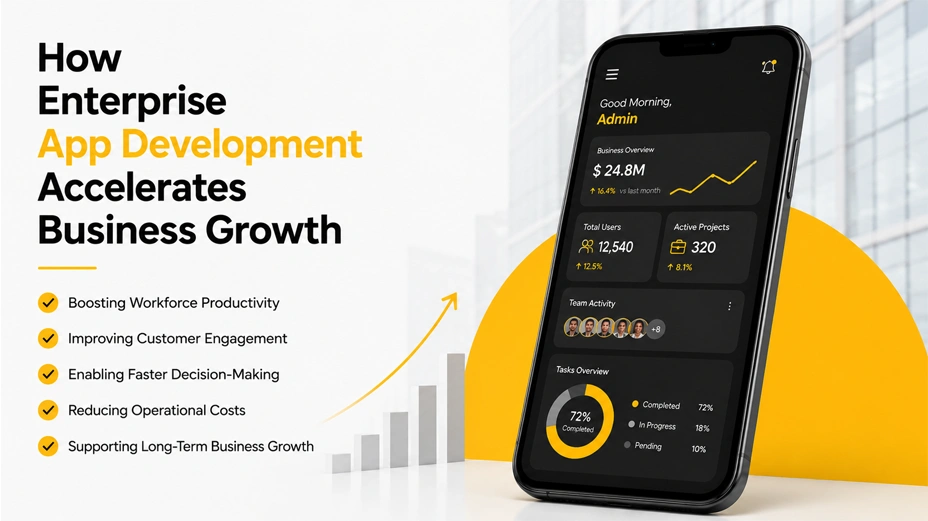
The growth case for enterprise mobile apps sits across three distinct dimensions: internal efficiency, customer experience, and strategic speed. Each deserves a closer look.
Workforce Productivity and Operational Efficiency
This is where the ROI case is clearest. Enterprise mobile apps give employees secure, on-demand access to the tools and data they need without being tethered to a desk. The operational math compounds quickly:
- A field technician who can close a service ticket from their phone, rather than driving back to the office, saves hours per week.
- A manager who approves purchase orders through a mobile app instead of waiting to log in at a desktop eliminates bottlenecks in procurement.
- A sales rep who has full CRM access during a client visit can update records, check order history, and follow up in real time rather than reconstructing notes at the end of the day.
Research from Apperian, referenced by Motivity Labs, found that enterprise apps can increase employee productivity by over 34%. For an organization with hundreds or thousands of employees, that is not a marginal gain. It is an operational transformation.
Customer Engagement and Revenue Growth
Customer-facing enterprise apps create direct channels for engagement that are faster, more personal, and more measurable than almost any other touchpoint. Consider what a well-built mobile app for business does for customer relationships:
- It gives customers self-service access to accounts, orders, and support, reducing the volume of inbound service requests.
- It enables push-based communication: order confirmations, delivery updates, personalized offers, and service reminders.
- It creates behavioral data that the business can use to improve products, predict churn, and personalize outreach.
Healthcare enterprises using mobile apps for telehealth services, for example, have seen a 30% increase in patient visits (Zipdo). Similar dynamics show up in retail, logistics, and financial services, anywhere customers interact with a business repeatedly and have a clear preference for digital access.
Faster Decision-Making Through Real-Time Data
One of the most underappreciated benefits of enterprise application management is what it does for leadership and operational visibility. When enterprise apps integrate with analytics platforms and core business systems, decision-makers get live access to the data they need rather than waiting for reports to be compiled and shared.
This matters more than it sounds. In fast-moving markets, the ability to see a supply chain delay forming, identify a support ticket surge before it becomes a crisis, or track sales pipeline health in real time gives businesses a response window that their slower competitors do not have.
Reduced Operational Costs
The cost reduction case for enterprise app development is well-documented. Custom mobile apps can reduce operational costs by up to 15% through better resource management (Wifitalents). More broadly, cost savings from enterprise mobile apps average $2.1 million per 1,000 employees annually (Zipdo).
The savings come from multiple directions: fewer manual data entry errors, reduced paper-based processes, faster approvals, lower call center volumes from self-service functionality, and better resource utilization from real-time scheduling and dispatching tools.
Types of Enterprise Apps Worth Building
Enterprise application development covers a wide range of application types. The right category depends on the specific workflow problems a business needs to solve.
| App Type | What It Does | Best For |
| Employee Productivity Apps | Task management, internal communication, document access, approvals | All enterprise functions |
| CRM Mobile Apps | Real-time access to customer records, pipeline management, contact history | Sales and account management teams |
| Field Service Apps | Job scheduling, work order management, real-time reporting, offline access | Field technicians, logistics, utilities |
| ERP Mobile Apps | Access to inventory, finance, and procurement data on mobile | Operations, procurement, finance |
| HR and Onboarding Apps | Leave management, onboarding workflows, payroll access, policy acknowledgments | HR and distributed workforces |
| Customer-Facing Apps | Self-service portals, loyalty programs, booking, support | Customer-facing businesses |
Sales representatives using mobile CRM apps see a 15% increase in productivity compared to those who do not (Wifitalents). That figure is modest when cited in isolation. Multiplied across a sales team of 50 or 200 people, it represents a meaningful and measurable revenue impact.
The Build Process: What It Actually Takes to Create an App for Your Business
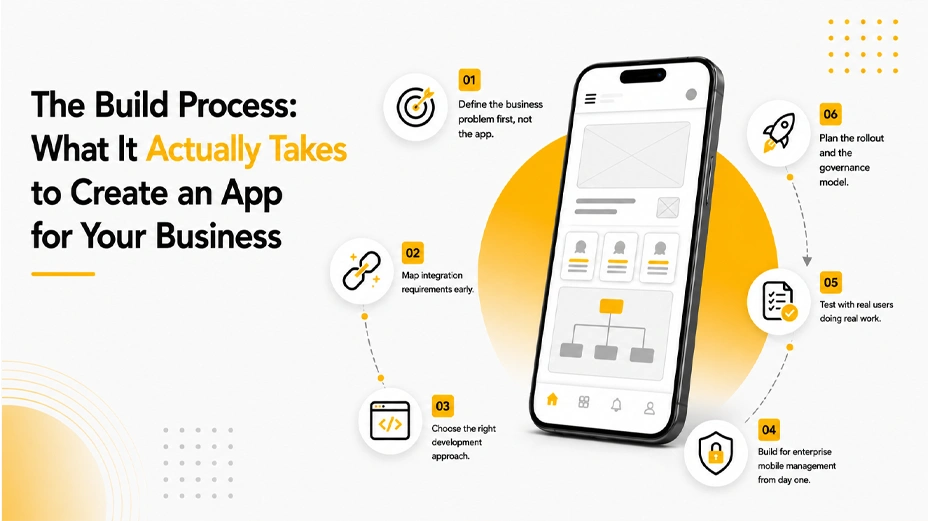
Knowing that an enterprise app will add value is the starting point. Knowing how to build one well is a different conversation. Here is how a structured enterprise application development process typically unfolds.
Step 1: Define the business problem first, not the app. The most common reason enterprise app projects underdeliver is that teams start with a feature list rather than a workflow problem. The right starting question is: which specific process, if made mobile and real-time, would produce the clearest operational improvement? Answer that before writing a line of code.
Step 2: Map integration requirements early. A business app that does not connect to the systems employees already use adds friction rather than removing it. Integration with ERP, CRM, HRMS, and identity management systems needs to be planned at the architecture stage, not retrofitted later. This is also where enterprise app management requirements, including MDM compatibility, data policies, and role-based access, should be defined.
Step 3: Choose the right development approach. Three paths are available for enterprise mobile app development:
- Native development (Swift for iOS, Kotlin for Android): Best performance and full platform feature access. Higher cost and longer development timelines. Native apps offer 20% better performance metrics compared to hybrid alternatives (Wifitalents).
- Cross-platform frameworks (React Native, Flutter): A single codebase that runs on both platforms. 74% of enterprise apps are now built using cross-platform frameworks (Wifitalents). A practical balance of reach and cost for most use cases.
- Low-code/no-code platforms: Increasingly used for internal tools and workflow apps. Gartner projects that 70% of new enterprise applications will use low-code or no-code development by 2025 (Kissflow).
The right choice depends on the complexity of the use case, the performance requirements, and the internal technical resources available.
Step 4: Build for enterprise mobile management from day one. Security cannot be a consideration that comes after the app is built. Enterprise mobile management requirements, including remote wipe capability, encrypted data storage, secure authentication, and app update management, should be built into the architecture from the start. 63% of enterprise mobile apps contain at least one critical security flaw (Zipdo). That figure reflects what happens when security is treated as an afterthought.
Step 5: Test with real users doing real work. Usability testing in enterprise app development is non-negotiable. An app that works in a demo environment but breaks under the actual data volumes, network conditions, or device configurations employees use in the field is not a finished product.
Step 6: Plan the rollout and the governance model. Enterprise application management does not end at launch. Who owns the app after it is live? How are updates pushed? How are usage and performance monitored? How does the app evolve as business needs change? These questions need answers before the first employee downloads the app.
Enterprise Mobile Management: The Layer Most Businesses Underestimate
Building a great enterprise app is one challenge. Managing it across hundreds or thousands of devices in the field is another. Enterprise mobile management (EMM) refers to the policies, tools, and practices that govern how mobile apps and devices operate within an organizational environment.
An enterprise mobile management strategy typically covers:
- Mobile Device Management (MDM): Controls which apps can be installed, enforces encryption, and enables remote wipe for lost or stolen devices.
- Mobile Application Management (MAM): Manages specific apps and their data policies without necessarily controlling the entire device. Critical for BYOD (Bring Your Own Device) environments, where 66% of organizations allow personal devices to access corporate systems (Wifitalents).
- Identity and Access Management: Ensures that only the right people access the right data within the app, with authentication standards that meet enterprise security requirements.
- Update and Version Management: Coordinating app updates across a large, dispersed user base without disrupting operations requires a managed rollout process, not just an app store update.
Enterprise application management is the difference between a mobile app that creates productivity and one that creates a security liability. Organizations that skip this layer often discover the consequences in the form of data breaches, compliance violations, or IT incidents.
What Separates Successful Enterprise App Deployments from Expensive Failures
40% of enterprise mobile app projects fail due to poor integration with legacy systems (Zipdo). That is a remarkably high failure rate for technology that is well-understood and widely deployed. The failure is almost never in the technology itself. It is in the conditions under which the technology is applied.
The conditions that determine whether a business app actually works:
- A specific, measurable problem: “Improve operations” is not a deployable objective. “Reduce the time field technicians spend on manual reporting by enabling real-time job closure from mobile devices” is one.
- Clean data and connected systems: An enterprise app is only as useful as the data it surfaces. If core business data lives in siloed, inconsistent, or outdated systems, the app will reflect those problems directly to its users.
- Defined governance before launch: Who approves the app for release? Who manages updates? Who handles security incidents? These answers need to exist before the app goes live.
- User adoption as a metric, not an assumption: A business app that employees do not use does not generate ROI. User adoption strategy, including training, change management, and feedback loops, is part of the development process, not an afterthought.
- Iteration budget: The first version of an enterprise mobile app is never the final version. Successful enterprise application development programs build in the time and budget to refine the app based on real-world usage data, not just pre-launch testing.
Conclusion
Enterprise mobile app development is not a technology investment. It is an operational investment. The businesses that understand this distinction, and design their approach accordingly, building apps around specific workflow problems, connecting them cleanly to existing systems, governing them with proper enterprise mobile management practices, and measuring them against real business outcomes, are the ones that see the returns the market data promises.
The path to those returns is rarely as complex as it seems, but it requires clarity, discipline, and a willingness to iterate. The first version of your enterprise app will not be the last, and that is exactly as it should be.
If you are thinking through what enterprise app development could look like for your business, or you need a clear-eyed assessment of where to start, reach out at coffee@sparkeighteen.com.