
We recently spoke with a product lead at a fast-growing fintech startup who was facing a familiar, yet painful, dilemma. Their development team was pushing code at record speed, but every release cycle felt like a game of Russian roulette. “We’re hitting our development milestones,” they explained, “but the final week of testing is a bloodbath of critical bugs, hotfixes, and delayed launches. Our time-to-market is slipping because we’re constantly fixing what we thought was already finished.”
This scenario is far from unique. In the rush to meet aggressive deadlines, many organisations treat quality assurance as a final hurdle rather than a continuous thread. However, according to research from the IBM Systems Sciences Institute, the cost of fixing a bug found during the testing phase is 15 times more than one found during design, and this cost skyrockets to 100 times more if the defect is only discovered after the product has been released to the public (Functionize).
So in this blog, we will explore how early intervention through quality assurance automation testing transforms the software development life cycle (SDLC), the specific QA automation tools that drive these efficiencies, and why investing in QA automation testing services is the smartest move for companies looking to outpace their competition. Furthermore, we will look at how QA automation tools can be integrated seamlessly into existing workflows.
The Bottleneck of Traditional Testing
In a traditional “Waterfall” or late-stage testing model, the quality team only receives the software once development is “feature complete”. This creates a massive backlog of testing tasks that must be squeezed into a tiny window before the launch date. This pressure often leads to:
- Late-Stage Bottlenecks: A surge of bugs found right before launch, causing immediate delays.
- High Remediation Costs: Developers must revisit code they wrote weeks ago, losing time to “context switching”.
- Unpredictable Launch Dates: Stakeholders lose confidence as release dates are repeatedly pushed back.
- Technical Debt: Small issues are ignored to meet deadlines, leading to bigger problems later.
By contrast, integrating quality assurance automation tools from the very first sprint allows for continuous validation. Instead of waiting for a monolithic build, the team uses automated QA testing to verify small chunks of code as they are written. This shift doesn’t just find bugs; it prevents them from compounding. By leveraging quality assurance automation tools consistently, teams ensure that the foundation of the product remains solid from day one. In many cases, quality assurance automation tools act as an early warning system for architectural flaws. Using quality assurance automation tools effectively is a hallmark of a mature engineering team.
How Early QA Accelerates Time-to-Market
The relationship between early testing and speed is often misunderstood. Some believe that adding testing steps early on will slow down the initial development. In reality, the data suggests the opposite. According to a report from NIST (National Institute of Standards and Technology), inadequate software testing infrastructure costs the US economy billions annually, largely due to the time wasted on fixing errors that could have been caught earlier (NIST Report).
Here is how early QA automation specifically reduces your time-to-market:
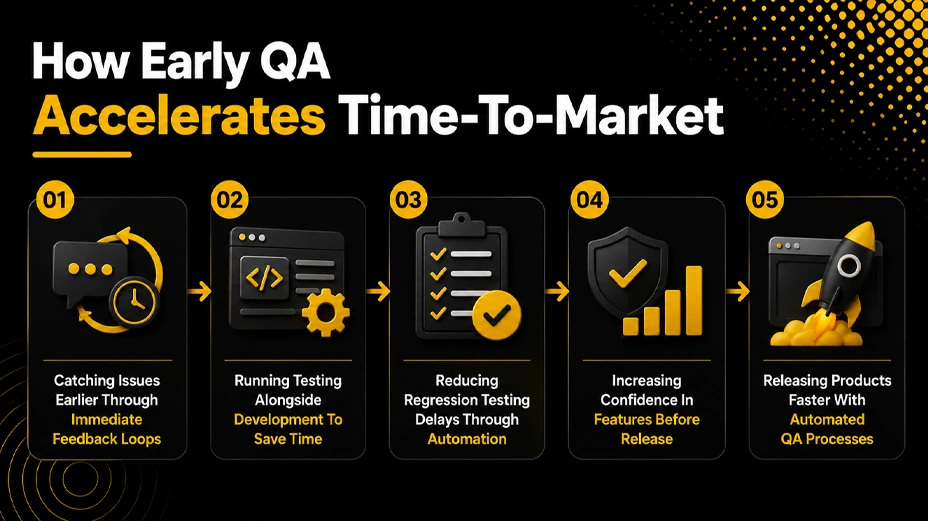
- Immediate Feedback Loops: When a developer submits code, QA automation tools can run a suite of regression tests within minutes. If something breaks, the developer knows immediately while the logic is still fresh in their mind. This eliminates the days or weeks of delay that occur when a bug is found long after the code was written.
- Parallel Development and Testing: With automated quality assurance, testing doesn’t have to wait for development to finish. QA engineers can write scripts based on requirements while developers are still coding. This parallel workflow means that the moment a feature is ready, the quality assurance automation testing is already prepared to validate it.
- Reduced Regression Testing Time: As a project grows, the number of things that could potentially break increases. Manual regression testing becomes an impossible task. By using QA testing automation tools, teams can run thousands of tests overnight, ensuring that new features haven’t broken existing functionality without adding a single hour to the project timeline.
- Higher Confidence in “Done”: In many teams, “done” just means the code is written. With automated QA testing, “done” means the code is written, tested, and verified against requirements. This certainty allows project managers to plan launches with far greater accuracy.
Choosing The Right QA Automation Tools For Faster Delivery
To achieve these speed gains, selecting the right quality assurance automation tools is critical. The market has evolved significantly, moving from complex, code-heavy frameworks to more agile, AI-enhanced solutions.
According to Testlio’s 2025 Test Automation Statistics, over 72% of successful businesses now benefit from QA automation in their deployment processes (Testlio). These organisations typically rely on a mix of the following:
- Unit Testing Frameworks: Tools like JUnit or NUnit that allow developers to test individual functions.
- API Testing Tools: Solutions like Postman or RestAssured that verify the data flow between services.
- UI Automation Tools: Frameworks like Selenium, Playwright, or Cypress that simulate user interactions.
- Mobile Testing Platforms: Tools like Appium that ensure performance across various devices and operating systems.
When businesses leverage QA testing automation tools effectively, they don’t just test faster; they test smarter. For instance, many modern QA automation tools now include “self-healing” capabilities, where the test scripts automatically adjust to minor UI changes, reducing the time spent on test maintenance. Using QA automation tools consistently ensures that no small change goes unverified.
The Economic Impact of Quality Assurance Automation Testing
Beyond just speed, there is a clear financial argument for quality assurance automation testing. A study by ThinkSys projected that the global software testing market will reach $112.5 billion by 2034, driven largely by the need for faster, more reliable releases (ThinkSys QA Trends 2026).
The return on investment (ROI) for QA automation comes from several areas:
| Area of Impact | Manual Testing Outcome | Automated QA Outcome |
| Execution Speed | Limited by human hours | Runs 24/7 at machine speed |
| Defect Detection | 60-70% detection rate | Up to 90% detection rate |
| Cost per Test | Increases with project scale | Decreases as scripts are reused |
| Staff Utilisation | Testers do repetitive tasks | Testers focus on complex UX |
By investing in QA automation testing services, companies can reallocate their most expensive resource, human talent, away from boring, repetitive checks and towards high-value activities like exploratory testing and user experience design. Using QA automation testing services allows teams to scale their testing efforts without a linear increase in headcount.
When to Partner with QA Automation Testing Services
For many organisations, the challenge isn’t knowing that they need automated quality assurance, but rather knowing how to implement it without disrupting their current flow. Building an in-house automation team is expensive and time-consuming. This is where professional qa automation testing services become invaluable. Selecting the right partner for qa automation testing services can be the difference between a failed implementation and a seamless transition.
You should consider external QA automation testing services if:
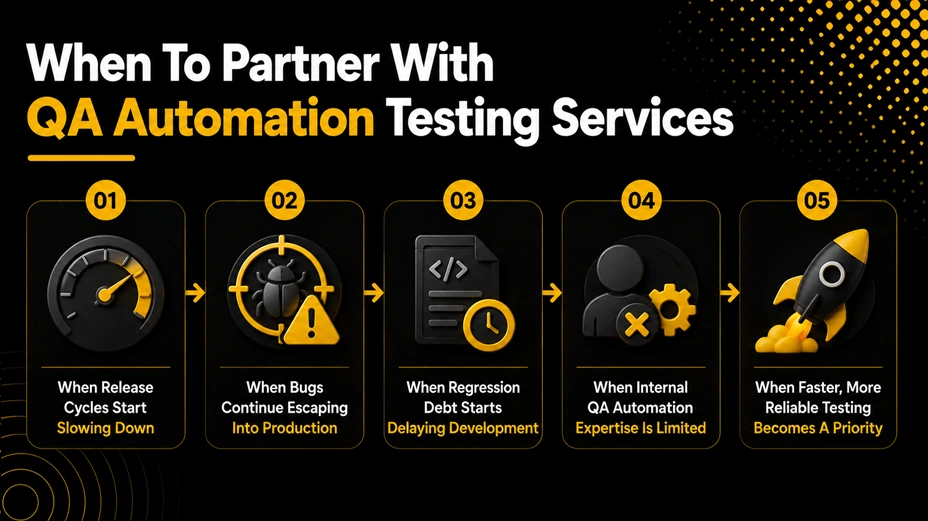
- Your release cycles are slowing down: If it takes longer to test a release than it did to build it, your process is broken.
- Bugs are escaping to production: If customers are finding bugs that your team missed, you need better coverage.
- You have high regression debt: If you’re afraid to change code because you don’t know what will break, you need automated QA testing.
- You lack internal expertise: If your team is great at manual testing but lacks the coding skills for quality assurance automation testing, bringing in experts can jump-start your transition.
Reliable QA automation testing services provide the technical depth required to build robust, maintainable test suites. Whether you are building an internal team or partnering with QA automation testing services, the goal remains the same: to deliver better software, faster.
Conclusion
In the modern digital economy, speed is a competitive advantage, but speed without quality is a recipe for disaster. Early intervention through QA automation is the only way to maintain a rapid release cadence without sacrificing the stability of your product. By integrating QA testing automation tools early in the cycle, you transform testing from a bottleneck into a catalyst for growth.
As we have seen, the data is clear: finding bugs early isn’t just a technical preference; it is a financial necessity. By adopting automated quality assurance and leveraging quality assurance automation testing, you ensure that your team is always moving forward, not constantly looking back to fix the past. So if you need assistance accelerating your release cadence without sacrificing quality, you can reach out at coffee@sparkeighteen.com.