A practical guide to predictive data analytics: how the models work, where they deliver the most value for business, and why AI and machine learning have changed what is now possible.
Most businesses are sitting on more data than they know what to do with. Transaction records, customer behaviour logs, marketing campaign history, operational metrics, and supply chain data: the problem for the majority of organisations is not a shortage of information but a shortage of the right analytical capability to turn that information into decisions that happen before a problem occurs rather than after.
That is the core distinction between traditional business intelligence and predictive data analytics. Business intelligence tells you what happened. Predictive data analytics tells you what is likely to happen next and with enough specificity to act on it.
The shift from descriptive to predictive is not purely technical. It is a change in how decisions get made: from reviewing what the data shows to acting on what the data anticipates. This guide covers how predictive analytics models work, where they produce the most measurable business value, the role that AI and machine learning now play, and what separates organisations that implement predictive analytics solutions successfully from those that collect the data without ever extracting the insight.
Key Takeaways
- Predictive data analytics uses historical data and statistical models to generate probability-based forecasts about future events, not certainties, but directionally reliable signals.
- The gap between traditional data analytics for business and predictive analytics is the gap between reviewing the past and shaping the future.
- AI and predictive analytics are now deeply intertwined: machine learning and predictive analytics together enable models that improve automatically with new data, reducing the manual effort of model maintenance.
- Predictive marketing analytics, demand forecasting, churn prediction, and risk scoring are the four areas where most businesses generate the fastest measurable ROI from predictive analytics solutions.
- The quality of the input data is the single largest determinant of predictive model accuracy: better data governance consistently outperforms more sophisticated modelling on poor data.
- Predictive analytics services bring the combination of data science expertise and domain knowledge that most organisations cannot build internally in a short timeframe.
Predictive Analytics vs Traditional Business Intelligence: The Core Difference
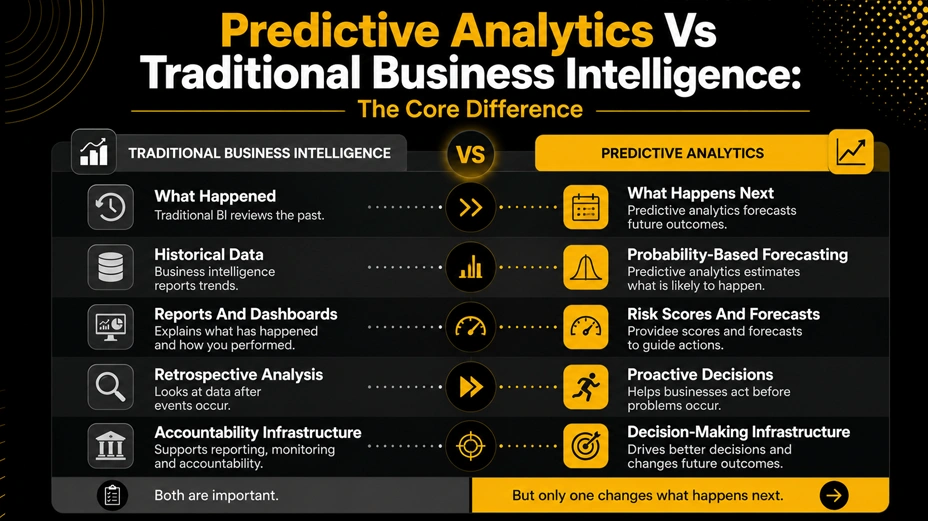
The distinction between traditional business intelligence and data analytics for business that incorporates prediction is worth establishing clearly, because the two are often conflated in commercial conversations and they serve fundamentally different purposes.
Traditional business intelligence and data analytics is retrospective: it answers questions about what has already occurred. How many units did we sell last quarter? Which customer segments had the highest churn rate last year? Which product categories are growing? These are valuable questions, and well-structured dashboards answer them efficiently. But they do not help a business decide what to do next. They describe a situation; they do not inform a future action.
Predictive data analytics answers a different category of question. Which customers are most likely to churn in the next 30 days? Which prospects are most likely to convert if contacted this week? Which supply chain nodes are most likely to experience a delay in the next two months? These questions have direct operational consequences. Acting on them in advance produces measurably different outcomes from acting on them after the event.
Traditional BI vs Predictive Data Analytics: Side by Side
| Dimension | Traditional Business Intelligence | Predictive Data Analytics |
| Core question | What happened? | What is likely to happen next? |
| Data orientation | Historical, backward-looking | Historical plus forward-looking probability |
| Output | Reports, dashboards, summaries | Forecasts, risk scores, recommendations |
| Decision type | Describes a situation | Informs a future action |
| Timing of insight | After the event | Before the event |
| Technology base | SQL, BI tools, spreadsheets | Machine learning, statistical models, AI |
| Business value | Accountability and review | Competitive advantage and risk reduction |
Key distinction: Traditional business intelligence is accountability infrastructure. Predictive data analytics is decision-making infrastructure. Both matter, but only one changes what happens next.
How Predictive Analytics Models Work
Predictive analytics models are mathematical functions that learn relationships from historical data and apply those relationships to new data to generate a probability or a forecast. The word ‘model’ is used loosely in commercial contexts, but in practice every predictive model follows the same core process: collect historical data, identify the variables that correlate with the outcome of interest, train the mathematical function on that data, validate its accuracy on data it has not seen before, and then deploy it to generate predictions on current data.
The accuracy of a predictive model depends on three things: the quality and volume of the training data, the relevance of the features (input variables) selected, and the appropriateness of the model type for the specific problem. The third factor is where both AI and predictive analytics expertise become valuable, because different business problems suit different model architectures.
The Main Predictive Analytics Models Used in Business
| Model Type | How It Works | Business Use Case | Data Required | AI/ML Dependency |
| Regression models | Identifies relationships between variables | Revenue forecasting, pricing | Historical numerical data | Low (statistical) |
| Classification models | Assigns inputs to predefined categories | Credit scoring, churn prediction | Labelled historical records | Medium |
| Time series forecasting | Analyses patterns across sequential time-stamped data | Demand planning, stock forecasting | Timestamped transactional data | Low–Medium |
| Decision trees | Maps decisions and outcomes as branching paths | Customer segmentation, risk triage | Mixed feature data | Low–Medium |
| Neural networks / deep learning | Detects complex, non-linear patterns | Fraud detection, NLP, image analysis | Very large labelled datasets | High |
| Ensemble models (e.g. XGBoost) | Combines multiple models for higher accuracy | Customer LTV, propensity scoring | Large historical datasets | Medium–High |
The Role of Model Training and Validation
A predictive model that is trained on all available data and then immediately deployed has not been tested. The standard practice in machine learning and predictive analytics is to split available data into a training set, used to build the model, and a held-out test set, used to measure how accurately the model performs on data it has never seen. A model that performs well on training data but poorly on the test set is overfitting: it has memorised the training data rather than learning generalisable patterns. Overfitted models produce misleading confidence in production environments and are one of the most common failure modes in commercial predictive analytics deployments.
Ongoing model monitoring is equally important. Business conditions change, customer behaviour shifts, and supply chains evolve. A model trained on pre-2020 consumer purchasing data is not a reliable predictor of 2025 consumer behaviour. Machine learning and predictive analytics environments that incorporate automatic retraining on new data address this problem systematically rather than relying on manual model refresh cycles.
Where Predictive Analytics Delivers the Most Business Value
Predictive analytics for business generates the clearest return in four application areas: customer churn prediction, demand and supply chain forecasting, risk and fraud detection, and predictive marketing analytics. Each is described below with the specific mechanism by which it improves decision-making.
Customer Churn Prediction
Churn prediction models assign a probability score to each active customer based on their recent behaviour: login frequency, feature usage, support ticket volume, payment history, and engagement with communications. Customers above a defined risk threshold are flagged for intervention before they cancel, not after.
Research by Bain and Company found that a 5% increase in customer retention rates produces profit increases of 25% to 95% depending on the industry. The research is referenced at bain.com/insights/retaining-customers. Predictive analytics solutions for churn make this lever actionable at scale, identifying which customers need attention before the revenue is already lost.
- What it changes: retention teams move from reacting to cancellation requests to proactively engaging at-risk customers when intervention is still possible.
- Typical model inputs: days since last login, number of features used, support contact frequency, account age, billing status, engagement with in-app messaging.
- Output: a risk score and a recommended intervention type, escalated to the relevant team automatically.
Demand Forecasting and Supply Chain Optimisation
Demand forecasting models predict future product or service demand using historical sales data, seasonality patterns, promotional calendars, external economic indicators, and in more sophisticated implementations, real-time signals such as social media sentiment or weather data. Better demand forecasts reduce both overstock, which ties up working capital, and stockout, which costs sales and damages customer relationships.
According to Gartner, companies that use AI predictive analytics for supply chain planning reduce forecasting errors by 50% and reduce lost sales due to product unavailability by 65% compared to organisations using traditional planning methods. Full research context is available at gartner.com/en/supply-chain.
Risk Scoring and Fraud Detection
Risk scoring models assign probability-based risk ratings to credit applications, insurance underwriting decisions, and transaction approvals in real time. Fraud detection models identify anomalous transaction patterns that deviate from a customer’s established behaviour, flagging or blocking them before the transaction completes. Both are established applications of AI and predictive analytics in financial services, and both are now accessible to businesses outside the financial sector through predictive analytics services rather than requiring in-house model development.
- Credit risk: probability of default modelled from applicant financial history, behavioural data, and third-party bureau data.
- Fraud detection: transaction-level anomaly detection using neural networks trained on millions of labelled fraud and non-fraud examples.
- Insurance underwriting: claims probability modelled from applicant demographics, historical claims data, and external risk indicators.
Predictive Marketing Analytics
Predictive marketing analytics applies predictive models to the full customer acquisition and lifecycle journey: which prospects are most likely to convert from a given campaign, which customers are most likely to respond to an upsell offer, which segments will generate the highest lifetime value, and which channels will produce the best return on the next campaign’s budget.
Salesforce’s State of Marketing report found that high-performing marketing teams are 2.9 times more likely to use AI for predictive analytics than underperforming teams. The full report is available at salesforce.com/resources/research-reports/state-of-marketing/.
The commercial mechanism is straightforward: predictive marketing analytics replaces broad-audience targeting with probability-ranked audience selection. Rather than sending the same campaign to all customers and measuring the aggregate response, a predictive model identifies the customers most likely to respond and concentrates spend on them. The same budget, applied to a more precisely identified audience, produces a higher return.
The Role of AI and Machine Learning in Predictive Analytics
The terms AI and predictive analytics are used interchangeably in many commercial contexts, but they are not the same thing. Predictive analytics is a practice, the use of data to generate forward-looking forecasts and probability scores. AI and machine learning are technologies that enable certain types of predictive models, particularly those that handle large, complex datasets with many interacting variables.
The practical effect of machine learning on predictive analytics for business has been threefold. First, it has made models viable on datasets that were too large and too complex for traditional statistical methods. Second, it has enabled models that improve automatically as new data flows in, reducing the maintenance burden of keeping models current. Third, through natural language processing and computer vision, it has extended the range of data types that can feed into a predictive model beyond structured numerical data to include text, images, and audio.
Specific AI Applications in Predictive Analytics
- Natural Language Processing (NLP): analysing customer support tickets, social media posts, and review text to predict satisfaction trends, churn risk, and emerging product issues before they surface in structured data.
- Computer vision: analysing visual data for quality control prediction in manufacturing, footfall prediction in retail, and infrastructure condition monitoring in facilities management.
- Reinforcement learning: optimising sequential decision-making in supply chain routing, dynamic pricing, and resource allocation by learning from the outcomes of previous decisions.
- Large language models: generating narrative summaries of predictive model outputs that can be consumed by non-technical business users, making the output of AI for predictive analytics accessible beyond data science teams.
According to IDC, worldwide spending on AI solutions, including machine learning and predictive analytics infrastructure, was forecast to reach $632 billion by 2028, with the fastest growth in applications that directly support business decision-making. Full forecast data is available at idc.com/getdoc.jsp?containerId=prUS52300424.
Important distinction: AI predictive analytics is not magic. It is pattern recognition applied to large datasets. The quality of the output depends entirely on the quality and representativeness of the input data. An AI model trained on biased or incomplete data produces biased or incomplete predictions, regardless of the sophistication of the algorithm.
What Separates Successful Predictive Analytics Implementations
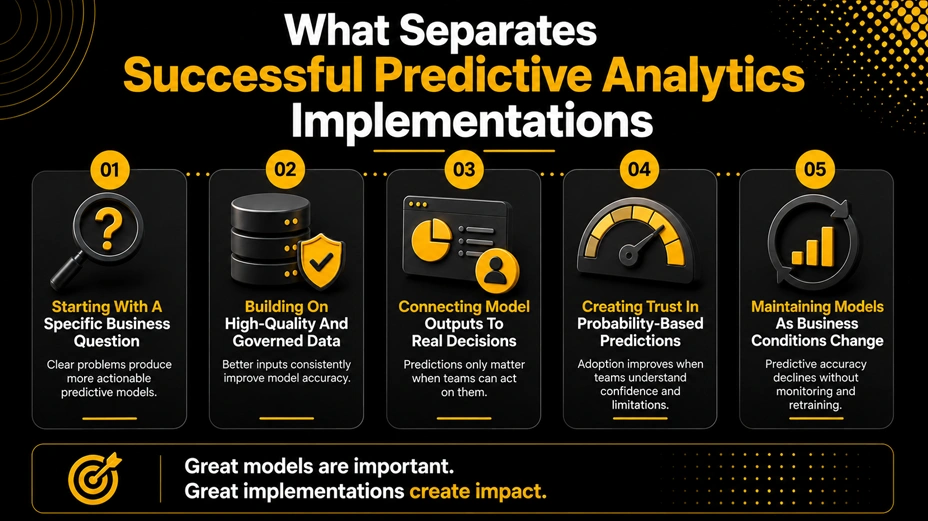
The gap between organisations that extract real business value from predictive analytics solutions and those that invest in the technology without meaningful return is rarely about the sophistication of the models. It is almost always about the foundational conditions that determine whether good models can be built and acted on.
The Five Conditions That Determine Implementation Success
- Data quality and governance: predictive models require clean, consistent, well-labelled historical data. Organisations without a data governance practice, where the same metric is defined differently in different systems, where records have significant missing values, or where historical data has not been retained, will find that predictive analytics services spend more time on data preparation than on modelling. Investment in data quality before predictive analytics implementation is not optional; it is the prerequisite.
- A specific, measurable business question: the predictive analytics implementations that produce the clearest ROI start with a single, well-defined question. Which customers will churn in the next 60 days? Which transactions are fraudulent? Which prospects will convert from this campaign? Broad mandates to ‘use data better’ do not produce focused models or actionable outputs.
- An operational integration path: a churn prediction model that produces a risk score list and distributes it as a weekly spreadsheet to the sales team has limited impact compared to one that automatically creates a follow-up task in the CRM for the account manager when a score crosses a threshold. The model’s output needs to reach the person making the decision, in the system where they make it, at the time they need it.
- Organisational trust in model outputs: predictive models produce probabilities, not certainties. Organisations that reject a model’s output every time it disagrees with an experienced human’s intuition will not benefit from predictive analytics. Building appropriate trust in model outputs, including transparency about confidence levels and error rates, is a change management challenge as much as a technical one.
- Ongoing model maintenance: models trained on historical data become less accurate as conditions change. A demand forecasting model trained before a significant market shift will produce increasingly unreliable forecasts after it. Successful predictive analytics solutions include a model monitoring and retraining cycle that keeps accuracy within acceptable bounds as business conditions evolve.
Final Thoughts
Predictive data analytics has moved well past the stage of being a competitive differentiator available only to the largest, most technically sophisticated organisations. The combination of accessible cloud infrastructure, open-source machine learning tooling, and mature predictive analytics services has made it a practical investment for businesses of most sizes, in most industries.
The organisations that benefit most are not necessarily the ones with the most data or the most sophisticated models. They are the ones that start with a specific, well-defined business question, invest in the data quality that good models require, and build an operational path from model output to business decision. Those three conditions, applied consistently, are what separate predictive analytics implementations that produce measurable growth from those that produce impressive presentations and limited change.
AI and predictive analytics will continue to evolve quickly, with AI for predictive analytics in particular expanding into new data types and new decision contexts at a pace that is difficult to track from the outside. The businesses best positioned to benefit from that evolution are the ones building the foundational data and analytical capabilities now, rather than waiting for the technology to mature further.
If you need guidance on implementing predictive analytics solutions for your business or want to discuss the right data analytics approach for your specific decision-making challenges, reach out at coffee@sparkeighteen.com.