There is a moment when a technology stops being experimental and starts being essential. For generative AI, that moment is now.
Since ChatGPT arrived in late 2022, the pace has been relentless. But 2026 is different. This is not the year of trying generative AI; it is the year of running it at scale, proving its value, and making hard decisions about where it goes next. Executives are no longer asking, “Should we explore this?” They are asking, “How do we make this reliable for thousands of users?”
The numbers back this up. According to Grand View Research, the global generative AI market was valued at approximately $22.21 billion in 2025 and is projected to reach $29.63 billion in 2026, growing at a CAGR of 40.8% through 2033. Meanwhile,Global Market Insights puts the 2026 market at $83.3 billion, with the top five players, OpenAI, Anthropic, NVIDIA, Adobe, and Microsoft, collectively holding 58.1% of market share.
Whichever estimate you lean on, the trajectory is clear: generative AI is not slowing down.
But growth is only part of the story. What you actually need to understand in 2026 is where the technology is going, what problems it is solving, and where the risks are mounting. Below are the 10 trends shaping the future of generative AI this year.
1. ROI Has Replaced Curiosity as the Driving Force
For the past two years, most companies were willing to fund generative AI experiments without demanding proof of return. That patience has officially expired.
According to PwC’s 2025 Global CEO Survey (pwc.com):
- 56% of executives reported efficiency gains from GenAI deployments
- 34% saw profitability increases
- 32% reported revenue increases
At the same time, MIT’s “GenAI Divide: State of AI in Business 2025” report (mlq.ai) found that despite $30 to $40 billion in GenAI business investment, 95% of organizations are seeing zero return, while just 5% of integrated AI pilots are extracting real, measurable value.
This gap is what is shaping 2026. Business leaders are demanding metrics. They want proof that their generative AI platform investments are translating into outcomes, not just activity. For any generative AI company or internal team still running pilots with no clear success criteria, the window is closing fast.
The future of generative AI, at least on the enterprise side, is tied directly to demonstrating hard value.
2. Generative AI Is Becoming Infrastructure, Not a Feature
Here is a comparison worth sitting with: electricity versus a device that runs on electricity. Most people interact with the device. The electricity is invisible. That is exactly where generative AI is heading in 2026.
Generative AI models are no longer things you visit through a standalone chat interface. They are being embedded into ERP systems, CRM workflows, ticketing platforms, and supply chain dashboards. Users will not always know they are interacting with a generative AI application. They will just notice that the software is smarter, faster, and more helpful.
Microsoft CTO Kevin Scott has predicted that AI will write 95% of code by 2030, with senior developers using generative AI tools as force multipliers for scope and output. Code generation is just one example. The same embedding is happening in healthcare documentation, legal drafting, financial analysis, and marketing operations.
The phrase “generative AI for business” is becoming redundant. At some point, it is just business.
3. Agentic AI: From Answering Questions to Getting Things Done
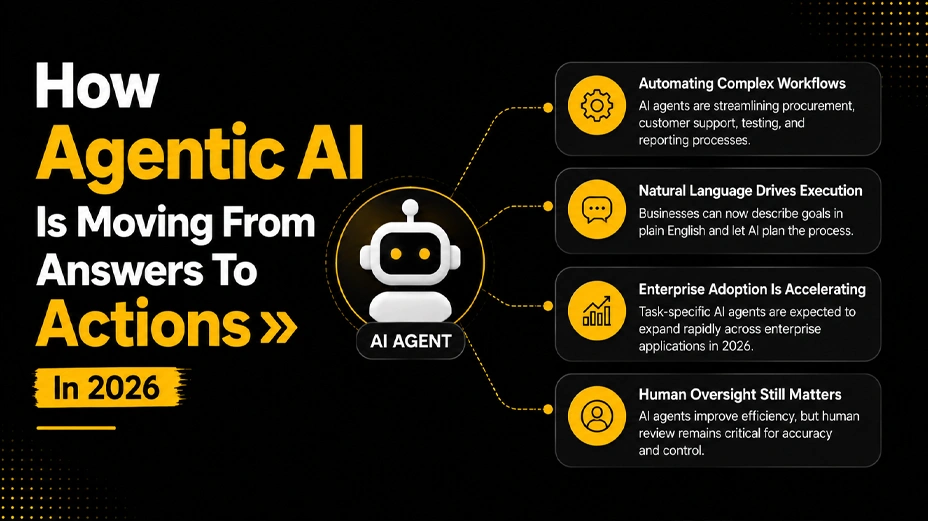
Generative AI explained simply: it takes your input and produces an output. Agentic AI takes that a step further. It takes your goal and figures out the steps to achieve it, then executes those steps, often without waiting for you to confirm each one.
This is the shift happening at scale in 2026. Gartner predicted in August 2025 that enterprise applications with task-specific AI agents will rise from just 5% to 40% by the end of 2026 (Gartner press release). That is a staggering increase in a single year.
What makes this possible is the natural language capability of today’s generative AI models. Before, instructing a machine required formal logic and code. Now, you can describe a goal in plain English, and a well-designed agent will interpret it, plan for it, and execute.
Key use cases for agentic generative AI programs in 2026:
- Automated customer service resolution, start to finish
- Multi-step procurement and vendor management workflows
- Software testing and bug-fixing pipelines
- Research aggregation and report generation across data sources
- Real-time fraud detection and case escalation in financial services
The leap from generative AI to agentic AI is the leap from answers to outcomes. And in 2026, outcomes are what the market is paying for.
4. Human Oversight Is Not Going Away But Getting More Important
There is a common assumption that as generative AI tools become more capable, humans become less necessary. The actual situation is almost the opposite.
As agentic systems take on more end-to-end execution, the cost of unchecked errors scales up dramatically. A hallucination in a chatbot is annoying. A hallucination in an autonomous financial workflow is a liability. This is why the role of human judgment is not shrinking in 2026, it is being elevated.
A September 2025 Boston Consulting Group report (bcg.com) put it clearly: “Fluency in AI is becoming essential across roles, alongside systems thinking, problem framing, and sound judgment.” With agents handling execution, the report notes, “AI takes on end-to-end execution, and humans steer strategy and oversight.”
In practice, this means:
- Establishing clear AI guardrails before deploying autonomous workflows
- Training non-technical staff to spot errors and intervene appropriately
- Building review checkpoints into high-stakes generative AI applications
- Assigning accountability for AI-generated outputs at the organizational level
“AI stewardship” is becoming a real career competency. The most valuable professionals in 2026 are not necessarily those who build generative AI programs, but those who govern them responsibly.
5. Responsible AI Is Moving From Principle to Practice
Generative AI explained honestly includes this: the technology is not neutral, and it is not infallible. It can hallucinate facts. It can reflect biases in training data. It raises serious questions about copyright, consent, and data privacy. These are not edge-case concerns. They are central challenges for every organization deploying generative AI technologies at scale.
A 2025 report from HCLTech and MIT Technology Review Insights (hcltech.com) found that:
- 87% of business executives recognize responsible AI as critically important
- 85% say they are unprepared to adopt responsible AI principles
- Main barriers include implementation complexity, shortage of in-house expertise, regulatory compliance gaps, and inadequate resource allocation
A September 2025 IEEE survey of 400 CIOs, CTOs, and IT directors (ieee.org) found that 44% cite AI ethical practices as the top skill for AI-related hires in 2026, ahead of data analysis, machine learning, and software development.
Responsible AI covers six pillars most organizations are working toward:
- Fairness: outputs do not systematically disadvantage protected groups
- Accuracy: the system produces factually correct, verifiable results
- Transparency: decision processes are explainable and auditable
- Accountability: humans and organizations can be held responsible for outcomes
- Privacy: data used to train and run generative AI models is handled lawfully
- Safety: the system does not produce content that causes harm
Generative AI trends in 2026 are pushing responsible AI from an ethics statement on a website to an operational requirement baked into every deployment.
6. Cybersecurity Is One of the Biggest Generative AI Use Cases, and One of the Biggest Risks
Generative AI is a dual-use technology in the truest sense. The same capabilities that help defenders automate threat detection also help attackers automate exploits.
A 2025 Gartner survey (gartner.com) reported that 54% of cybersecurity respondents said their organizations experienced an attack on enterprise AI applications in the prior 12 months.
Common attack vectors on generative AI platforms and models include:
- Prompt injection: manipulating inputs to override intended behavior
- Data poisoning: corrupting training data to introduce vulnerabilities
- Model inversion attacks: reconstructing private training data through repeated queries
- API exploitation: overloading or extracting proprietary models via query patterns
- Social engineering: using AI-generated content to spread embedded threats through trusted channels
The challenge is structural. Adversaries are not bound by working hours, legal constraints, or ethical frameworks. They iterate fast, coordinate globally, and target the weakest links in an increasingly AI-integrated tech stack.
For any organization running generative AI programs in 2026, cybersecurity is not an afterthought. It is a core design consideration.
7. Multimodal Generative AI Models Are Becoming the Standard
Early generative AI applications were largely text-based: chatbots, copy generators, and code assistants. The models powering them operated in a single modality. That era is ending.
In 2026, the leading generative AI models, GPT-4o, Gemini 1.5, Claude 3, and others, process and generate across text, images, audio, video, and code, often within the same interaction. This is what multimodality means in practice: you can describe a marketing brief in text, receive a draft image, request an audio narration, and refine a video script, all within one generative AI application.
Generative AI use cases expanding thanks to multimodality:
- Healthcare: combining medical imaging analysis with natural language diagnostic summaries
- Retail: generating product visuals alongside written descriptions from a single data input
- Education: producing adaptive learning content across reading, audio, and interactive formats
- Manufacturing: integrating visual defect detection with real-time language-based reporting
Generative AI technology is becoming genuinely cross-modal. The implications for content production, diagnostics, design, and communication are hard to overstate.
8. Smaller, Specialized Generative AI Models Are Gaining Ground
For most of 2023 and 2024, the dominant narrative in generative AI was scale: bigger models, trained on more data, with more parameters, would always win. In 2026, that narrative has become more complicated.
Several factors are pushing organizations toward smaller, domain-specific generative AI models:
- Cost: running large frontier models at enterprise scale is expensive; smaller fine-tuned models often perform comparably on narrow tasks at a fraction of the cost
- Latency: specialized models run faster, which matters in real-time applications
- Privacy: on-premises or edge-deployed smaller models keep sensitive data out of third-party cloud infrastructure
- Accuracy: a model fine-tuned on legal documents will outperform a general model on legal tasks
This does not mean large models are going away. Generative AI platforms like those offered by OpenAI, Google, Anthropic, and Mistral will continue to lead for general-purpose tasks. But the smartest generative AI company deployments in 2026 are often combining a frontier model for reasoning with a specialized model for domain-specific execution.
9. Generative AI and Data Quality Are Directly Linked
You cannot separate the quality of a generative AI application from the quality of the data feeding it. This is one of the most underappreciated constraints in the current market, and it is becoming a major competitive differentiator.
Organizations with clean, structured, well-governed data are getting faster, more accurate results from their generative AI tools. Those with fragmented, inconsistent, or poorly labeled data are finding that even the best models produce unreliable outputs.
Key data challenges for generative AI programs in 2026:
- Retrieval-augmented generation (RAG) requires high-quality, well-indexed knowledge bases to produce reliable responses
- Fine-tuning models on low-quality proprietary data bakes in errors that are hard to detect and harder to remove
- Synthetic data generation (creating training data artificially) is growing as a solution, but requires careful validation to avoid amplifying existing biases
- Data lineage, knowing where your training data came from, who owns it, and whether it was collected lawfully, is now a legal and compliance question, not just a technical one
The organizations treating data infrastructure as inseparable from their generative AI strategy are already pulling ahead. The future of generative AI is inseparable from the future of data governance.
10. Generative AI Regulation Is Becoming Operational Reality
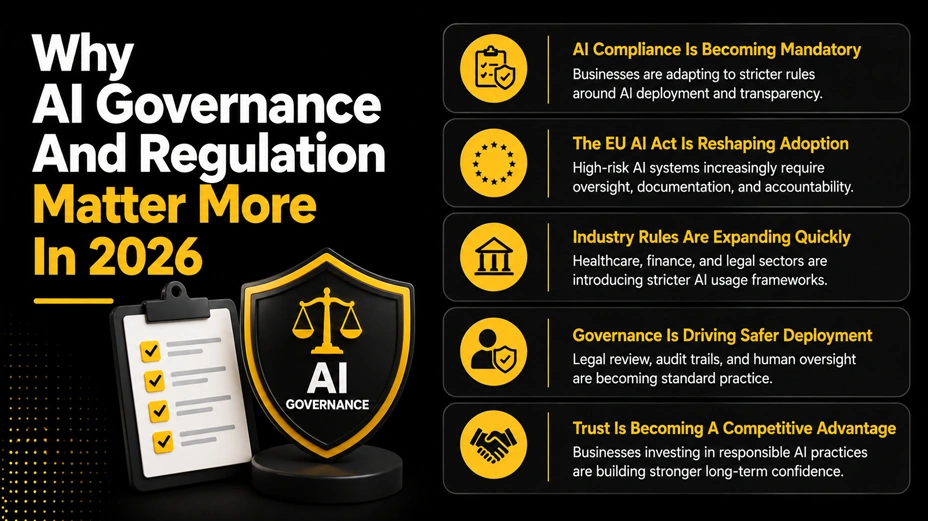
The global regulatory environment around generative AI technology has moved from discussion to enforcement in 2026. This is no longer a “watch this space” situation.
Key regulatory developments shaping generative AI for business:
- EU AI Act: the world’s most comprehensive AI regulation is now in phased enforcement, with high-risk AI systems subject to mandatory transparency, human oversight, and conformity assessment requirements (European Union)
- US Executive Orders on AI: federal agencies are implementing requirements around AI procurement, safety testing, and disclosure for government-adjacent use cases
- Sector-specific rules: healthcare, finance, and legal sectors are seeing tailored guidance on when and how generative AI applications can be used in high-stakes decisions
- Copyright litigation: multiple ongoing cases involving training data usage are establishing precedents that will affect how every generative AI company operates
For businesses, this means:
- Legal review of generative AI tool procurement is no longer optional
- Compliance teams need to be involved in model selection and deployment decisions
- Documentation of AI-assisted outputs is becoming a regulatory expectation in certain sectors
- International deployments require understanding local frameworks, not just the EU AI Act
Regulation is not the enemy of generative AI trends. Handled thoughtfully, clear rules create trust, and trust drives adoption. The organizations investing in compliance infrastructure now will face fewer disruptions later.
Where Generative AI Technology Stands in 2026: A Quick Snapshot
| Dimension | Status in 2026 |
| Market size | $83.3B and growing toward $988.4B by 2035 |
| Enterprise adoption | 88% of organizations using AI in at least one business function (AmplifAI) |
| ROI reality | 95% seeing zero return; 5% extracting significant value |
| AI agent integration | Rising from 5% to 40% of enterprise apps by end of 2026 |
| Cybersecurity risk | 54% of enterprises experienced AI-targeted attacks in 12 months |
| Responsible AI readiness | 87% recognize importance; 85% say they are not ready |
Conclusion
The future of generative AI in 2026 is not a question of whether to participate. That decision has largely been made for most organizations. The real questions now are about how to do it well: how to prove ROI, govern responsibly, defend against new attack surfaces, stay compliant with emerging regulation, and build the human judgment layer that keeps autonomous systems from running off the rails.
Generative AI models are more capable than ever. Generative AI tools are more embedded in daily workflows than ever. The generative AI company landscape is more competitive, more specialized, and more accountable than ever. What this moment demands is not more excitement about what the technology can theoretically do but a clear-eyed strategy about how to deploy it in ways that actually deliver value.
The organizations that get this right in 2026 will not just survive the AI transition. They will define what comes next.
If you need help building a generative AI strategy that is grounded in real business outcomes, you can reach out at coffee@sparkeighteen.com.