Picking a frontend framework is not a purely technical decision. It affects how quickly your product ships, how much it costs to build and maintain, what kind of engineers you need to hire, and how well the application scales as your user base grows. The wrong choice does not just slow down your development team. It can lock you into a stack that becomes expensive to migrate away from, or one that your business grows out of faster than expected.
React vs. Angular is one of the most searched comparisons in the technology space for a reason. Both are mature, battle-tested choices used in production by some of the largest companies in the world. Both can support complex, scalable applications. But they are built on fundamentally different philosophies, and those differences have real consequences for the kind of product you can build and the team you need to build it.
Any honest react js vs angular evaluation reaches the same conclusion: there is no universal winner. React and Angular each fit different product requirements, team compositions, and business contexts. This blog unpacks each framework honestly, compares them across the factors that matter to businesses, and gives you a practical decision framework to reach a confident choice for your specific situation.
Key takeaways
- React is a flexible UI library; Angular is a complete, opinionated full framework. The right choice depends on your product complexity and team.
- Angular JS vs React JS comparisons often focus on syntax, but the more important differences are in architecture, type safety, and built-in tooling.
- React suits teams that prefer composability and ecosystem choice; Angular suits teams that need structure, enterprise tooling, and built-in conventions.
- Performance differences between React and Angular are smaller than commonly claimed; implementation quality matters more than framework choice.
- Choosing between React and Angular without validating your team’s skills, your scaling requirements, and your integration needs is one of the most common and costly technology mistakes.
React vs. Angular: quick comparison at a glance
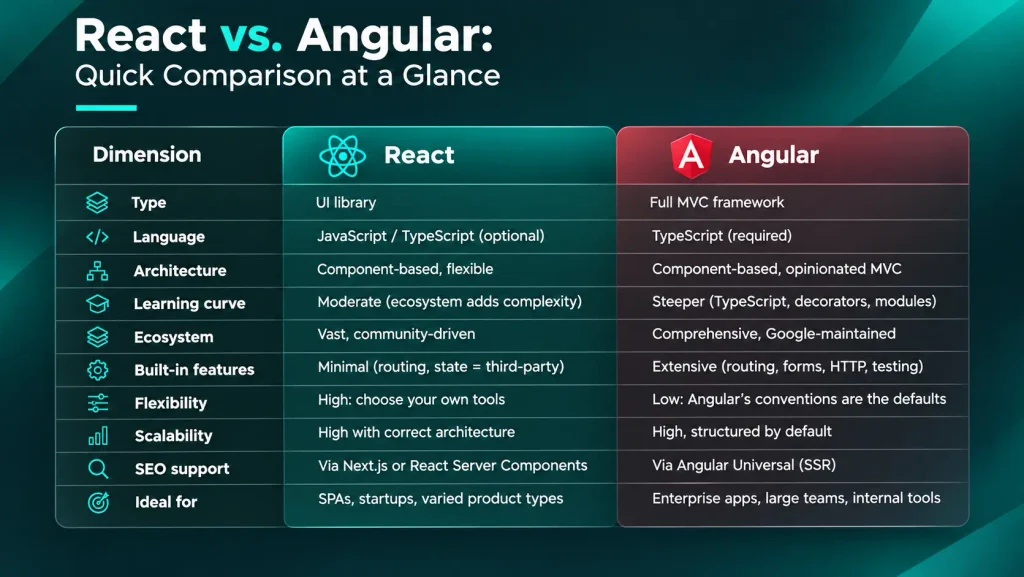
Before going deep on each framework, here is a structured side-by-side view covering the dimensions that most directly affect business and product decisions.
| Dimension | React | Angular |
|---|---|---|
| Type | UI library | Full MVC framework |
| Language | JavaScript / TypeScript (optional) | TypeScript (required) |
| Architecture | Component-based, flexible | Component-based, opinionated MVC |
| Learning curve | Moderate (ecosystem adds complexity) | Steeper (TypeScript, decorators, modules) |
| Ecosystem | Vast, community-driven | Comprehensive, Google-maintained |
| Built-in features | Minimal (routing, state = third-party) | Extensive (routing, forms, HTTP, testing) |
| Flexibility | High: choose your own tools | Low: Angular’s conventions are the defaults |
| Scalability | High with correct architecture | High, structured by default |
| SEO support | Via Next.js or React Server Components | Via Angular Universal (SSR) |
| Ideal for | SPAs, startups, varied product types | Enterprise apps, large teams, internal tools |
For business readers making this decision: React gives you more control and flexibility at the cost of more decision-making. Angular gives you more structure and consistency at the cost of a steeper initial investment. Neither choice is wrong; they simply serve different contexts well.
What is React? Understanding its architecture and business applications
React is a JavaScript library developed and maintained by Meta (formerly Facebook). First released in 2013, it has become one of the most widely used frontend technologies in the world. React introduced the concept of a virtual DOM and component-based UI development into mainstream web development, and both ideas have since influenced the broader ecosystem including Angular itself.
What makes React distinctive is what it does not include by default. It handles UI rendering and component management, and leaves routing, state management, testing, and API communication to the developer to assemble from the ecosystem. This has made it extremely flexible, and also more complex to standardise at scale.
How React works
React applications are built from components: self-contained units of UI that manage their own state and render based on props passed from parent components. React’s virtual DOM computes the minimum number of real DOM changes required to reflect a state update, which keeps rendering fast in most practical applications.
React does not enforce any particular folder structure, state management pattern, or routing solution. This freedom allows teams to tailor their stack precisely to the product’s needs, but it also means decisions that Angular makes automatically must be made deliberately in React.
Key features of React
React’s core features include JSX (a syntax extension that lets you write HTML-like code in JavaScript), a unidirectional data flow, hooks for managing state and side effects in functional components, and a reconciliation algorithm that handles efficient re-rendering. React also supports concurrent rendering as of React 18, which improves responsiveness in complex UIs.
React ecosystem and commonly used tools
The React ecosystem is one of the richest in frontend development. Common additions to a React project include React Router or TanStack Router for routing, Redux, Zustand, or Jotai for state management, React Query or SWR for server state, Vite or Webpack for bundling, and Jest with React Testing Library for testing.
For teams building on React, Spark Eighteen’s guide to React.js features and benefits covers the practical engineering and product considerations in depth.
Advantages of React for businesses
React advantages over Angular include faster time to first prototype, a larger global talent pool, and a higher degree of flexibility in how the application is structured. React’s component model is straightforward to learn for developers already familiar with JavaScript, and its ecosystem has excellent support for modern patterns like micro-frontends, design systems, and server components.
React’s ecosystem also has stronger tooling for certain application types, particularly consumer-facing products that require highly optimised, visually complex interfaces.
Limitations and challenges of React
React’s main challenge for businesses is the absence of built-in opinions. Teams that do not establish clear architectural standards early often end up with inconsistent codebases as the project scales. Choosing the wrong state management approach, over-engineering the data layer, or failing to manage bundle size are common sources of technical debt in React applications.
React also does not ship with a built-in solution for server-side rendering, which requires adopting a framework like Next.js for SEO-sensitive applications.
Types of applications best suited to React
React performs particularly well in single-page applications, consumer-facing web products, design-system-driven interfaces, marketing-heavy sites with complex interactive components, and applications that share UI components across web and mobile via React Native. It is also well-suited to startups and products that expect frequent changes in direction, since its flexibility means lower migration costs when requirements shift.
What is Angular? Understanding its architecture and business applications
Angular is a full-featured frontend framework developed and maintained by Google. It was first released as AngularJS in 2010, then completely rewritten as Angular 2 in 2016. The modern Angular (versions 2 through the current release) is a significantly different product from AngularJS in architecture, language, and philosophy. When people discuss angular js vs react js today, or debate angular or react js for a new project, they are comparing the modern Angular (version 2+) with React, not the original AngularJS.
Angular takes the opposite approach to React. It includes routing, form handling, HTTP communication, state management patterns, and testing utilities out of the box. Teams adopting Angular accept Google’s opinions about how an application should be structured in exchange for a consistent, predictable development experience.
How Angular works
Angular applications are structured around modules, components, services, and dependency injection. Components define the UI; services handle business logic and data; modules group related functionality. Angular uses TypeScript exclusively and relies heavily on decorators to annotate classes with Angular-specific metadata.
Angular’s change detection system monitors the application state and updates the DOM accordingly. The framework also supports reactive programming via RxJS, which is used extensively for handling asynchronous operations and event streams.
Key features of Angular
Angular’s key features include a built-in dependency injection system, two-way data binding for form-heavy applications, the Angular CLI for project scaffolding and build optimisation, a built-in HTTP client, Angular Material for UI components, and the Angular testing utilities that integrate with Jasmine and Karma. Angular 17 introduced signals, a modern reactivity primitive that improves performance and simplifies state management.
Angular ecosystem and built-in development tools
Angular’s ecosystem is narrower than React’s but more internally consistent. The Angular CLI handles project creation, development server, testing, and production builds. NgRx provides Redux-pattern state management for complex applications. Angular Material provides a complete design system. Angular Universal enables server-side rendering. Because Angular makes most of these decisions for you, the ecosystem debate matters less than it does in React.
Advantages of Angular for businesses
Angular suits businesses that need consistency across large teams. Because the framework makes architectural decisions by default, two Angular developers who have never worked together will be more likely to structure a feature the same way than two React developers would. This consistency reduces onboarding time, makes code reviews faster, and helps large organisations maintain codebases across team changes.
Angular’s TypeScript requirement also reduces certain categories of runtime errors and makes large refactors safer. For enterprise projects with multi-year maintenance horizons, this matters significantly.
Limitations and challenges of Angular
Angular’s main limitation for businesses is its steeper learning curve. TypeScript, decorators, dependency injection, RxJS, and Angular’s module system are all required knowledge before a developer can contribute meaningfully. This makes early-stage projects slower to get off the ground and can be a hiring bottleneck in markets where Angular specialists are less common than React developers.
Angular’s bundle sizes have historically been larger than React’s, though improvements in Angular 17 and the introduction of standalone components have reduced this considerably.
Types of applications best suited to Angular
Angular performs best in enterprise applications, internal tools, large-scale dashboards, complex form-heavy applications, and products where multiple teams work on the same codebase simultaneously. Its built-in structure and TypeScript requirements are constraints that pay off when the codebase is large and needs to be maintained by people who did not write it.
React vs. Angular: 10 important differences businesses should understand
The debate between react vs angular is often framed too narrowly, focusing on syntax or bundle size while ignoring the differences that have the most practical impact on a business. Here are ten differences that actually matter.
Library vs. full framework
React is a library. Angular is a framework. This is the most fundamental difference between angular js and react js, and it shapes everything downstream. With React, you assemble an application from a collection of libraries. With Angular, you build inside a framework that makes those decisions for you. Neither approach is superior; they represent different philosophies about where control should sit.
Architecture and application structure
React applications can be structured in many ways. Angular applications follow a prescribed module-service-component pattern. For small teams, React’s flexibility is an advantage. For large teams, Angular’s consistency is worth the upfront constraint.
Programming language and type safety
React supports both JavaScript and TypeScript. Angular requires TypeScript. TypeScript adds development-time type safety, IDE support, and refactoring confidence, but it also adds compile-time overhead and requires developers to learn the type system. For teams already using TypeScript, Angular’s requirement is not a drawback. For teams new to TypeScript, it extends the learning curve.
Component development and reusability
Both frameworks use component-based architecture, but React’s components are simpler to write and test in isolation. Angular components carry more boilerplate due to the decorator system and module requirements. This difference becomes significant in projects that prioritise a component library or design system as a core deliverable.
State management and data flow
React has no built-in state management beyond component-level state and Context API. For applications with complex shared state, teams typically add Redux, Zustand, or Jotai. Angular provides RxJS and NgRx for reactive state management. Choosing the wrong state management approach in React is a common source of technical debt; Angular’s conventions guide teams toward more consistent patterns.
Performance and rendering
Both frameworks are fast in well-implemented applications. React’s virtual DOM and Angular’s incremental DOM (since Angular Ivy) take different approaches to rendering efficiency, but the difference is marginal in most applications. Performance depends far more on how components are written, how state is managed, and how data fetching is structured than on the framework itself.
SEO and server-side rendering
React’s default client-side rendering requires additional configuration for SEO-sensitive applications. Next.js is the standard solution. Angular Universal provides SSR for Angular applications. Both approaches work, but React’s SSR story is more mature and better documented. For teams where SEO is a primary product requirement, this is a meaningful consideration.
Security and application maintenance
Angular’s prescriptive nature tends to lead to more consistent security practices across a codebase. React’s flexibility means security decisions vary by team and can be inconsistent without explicit standards. Both frameworks have active security maintenance from their respective organisations and regular patch releases.
Ecosystem, integrations, and third-party libraries
React has a larger ecosystem, more third-party libraries, and stronger community tooling for a wider range of use cases. Angular’s ecosystem is narrower but more internally consistent. For products with unusual integration requirements, React’s ecosystem breadth can be a meaningful advantage.
Developer availability and team onboarding
React has a larger global developer pool. When teams are deciding between angular or react js based on hiring constraints, this talent availability difference is often decisive. Angular developers are more specialised. In most hiring markets, finding React engineers is faster and less expensive than finding Angular engineers with equivalent seniority. For businesses planning rapid team growth, this is a practical constraint worth factoring into the decision.
| Difference | React impact | Angular impact |
| Library vs. framework | More decisions required | Faster consistency at scale |
| Structure | Flexible, requires standards | Prescribed, reduces variability |
| TypeScript | Optional | Required |
| Component model | Simpler, less boilerplate | More structured, more setup |
| State management | Third-party choices required | RxJS / NgRx built in |
| Performance | Excellent with good architecture | Excellent with good architecture |
| SEO | Requires Next.js or RSC | Requires Angular Universal |
| Security | Depends on team discipline | More consistent by default |
| Ecosystem | Vast, varied | Focused, internally consistent |
| Hiring | Larger talent pool | Specialist pool, more selective |
React vs. Angular performance: which is better for scalable applications?
Performance is the most commonly misrepresented dimension in any react vs angular discussion. Generic claims that one is faster than the other rarely reflect real application conditions. Generic claims that one is faster than the other are almost always based on benchmarks that do not reflect real application conditions. The reality is more nuanced and more useful.
Rendering and application responsiveness
React uses a virtual DOM to batch DOM updates and minimise repaints. Angular Ivy uses a tree-shakeable incremental DOM that reduces runtime overhead. In practice, the angular js vs react js rendering approaches both deliver fast results in well-implemented applications. The rendering architecture is not the primary variable in production performance.
Performance under high user traffic
Under high load, the performance bottleneck is typically not the frontend framework but rather the API, the database, and the CDN strategy. Both React and Angular deliver consistent client-side performance at high traffic volumes. The choice between angular js vs react js does not meaningfully change how a frontend application performs under server-side stress.
Code optimisation and bundle size
React’s minimal footprint means smaller initial bundle sizes when third-party libraries are managed carefully. Angular’s built-in features add to the base bundle but reduce the need for additional libraries. With modern tree-shaking and code splitting, both frameworks can achieve comparable production bundle sizes when optimisation is treated as a first-class concern.
API communication and data-heavy interfaces
Angular’s built-in HTTP client and RxJS integration provides structured patterns for managing API requests, caching, error handling, and reactive data streams. React teams typically use React Query or SWR for server-state management, which provides comparable functionality with a different API. Neither approach has a meaningful performance advantage in most applications.
What matters more: framework choice or implementation quality?
Implementation quality. Every performance audit Spark Eighteen has conducted on underperforming frontend applications has identified implementation issues, not framework limitations, as the root cause. Unnecessary re-renders, unmanaged bundle growth, missing code splitting, inefficient data fetching, and absent caching are the common culprits, and they appear in both React and Angular applications. If your team has strong frontend engineering discipline, either framework can support a highly performant application. The question of which is better angular or react ultimately comes down to team, product context, and architectural discipline. If it does not, neither framework will save you.
React vs. Angular: which framework is better for different business applications?
The right answer to react js vs angular depends heavily on what you are building. Here is how the two frameworks align with common product types.
SaaS platforms and subscription-based applications
SaaS products typically have complex, evolving interfaces, diverse user roles, frequent feature additions, and varying UX requirements across customer segments. React’s composability and ecosystem flexibility make it well-suited here. The react advantages over angular in rapidly evolving SaaS products include faster iteration cycles and a broader ecosystem of UI libraries, particularly when the product team expects the interface to change frequently. Angular suits SaaS products that prioritise consistency, particularly those with large development teams working on the same codebase.
Enterprise applications and internal dashboards
This is where Angular performs at its best. Enterprise applications are characterised by complex forms, multi-module codebases, large engineering teams, and long maintenance lifespans. Angular’s enforced structure, TypeScript requirement, built-in dependency injection, and comprehensive built-in tooling significantly reduce the coordination overhead that grows rapidly in React-based enterprise projects without deliberate architectural standards.
eCommerce websites and marketplaces
eCommerce applications prioritise SEO, page speed, and Core Web Vitals. In this context, react js vs angular comparisons consistently favour React due to the Next.js ecosystem’s SSR maturity. React with Next.js is the dominant choice in this space for good reason: Next.js provides incremental static regeneration, server-side rendering, and edge-deployed pages that deliver strong SEO and performance. The difference between angular or react js in eCommerce is primarily driven by the maturity of the React/Next.js ecosystem for this use case.
FinTech and payment applications
FinTech applications require security, complex form handling, real-time data updates, and rigorous testing. Angular’s TypeScript requirement, built-in validation utilities, and RxJS integration for real-time streams make it a natural fit. React can serve FinTech applications equally well with the right libraries, but the additional setup cost is real. For teams new to both frameworks, Angular’s prescriptive structure reduces the number of security-relevant architectural decisions that must be made from scratch.
Healthcare and patient-facing platforms
Healthcare platforms require accessibility, security, compliance, and performance across diverse devices. Both frameworks are used in healthcare. The choice depends more on team expertise and compliance requirements than on the framework. Teams that value Angular’s structured TypeScript patterns for handling complex patient data flows often prefer it for backend-for-frontend layers and clinical dashboards.
Real-time applications and data-intensive platforms
Real-time applications, trading dashboards, monitoring tools, and analytics interfaces require efficient handling of frequent data updates. Angular’s RxJS integration provides native support for reactive data streams, which suits high-frequency update patterns well. React handles real-time data well with the correct state management setup, but RxJS’s composability gives Angular teams a natural advantage in applications where event streams are complex.
Startup MVPs and rapidly evolving products
For early-stage products where speed to market, iteration, and hiring flexibility are the primary concerns, React is typically the stronger choice. The larger developer pool reduces hiring risk. The flexibility allows the product to pivot without deep framework refactoring. The absence of enforced structure is a worthwhile trade-off when the product has not yet settled on its final architecture.
React vs. Angular development cost and time-to-market
Understanding the financial implications of this choice requires looking beyond initial development cost to the full lifecycle of the product. When evaluating react vs angular for a business decision, cost has multiple dimensions.
Initial development effort
React projects typically start faster because the library is smaller and the first few components are quicker to build. Angular projects require more setup time: TypeScript configuration, module structure, service injection, and the Angular CLI workflow all require upfront investment. For projects under six months in development, React often delivers faster initial output. For projects with longer development cycles, the difference diminishes.
Developer hiring and team availability
React developers are more widely available and, in most markets, less expensive to hire at equivalent skill levels. Angular developers are more specialised and may require longer recruiting cycles. For businesses planning to scale their engineering team, this hiring landscape deserves explicit consideration in the technology decision.
Third-party tools and infrastructure costs
React projects often require additional paid or maintained libraries for state management, routing, and form handling. Angular’s built-in equivalents reduce direct licensing or maintenance costs for these functions. The total cost difference is typically small but worth quantifying for large teams.
Maintenance and upgrade considerations
Angular follows a predictable release cycle with long-term support versions and an official migration guide between versions. React’s core API has remained stable, but the ecosystem libraries that React projects depend on change independently and require more active maintenance. Teams that underestimate ecosystem maintenance costs often find that React projects require more ongoing upkeep than Angular projects of comparable size.
Long-term total cost of ownership
Both frameworks are free and open source. In any react framework vs angular cost analysis, the meaningful differences appear in team size, ecosystem maintenance, and hiring costs, not licensing. Long-term cost is determined by team size, upgrade cycles, the complexity of the ecosystem you adopt, and how often the product requires significant architecture changes. Neither react framework vs angular is categorically cheaper over a five-year horizon. The cost outcome depends on the team, the product, and the management of technical debt.
React vs. Angular: which framework is better for SEO?
SEO performance is frequently cited as a deciding factor in the react js vs angular debate, often with oversimplified conclusions that collapse complex implementation decisions into a simple framework preference. The reality requires more precision.
Client-side rendering vs. server-side rendering
Both React and Angular default to client-side rendering, in which the browser downloads a JavaScript bundle and renders the page. Search engine crawlers have improved their JavaScript rendering capabilities, but client-side rendered pages are still at a disadvantage for SEO compared to server-rendered HTML, particularly for time-sensitive indexing and Core Web Vitals performance.
SEO options in React applications
React’s primary SSR solution is Next.js, which offers static site generation, server-side rendering, incremental static regeneration, and React Server Components. Next.js is a mature framework with excellent SEO tooling, strong documentation, and widespread production adoption. For teams prioritising SEO, adopting Next.js alongside React is the standard approach and is well-supported.
For a detailed look at how Next.js compares to plain React and what the architectural implications are, Spark Eighteen’s Next.js vs. React deep dive is a practical guide.
SEO options in Angular applications
Angular’s SSR solution is Angular Universal, integrated directly into the Angular CLI since Angular 16. Angular Universal enables server-side rendering and static site generation. It is a less commonly deployed solution than Next.js, partly because Angular’s primary audience is enterprise and internal tooling, where SEO is less critical. For public-facing Angular applications, Angular Universal is capable but requires more configuration and has fewer third-party guides.
Page speed, Core Web Vitals, and crawlability
Page speed, Largest Contentful Paint, Cumulative Layout Shift, and First Input Delay are the primary SEO performance signals in Google’s ranking algorithm. These metrics are determined by how efficiently the page loads and renders, not by which framework was used to build it. A well-implemented Angular app with server-side rendering can outperform a poorly optimised React app, and vice versa.
Technical SEO considerations before selecting a framework
Before selecting a framework based on SEO requirements, define specifically which SEO signals matter to your product. If you need fast indexing of frequently updated content, server-side or incremental static rendering is a requirement regardless of framework. If your product is an enterprise dashboard behind authentication, SEO is irrelevant to the framework decision. Linking SEO requirements to architectural requirements first prevents the mistake of using SEO as a tiebreaker when it is not actually a differentiating factor.
Common mistakes businesses make when choosing React or Angular
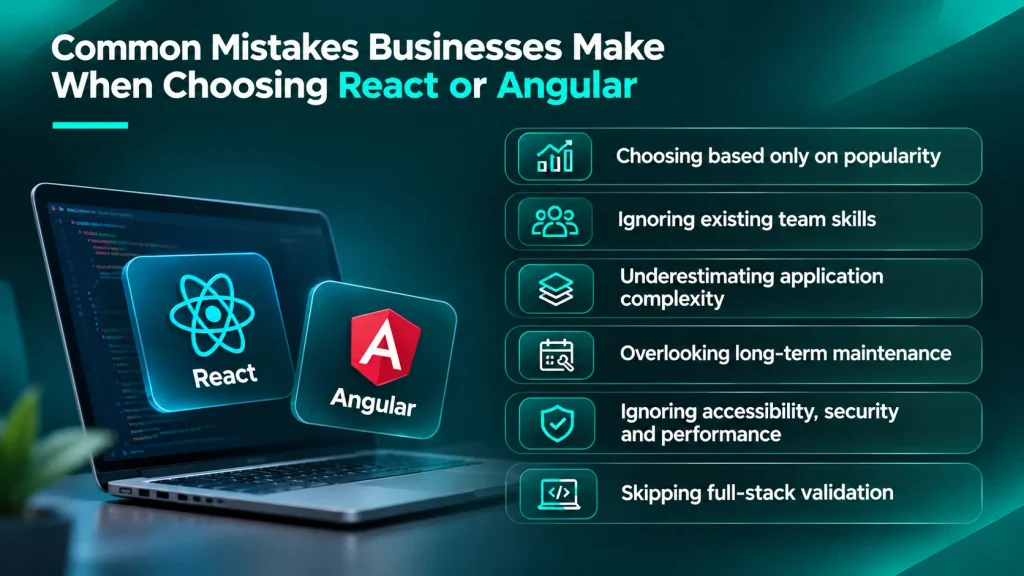
The wrong choice between angular or react which is best for your context is rarely the result of a bad instinct. It is usually the result of a flawed decision process.
Choosing based only on popularity. React being the more popular choice does not make it the right choice for every project, just as the react advantages over angular in flexibility do not outweigh Angular’s strengths in contexts that require built-in structure. Stack Overflow surveys and GitHub star counts reflect the choices of the total developer population, not the conditions of your specific product. React being more popular does not make it the right choice for your enterprise dashboard project. Angular being more structured does not make it the right choice for your startup MVP.
Ignoring existing team skills. The fastest route to a working product is building with what your team already knows well. The difference between angular js and react js in terms of learning curve is real, and reskilling an experienced React team to Angular (or vice versa) incurs genuine productivity costs that are often excluded from initial estimates.
Underestimating application complexity. Products almost always grow more complex than originally scoped. Choosing React for a product that evolves into an enterprise-scale system often requires architectural retrofitting that could have been avoided with Angular’s structure from the start.
Overlooking long-term maintenance. The team that ships the first version is rarely the team that maintains the product three years later. Angular’s enforced conventions make a codebase easier for a new team to understand and extend. React codebases without explicit standards can become difficult to onboard into.
Ignoring accessibility, security, and performance requirements. Both frameworks support all three, but each requires deliberate investment. Neither will deliver accessible, secure, or performant software by default. Treat these as explicit requirements, not side effects of choosing the right framework.
Selecting a framework without validating the complete technology stack. The react framework vs angular choice does not exist in isolation. The angular or react choice does not exist in isolation. It has implications for your build tooling, your testing strategy, your CI/CD pipeline, your CDN configuration, and your deployment infrastructure. Validate the full stack before committing.
How to choose between React and Angular: a practical decision framework
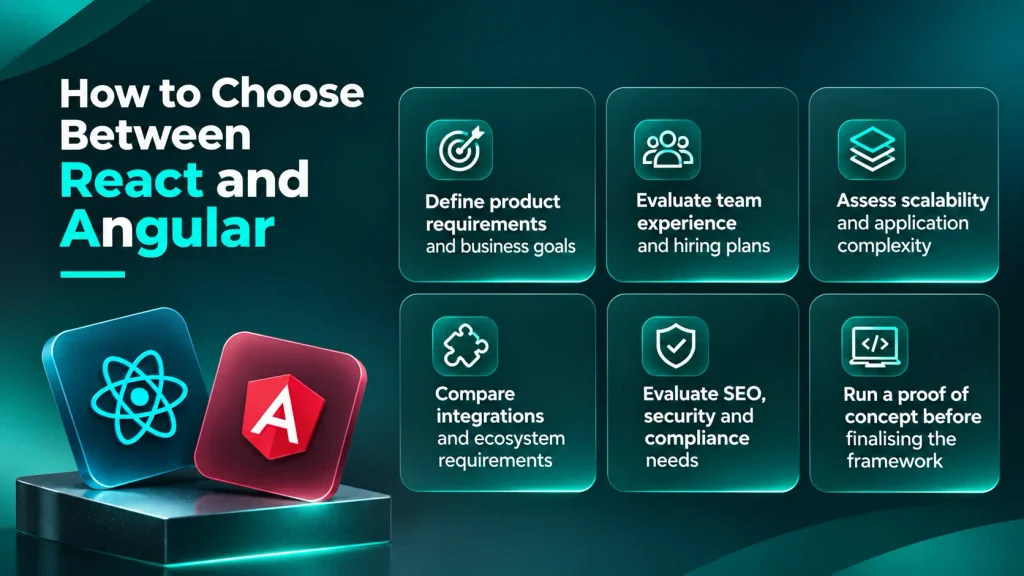
There is no universal answer to which is better angular or react for a given business. There is a process for reaching the right answer for your context.
Define your product requirements and business goals
Start with what the product needs to do, not with the technology. Understanding the difference between angular js and react js philosophically, not just syntactically, is what makes this step productive. What is the complexity of the UI? How many concurrent users will the system need to serve? Is SEO a growth requirement? Is the product primarily internal or public-facing? What is the expected lifespan of the codebase? The answers to these questions should shape the technology choice, not the other way around.
Evaluate team experience and hiring plans
Take a clear-eyed look at your existing team’s skills and your hiring timeline. If your team is experienced in one framework, the burden of proof for switching is high. If you are building a new team, factor in talent availability in your hiring market and the risk profile of building on a less common framework.
Assess scalability and expected application complexity
If the application is expected to remain relatively contained and focused, React’s flexibility is manageable. If the application is expected to grow into a large, multi-module system maintained by multiple teams over several years, Angular’s enforced structure becomes an asset rather than a constraint.
For teams navigating this kind of technology decision without in-house senior engineering leadership, Spark Eighteen’s guide to making critical tech decisions without a technical co-founder is a useful reference.
Compare integrations and ecosystem requirements
Document the third-party systems your application needs to integrate with. Check which framework has better-maintained or more widely used connectors for those systems. In most cases, both frameworks will have adequate integration options, but specific industries or platforms may have better community support in one ecosystem than the other.
Evaluate SEO, security, and compliance needs
If SEO is a primary growth lever, make SSR a first-class architectural requirement and validate how each framework supports it in your specific deployment context. If your product handles sensitive data subject to regulatory requirements, evaluate which framework’s built-in tooling reduces the surface area for security mistakes.
Run a proof of concept before making the final decision
For projects with a development lifecycle over six months, investing two to four weeks in a proof of concept is almost always worthwhile. Build the most complex anticipated part of your system, not the simplest. If the most technically demanding feature works well in one framework, that is a stronger signal than any benchmark or survey.
Decision matrix:
| Choose React when… | Consider Angular when… | Evaluate both when… |
| Team is experienced in React | Team is experienced in Angular | Greenfield project, no team constraint |
| Product is a consumer SPA or marketing-driven site | Product is enterprise, internal tooling, or multi-team | Building an enterprise SaaS with high UI complexity |
| Hiring flexibility and talent pool size matter | Codebase consistency across a large team is a priority | Strong SEO requirements with complex UI |
| Product direction may change significantly | Long-term maintenance by rotating teams is expected | Tight budget for tooling decisions |
| Rapid prototyping and iteration is the priority | Type safety and built-in conventions reduce decision fatigue | Regulated industry with strict compliance requirements |
React vs. Angular: final verdict
After going through all the dimensions, the conclusion that holds up across every honest react vs angular comparison is this: both frameworks are excellent choices for the right context, and genuinely poor choices for the wrong one.
In a react vs angular comparison, React gives you speed, flexibility, and ecosystem breadth. It is the better choice when your team has the discipline to manage that flexibility, when your product needs to move quickly, or when you are building consumer-facing interfaces that require a customised experience. React advantages over angular become most apparent in products that iterate frequently and teams that value composability over convention.
Angular gives you structure, type safety, and built-in tooling. It is the better choice when your team values consistency, when the product is large and long-lived, when enterprise compliance and security require clear architectural standards, or when you are building for teams that may not have been involved in the initial build. The question of angular or react which is best is ultimately about your context, not about the technology itself.
As an IT company that has built frontend systems across consumer, enterprise, and healthcare contexts, Spark Eighteen’s view is straightforward: there is no default correct answer, but there is a correct process for reaching one. If you are unsure which framework your product needs, we can help you work through the decision with the specificity your project requires.