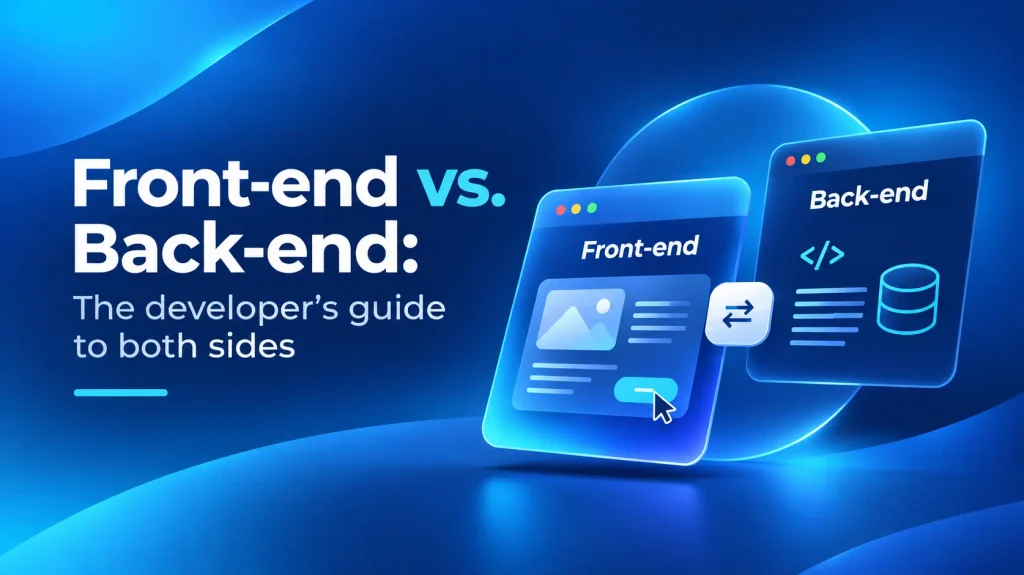
Every time you open a website, two entirely separate systems swing into action. One determines what you see, how it looks, and whether clicking a button feels satisfying or frustrating. The other decides what data you get, how fast it arrives, and whether your actions are saved, processed, and returned reliably.
That split, between what happens in the browser and what happens on the server, is the foundation of front-end and back-end development. Understanding this difference matters whether you are hiring a developer, planning a product, managing a team, or simply trying to have a more informed conversation with your engineering department.
Discussions around front-end vs back-end development often stay surface-level. This blog goes deeper. You will learn what each discipline actually involves, which technologies define each side, how the two interact, and how to think about investment and hiring decisions when building or scaling a digital product. Whether you are navigating backend vs frontend development conversations with your team or making a career decision, this guide covers what actually matters.
Key takeaways
- Front-end development handles everything users see and interact with; back-end development handles data, server logic, and processing.
- Front-end developers work with HTML, CSS, and JavaScript frameworks; back-end developers work with server-side languages, databases, and APIs.
- Both sides rely on distinct frontend and backend technologies that must communicate seamlessly.
- Understanding back end vs front end web development helps teams hire more precisely, estimate work more accurately, and build products more deliberately.
- Full-stack development combines both disciplines, but deep expertise on one side still produces better outcomes for complex products.
What is front-end and back-end development?
Frontend and backend development are the two foundational layers of any web or mobile application. While they serve completely different purposes, they are not independent. Every user action on the front end triggers a process on the back end, and the back end shapes what the front end can display.
Understanding front-end and back-end development as a system, rather than two separate silos, is what separates experienced engineering teams from fragmented ones. The handoff between the two sides happens thousands of times in a single user session, and the quality of that handoff directly determines how the product performs.
Defining front-end development
Front-end development refers to everything a user directly sees and interacts with in a web application. This includes the layout, visual design, navigation, buttons, forms, animations, and the responsiveness of the interface across different screen sizes. front-end web development is the craft of translating visual designs into working, interactive code that runs inside a browser.
The core languages of the front end are HTML, which structures content; CSS, which styles it; and JavaScript, which makes it dynamic. Beyond these fundamentals, frontend website development now involves a broad set of tools, front end development frameworks, build systems, and component libraries that have fundamentally changed how interfaces are built and maintained.
Spark Eighteen’s perspective on the role of front-end development in user experience goes deeper on how front-end choices directly shape product quality and user retention.
Defining back-end development
Back-end development covers everything that happens on the server side of an application. It includes the server itself, the database, the application logic, the API layer, and all the processes that run behind what users see. When you submit a form, the front end sends the data to the back end, which validates it, stores it, processes it, and returns a response.
Back-end developers are responsible for the reliability, security, scalability, and performance of the system. If the front end is what users touch, the back end is the infrastructure that makes those interactions meaningful and durable.
For teams building mobile products with complex server-side requirements, Spark Eighteen’s mobile app backend development guide covers the architecture decisions that matter most at scale.
Why the distinction matters
The front-end and back-end distinction is not merely semantic. It shapes how teams are structured, how projects are scoped, how bugs are diagnosed, and how systems scale. Knowing which side of the stack a problem lives on is the first step to fixing it efficiently, and the first step to building a team capable of fixing it at all.
Front-end vs. back-end development: a quick comparison
Before going deeper on each side, here is a side-by-side view of back end vs front end web development at a high level.
| Aspect | Front-end development | Back-end development |
| Runs on | Browser / client | Server |
| Core languages | HTML, CSS, JavaScript | Python, Java, Go, PHP, Node.js |
| Main concern | UI, UX, visual output | Logic, data, server performance |
| Primary frameworks | React, Vue.js, Angular | Django, Express, Spring, Laravel |
| Communicates via | HTTP requests, REST, GraphQL | APIs, databases, message queues |
| User visibility | Directly visible | Invisible to users |
| Testing focus | UI rendering, interaction, accessibility | Unit tests, integration, load testing |
| Performance metric | Page speed, rendering smoothness | Latency, throughput, uptime |
This snapshot of front-end vs back-end development captures the structural differences clearly, but the reality on working teams is more nuanced. Each discipline has its own career path, its own tooling ecosystem, and its own engineering culture.
What do front-end developers do?
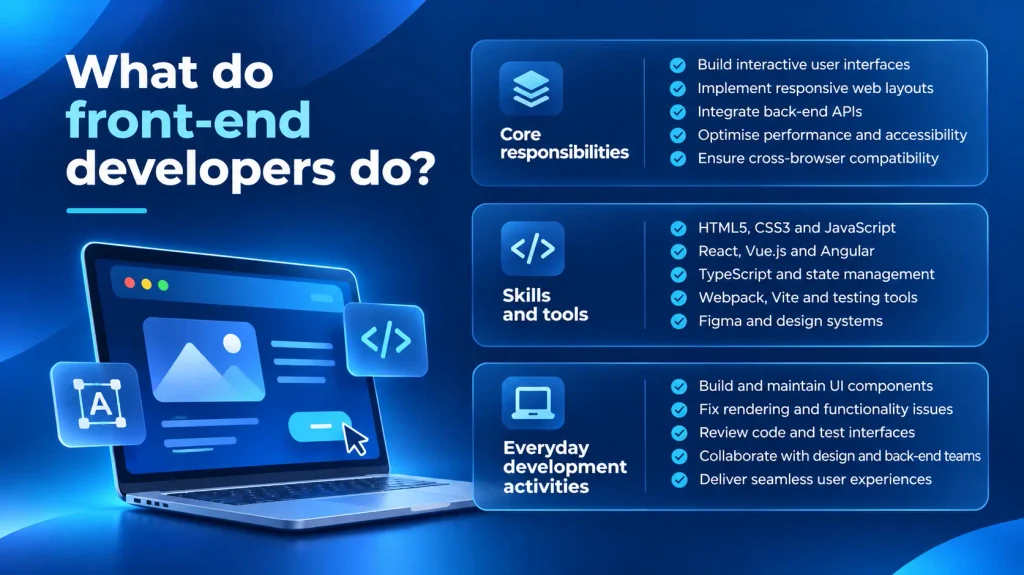
Front-end developers translate design specifications and business requirements into code that runs directly in a browser. Their work sits at the intersection of design, engineering, and user experience, and while the role has expanded significantly with modern JavaScript frameworks, the core responsibility has remained consistent: make the interface work correctly, look right, and behave intuitively across different devices and contexts.
Core responsibilities of front-end developers
Front-end developers build and maintain every visible element of a web product. This includes implementing layouts with HTML and CSS, writing JavaScript to manage dynamic behaviour, integrating with back-end APIs to fetch and display data, and optimising the interface for speed and accessibility.
They are also responsible for cross-browser compatibility, mobile responsiveness, and ensuring that front end development frameworks are used consistently across the codebase. In teams that work with design systems, these engineers often own the component library and set standards for how the UI is built across the product.
Skills and tools front-end engineers use
The modern front-end stack typically includes HTML5, CSS3, and JavaScript (ES6+). Beyond these, front-end frameworks like React, Vue.js, or Angular are standard across most product teams. UI engineers also work with TypeScript, state management libraries, CSS preprocessors, bundlers like Webpack or Vite, and testing tools such as Jest and Cypress.
front-end specialists who work on design-heavy products may also be comfortable in Figma and have opinions on design tokens, spacing systems, and animation performance. The scope of the role varies considerably depending on team size and product type.
What front-end development looks like in practice
A typical sprint for front-end engineers involves implementing new UI components, fixing rendering bugs, reviewing pull requests, and collaborating with both design and back-end teams. In fast-moving product teams, frontend website development is rarely a solo activity. It requires alignment on API contracts, edge cases, and technical decisions that cross the boundary between front-end and back-end concerns.
What do back-end developers do?
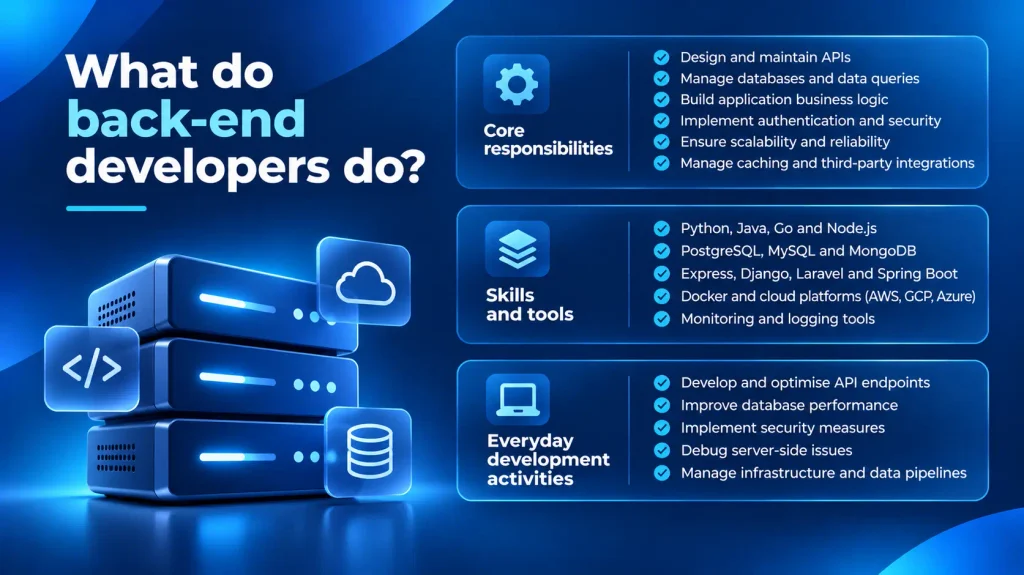
Back-end developers build the systems, services, and infrastructure that power everything users interact with on the front end. Their code does not render in a browser; it runs on servers, reads from and writes to databases, enforces business rules, and returns structured data to whatever client requests it.
Core responsibilities of back-end developers
Back-end developers design and maintain APIs, manage database schemas and queries, write the business logic that governs how data behaves, and ensure the application is secure, scalable, and reliable. They handle authentication, authorisation, background processing, caching, and third-party integrations.
Understanding backend languages for web development is core to the role. Each language brings different strengths: Python and Django for rapid development and data-intensive applications, Java and Spring for enterprise-scale systems, Go for high-performance services, and Node.js for real-time applications that want JavaScript across the full stack.
Skills and tools these back-end professionals use
back-end teams work with server-side languages, relational databases such as PostgreSQL and MySQL, and NoSQL databases such as MongoDB and Redis. They use backend frameworks like Express, Django, Laravel, Spring Boot, and FastAPI. They also manage containerisation tools like Docker, cloud infrastructure via AWS, GCP, or Azure, and monitoring and logging systems.
Understanding backend and frontend languages is increasingly useful for back-end engineers who need to interpret front-end errors, review API contracts, or contribute to shared tooling. Full fluency is not required, but working knowledge prevents blind spots.
What back-end development looks like in practice
A back-end developer’s sprint might include designing a new API endpoint, optimising a slow database query, adding rate limiting to a public endpoint, reviewing infrastructure changes, or debugging a data pipeline. For a deeper look at architecture decisions in real products, Spark Eighteen’s guide to backend development covers what actually matters when systems need to scale.
Frontend and backend technologies: languages and frameworks
Frontend and backend technologies are distinct ecosystems with different tooling cultures, different release cadences, and different optimisation priorities. Understanding both sides helps teams make informed decisions about stack choices, long-term maintenance, and hiring.
Both front-end and back-end sides of a product have experienced significant evolution over the last decade. The right understanding of frontend and backend technologies at the start of a project has long-lasting consequences, since migrating away from an entrenched stack is expensive and disruptive.
Frontend and Backend languages at a glance
The table below maps the primary Frontend and Backend languages used in modern web development:
| Layer | Languages | Primary use |
| Front-end | HTML, CSS, JavaScript, TypeScript | UI structure, styling, interactivity |
| Back-end | Python, Java, Go, PHP, Ruby, Node.js, C# | Server logic, data processing, APIs |
| Database | SQL (PostgreSQL, MySQL), NoSQL (MongoDB, Redis) | Data storage and retrieval |
| Shared | JavaScript / TypeScript via Node.js | Full-stack and server-side rendering |
This division reflects how backend and frontend languages have evolved separately: front-end languages are optimised for fast rendering in constrained browser environments, while back-end languages are optimised for concurrency, data throughput, and long-running processes.
Popular front-end frameworks
Front-end frameworks have fundamentally changed how interfaces are built. Rather than writing vanilla HTML and JavaScript for every feature, front end development frameworks introduce component-based architecture, declarative rendering, and state management patterns that make large codebases manageable and teams more productive.
The most widely adopted front-end frameworks today are React (maintained by Meta), Vue.js (community-led), and Angular (maintained by Google). React’s flexibility and ecosystem size make it the default choice for most product teams. Vue.js is favoured for its gentle learning curve and clean syntax. Angular is common in large enterprise codebases where convention and structure matter more than flexibility.
For teams using React in particular, Spark Eighteen’s guide to React.js features and benefits is a practical reference for engineering and product decision-makers.
Popular backend frameworks
Backend frameworks organise server-side code around conventions for routing, middleware, database access, and request handling. The most common backend frameworks in production today include Django and Flask for Python, Express and NestJS for Node.js, Spring Boot for Java, Laravel for PHP, and FastAPI for Python APIs that need high throughput.
The right backend framework depends on team familiarity, language preference, performance requirements, and ecosystem maturity. Django and Rails prioritise developer productivity and convention. Express and FastAPI prioritise flexibility and control. Spring Boot handles enterprise complexity at scale.
Backend languages for web development
The choice of backend languages for web development has long-term implications for team hiring, system performance, and infrastructure costs. Python dominates in data-heavy and machine-learning applications. Java and Go are preferred for high-throughput systems. PHP remains common in older CMS-driven products. Node.js has grown significantly as teams look to unify their stack under JavaScript or TypeScript.
Frontend and Backend languages each evolve at their own pace, so the right choice depends on the problem, the team’s existing expertise, and the product’s growth trajectory. No single language is universally superior.
10 key differences between front-end and back-end development
The debate around front-end vs back-end development often gets framed as a question of which is harder or more valuable. That framing is counterproductive. The two disciplines are genuinely different, and understanding how they differ helps teams collaborate better, hire more precisely, and avoid the assumption that one side of the stack automatically understands the other.
Here are ten meaningful differences that shape frontend and backend development in practice:
1. Where the code runs Front-end code runs in the user’s browser. Back-end code runs on a server. This shapes everything from how errors surface to how security must be enforced, and it means the two sides are tested and deployed in entirely different environments.
2. What the user sees these professionals work in the visible layer. server-side specialists work in the invisible layer. Neither is more important; both are essential. Products that excel on only one side fail to deliver on the other.
3. Primary languages Front-end relies on HTML, CSS, and JavaScript. Back-end relies on Python, Java, Go, PHP, or other server-side languages. Frontend and backend languages reflect the fundamentally different environments in which code runs.
4. Frameworks and tools front-end teams use front-end frameworks like React, Vue, or Angular. back-end engineers use backend frameworks like Django, Express, or Spring Boot. Each set of tools is optimised for its environment.
5. Data handling Front-end code receives and displays data. Back-end code retrieves, validates, transforms, and stores it. The two sides meet at the API boundary, where data format and structure must be agreed in advance.
6. Performance concerns front-end engineers optimise for page speed, rendering performance, and smooth interaction. these professionals optimise for query speed, server throughput, and system reliability. The metrics are different, but both matter to users.
7. Security responsibilities Both sides share security responsibility differently. interface engineers must protect against XSS and UI-layer vulnerabilities. back-end teams handle authentication, authorisation, injection attacks, and data protection.
8. Testing approach Front-end testing focuses on UI behaviour, component rendering, and user interactions. Back-end testing focuses on unit tests for business logic, integration tests for APIs, and load tests for performance under demand.
9. Career development front-end engineers often develop skills in design systems, accessibility, and UX engineering. back-end engineers develop expertise in databases, distributed systems, and infrastructure. These are different professional disciplines.
10. How the two sides interact Frontend and backend technologies communicate through APIs, most commonly REST or GraphQL. Neither side can function in isolation, and the cleaner the API contract, the smoother the collaboration between front-end vs back-end development teams.
Frontend and backend development: how they work together
Frontend and backend development are not independent. They are two sides of the same system, and the quality of a product depends on how well both sides collaborate. Treating them as separate concerns that only need to meet at a handoff creates friction, bugs, and misaligned expectations that slow teams down at exactly the wrong moment.
The request-response cycle
Every user interaction in frontend and backend development follows the same pattern. A user triggers an event in the browser. The front end sends a request to the back end. The back end processes the request, queries the database if needed, and returns a response. The front end receives that response and updates the interface accordingly.
This cycle happens hundreds or thousands of times in a single session. The speed, reliability, and correctness of that cycle determine how the product feels to use. Latency that engineers building the back end consider acceptable can still destroy user experience at the front end.
APIs: the bridge between front and back
APIs are the contract between front-end and back-end development. They define what data the back end will provide, in what format, and under what conditions. A poorly designed API creates as much pain for engineers building the UI as a poorly implemented database creates for back-end engineers.
The best teams define API contracts early in a project, involve both these specialists and server-side engineers in the conversation, and version APIs carefully to avoid breaking changes. When back end vs front end web development teams are aligned on the API layer, integration becomes predictable. When they are not, debugging becomes a blame game.
Why collaboration between teams matters
Front-end and back-end development should not compete for priority or status. The most effective engineering teams treat the two disciplines as complementary, give both sides visibility into each other’s constraints, and build shared ownership over the product’s end-to-end quality. Backend vs frontend development alignment is ultimately a culture question, not a tools question.
Frontend website development: types of web applications
The kind of web application being built influences how much emphasis falls on the front end versus the back end. Frontend website development is not a one-size-fits-all discipline. The right approach depends on what the product needs to do, who uses it, and how it needs to scale over time.
Static vs. dynamic websites
Static websites serve pre-built HTML files directly from a server or CDN. They are fast, cheap to host, and appropriate for content that rarely changes. Dynamic websites generate HTML on request, usually pulling data from a back-end database. front-end web development for dynamic sites requires handling asynchronous data fetching, loading states, and error handling at the UI layer.
Single-page applications vs. multi-page applications
Single-page applications load once and update dynamically without full page reloads. They offer a smooth, app-like experience but place more responsibility on front end development frameworks to manage routing, state, and data fetching. Multi-page applications follow the traditional server-rendered model and are simpler to build, but can feel slower between page transitions.
The choice between SPAs and MPAs reflects the broader tension in back end vs front end web development: how much logic should live in the browser versus on the server. This is not a purely technical question; it has implications for SEO, initial load performance, and maintenance cost.
Progressive web apps
Progressive web apps blur the line between frontend website development and native mobile apps. They are built with web technologies but can work offline, send push notifications, and be installed on a device. Frontend and backend technologies both play a role here: the front end manages the service worker and offline caching, while the back end handles sync, push notifications, and data persistence.
Back end vs front end web development: choosing the right path
Deciding how to invest in back end vs front end web development is one of the most consequential planning decisions a product team makes. The right balance depends on what the product is trying to achieve, where the current bottlenecks are, and what kind of team you have or are building.
When to prioritise front-end investment
Prioritise front-end investment when user experience is a direct differentiator, when your product is competing on interface quality, or when front-end performance is visibly affecting conversion or retention. front-end engineers who can build accessible, fast, and well-structured interfaces are the difference between a product people enjoy using and one they merely tolerate.
If your team is using client-side frameworks without consistent patterns, or lacks a coherent front end development frameworks strategy, that too is a signal that front-end investment is overdue. Technical debt on the front end tends to compound visibly, in slower builds, inconsistent UIs, and difficulty onboarding new developers.
When to prioritise back-end investment
Prioritise back-end investment when the system is struggling to handle load, when your choice of backend languages for web development is creating technical debt, when server-side frameworks are mismatched to the product’s complexity, or when data integrity and security concerns are unresolved.
back-end professionals who understand distributed systems, caching strategies, and database optimisation deliver compounding returns as a product scales. Underinvesting in the back end creates invisible problems that surface only under pressure, often at the worst possible moment.
Full-stack vs. specialised teams
Full-stack developers who understand backend and frontend languages across the stack are valuable, particularly in early-stage products where breadth matters more than depth. As products grow, specialisation usually produces better outcomes. the front-end team who go deep on accessibility, performance, and design systems, and back-end engineers who go deep on data architecture and systems reliability, produce qualitatively different work than generalists.
The question of full-stack versus specialised teams is a function of product maturity, team size, and the complexity of the problem being solved, not a universal preference or ideology. Backend and frontend languages are both expansive enough that genuine expertise on one side often comes at the cost of depth on the other.
Backend vs frontend development: challenges and misconceptions
Backend vs frontend development is frequently misunderstood, often by developers on both sides of the divide. These misconceptions create friction in teams, lead to poor hiring decisions, and produce systems that neither side is proud of.
Common front-end challenges
Front-end development is frequently underestimated as a discipline. The assumption that it is “just styling” persists in engineering cultures that conflate technical complexity with invisibility. In reality, front-end challenges include managing complex state across deeply nested component trees, optimising rendering performance in JavaScript-heavy applications, maintaining accessibility standards across a large codebase, and keeping JavaScript frameworks and their dependencies up to date without introducing breaking changes.
Front-end vs back-end development as a conversation often skips the fact that these developers work in a constrained, unpredictable environment. They cannot control the device, the network, the viewport, or the user’s behaviour. Building robust UIs under those conditions requires genuine engineering skill.
Common back-end challenges
the back-end team face a different set of pressures. Backend and frontend languages evolve at different rates, and the back-end ecosystem is broader and more fragmented. Database design decisions made early in a product’s life are expensive to undo. Scaling systems horizontally introduces distributed systems complexity that many teams are unprepared for.
The assumption that back-end problems are purely technical, and therefore easier to scope, overlooks how much of back-end engineering is about trade-offs: consistency versus availability, normalisation versus performance, flexibility versus constraint.
The full-stack debate
Frontend and backend development disciplines both benefit from developers who understand the other side, but expecting one person to be truly excellent at both rarely scales. Frontend and backend languages represent different mental models, different tooling cultures, and different career development paths. The most effective teams build genuine expertise on both sides while maintaining enough shared context for meaningful collaboration.
How Spark Eighteen approaches this area of software engineering
Spark Eighteen is a software engineering company that builds digital products and platforms for growth-stage and enterprise clients. The engineering teams here work across the full stack, with dedicated front-end teams and these engineers supported by strong technical leadership and clear architectural principles.
Whether a project leads with web UI development, complex back-end systems design, or both, the approach is consistent: understand the product’s real requirements, choose technologies that fit the problem, and build systems that are maintainable over time, not just impressive at launch.
As an IT solution company working with clients across sectors, Spark Eighteen’s approach to front-end and back-end engineering is shaped by one central principle: product quality and engineering quality are not separate concerns. They are the same concern.
Final thoughts
full-stack development are not competing disciplines. They are complementary halves of a complete system, each demanding genuine expertise, each shaped by its own history of tools, patterns, and trade-offs.
For teams building serious digital products, both sides of a product maturity matters as much as product vision. A beautiful interface on top of a brittle back end fails under pressure. A reliable back end behind a confusing interface fails to retain users. Backend vs frontend development is not a choice; it is a balance that successful teams maintain deliberately.
If you are building a product and want an engineering partner who takes both sides of the stack seriously, speak to Spark Eighteen. We help companies architect, build, and scale software that holds up.