MIT research puts the share of generative AI pilots that fail to produce measurable business impact at 95%. The most common reason is not the model, the infrastructure, or the data. It is a team assembled in the wrong sequence, missing critical roles, or built around the wrong definition of AI expertise. A data scientist alone cannot build a production AI system. AI engineers without a product manager cannot align a system to a business outcome. And an AI model without an MLOps engineer will drift silently in production until a user notices. This guide gives engineering leaders and technical decision-makers a clear map of the roles, structures, and hiring paths that close the gap between AI pilots and AI in production.
How do you build an AI team?
Start with the business problem, not the job description. Define the AI use case, identify which capabilities the problem requires, audit what your team already has, and hire or outsource to fill the gaps. A focused team of four to six covering data engineering, ML engineering, product ownership, and evaluation can take a scoped AI pilot to production faster than a large team assembled without a defined problem.
Key takeaways
- 95% of generative AI pilots fail to produce measurable business impact; the most common cause is missing team capabilities, not technology failure.
- An AI team requires cross-functional roles: data engineering, ML engineering, MLOps, product ownership, evaluation, and governance are all distinct specialisms.
- Team size should match project scope; a small team with the right coverage outperforms a large team with duplicated skills and no ownership structure.
- The build-vs-hire-vs-outsource decision is an architecture question before it is a cost question; the wrong answer creates lock-in that is expensive to reverse.
- Hiring before defining the AI use case is the most common and most avoidable AI team-building mistake.
What is an AI team?
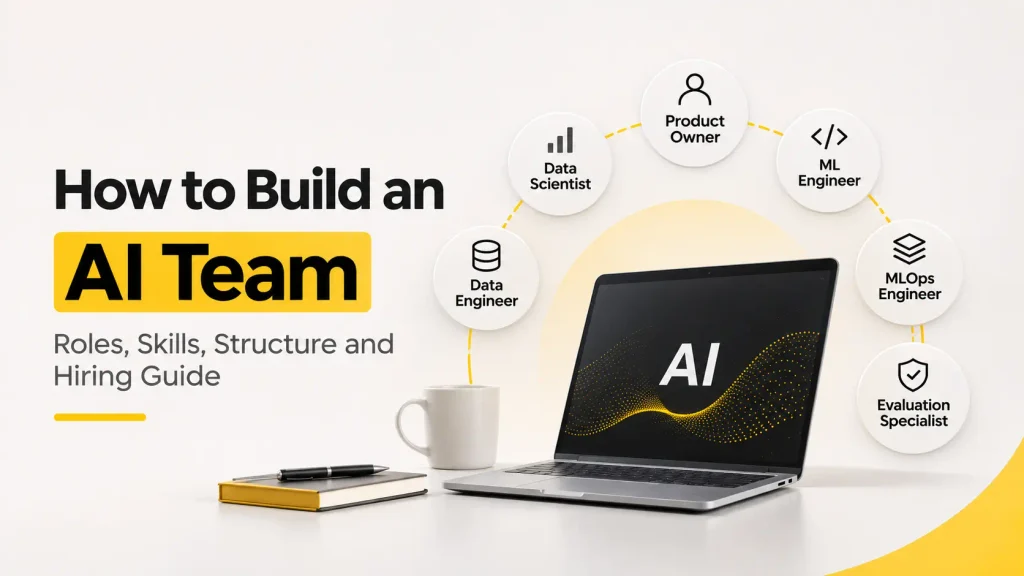
An AI team is a cross-functional group of specialists who collectively cover every layer required to take an AI system from problem definition to production: data infrastructure, model development, application integration, evaluation, deployment, and governance. No single AI professional covers all of these layers, which is why AI teams are structurally different from conventional software delivery teams.
Why AI projects need cross-functional teams
AI projects fail at the seams between specialisms, not at the centre of any one discipline. A model trained without clean data fails silently. A model deployed without monitoring drifts undetected. A system built without product ownership solves the wrong problem. Cross-functional AI teams exist because each failure mode requires a different kind of expertise to prevent it.
AI team vs traditional software development team
A traditional software team builds deterministic systems: the output is defined by code. An AI team builds probabilistic systems: the output is shaped by data, model behaviour, and evaluation criteria. This introduces roles that do not exist in conventional software delivery, including MLOps engineers, AI evaluation specialists, and data scientists whose job is to validate model behaviour rather than write application logic.
When should a business build an AI team?
Build a dedicated team of AI professionals when AI capability is central to the product or business outcome, when you have a specific use case with measurable success criteria, and when you have data infrastructure to support model development. For organisations running multiple AI projects simultaneously, a permanent team with defined ownership consistently outperforms ad hoc groups assembled and disbanded for each use case. AI pilots that run without clear ownership and success metrics do not require a permanent team; they require a time-boxed proof of concept with defined exit criteria.
AI team roles at a glance
| Role | Primary function | Key skill | When needed |
| AI/ML Engineer | Build and deploy AI models | PyTorch, model serving | Always |
| Data Scientist | Validate and benchmark models | Statistical analysis, evaluation | Always |
| Data Engineer | Build data pipelines | SQL, Spark, dbt | Always |
| AI/ML Researcher | Explore model architectures | Research, experimentation | Advanced use cases |
| MLOps Engineer | Manage model lifecycle in production | CI/CD, monitoring | At production stage |
| Software Engineer | Build application layers | APIs, system design | Always |
| AI Product Manager | Define use cases and success metrics | Product strategy, stakeholder management | Always |
| AI/UX Designer | Design AI interaction patterns | UX research, prototyping | Customer-facing applications |
| QA and AI Evaluation Engineer | Test AI outputs systematically | Evaluation frameworks | Before every deployment |
| AI Security Specialist | Secure AI systems against AI-specific threats | Prompt injection, adversarial testing | Production systems |
| AI Governance and Compliance Specialist | Ensure regulatory compliance | AI regulation, audit frameworks | Regulated industries |
Essential roles in an AI development team
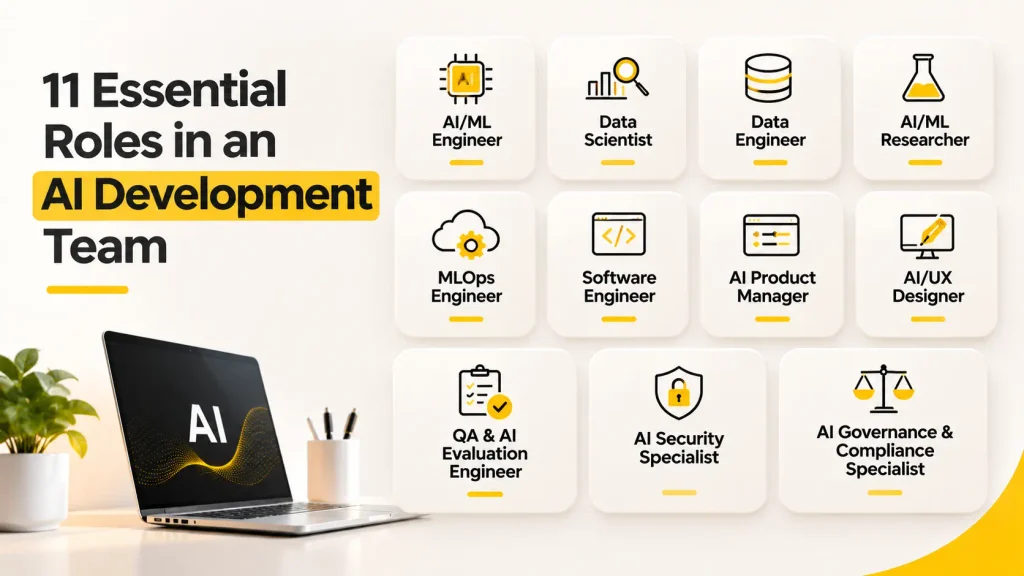
Not every AI project needs every role from the start. The list below reflects what a fully capable AI development team looks like; treat it as a coverage map, not a hiring checklist, and prioritise based on which gaps create production risk first.
AI/ML engineer
AI and ML engineers build, fine-tune, and deploy AI models. They bridge model research and production systems, selecting the right approach, whether API-first, fine-tuned open model, or custom-trained, integrating models with application code, and optimising for latency and cost. They are the core of any AI development team.
Data scientist
Data scientists design experiments, validate model behaviour, analyse outputs for bias and accuracy, and translate business requirements into measurable evaluation criteria. They own the question of whether the model is actually working, not just whether it is running.
Data engineer
Data engineers build and maintain the pipelines that move data from source systems into model-ready formats. Clean, well-structured training and evaluation data is the most consistent determinant of model quality; without a data engineer, the team is building on unstable ground. Our guide on data preparation best practices for AI models covers the methods that underpin reliable AI data pipelines.
AI/ML researcher
Researchers explore novel model architectures, evaluation approaches, and training techniques. This role is relevant for teams building proprietary models or operating at the frontier of AI capability; most enterprise AI teams access research through open-source frameworks rather than in-house research functions.
MLOps engineer
MLOps engineers manage the model lifecycle in production: deployment pipelines, versioning, monitoring, retraining triggers, and rollback. Without this role, production AI models degrade silently and model updates carry uncontrolled risk.
Software engineer
Software engineers build the application and API layers that make AI capability accessible to end users. In product teams, this role often splits between an AI web developer handling browser-based delivery and an AI app developer handling mobile or desktop experiences. FastAPI services, data connectors, authentication, rate limiting, and system integration are software engineering problems that require software engineering expertise to do correctly.
AI product manager
The AI product manager defines the business problem the AI system must solve, owns the success metrics, manages stakeholder expectations, and prioritises the roadmap. Without product ownership, AI developers build technically interesting systems that fail to align with business outcomes.
AI/UX designer
AI/UX designers create interaction patterns for AI-powered interfaces, manage the communication of uncertainty and limitations to users, and run usability testing on AI outputs. This role is critical for customer-facing AI applications where user trust and comprehension directly affect adoption.
QA and AI evaluation engineer
QA and AI evaluation engineers build systematic test suites for AI outputs using frameworks such as Ragas and DeepEval to measure hallucination rate, factual accuracy, and output quality. They create the evaluation infrastructure that makes it safe to ship model changes without manual review of every output.
AI security specialist
AI security specialists address attack surfaces specific to AI systems: prompt injection, adversarial inputs, data poisoning, and model extraction. Conventional application security does not fully cover these threats; dedicated expertise is required for any production system handling sensitive data.
AI governance and compliance specialist
Governance and compliance specialists ensure AI systems meet regulatory requirements including the EU AI Act, GDPR, HIPAA, and sector-specific obligations. They own audit trails, bias assessments, and the documentation required to defend model decisions to regulators.
AI prompt engineer
AI prompt engineers design, version, and evaluate the instruction sets that shape LLM behaviour within an application. They own prompt libraries, run systematic prompt regression testing, and manage output quality at the instruction layer — a specialisation that becomes load-bearing as the volume and complexity of LLM-driven features grows beyond what AI and ML engineers can sustain alongside model and infrastructure work.
What does each AI team role do?
Defining roles precisely before hiring prevents the most common AI team mistake: assembling AI professionals with the right titles but the wrong scope. For each role, document four things.
Responsibilities
What decisions does this role own? Where does their scope start and end? Role overlap creates gaps, not coverage; each responsibility should have a single named owner across the AI team.
Required skills
What technical and domain competencies are non-negotiable versus learnable on the job? AI experts are in short supply; being precise about must-have skills prevents filtering out strong candidates on secondary criteria. For specialised roles such as AI prompt engineers, distinguish between deep expertise in prompt engineering methodology and general LLM familiarity; the former is rare, the latter is widespread.
Typical deliverables
What does the role produce in a given sprint or quarter? Deliverables for AI roles include trained models, evaluation reports, data pipelines, deployment configurations, and governance documentation, not just code commits.
When the role is needed
Not all AI roles are needed from day one. A governance specialist is essential for a regulated healthcare deployment; they may not be needed for an internal productivity tool. Map each role to the project stage at which its absence creates production risk.
AI team structure by project type
Team structure should follow the problem, not a template. The five structures below map to the most common AI delivery contexts; most real teams are variations or hybrids of these models, shaped by the use case, team size, and the maturity of the existing engineering organisation.
Generative AI application team
A GenAI application team includes an AI/ML engineer, software engineer, data engineer, QA and evaluation engineer, and product manager. The focus is on API integration, prompt engineering, RAG architecture, and evaluation pipelines rather than model training from scratch.
Machine learning product team
An ML product team adds a data scientist and MLOps engineer to the core structure, focusing on model training, feature engineering, evaluation, and production monitoring. This structure is right for teams building predictive or classification models on proprietary data.
AI agent development team
AI agent teams require additional expertise in orchestration frameworks, multi-step planning, tool use, failure mode design, and agent evaluation. The engineering complexity of building reliable AI agents is substantially higher than building single-turn LLM applications; teams consistently underestimate this.
Enterprise AI platform team
An enterprise AI platform team builds the shared infrastructure other product teams use: model serving, evaluation frameworks, data pipelines, governance tooling, and deployment standards. This team requires MLOps engineers, platform engineers, data engineers, and governance specialists alongside AI/ML engineers.
AI-powered SaaS product team
A SaaS AI team integrates AI capability into a product used by external customers, combining conventional product engineering with AI-specific roles. Depending on the product surface, this means engaging an AI web developer for the browser experience, an AI app developer for mobile, and AI software developers for the service and API layers. Add AI/UX designers, AI security specialists, and evaluation engineers on top, with the product manager owning the AI feature roadmap.
How large should an AI team be?
There is no universal answer, but there is a useful rule: the team should be large enough to cover every layer that determines production readiness, and no larger. Redundancy without clear role separation creates coordination cost without adding capability.
Small AI team
Three to five people covering a focused use case end to end. A practical minimum includes one AI/ML engineer, one data engineer, and one product manager, with evaluation and MLOps distributed across the team. This structure suits internal tools, first AI pilots, and first production deployments with limited scope.
Mid-sized AI team
Six to twelve people with dedicated roles for MLOps, evaluation, UX, and security. This structure supports multiple concurrent use cases and is right for businesses moving from a first deployment to an AI programme with several production systems.
Enterprise AI team
Fifteen or more people supporting platform infrastructure, multiple product lines, regulatory compliance, and ongoing research. At this scale, teams typically split into platform teams for shared infrastructure and product squads for feature delivery, with a governance function operating across both.
Team size comparison table
| Team type | Size | Typical roles | Best for |
| Small AI team | 3–5 | ML Engineer, Data Engineer, PM | Single use case, AI pilots |
| Mid-sized AI team | 6–12 | + MLOps, QA/Eval, UX, Security | Multiple deployments, scale-up |
| Enterprise AI team | 15+ | + Platform, Research, Governance | Enterprise programme, regulated industries |
Skills required for an AI development team
AI engineers, data scientists, and MLOps engineers each own a distinct layer of the AI system; the skills below reflect what each function actually requires in production, not what looks good on a job description. Strong AI teams have meaningful coverage across all eight areas, even if some are held by the same person in smaller structures.
Machine learning
Supervised and unsupervised learning, fine-tuning foundation models, prompt engineering, evaluation methodology, and proficiency with PyTorch, TensorFlow, and Hugging Face are the core ML competencies any AI team requires. AI prompt engineers who specialise in LLM instruction design, chain-of-thought sequencing, and prompt versioning are an emerging specialisation within this skill group, particularly for teams building generative AI applications at scale.
Data engineering
Pipeline design, data quality validation, feature engineering, and experience with dbt, Apache Spark, Airflow, and vector databases determine whether model inputs are reliable. AI app development is only as strong as the data feeding the model.
Software engineering
API design, system integration, containerisation, and production service patterns are the software engineering skills that determine whether AI capability is accessible and reliable in production. AI software developers need these as strongly as their ML knowledge.
Cloud and infrastructure
GPU compute provisioning, cloud platform familiarity across AWS, Azure, and GCP, cost management, and understanding of managed inference versus self-hosted options are infrastructure skills that affect both capability and AI team cost.
MLOps
CI/CD for model and prompt updates, experiment tracking, model versioning, automated retraining pipelines, and production monitoring are the MLOps skills that make AI systems maintainable and updatable over time.
AI security
Prompt injection testing, adversarial input evaluation, PII detection and redaction, secrets management, and familiarity with AI-specific attack surfaces are the security skills that production AI systems require and that conventional security teams may not cover.
AI evaluation
Systematic evaluation framework design, automated quality checks using Ragas or DeepEval, hallucination detection, bias assessment, and regression testing for model changes are the evaluation skills that determine whether model updates can be shipped safely.
Business and domain expertise
Understanding of the business process the AI system is augmenting, including domain-specific success criteria, regulatory context, and user behaviour, is not a technical skill but is as consequential as any of the technical competencies above.
How to build an AI team from scratch
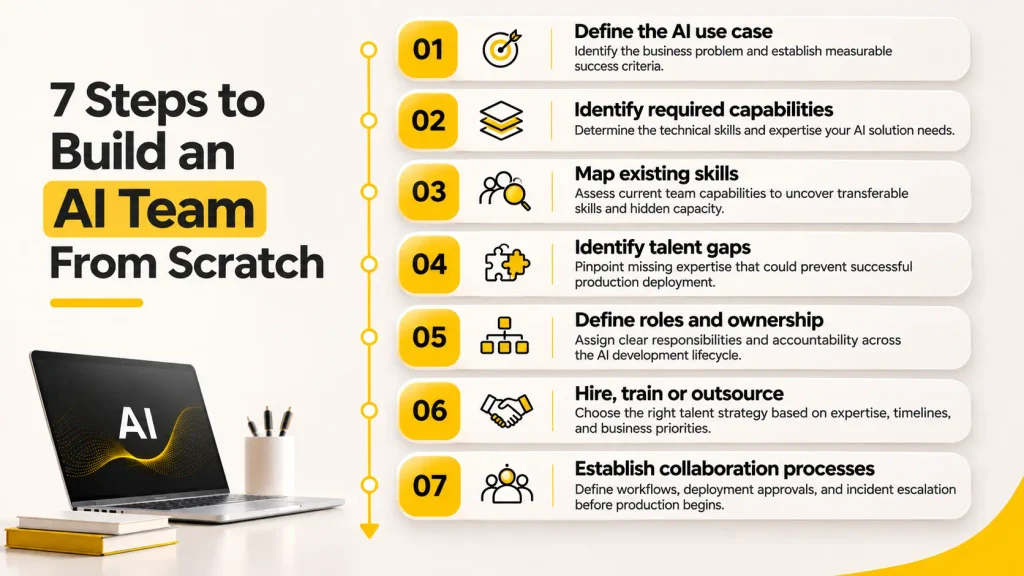
The sequence matters as much as the steps. Teams that define the use case first and hire to close specific gaps consistently deliver faster than teams that build headcount speculatively and define scope afterwards. Follow this order and resist the pressure to compress steps.
Define the AI use case
Start with the business problem: what decision or outcome does the AI system need to improve, and how will success be measured? A use case without measurable success criteria cannot be prioritised, funded, or evaluated.
Identify required capabilities
Work backward from the use case to the capabilities required. Does this need model training or API integration? RAG or fine-tuning? Real-time inference or batch processing? The answers determine which AI team roles you need and in what order.
Map existing skills
Audit your current team against the required capabilities before opening roles. Backend engineers often have skills transferable to API integration; analysts with strong SQL can co-own data pipelines. AI and ML engineers can sometimes be sourced from data science teams with production engineering experience; moving the other way, from pure analysis to ML engineering, typically requires six to twelve months of structured upskilling. Hidden capacity surfaces when you look before you hire.
Identify talent gaps
Roles without existing coverage that directly affect production viability are the gaps that matter. Across most AI projects, the most commonly missing capabilities are data engineering, ML engineering, and AI evaluation. AI engineers are in short supply at every seniority level; expect longer hiring timelines and higher salary expectations than for generalist software roles.
Define roles and ownership
Write role descriptions that specify what each person owns, not just what they do. Every part of the AI system, from data pipeline to governance, should have a named owner before the first hire is made.
Hire, train or outsource
For roles central to long-term competitive advantage, hire directly. For adjacent skills that can be developed with structured support, upskill from within. For deep niche expertise needed on a defined timeline, partner with an software company that has AI delivery experience across the full stack.
Establish collaboration processes
Define how the AI team interacts with the rest of engineering, what the deployment approval process looks like, and how model incidents are escalated. These processes must exist before the first production deployment, not be retrofitted after the first incident.
Build vs hire vs outsource an AI team
Each approach makes a different trade-off between speed, control, cost, and knowledge retention. The right answer depends on how central AI is to the business model and how quickly the use case needs to reach production; most enterprise AI programmes end up with some combination of all three.
| Approach | Best for | Risk | Timeline |
| In-house build | Differentiating AI capabilities, sensitive data | High cost, slow hiring | 6–18 months |
| Hiring AI developers | Permanent capability addition | Competitive talent market | 3–9 months |
| Team augmentation | Filling specific skill gaps | Coordination overhead | 4–8 weeks |
| Outsourcing AI development | Full-stack delivery, speed to market | Knowledge retention risk | 2–8 weeks to start |
| Hybrid AI team model | Most enterprise AI programmes | Managing two team structures | Variable |
Building an in-house AI team
In-house teams provide full control, institutional knowledge, and alignment with business context. They are the right choice when AI capability is a long-term product differentiator and when data sensitivity prevents third-party access. For businesses that want in-house capability but cannot wait for full team assembly, an IT software development company can deliver AI projects in parallel while the permanent team is built. The trade-off of building fully in-house is time to hire, competitive salaries, and the overhead of building team processes from scratch.
Hiring AI developers
Hiring AI developers and AI engineers into an existing team adds permanent capability without building from scratch. Demand for AI web developers, AI app developers, and AI software developers significantly outpaces supply. AI experts at senior and principal level carry hiring timelines of six to twelve months in competitive markets; plan accordingly when building your first AI team.
AI team augmentation
Team augmentation adds specialist AI professionals to an existing engineering team for a defined scope, filling capability gaps without changing the core structure. This works well for teams with a clear delivery plan that are missing specific technical expertise.
Outsourcing AI development
Outsourcing to an IT development company that specialises in AI delivers a full project team with production experience. AI software developers engaged through outsourcing bring ready deployment experience, reducing the ramp-up time that in-house hires typically need. This model is right for businesses that need to move quickly, lack internal AI capability, or need to run a production AI project while building internal capacity in parallel. The primary risk is knowledge retention; address it with clear documentation and handover requirements.
Hybrid AI team model
A hybrid model combines in-house roles for product ownership, governance, and domain expertise with external AI developers for technical delivery. This is the most common structure for enterprise AI programmes; it preserves business alignment while accessing technical depth that would take years to build internally.
AI team cost: what businesses should budget for
AI team cost is not just headcount. Infrastructure, tooling, evaluation frameworks, and training all carry real line items; underestimating them is one of the most consistent reasons AI project budgets run over in the second half of a delivery cycle. Plan across all five categories below.
Salaries and hiring costs
AI and ML engineers earn $140,000 to $185,000 in base salary in the US as of 2026; LLM and generative AI specialists command $175,000 to $260,000. Data scientists average $120,000 to $160,000 and MLOps engineers $130,000 to $175,000. Add recruiter fees of 15 to 25 percent of first-year salary for direct hires.
Infrastructure costs
GPU compute for model training and inference, vector database hosting, cloud storage, and observability tooling are the primary infrastructure line items. A managed inference API approach significantly reduces infrastructure investment in early stages; self-hosted inference becomes cost-effective only at high token volumes.
AI tools and platform costs
Evaluation frameworks, MLOps tooling, experiment tracking, and model serving infrastructure each carry licensing or usage costs. Budget for an evaluation platform (Ragas, DeepEval), experiment tracking (MLflow), a vector database, and a production observability tool as a baseline AI development stack.
Training and upskilling
Structured upskilling for engineers moving into AI roles reduces hiring cost and preserves institutional knowledge. Budget for courses, certifications, and dedicated learning time; the AI tooling landscape evolves fast enough that annual reinvestment is necessary, not optional.
Outsourcing and team augmentation
Outsourced AI development from established providers typically costs $80 to $180 per engineer per hour depending on seniority and geography. For a full-stack AI project team of five engineers across six months, budget $1M to $1.8M at market rates. Team augmentation for a single specialist role runs $15,000 to $30,000 per month.
How to manage an AI team for production success
AI teams are managed differently from conventional software teams because AI systems behave differently in production. The practices below address failure modes specific to AI delivery, not just software delivery in general; most of them need to be in place before the first production release, not retrofitted after it.
Define ownership
Every component of the AI system needs a named owner: the data pipeline, the model, the evaluation process, the governance framework. Ownership ambiguity is the leading cause of production incidents going unaddressed and technical debt accumulating without accountability.
Establish AI development standards
Document standards for prompt versioning — a responsibility that typically sits with AI prompt engineers — model evaluation thresholds, data quality requirements, and deployment approval criteria before the first model goes live. Standards established after incidents are more expensive and less effective than those designed in from the start.
Create evaluation processes
Define what a passing evaluation result looks like for each AI system before building the evaluation suite. Quality thresholds set after deployment are optimised for narrative rather than for learning.
Implement MLOps
Automated deployment pipelines, model versioning, experiment tracking, and rollback capability should be in place before the first production release. AI systems without MLOps infrastructure cannot be updated safely or adapt to changing conditions without significant operational risk.
Establish AI governance
Define model ownership, incident escalation paths, bias monitoring, and documentation requirements for regulatory compliance before deployment. For teams operating in healthcare, finance, or sectors covered by the EU AI Act, governance is an operational prerequisite, not a future concern.
Monitor production performance
Instrument AI systems with latency, error rate, cost per inference, and model quality metrics from day one. AI models without monitoring degrade silently; a model accurate at launch can drift significantly as real-world data distributions shift over time.
Common AI team-building mistakes
Most of these mistakes compound each other. A team without product ownership and without evaluation expertise will consistently ship AI features that solve the wrong problem, without any mechanism to discover that this is happening.
Hiring only data scientists
Data scientists validate models; they do not build production systems. Teams built primarily from data scientists lack the engineering capability to deploy, serve, and maintain AI in production, and their AI pilots fail to move beyond a notebook environment.
Ignoring data engineering
The most common cause of AI underperformance is data quality, not model capability. Teams that skip data engineering expertise produce models trained on unreliable data and misdiagnose the problem as a model failure.
No product ownership
Without a product manager defining the use case and success criteria, AI teams optimise for technical performance rather than business outcomes. The result is accurate models solving the wrong problem.
No AI evaluation expertise
Deploying a generative AI system without systematic evaluation means quality is unknown until a user reports a failure. AI evaluation engineers exist to prevent this; skipping the role does not eliminate the risk, it delays discovery.
No production or MLOps capability
AI teams that cannot safely deploy, monitor, and update models in production deliver demos, not production AI. MLOps capability is a baseline requirement for any AI system that continues operating after the pilot phase.
Hiring before defining the use case
The most avoidable mistake is assembling an AI team before defining what it will build. Roles hired without a use case are scoped to the wrong problem and generate overhead before any value is delivered. Define the use case first.
How to choose an AI development partner
Choosing an AI development partner is a different decision from choosing a general software contractor. The criteria below reflect what determines whether an external team can deliver production AI, not just prototype AI; weight them accordingly when evaluating proposals.
Technical expertise
Evaluate expertise across the full AI stack: data engineering, AI and ML engineers, MLOps, evaluation, and security. A partner whose AI experts cover only model fine-tuning without production MLOps experience cannot deliver a reliable AI system at scale.
Industry experience
AI systems are shaped by domain context; healthcare AI requires different data handling, evaluation criteria, and compliance posture than retail AI. A partner with sector experience reduces time spent building domain understanding that experienced teams already have.
Production AI experience
Ask specifically about production deployments, not pilots. A partner who can demonstrate AI models running in production for twelve or more months has navigated the operational challenges that pilots do not surface.
Security and governance
Verify the partner’s approach to PII handling, secrets management, AI auditability, and compliance with applicable regulations. For regulated industries, ask how they have addressed AI-specific regulatory requirements in previous engagements.
Team scalability
The ability to scale the team up or down as project scope changes matters as much as initial capability. A partner with a small pool of AI experts cannot respond to scope changes or staff parallel workstreams. Ask whether the IT software partner can field both AI web developer and AI app developer expertise, or only one product surface; the answer matters if your product serves both browser and mobile users.
Knowledge transfer
Understand what the engagement looks like beyond initial delivery: documentation standards, internal training, and handover processes that ensure your team can own and evolve the system after the engagement ends.
Conclusion
Building an AI team is an architecture decision before it is a hiring decision. The businesses achieving measurable returns from AI are not those with the most AI professionals or the most advanced models; they are the ones who defined the problem before assembling the team, matched roles to production requirements rather than research credentials, and built the data, evaluation, and governance layers that determine whether AI systems deliver durable value. The gap between AI pilots and AI in production is, in most cases, a team design gap. Closing it starts with an honest assessment of which capabilities your current team has, which it lacks, and which gaps create production risk if left unfilled.
Need help building an AI development team?
Spark Eighteen is an IT software development company that works with engineering teams designing and building production AI systems. From scoping the right AI use case to assembling the roles, architecture, and governance processes required to take AI models to production, we help businesses close the gap between AI pilots and AI that delivers measurable results. Write to us at coffee@sparkeighteen.com.